Our readers keep the lights on and my smoothie glass nicely filled. As an Amazon Associate, I earn from qualifying purchases.
Moving from a basic headphone dongle to a dedicated portable stack fundamentally changes how you hear your music library. The difference isn’t subtle — it’s the gap between a thin, lifeless signal and a soundstage with actual depth, instrument separation, and controlled bass that doesn’t bleed into the mids.
I’m Mohammad Maruf — the founder and writer behind WellFizz. I’ve spent countless hours cross-referencing THD+N figures, output impedance charts, and DAC chipset datasheets to find which portable DAC/amps actually deliver on their spec sheets rather than just looking the part.
This guide breaks down seven of the top contenders, from sub- entry-level wonders to premium desktop-grade portable units, to help you find the absolute best dac amp portable for your headphones and listening habits.
How To Choose The Best DAC Amp Portable
Not all portable DAC/amps are created equal, and the wrong pick can leave your expensive headphones sounding flat or hissy. Focus on these four areas to match the hardware to your gear.
Output Power and Impedance Matching
A spec like “280mW at 32 ohms” tells you how hard the amp can drive low-impedance headphones. High-impedance headphones (above 150 ohms) need higher voltage, measured in mW at 300 ohms. If you own sensitive IEMs, look for a low noise floor — anything above 2.0uV of audible noise will produce a constant hiss in quiet passages.
DAC Chipset and File Support
The DAC chip (ESS, AKM, or Cirrus Logic) determines the maximum resolution and tonal character. Flagship chips like the ES9038Q2M or AK4493S decode PCM up to 768kHz and native DSD256-DSD512. MQA support matters if you stream Tidal Masters, but for most listeners, a clean implementation of standard lossless formats is more important than exotic file compatibility.
Connection Type and Form Factor
USB-C dongles are the most portable and require no battery, but they drain your phone’s charge. Bluetooth receivers like the FiiO BTR series offer cable-free freedom with LDAC or aptX HD, but add latency and compression. Battery-powered DACs like the iFi Hip-dac 3 isolate the amp circuit from the phone’s noisy USB power, delivering cleaner sound at the cost of needing recharging.
Outputs and Gain Staging
A 4.4mm balanced output delivers up to double the voltage of a single-ended 3.5mm jack, which is critical for driving planars or high-impedance dynamics to their full potential. Multi-stage gain switches let you match the amp’s output to your headphone’s sensitivity — too much gain with sensitive IEMs creates audible noise, while too little leaves high-impedance cans sounding anemic.
Quick Comparison
On smaller screens, swipe sideways to see the full table.
| Model | Category | Best For | Key Spec | Amazon |
|---|---|---|---|---|
| iFi Hip-dac 3 | Battery-Powered | Desktop-grade portable sound | 400mW balanced @ 32Ω | Amazon |
| FiiO BTR17 | Bluetooth / USB | Multipoint wireless + desktop mode | 650mW desktop mode @ 32Ω | Amazon |
| iFi GO blu | Bluetooth Receiver | Ultra-portable wireless streaming | LDAC / aptX Adaptive support | Amazon |
| FiiO BTR7 | Bluetooth / USB | Bluetooth versatility + THX amps | Dual ES9219C + THX AAA | Amazon |
| Topping DX1 | USB Desktop | Desktop entry-level powerhouse | 280mW @ 32Ω / AK4493S | Amazon |
| S.M.S.L DS100 | Desktop DAC/Amp | MQA decoding + multiple inputs | 7Vrms balanced @ 600Ω | Amazon |
| Fosi Audio DS1 | USB Dongle | Budget-friendly ESS DAC | 220mW balanced @ 32Ω | Amazon |
In‑Depth Reviews
1. iFi Hip-dac 3

The Hip-dac 3 stands out as the only true battery-powered portable DAC/amp in this roundup that doesn’t compromise on desktop-grade output. Its revised internal power supply components deliver a notably quieter operation than the previous generation, with a black background that reveals micro-details even in complex orchestral passages. The Burr-Brown DAC chipset imparts a natural, slightly warm tonality that pairs especially well with analytical headphones like the Sennheiser HD 600.
With a full 400mW into 32 ohms from its 4.4mm balanced output, it drives planar magnetics like the Hifiman Sundara to satisfying volume levels without breaking a sweat. The PowerMatch gain switch lets you toggle between low and high gain to match IEMs or full-sized cans, while the XBass circuit adds a controlled low-end shelf that avoids muddying the mids. Battery life clocks in around eight hours of continuous playback, enough for a full day of commuting or desk work.
Build quality is exceptional — the aluminum housing with its stealth matte finish feels dense and premium in hand. The dual USB-C inputs (one for data, one for charging) are a thoughtful touch that prevents the cable clutter typical of single-port designs. It includes both USB-A-to-C and USB-C-to-C cables, plus a Lightning adapter, so it’s ready out of the box for nearly any source device.
Why it’s great
- True battery-powered isolation eliminates phone noise
- Powerful 4.4mm balanced output drives high-impedance headphones
- Includes Lightning-to-USB-C cable for iOS users
Good to know
- No Bluetooth — wired only
- Battery adds bulk compared to dongle-sized units
2. FiiO BTR17
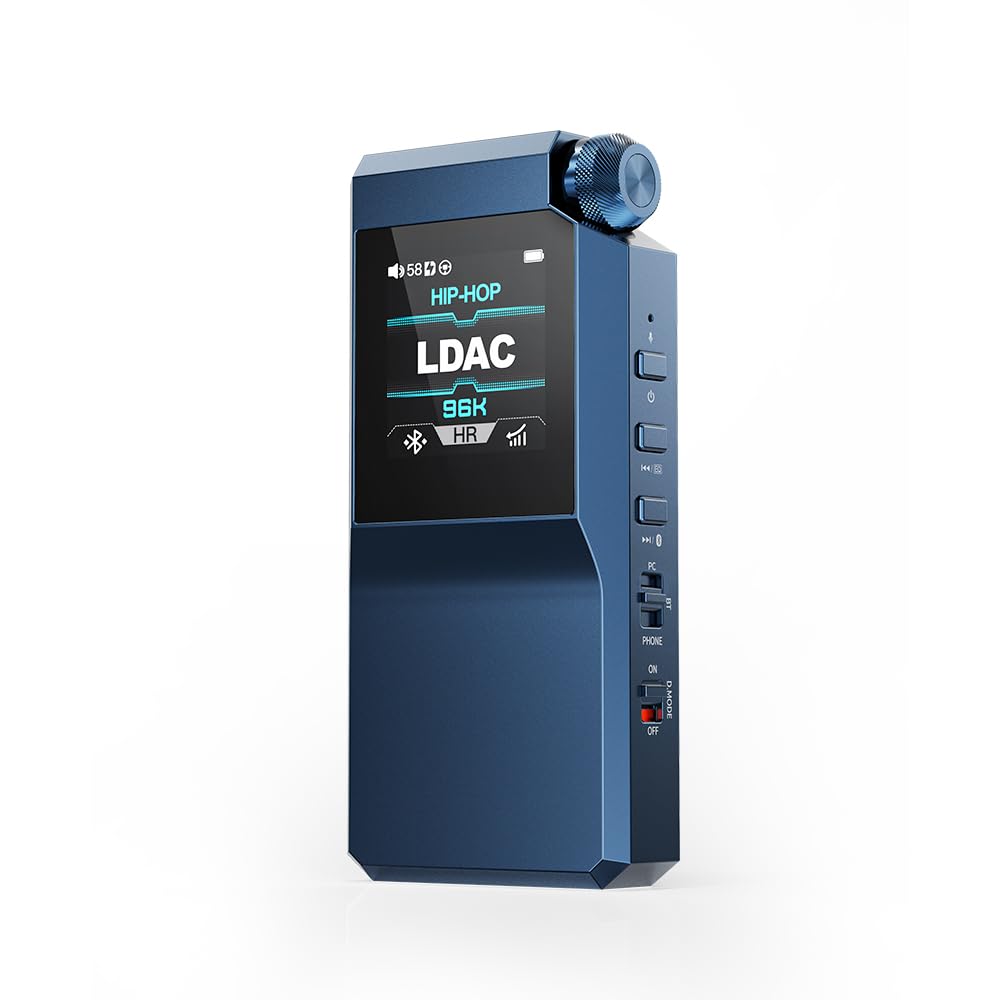
The BTR17 is FiiO’s most ambitious portable DAC/amp yet, combining Bluetooth 5.4 with a desktop-grade USB mode that unlocks 650mW of balanced output. The dual ES9069Q DAC chips, based on ESS’s fourth-generation 32-bit HyperStream architecture, deliver a dynamic range of 130dB with total harmonic distortion at -120dB — figures that rival much larger desktop stacks. When used in desktop mode with an external power supply, the BTR17 bypasses its battery entirely, preventing charge cycles and letting the amps run at full tilt.
Its three-mode switch (PC/BT/PHONE) automatically optimizes power delivery based on the connected source. In Bluetooth mode, the Qualcomm QCC5181 chip supports LDAC and aptX Lossless at 96kHz/24-bit, making it one of the few portable DAC/amps that can stream hi-res losslessly over wireless. The 10-band parametric EQ, adjustable via both the FiiO Control app and a web interface, gives you surgical control over frequency response without leaving the Bluetooth codec’s sampling rate.
Build quality is robust with a clear OLED screen that shows codec, volume, and battery status at a glance. The volume wheel has a satisfying detent feel, and the dedicated gain switch lets you toggle between three levels. The BTR17 ships with a leather case and multiple cables, though the app’s menu navigation can be sluggish during EQ adjustments.
Why it’s great
- Desktop mode delivers 650mW without draining the battery
- Full LDAC and aptX Lossless support for wireless hi-res
- 10-band parametric EQ is incredibly powerful
Good to know
- App interface is slow and sometimes buggy
- Bluetooth-focused; wired mode is less intuitive than a pure USB dongle
3. iFi GO blu

Its Qualcomm 5100 series Bluetooth chip supports every relevant codec: AAC, aptX, aptX HD, LDAC, and HWA, making it future-proof regardless of your phone’s ecosystem. The analog volume knob provides smooth, stepped control without the quantization noise common to digital volume circuits, and it doubles as a power switch and play/pause button.
Sonic character leans slightly warm, with the XBass and XSpace circuits offering optional bass boost and soundstage widening that are genuinely useful rather than gimmicky. The 4.4mm balanced output delivers noticeably cleaner sub-bass extension with demanding IEMs like the Campfire Andromeda. Bluetooth range is excellent, holding a stable LDAC connection at 24-bit/96kHz even through multiple walls across a typical apartment floor plan.
Battery life hovers around eight hours of continuous streaming, and the built-in microphone supports clear hands-free calls with cVc 8.0 noise suppression. The only significant omission is the lack of a belt clip or lanyard in the box, which is surprising for a device clearly designed for on-the-go use. The volume knob’s flush design also makes it easy to bump accidentally when pulling the unit out of a pocket.
Why it’s great
- Ultra-lightweight at 27 grams
- Analog volume knob with tactile feedback
- X-Bass and XSpace effects are genuinely useful
Good to know
- No included clip or lanyard for attaching to clothing
- Volume knob is easy to turn accidentally in a pocket
4. FiiO BTR7

The BTR7 combines dual ESS ES9219C DAC chips with THX AAA amplifier technology in a compact Bluetooth receiver chassis. This combination produces a dead-silent background — the noise floor is low enough that even ultra-sensitive multi-BA IEMs like the Shure SE846 remain hiss-free. The 4.4mm balanced output delivers enough swing to drive 300-ohm Sennheiser HD660S2 to convincing listening levels, a feat that typically requires a desktop amp.
Bluetooth support covers the full spectrum: LDAC, aptX Adaptive, aptX LL, aptX HD, AAC, and SBC. The XMOS XUF208 chip handles USB DAC duties up to PCM 384kHz and native DSD256, with MQA 8x rendering available for Tidal subscribers. The color screen shows album art and codec information, though navigating the menu system is clunky — adjusting EQ requires several clicks through non-intuitive submenus.
Battery life is the BTR7’s weakest point. The larger color screen and powerful THX amps draw significant power, yielding roughly six to seven hours of continuous use, which is below average for this category. The aluminum and glass build feels premium, and the included clip is sturdy enough to keep the unit secured to a belt or bag strap during movement.
Why it’s great
- THX AAA amps provide a dead-silent background for sensitive IEMs
- Drives 300-ohm headphones with authority from balanced output
- Color screen with album art display
Good to know
- Battery life is below average at 6-7 hours
- Menu system is confusing and unintuitive
5. Topping DX1
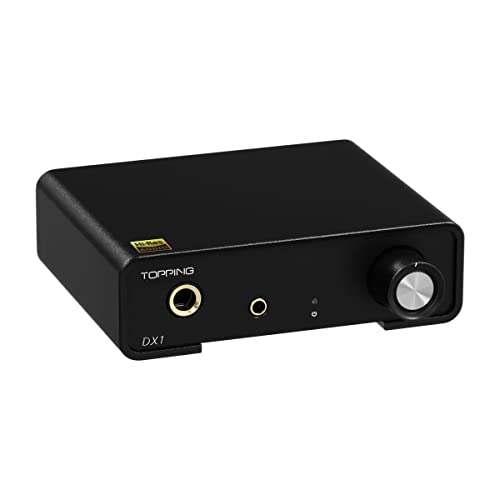
The Topping DX1 targets the entry-level desktop user who wants a clean DAC/amp stack without breaking the bank. Its AK4493S DAC chip, AKM’s sub-flagship VELVET Sound architecture, decodes PCM up to 32-bit/384kHz with a dynamic range of 120dB. The discrete LNRD circuit filters USB 5V power noise down to below 2.0uV in the DAC section and 1.0uV in the amp section, making it one of the cleanest implementations at this price point for IEM use.
Output power is rated at 280mW per channel into 32 ohms from the 6.35mm single-ended jack, and 51mW into 300 ohms. This is enough for most dynamic headphones under 150 ohms — the DT 990 Pro 80-ohm and HD 560S are driven to satisfying volumes with headroom to spare. However, high-impedance planars like the HD 6XX at 300 ohms will need to run the DX1 near maximum volume, which reveals its USB power limitation.
The DX1 also functions as a pure DAC with a fixed-volume line output, letting you connect it to a standalone amplifier later. Plug-and-play compatibility spans Windows 10/11, macOS, Linux, iOS, and Android without driver installation for basic use, though ASIO applications on Windows require the dedicated driver. The lack of an on/off switch is an annoyance — the DAC stays powered as long as USB is connected.
Why it’s great
- Ultra-low noise floor with discrete LNRD filtering
- Can function as a pure DAC with fixed line output
- Plug-and-play across all major operating systems
Good to know
- Struggles with high-impedance headphones above 250 ohms
- No physical on/off switch
6. S.M.S.L DS100

The DS100 from S.M.S.L packs desktop-level connectivity into a compact form factor that sits between a dongle and a full-size stack. The Cirrus Logic CS43131 DAC chipset, combined with the third-generation XMOS XU-316 USB controller, supports PCM up to 32-bit/768kHz and DSD256 native. Where the DS100 truly differentiates itself is its coaxial and optical S/PDIF inputs, which let it integrate into a home stereo or TV setup — no other unit in this roundup offers multi-input flexibility.
Distortion is rated at an astonishingly low 0.00017% (-115dB), and the CK-03 clock processing circuit reduces jitter significantly. The 4.4mm balanced output delivers 7Vrms into 600 ohms, a voltage swing that can drive even vintage high-impedance headphones like the Beyerdynamic DT 880 600-ohm to concert levels. The 6.35mm single-ended output is less powerful but remains clean and detailed for everyday listening.
The aluminum chassis with CNC-machined gold-plated terminals feels solid on a desk. Four LED lights indicate volume level and the active input source, though the lack of a screen means you’ll need to memorize which LED pattern corresponds to which setting. Windows users must download the dedicated driver from the S.M.S.L website, which adds an extra setup step compared to plug-and-play competitors.
Why it’s great
- Coaxial and optical inputs for multi-source setups
- Ultra-low 0.00017% THD+N distortion
- 7Vrms balanced output drives 600-ohm headphones
Good to know
- Windows requires manual driver installation
- No screen — LED indicators take time to learn
7. Fosi Audio DS1

The Fosi Audio DS1 proves that budget-friendly DAC/amps can still deliver reference-grade performance. Its ES9038Q2M DAC chip from ESS Technology is the same flagship silicon found in units costing three times as much, supporting DSD512 and 32-bit/768kHz PCM. The signal-to-noise ratio exceeds 120dB with a noise floor below 1.6uV, creating a black background that reveals subtle decays on acoustic recordings and studio chatter in live albums.
Output is rated at 220mW from the 4.4mm balanced jack into 32 ohms, enough to drive 150-ohm headphones like the Beyerdynamic DT 990 Edition on low gain without distortion. The DS1 handles 300-ohm loads competently — reviewers report it driving Sennheiser HD 6XX to satisfying levels with a few steps of extra volume. The volume rocker on the unit is independently controlled from the source device, which is a rare feature at this price and prevents accidental ear-splitting blasts when switching devices.
Build quality is surprisingly solid for a sub- unit. The metal housing weighs 1.28 ounces and feels dense, though it can run warm during extended listening sessions. The DS1 includes a USB-C-to-C cable and a USB-A-to-C converter, plus a 24-month manufacturer warranty. Compatibility spans Android, iOS, Windows, and macOS, but some Pixel 8 Pro users report compatibility issues with static noise, so verifying phone support before purchase is wise.
Why it’s great
- Flagship ES9038Q2M DAC chip at entry-level pricing
- Independent volume control prevents sudden volume spikes
- Included 24-month warranty adds peace of mind
Good to know
- Can run warm during extended listening
- Some Android phones (Pixel 8) have compatibility issues
FAQ
How much output power do I need for my headphones?
Is a balanced 4.4mm output always better than single-ended 3.5mm?
Can I use a portable DAC amp with my iPhone without an adapter?
What’s the difference between LDAC and aptX Adaptive for portable use?
Final Thoughts: The Verdict
For most users, the best dac amp portable winner is the iFi Hip-dac 3 because it delivers battery-powered desktop-grade balanced output in a pocketable form factor with superior noise isolation. If you want wireless freedom with lossless LDAC and a desktop mode that bypasses battery drain, grab the FiiO BTR17. And for a budget-conscious entry point that doesn’t sacrifice the ESS chipset, nothing beats the Fosi Audio DS1.

Mo Maruf
I created WellFizz to bridge the gap between vague wellness advice and actionable solutions. My mission is simple: to decode the research and give you practical tools you can actually use.
Beyond the data, I am a passionate traveler. I believe that stepping away from the screen to explore new environments is essential for mental clarity and physical vitality.