Our readers keep the lights on and my smoothie glass nicely filled. As an Amazon Associate, I earn from qualifying purchases.
Whether you’re breaking down a whole chicken, portioning steaks for the grill, or prepping a slow-braised roast, the board you choose directly affects how your knives perform and how safe your countertop stays. A flimsy plastic sheet that slides every time you apply pressure or a thin wooden board that warps after a single wash turns a simple prep job into a frustrating battle. The right slab must absorb the shock of a heavy cleaver, contain the flood of raw juices, and remain flat even under aggressive chopping.
I’m Mohammad Maruf — the founder and writer behind WellFizz. I’ve spent countless hours analyzing material hardness ratings, edge grain versus end grain construction, and dimensional stability across dozens of butcher blocks and poly boards to isolate the models that genuinely protect your knife edge and hold still on wet countertops.
This guide breaks down the seven top contenders for the best cutting board for meat, comparing thickness, surface hardness, juice management, and long-term durability so you can choose the right surface for your cooking style.
How To Choose The Best Cutting Board For Meat
Selecting a board for raw meat, poultry, and fish involves more than just picking a large rectangle. The material, thickness, surface structure, and groove design all determine whether your board stays sanitary, stays put, and stays flat over time. Here are the key factors to weigh.
Material: Wood vs. Plastic vs. Bamboo
Wood, especially end-grain wood, is the most forgiving on knife edges because the fibers part and close around the blade rather than shearing against it. Plastic polypropylene boards are non-porous and dishwasher-safe, making them the easiest to sanitize, but they dull blades noticeably faster. Bamboo sits between the two — harder than most wood species, which keeps the board surface smooth, but that hardness can accelerate knife dulling compared to walnut or teak.
Thickness and Weight for Stability
A board under 1 inch thick tends to bow, warp, or shift under heavy chopping pressure. For meat prep, a minimum of 1.5 inches is ideal — the extra mass keeps the board planted on the counter without needing a damp towel underneath. Thicker boards also resist cracking as moisture cycles through washing and drying.
Juice Groove Design
A well-designed juice groove should be deep enough (at least ¼ inch) and positioned close enough to the edge to capture pooling liquids without reducing usable cutting area. Shallow grooves overflow when you rest a medium-rare roast, sending blood and juices onto the counter. A second groove on a reversible board adds flexibility for veggie prep on the clean side.
End Grain vs. Edge Grain
End-grain boards are constructed by gluing together small blocks of wood with the grain facing upward, creating a surface that looks like a checkerboard. This structure is self-healing — knife cuts close up after use — so the board hides scars and stays smooth. Edge-grain boards are made from long strips glued side-by-side, which is cheaper but shows cut marks and can warp more easily. For heavy meat work, end grain is the premium choice.
Quick Comparison
On smaller screens, swipe sideways to see the full table.
| Model | Category | Best For | Key Spec | Amazon |
|---|---|---|---|---|
| Yes4All Teak Board | End Grain Teak | Knife edge preservation | 1.5″ thick end grain | Amazon |
| BABILONIA Walnut Board | End Grain Walnut | Stability + plate slide | 1.7″ thick, 3-in-1 | Amazon |
| Socisen Bamboo Board | 5-Layer Bamboo | Non-slip heavy cutting | 1″ thick, rubber feet | Amazon |
| GAOMON Acacia Board | Acacia Wood | Large surface / stove cover | 24″ x 18″ x 1.1″ | Amazon |
| FANICHI Acacia Board | Acacia Wood | Reversible design | 1.5″ thick, cracker holder | Amazon |
| Thirteen Chefs Poly Board | HDPP Plastic | Dishwasher sanitizing | 3/4″ thick, 18×12″ | Amazon |
| BAMOTTO Bamboo Board | Bamboo | Budget XXL surface | 24″ x 18″ x 3/4″ | Amazon |
In‑Depth Reviews
1. Yes4All Large Teak Cutting Board

The Yes4All teak board earns the top spot because it nails the three requirements that matter most for meat prep: genuine end-grain construction, a full 1.5-inch thickness, and a dense hardwood species that naturally resists moisture and bacterial absorption. Teak’s tight grain structure means the board withstands humidity changes better than acacia or bamboo, so you are far less likely to see warping after repeated wash-and-dry cycles. The 20×15-inch surface provides ample room for a whole turkey or a large brisket without crowding the cutting zone.
The juice groove is wide and deep enough to contain runoff from a resting roast, and the built-in handles on both sides make it easy to lift and carry the board to the sink. At 11.2 pounds, this board stays planted on the counter without needing non-slip feet underneath. The end-grain blocks close up around knife cuts rather than showing permanent grooves, so the surface remains smooth and knife-friendly for months with proper oiling.
Teak contains natural oils that reduce how often you need to reapply mineral oil compared to walnut or maple, lowering maintenance for cooks who want a premium board without a weekly ritual. A periodic coat of board butter keeps the grain sealed and the color rich.
Why it’s great
- End-grain teak preserves blade sharpness longer than edge-grain or bamboo
- Deep juice groove fully contains liquids from large roasts
- Substantial weight and thickness prevent sliding during heavy chopping
Good to know
- Requires hand washing and periodic mineral oil treatment
- Initial sanding finish may feel slightly rough on the groove edges
2. BABILONIA American Black Walnut Cutting Board
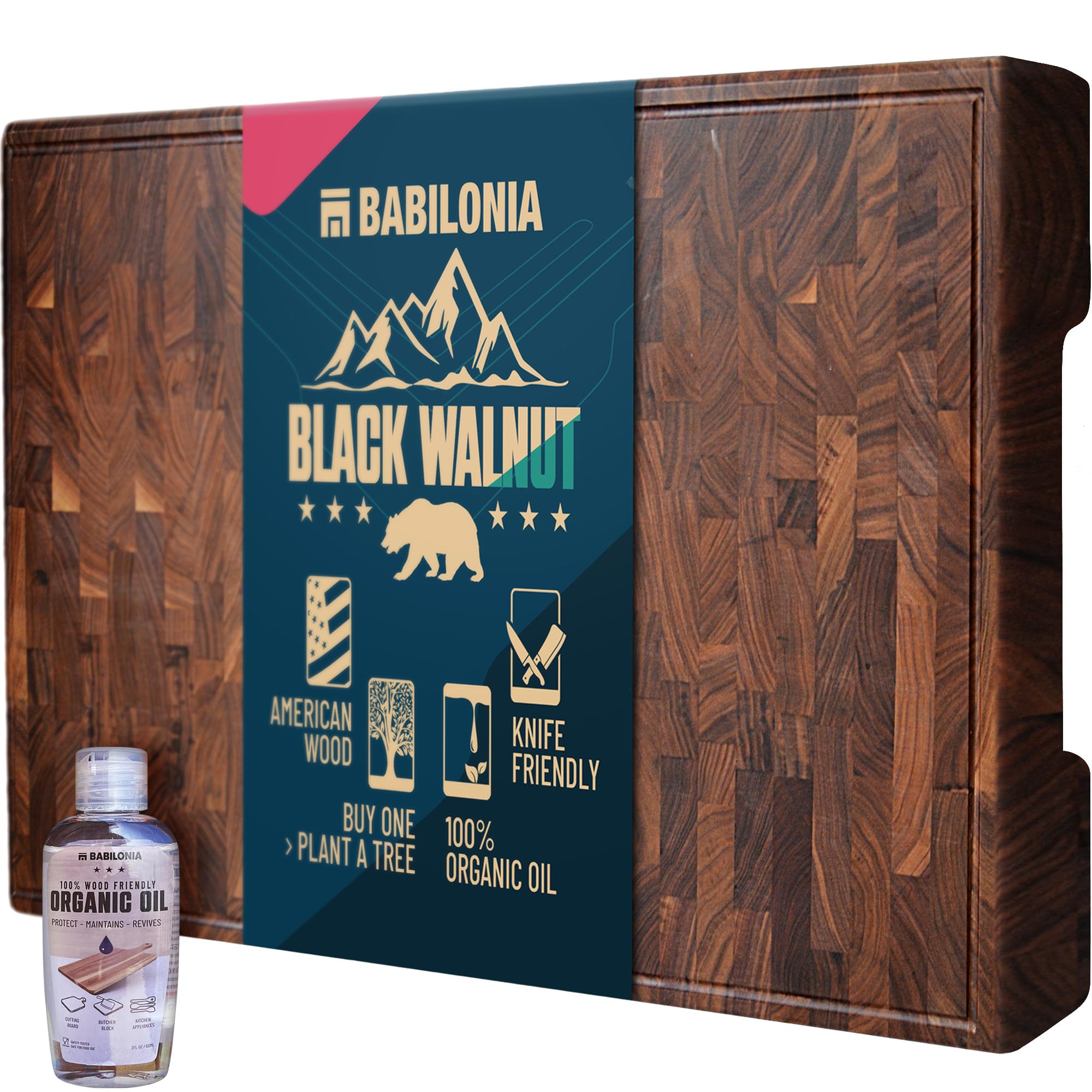
The BABILONIA walnut board stands out because it integrates a plate slide notch and a stainless steel plate right into the butcher block — a feature that directly addresses the messy process of transferring diced meat or vegetables to a pan without lifting the board. The 1.7-inch thickness gives this board a tank-like stability that resists any bounce when you’re working through tough sinew or bones. End-grain walnut is naturally shock-absorbent, so your knife edge stays sharper for longer compared to edge-grain or plastic surfaces.
Walnut has a lower density than teak but higher than acacia, providing a forgiving cutting feel that many chefs prefer for long prep sessions. The hidden hand slots on the underside make gripping the board easy without interfering with the flat reversible surface. The included bottle of organic mineral oil means you can begin conditioning the board immediately after unwrapping.
The juice groove wraps around the edge to catch runoff, though it is not as deep as the Yes4All teak board, so heavier pooling during steak carving requires a brief pause to wipe. The self-healing end-grain surface hides knife marks well, maintaining a show-quality appearance even after months of use.
Why it’s great
- Integrated plate and notch for direct ingredient transfer
- 1.7-inch thickness provides excellent stability and weight
- Includes free mineral oil and stainless steel plate
Good to know
- Juice groove is shallower than the teak board
- Limited 15.7×10.2-inch surface may feel tight for whole turkeys
3. Socisen XXL Bamboo Cutting Board
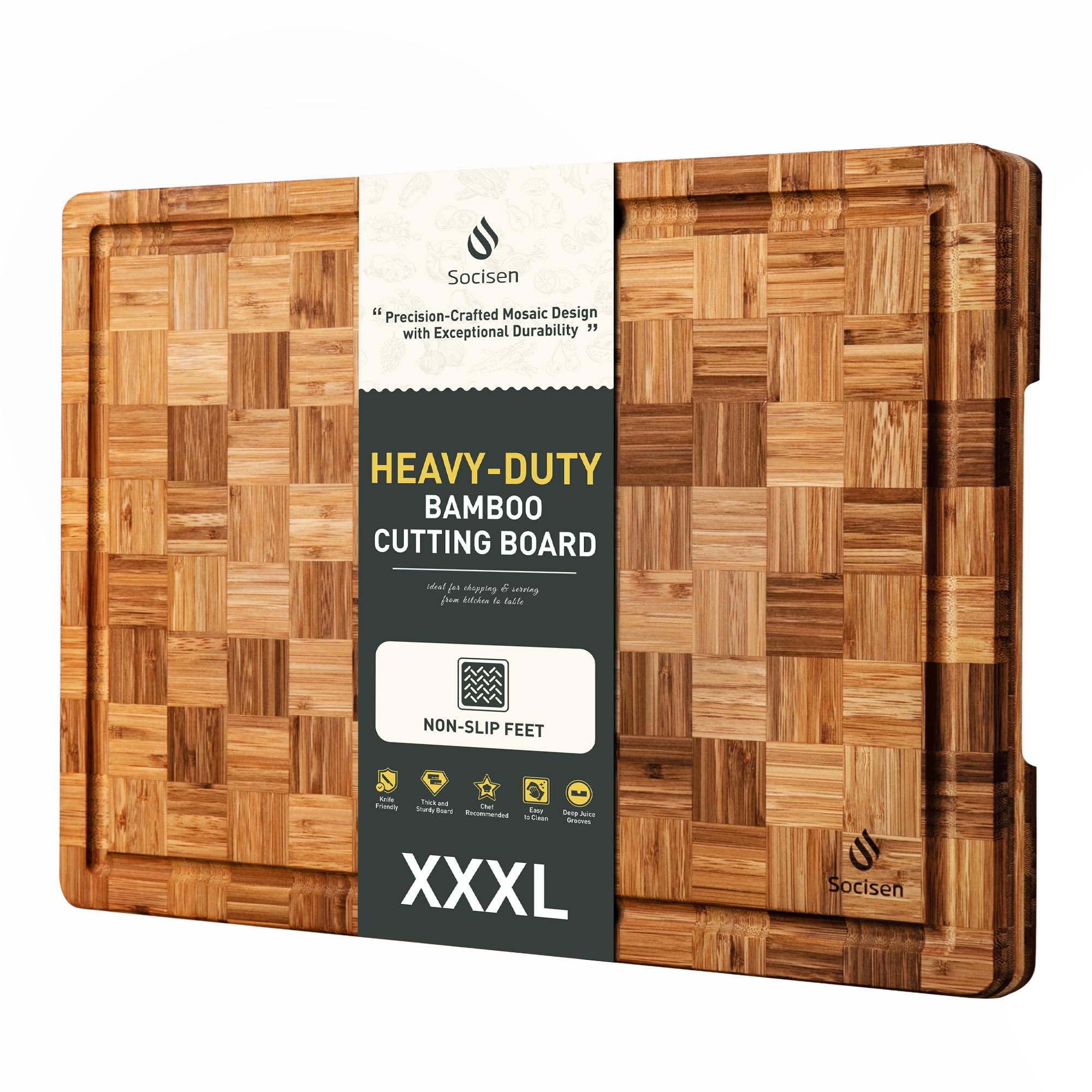
The Socisen board brings a 24×18-inch working surface with a 5-layer laminated bamboo construction that is noticeably denser and more warp-resistant than single-ply bamboo boards. Four rubber feet on the underside grip the counter aggressively, so the board does not shift even when you’re applying downward force to separate chicken quarters or slice through thick pork shoulder. The 1-inch thickness keeps the weight manageable for lifting and storing while still providing enough mass to feel solid under the knife.
Bamboo is harder than most domestic hardwoods, which gives this board a smooth, splinter-free surface that resists knife penetration. That same hardness means your edge will dull slightly faster than on an end-grain teak or walnut board, but the trade-off is a surface that stays pristine-looking with minimal maintenance. The juice groove is carved close to the edge to maximize cutting area while still preventing liquid runoff.
One advantage of this board is that it comes pre-finished with food-grade mineral oil, so you can use it immediately without an initial conditioning step. The rounded edges are comfortable for extended prep work, and the dense bamboo does not absorb odors or stains as readily as softer woods.
Why it’s great
- Rubber feet provide excellent non-slip grip on wet countertops
- Large 24×18 surface suits big meat cuts and multi-ingredient prep
- Pre-oiled and ready to use out of the box
Good to know
- Bamboo hardness dulls knives faster than end-grain wood
- Juice groove can overflow with very juicy resting meats
4. GAOMON 24 x 18 Acacia Cutting Board

The GAOMON acacia board delivers a massive 24×18-inch surface at a mid-range price point, making it one of the most spacious options for cooks who regularly handle large roasts, whole briskets, or multiple racks of ribs. Acacia wood has a natural water resistance that helps prevent warping, and the 1.1-inch thickness adds enough heft to stay in place during most cutting tasks. The juice groove is carved full-length along one edge to catch drips without reducing the main cutting area.
Many owners repurpose this board as a stove-top cover to add counter space in smaller kitchens, and the reversible flat side works well for kneading dough or rolling out pastry. Acacia is harder than walnut but softer than bamboo, offering a middle ground for knife-edge life. The board’s weight is only 9.1 pounds, making it lighter than the Socisen bamboo board despite similar dimensions, which is helpful for lifting and storing but means it may slide slightly more during aggressive chopping.
The natural acacia grain varies significantly between boards, so each piece has a unique appearance. The surface shows cut marks relatively quickly because the wood is not end-grain, but the marks tend to blend into the dark grain pattern rather than standing out.
Why it’s great
- Very large cutting area at a budget-friendly price
- Acacia wood offers good water resistance and durability
- Reversible surface suitable for dough and serving
Good to know
- Edge-grain surface shows knife marks readily
- 1.1-inch thickness may slide without a damp towel underneath
5. FANICHI Acacia Wood Cutting Board
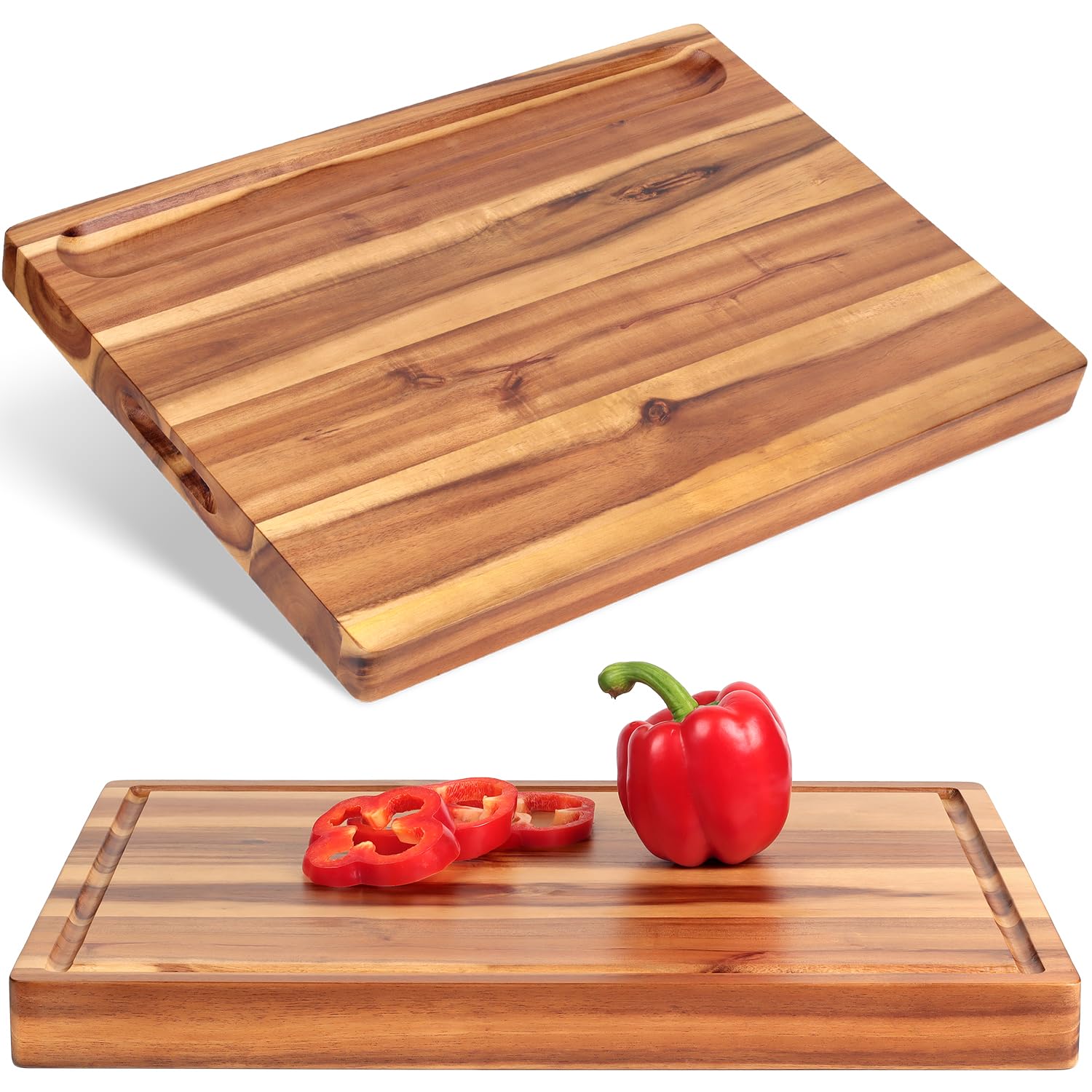
The FANICHI acacia board hits a sweet spot with its 1.5-inch thickness — enough mass to stay planted under heavy chopping without feeling cumbersome to lift. The 17×13-inch surface is smaller than the GAOMON board, but the extra depth makes up for the reduced length when cutting large pieces of meat. A deep juice groove runs around one edge to catch runoff, and the reverse side features a long cracker holder for charcuterie-style serving.
Acacia wood’s natural oil content means this board resists absorbing moisture and stains better than maple or cherry, reducing the risk of odor retention from raw meat. The board arrives pre-oiled and ready to use, though regular re-oiling every few weeks helps maintain the water resistance. The inner side handles are recessed so they do not interfere with the flat surface but make it easy to carry the board to the sink.
Because acacia is a hardwood with a pronounced grain, the surface is smooth but not slick, providing a slight grip that helps keep meat in place while slicing. The wood’s dark coloring hides most knife scars, so the board maintains a presentable appearance on the counter.
Why it’s great
- 1.5-inch thickness provides solid stability without excessive weight
- Reversible with integrated cracker holder for serving
- Dark acacia grain hides knife marks well
Good to know
- Smaller surface may not fit a full turkey or brisket
- Can feel unbalanced on some countertops without a towel
6. Thirteen Chefs Large Poly Cutting Board

The Thirteen Chefs poly board is the only entry-level option in this guide that can go straight into a dishwasher, making it the most sanitary choice for households that handle raw poultry and pork frequently. The high-density polypropylene construction withstands commercial dishwasher temperatures up to 200°F without warping, and the black color hides both knife scars and staining from beet juice or marinades. At 18×12 inches and 3/4-inch thick, it fits into standard dishwasher racks and kitchen drawers.
Polypropylene is softer than polyethylene, meaning it produces less drag on your knife edge, but it still dulls blades faster than any wood board. The textured surface prevents food from sliding around during chopping, and the board’s 5-pound weight keeps it reasonably stable on dry countertops. HACCP guidelines recommend using a black board for cooked meats, which adds a layer of food-safety logic for multi-board kitchens.
One limitation is that the relatively thin construction allows the board to rock slightly if you apply pressure near the edges. Serrated knives and cleavers will scar the surface, so this board is best reserved for boneless meats and everyday veggie prep alongside a wood board for heavy-duty tasks.
Why it’s great
- Dishwasher safe up to 200°F for easy sanitization
- Non-porous HDPP resists bacterial absorption
- Black color hides stains and knife scars
Good to know
- Thinner 3/4-inch design may flex or rock under pressure
- Plastic surface dulls knives faster than wood alternatives
7. BAMOTTO CRAFTBAMBOO XXL Bamboo Board

The BAMOTTO bamboo board gives you a 24×18-inch surface at a budget-friendly price, making it the most affordable entry point for cooks who need a large work area without spending on premium hardwoods. Bamboo is naturally dense and resistant to moisture absorption, so this board is less likely to warp than thin acacia or pine boards at the same price point. The juice groove runs along the front edge to catch drips from carving, and the reverse side remains flat for use as a cheese board or serving platter.
At 3/4-inch thick, this board is noticeably lighter than the Socisen or GAOMON options, weighing only 5 pounds, which makes it easy to move and store. However, the thinner profile means the board may slide around during heavy chopping unless you place a silicone mat or damp towel underneath. Many owners add rubber feet themselves to solve this. The bamboo surface is polished smooth and resists splintering, though it will show cut marks over time because it is edge-grain construction.
Bamboo’s hardness means your knives will require more frequent sharpening compared to using an end-grain wood board. The board arrives with a protective coating that should be lightly sanded and replaced with mineral oil before first use to prevent staining from raw meat juices.
Why it’s great
- Massive 24×18 surface at the lowest price point
- Lightweight and easy to store or move
- Bamboo resists moisture absorption and warping
Good to know
- 0.75-inch thickness requires a non-slip mat underneath
- Hard bamboo surface accelerates knife dulling
FAQ
Can I use a wooden cutting board for raw chicken and pork without it absorbing bacteria?
Why does my cutting board slide around when I chop meat?
How often should I oil a wood cutting board used daily for meat?
Final Thoughts: The Verdict
For most users, the best cutting board for meat winner is the Yes4All Large Teak Cutting Board because it combines genuine end-grain construction, a full 1.5-inch thickness, and teak’s natural moisture resistance in a size that handles whole roasts without dominating your counter. If you want the ingenious plate-slide feature and walnut’s knife-friendly surface, grab the BABILONIA Walnut Board. And for a dishwasher-safe option that handles raw poultry without porosity, nothing beats the Thirteen Chefs Poly Board.

Mo Maruf
I created WellFizz to bridge the gap between vague wellness advice and actionable solutions. My mission is simple: to decode the research and give you practical tools you can actually use.
Beyond the data, I am a passionate traveler. I believe that stepping away from the screen to explore new environments is essential for mental clarity and physical vitality.