Our readers keep the lights on and my smoothie glass nicely filled. As an Amazon Associate, I earn from qualifying purchases.
That faint hiss, the muddy bass, the veiled vocals you blame on your headphones — the real culprit is often the weak, noisy DAC built into your phone or laptop. A dedicated DAC pulls the digital audio stream out of that electrically noisy environment and converts it cleanly, transforming the clarity, soundstage, and micro-detail of everything you listen to.
I’m Mohammad Maruf — the founder and writer behind WellFizz. I’ve spent countless hours digging into DAC chip specs, output power ratings, and real-user listening tests to separate the true budget audiophile gear from the disposable dongles.
To find the legit upgrades that won’t blow your budget, you need a guide built on specs and real performance, not hype. That\’s exactly what this guide to the best dac under 100 delivers.
How To Choose The Best DAC Under 100
The right DAC for you lives at the intersection of your headphones, your source device, and your listening habits. Before you buy, understand what the numbers actually mean and which feature set matches your use case.
DAC Chipset and Decoding Capability
The DAC chip does the actual digital-to-analog conversion. Top chips at this price point include the Cirrus Logic CS43131 and dedicated custom chips from brands like FiiO and Kiwi Ears. Look for support for PCM up to 32bit/384kHz and DSD128 or DSD256 — these specs guarantee the hardware can handle high-resolution audio files from services like Tidal or Amazon Music HD without downsampling.
Output Power and Headphone Impedance
A DAC is only useful if it can drive your headphones to a satisfying volume. Output power is measured in milliwatts (mW) and is usually quoted at a specific impedance, like 200mW @ 32Ω. For sensitive IEMs, even 30mW is plenty. For harder-to-drive over-ear headphones like the Sennheiser HD 560S (120Ω) or Hifiman Edition XS (18Ω but low sensitivity), you want at least 150mW to have clean headroom. Models offering a 4.4mm balanced output can deliver significantly more power than the standard 3.5mm single-ended jack.
Noise Floor and THD+N
The noise floor tells you how silent the background is when no music plays. A lower noise floor (measured in microvolts, µV) means less hiss, critical for listening with sensitive IEMs. Total Harmonic Distortion plus Noise (THD+N) reflects signal purity — a number below 0.001% is excellent at this tier, while 0.004% is still very good and inaudible to most ears. The signal-to-noise ratio (SNR) above 120dB indicates the DAC preserves the full dynamic range of your music.
Quick Comparison
On smaller screens, swipe sideways to see the full table.
| Model | Category | Best For | Key Spec | Amazon |
|---|---|---|---|---|
| FiiO KA11 | USB-C Dongle | Max power in a tiny body | 245mW @ 16Ω | Amazon |
| Fosi Audio DS2 | Dual-Chip Dongle | Clean dual-balanced output | THD+N 0.0001% | Amazon |
| Linsoul Kiwi Ears Allegro Mini | Compact Dongle | Compact build with dual outputs | THD+N 0.004% | Amazon |
| MYPIN DAC | Desktop/Bluetooth | Bluetooth + TV/Optical input | 192kHz/24bit DAC | Amazon |
| VANTEC USB 7.1 | Virtual Surround | Surround + optical SPDIF output | 7.1 Channel, SPDIF | Amazon |
In‑Depth Reviews
1. FiiO KA11 USB C to 3.5mm Audio Adapter

The FiiO KA11 is the portable DAC that redefines what a dongle can do. Housed in a tiny aluminum body measuring just 44mm long, it packs the Cirrus Logic CS43131 DAC chip alongside a powerful amplifier stage that delivers a staggering 245mW into a 16Ω load and 200mW into 32Ω. That’s enough clean power to drive demanding full-size headphones like the Sennheiser HD 560S and Hifiman Edition XS to satisfying listening levels, a feat most dongles at this price cannot manage. The THD+N measures below 0.0006% with a 125dB SNR, ensuring a completely black background and distortion-free playback.
Real-world use confirms its neutral, uncolored sound signature that reveals every detail in your music without adding warmth or brightness. Users report excellent clarity with IEMs like the Moondrop Chu2 and CCZ Melody, and it works plug-and-play with iPhone 15 Pro, Android phones, Windows PCs, and Macs. The inclusion of UAC 1.0 mode via the FiiO Control app adds compatibility with gaming consoles like the Nintendo Switch and PS5, making it a versatile companion for both music and gaming. The device does get warm after extended use, but this is normal given the power output in such a small chassis.
The main drawbacks are the permanently bright blue LED that cannot be disabled — a real annoyance for sleep listening — and a few reports of units failing after a few months due to internal wire detachment. However, for the combination of sheer output power, DAC chip quality, multi-platform support, and compact size, the KA11 remains the benchmark. It earns the top spot because it delivers performance that rivals dongles costing two to three times as much, all within a footprint smaller than a lighter.
Why it’s great
- Class-leading 245mW output power drives both IEMs and full-size headphones.
- Ultra-low THD+N of 0.0006% for completely clean, transparent sound.
- UAC 1.0 mode enables plug-and-play gaming console compatibility.
Good to know
- Blue LED stays on permanently and cannot be turned off.
- Some longevity concerns reported with internal wire durability.
2. Fosi Audio DS2 USB C to AUX Headphone Amp DAC

The Fosi Audio DS2 is the cleanest measuring DAC in this roundup, featuring dual Cirrus Logic CS43131 DAC chips in a single aluminum housing. The dual-chip architecture allows each channel to operate independently, delivering a 130dB SNR and an astonishingly low THD+N of just 0.0001% — numbers that rival desktop DACs many times the price. It offers both a 3.5mm single-ended output and a 4.4mm balanced output, with the balanced connection delivering 170mW per channel into 32Ω. This provides excellent headroom for demanding headphones like the Sennheiser HD 660S2, which users report gains deep bass and improved detail retrieval via the 4.4mm output.
Practical daily use reveals a dead-silent background with zero hiss, even with ultra-sensitive IEMs. The independent 60-step volume buttons on the side offer precise level control that works independently of your phone’s master volume, solving the coarse volume steps iOS imposes. Users consistently describe the sound as transparent, thick, and highly detailed, with reviewers noting it sounds nearly identical to more expensive DAPs and DACs like the HiBy FC4. Compatibility spans iPhone 15, iPad Pro, Android phones, Windows, macOS, and the PS5 via USB-C, making it a true universal solution. The included USB-C cable is thin and cheap, and the device is a notable power hog — draining about 16% of an iPhone battery per two hours of use — but the sonic purity is unmatched at this price.
On the downside, there is no dedicated app for control (the HiBy Music app can work but introduces complications). Some units have arrived showing signs of prior use, though Fosi’s customer support is responsive. If your priority is the lowest noise floor and the cleanest, most transparent audio path possible, especially with high-impedance headphones via the balanced output, the DS2 is the technical champion of this category.
Why it’s great
- Dual CS43131 chips deliver reference-grade 0.0001% THD+N and 130dB SNR.
- 4.4mm balanced output provides clean power for high-impedance headphones.
- Independent volume buttons offer precise control beyond the source device.
Good to know
- High battery drain — expect 16% per hour from an iPhone.
- Included USB-C cable is low quality and should be replaced.
3. Linsoul Kiwi Ears Allegro Mini
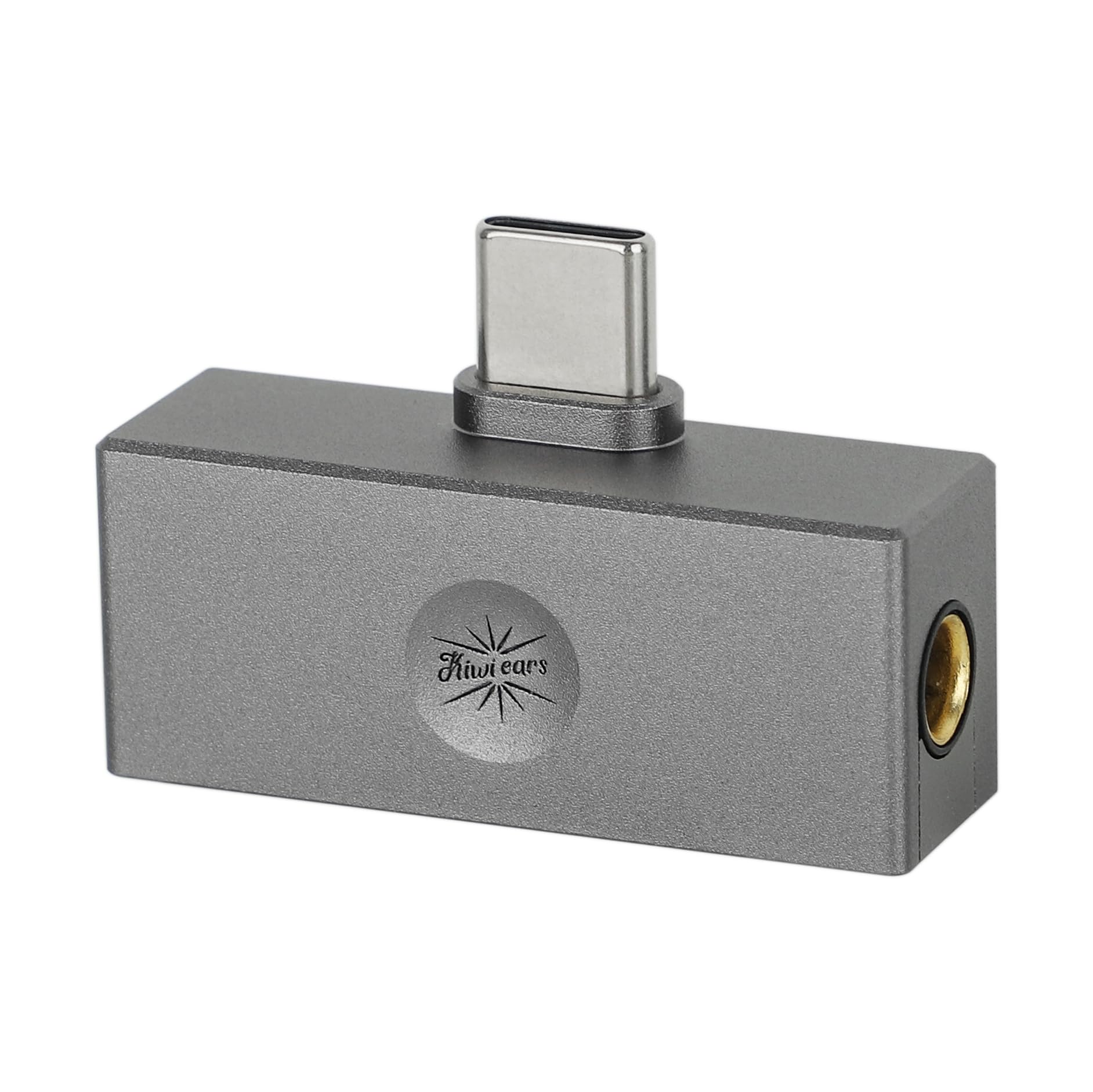
The Linsoul Kiwi Ears Allegro Mini delivers a surprisingly premium feature set at a budget price. Its defining feature is the inclusion of both a 3.5mm single-ended output and a 4.4mm balanced output in a chassis no larger than a typical USB-C dongle — no pigtail wires, just a rigid, all-aluminum alloy body. It supports PCM up to 32bit/384kHz and DSD128, a solid spec for high-resolution streaming. The THD+N measures 0.004% at 32Ω, which is audibly clean even for critical listening with sensitive IEMs. The sound signature is transparent and uncolored, acting as a neutral window into your music without adding warmth or treble emphasis.
Users consistently praise the build quality: the aluminum shell feels far more premium than its cost suggests, and the rigid form factor eliminates the failure point that pigtail cables often introduce. It works plug-and-play with Android devices running version 5.1 and above, PCs, and laptops, requiring no driver installation. The 4.4mm output provides a meaningful power boost for higher-impedance IEMs, though users note it can get excessively loud with low-impedance, high-sensitivity earphones. It fits well in most phone cases — even the Pixel 9 with a case — though bulky cases may block the USB-C connection. One reviewer noted it sounds “identical” to their phone’s built-in 3.5mm jack, which suggests it is transparent by design rather than adding a tonal flavor.
The main limitation is power: the Allegro Mini lacks the raw output muscle of the FiiO KA11 or Fosi DS2, so it is best suited for IEMs and efficient headphones rather than power-hungry over-ears like the HD 560S. It also gets warm during use, though never hot. If you want a compact, dual-output DAC that disappears into your setup and delivers a clean, neutral signal, this is the most refined option in the budget tier. The 4.4mm balanced output is a rare and valuable addition at this price.
Why it’s great
- Rare 4.4mm balanced output in an ultra-compact, rigid aluminum chassis.
- Transparent, uncolored sound with low 0.004% THD+N.
- Solid build eliminates fragile pigtail cables.
Good to know
- Low output power — not ideal for demanding over-ear headphones.
- May be excessively loud with very sensitive IEMs; no gain switch.
4. MYPIN 192kHz DAC with Bluetooth 5.0
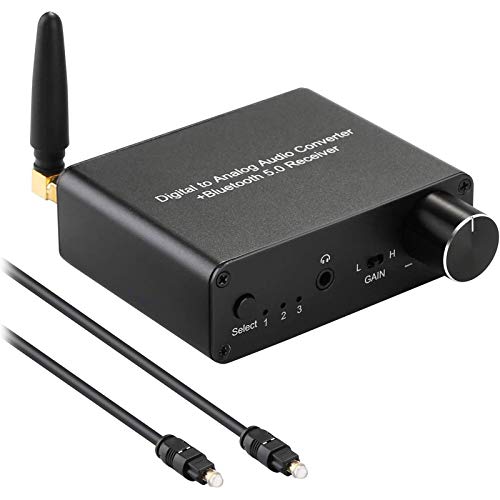
The MYPIN DAC takes a different approach from the portable dongles above, functioning as a desktop DAC and Bluetooth receiver in one compact metal box. It accepts digital audio via optical Toslink, coaxial, and Bluetooth 5.0 (with a dedicated antenna), converting it to analog output through stereo RCA and a front-panel 3.5mm headphone jack. The internal DAC chip handles sampling rates up to 192kHz/24-bit, which covers CD-quality and high-res streaming from services like Tidal. A built-in headphone amplifier supports headphones from 16Ω to 300Ω, making it compatible with a wide range of gear from sensitive IEMs to harder-to-drive studio headphones.
Users are impressed by the audio quality for the cost, reporting surprisingly clean sound via Bluetooth with very low background hiss. The analog output is variable via a front volume knob — which also acts as the power switch — letting you control both the headphone and RCA output level simultaneously. Setup is simple: plug in the USB power cable (not included), connect your source via optical or Bluetooth, and connect the RCA outputs to powered speakers or a receiver. It excels as a bridge between an older TV without Bluetooth and a soundbar, or as a Bluetooth receiver for a vintage amplifier. Reviewers note the Bluetooth range is limited to roughly 15 feet, and the volume knob feels somewhat spongy, but the core functionality is reliable.
The major limitation is that it cannot handle multichannel PCM or advanced formats like Dolby TrueHD or Atmos — it is strictly a 2.0 channel stereo device via optical and coaxial. The USB port is for power only, not data, so it cannot function as a USB DAC for a computer. Also, it can only pair with one Bluetooth device at a time. If your use case is upgrading the sound from a TV, streaming Bluetooth to a vintage amp, or needing a simple desktop DAC with multiple digital inputs, the MYPIN offers exceptional versatility for the price. It is the wrong choice, however, for anyone wanting a portable USB dongle or a straight computer DAC.
Why it’s great
- Accepts optical, coaxial, and Bluetooth 5.0 inputs for maximum flexibility.
- Built-in headphone amp supports 16-300Ω headphones.
- Volume knob doubles as a power on/off for the whole unit.
Good to know
- USB port is for power only — no USB data input for computers.
- Bluetooth range is limited to around 15 feet.
5. VANTEC USB External 7.1 Channel Audio Adapter

The VANTEC USB External 7.1 Channel Audio Adapter is a different breed of DAC — it is a dedicated external sound card for desktop PCs and laptops that eliminates motherboard audio noise and adds virtual 7.1 surround sound capabilities. It connects via USB 2.0 and offers analog outputs for 5.1 or 7.1 speaker setups, plus stereo microphone inputs (two, for true stereo recording). Most importantly for audiophiles on a budget, it includes both SPDIF optical input and output, allowing you to send a clean digital signal to an external receiver’s DAC for decoding, bypassing the analog conversion inside the VANTEC entirely. It supports sampling rates up to 48/44.1 kHz, which covers CD-quality and standard streaming but not high-res 192kHz audio.
Users report that it dramatically cleans up the audio from a PC, eliminating the electrical noise and hiss common with onboard sound chips. Reviewers using it as a straight optical bridge to an AV receiver note that the receiver’s DAC handles the decoding, resulting in excellent clarity. For home theater PC (HTPC) builds, it acts as a cheap and simple way to add SPDIF output. Setup requires driver installation on Windows (the process for Windows 10 involves navigating to a specific WIN81 folder) and is plug-and-play on Linux and modern Macs. The virtual 7.1 surround sound only works with specific source material that supports Dolby Digital or DTS; standard PCM output is limited to stereo. Users praise its stability and the improvement over integrated sound, noting louder, clearer audio with deeper bass after installation.
The hardware is old — the model number and design have been on the market for years — but it remains fully functional with modern Windows 11 and Mac Pro M4 machines. The blue LED indicator is distractingly bright, and the analog outputs are no better than a decent onboard sound card. If your goal is to add SPDIF optical output to a PC for a receiver, or to achieve 5.1/7.1 surround without upgrading your motherboard, the VANTEC is an inexpensive solution. For music listening on headphones, however, the portable dongle DACs above will deliver far superior sound quality due to their modern DAC chips and higher resolution.
Why it’s great
- Adds SPDIF optical input/output to any PC for clean digital audio out.
- Eliminates motherboard electrical noise and hiss.
- Supports virtual 5.1/7.1 surround for compatible content.
Good to know
- Limited to 48/44.1 kHz — no support for high-res audio.
- Analog output quality is on par with decent onboard sound; use optical for best results.
FAQ
Will a DAC under improve sound quality noticeably with standard streaming services?
Do I need a 4.4mm balanced output or is 3.5mm enough?
Why does my DAC dongle get warm during use?
Final Thoughts: The Verdict
For most users, the best dac under 100 winner is the FiiO KA11 because it delivers class-leading output power, an excellent CS43131 chip, and broad compatibility in a pocket-sized design that outperforms dongles costing twice as much. If you want the absolute cleanest signal path with a reference-grade 130dB SNR and dual balanced output, grab the Fosi Audio DS2. And for a compact daily driver with the rare convenience of both 3.5mm and 4.4mm outputs in a bulletproof aluminum body, nothing beats the Linsoul Kiwi Ears Allegro Mini.

Mo Maruf
I created WellFizz to bridge the gap between vague wellness advice and actionable solutions. My mission is simple: to decode the research and give you practical tools you can actually use.
Beyond the data, I am a passionate traveler. I believe that stepping away from the screen to explore new environments is essential for mental clarity and physical vitality.