Our readers keep the lights on and my smoothie glass nicely filled. As an Amazon Associate, I earn from qualifying purchases.
A single dull knife edge can turn a 15-minute prep into a 30-minute grind. Worse than that is a cutting board that warps, splits, or, even worse, traps meat juices in a porous surface that no amount of scrubbing can truly sanitize. Whether you are breaking down a whole chicken or mincing a pile of shallots, the surface beneath your blade determines your safety, your speed, and your knife’s lifespan. This category demands a board that handles the full span of kitchen work — raw proteins one minute, delicate produce the next — without cross-contamination or surface damage.
I’m Mohammad Maruf — the founder and writer behind WellFizz. The analysis here is based on hours of cross-referencing customer feedback, wood-density specs, and juice-groove geometry across seven different board sets to find the real performers.
From acacia slabs wide enough to carve a turkey to compact bamboo sets that segregate meat from vegetables, this guide breaks down exactly what separates a weekend-warrior board from a daily driver. Here are the best cutting boards for meat and vegetables you can buy right now, ranked by wood type, thickness, and real-world durability.
How To Choose The Best Cutting Boards For Meat And Vegetables
The wrong board forces you to scrub raw chicken juice out of deep knife scars or, worse, physically split under the weight of a bone-in roast. These four factors separate a board that lasts five years from one that goes in the trash after six months.
Wood species: Acacia vs. Bamboo
Acacia is a dense hardwood that sits higher on the Janka hardness scale than domestic oak. It resists water penetration better than most woods, making it ideal for meat carving where pooling juices are inevitable. Bamboo, technically a grass, is harder than many hardwoods but more brittle — it chews up knife edges faster if the board is made from vertical or edge-grain strips. For a dual-purpose board that sees heavy cleaver work and wet produce, acacia’s combination of impact resistance and moisture resilience gives it the edge. Bamboo works well if you keep your knives sharp and never leave it soaking.
Thickness and core construction
Any board under 0.75 inches thick will cup or warp within a few months of regular use, especially if it sits near a sink or dishwasher steam. The ideal thickness for a meat-and-vegetable board is 1 inch or more — that extra mass dissipates the impact force from a falling chef’s knife and prevents the board from rocking on an uneven counter. Multi-layer bamboo boards (5-ply or higher) resist warping better than single-piece bamboo slabs because the alternating grain directions cancel out internal stress.
Juice groove geometry
A groove that is too shallow — less than 0.2 inches deep — overflows the moment you carve a medium-rare steak or a wet watermelon. A groove that is too close to the edge steals usable cutting surface area. The best designs carve the groove about 0.75 inches from the board edge, with a depth of at least 0.3 inches, and a width wide enough to fit a fingertip for easy cleaning. Boards with a wide, U-shaped channel at one end (rather than a full perimeter trench) are easier to scrub without trapping food debris in the groove corners.
Size and dedicated use strategy
A single massive board (24 x 18 inches) is excellent for a Thanksgiving turkey or a large brisket, but it is a pain to wash in a standard sink and takes up prime counter real estate. A set of three boards in graduated sizes allows you to dedicate the smallest board to raw poultry and the largest to vegetables — eliminating the need to wash a board mid-prep. If you have space for only one board, choose a 24-inch board with a reversible design: one side for meat, the other for produce.
Quick Comparison
On smaller screens, swipe sideways to see the full table.
| Model | Category | Best For | Key Spec | Amazon |
|---|---|---|---|---|
| EDELHAUS Acacia Set | Premium Set | Prep-to-table serving | 3 boards + storage stand | Amazon |
| BETOLEAN Acacia Set | Mid-Range Set | Heavy cleaver work | 1.6-inch thick, 17-in board | Amazon |
| Fashionwu Acacia Board | Mid-Range Single | Large turkey carving | 24 x 18 x 1.2 inches | Amazon |
| GAOMON Acacia XL | Premium Single | Stove-cover / noodle board | 24 x 18 x 1.1 inches | Amazon |
| Socisen Bamboo Set | Mid-Range Set | Non-slip daily prep | 5-layer thickened, 2.8-in thick | Amazon |
| ROYAL CRAFT WOOD Bamboo Set | Entry-Level Set | Budget starter set | 3 sizes, built-in handles | Amazon |
| GAOMON Bamboo Board | Entry-Level Single | Over-the-sink chopping | 24 x 18 x 0.8 inches | Amazon |
In‑Depth Reviews
1. EDELHAUS Acacia Wood Cutting Board Set of 3
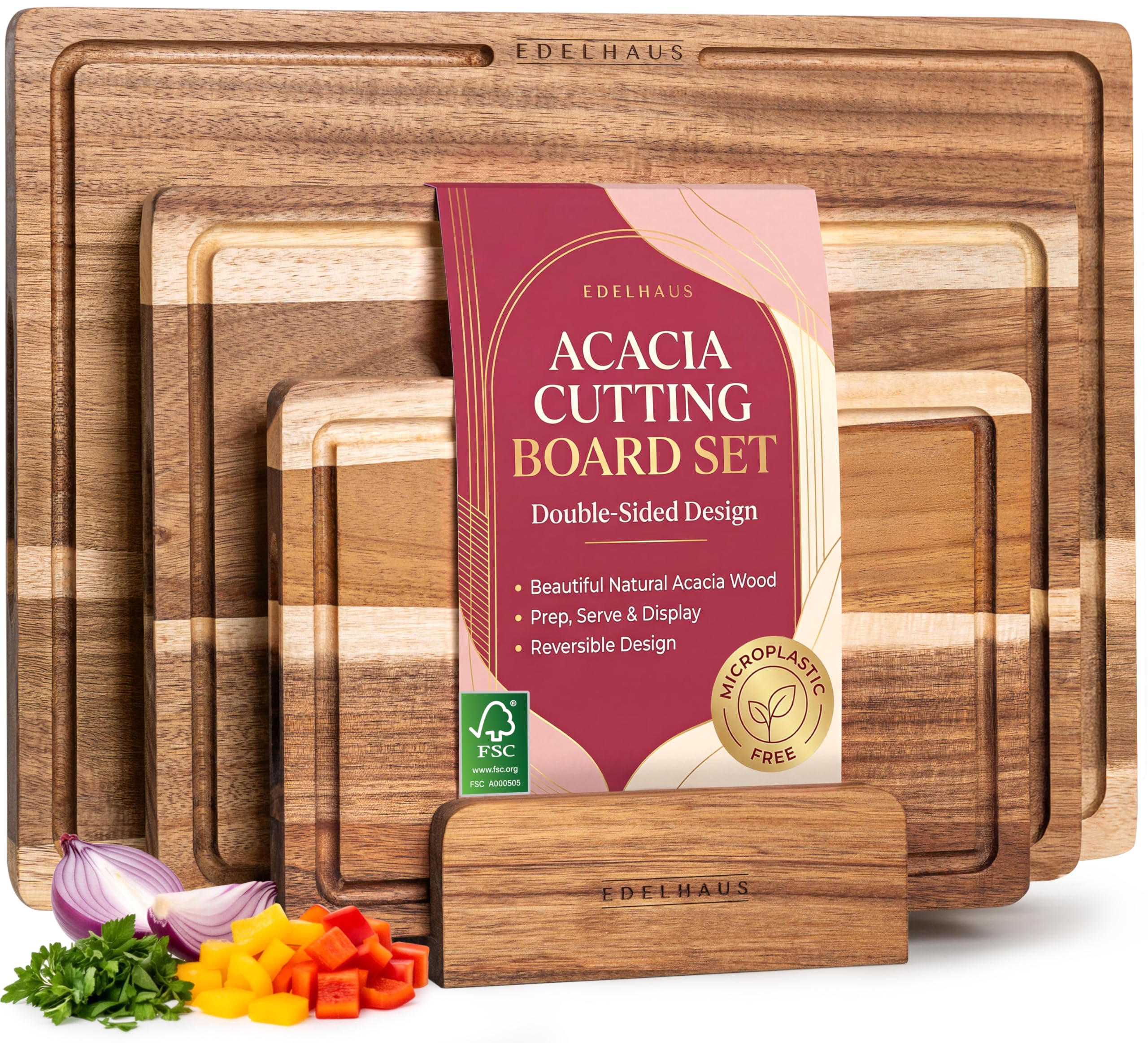
This set solves the two biggest pain points of a meat-and-vegetable kitchen: cross-contamination and board storage. The three acacia boards (15.7 x 11.8, 13 x 9.5, and 10.2 x 7 inches) give you a dedicated raw-protein board, a produce board, and a mini board for garlic-herb work — no more frantic mid-recipe rinsing. The double-sided design is what separates this set from the dozen other acacia bundles on the market: one side is a flat cutting surface, the other features recessed serving compartments that turn any board into a cheese or charcuterie platter in seconds. That dual-purpose utility makes this set feel like a premium kitchen upgrade rather than just three slabs of wood.
The acacia used here is dense and knife-friendly — it absorbs blade impact without showing deep gouges after a week of use. The juice grooves are cut deep enough (roughly 0.3 inches) to hold liquid from a freshly carved steak without spilling onto the counter. The set comes with a vertical storage stand that allows air to circulate between the boards, preventing the moisture buildup that causes warping in humid kitchens. At 7 pounds total with the stand, the boards feel solid but not cumbersome to lift and rinse.
One detail worth noting: the wood does emit a faint acacia aroma when first unboxed, but it fades completely after two or three hand washes. The boards require immediate drying after washing — acacia is more moisture-resistant than beech or walnut, but it is not waterproof. Some users have noted that the serving compartments are shallow (about 0.2 inches deep), so they work best for dry items like crackers and cured meat rather than wet dips. Still, for a household that preps meat and vegetables daily and entertains on weekends, this is the most versatile wood set in this lineup.
Why it’s great
- Double-sided design cuts the need for separate serving platters
- Three graduated sizes allow dedicated raw-meat segregation
- Vertical stand keeps boards dry and frees counter space
Good to know
- Serving compartments are shallow — not ideal for wet dips or salsa
- Acacia requires immediate drying after washing to prevent water rings
2. BETOLEAN Acacia Wood Cutting Boards Set of 3
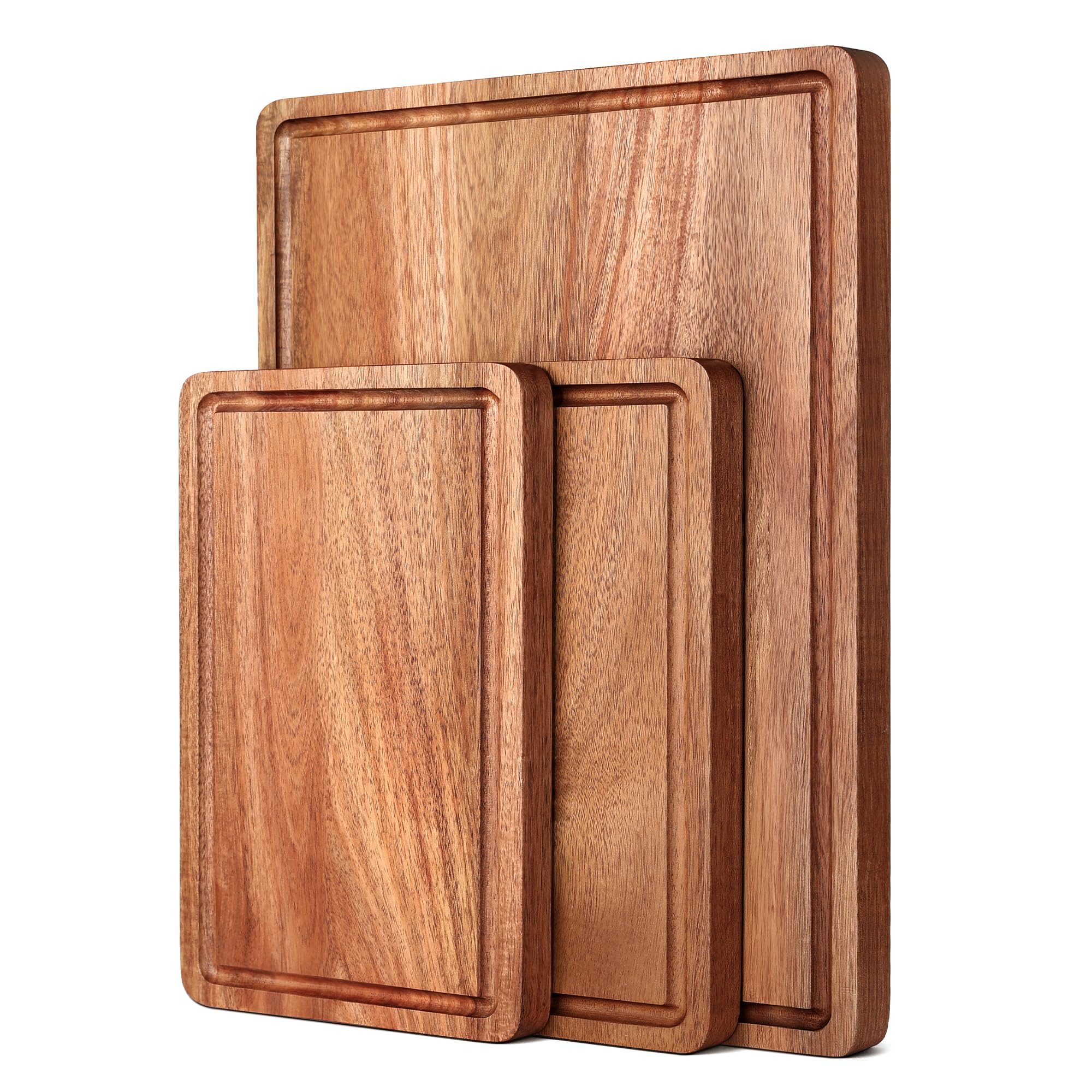
If your prep routine involves a cleaver splitting pork shoulders or a heavy chef’s knife hacking through butternut squash, board thickness is non-negotiable. The BETOLEAN set’s largest board measures 17 x 12 inches with a 1.6-inch thickness — enough mass to absorb the shock of a falling blade without transmitting vibration to your wrist. The three boards (17 x 12, 12 x 10, and 12 x 7 inches) are cut from acacia heartwood, meaning they use the densest, most moisture-resistant part of the log rather than the softer sapwood near the bark.
What surprised me about this set is the hidden handle design. Rather than protruding loops that catch on drawers or apron strings, the handles are carved into the underside of each board — allowing a flush grip for easy transport from counter to sink or table. The juice grooves are wide and U-shaped, which makes them far easier to scrub clean than narrow V-grooves that trap onion skins and meat fibers. The 12 x 7-inch board is the perfect size for a single chicken breast or a pile of garlic cloves, but it also works as a trivet for hot cast-iron pans without scorching the wood.
One trade-off: the acacia grain is beautiful but not perfectly uniform. Some boards in the set may show slight color variation between them, which is a natural characteristic of heartwood rather than a defect. The boards are also on the heavier side — the 17-inch board alone weighs close to 2.5 pounds — so if you have arthritis or grip issues, you might prefer a lighter bamboo alternative. But for anyone who wants a board set that can survive a cleaver without splitting, this is the most robust option here.
Why it’s great
- 1.6-inch thick acacia handles heavy cleaver impacts without bouncing
- Hidden underside handles make carrying easy and storage tidy
- Wide U-shaped juice grooves clean faster than narrow V-grooves
Good to know
- Boards are heavy — the largest piece is cumbersome for quick rinsing
- Natural grain variation means colors may not match perfectly between boards
3. Fashionwu Extra Large Acacia Wood Cutting Board

A 24 x 18-inch board is a specific tool for a specific job: you do not buy this size for dicing an onion. You buy it because you roast a 16-pound turkey at Thanksgiving or smoke a full packer brisket on weekends. The Fashionwu acacia board delivers exactly that footprint — a solid acacia slab at 1.2 inches thick that sits heavy on the counter without sliding. The juice groove runs close to the edge, which maximizes the usable surface area: you lose only about an inch of perimeter, leaving the full 24-inch length free for carving.
The acacia used here is smooth and well-sanded out of the box, with no rough patches or splinter zones. The board is reversible, so you can designate one side for raw meat and the other for bread or vegetables — a meaningful feature given that a board this size is a pain to scrub mid-cook. At 9 pounds (4.08 kg), it is heavy enough to stay planted but light enough to lift into a double-basin sink for washing — provided your sink is at least 22 inches wide.
Quality control is the catch. Multiple customer reports mention straight hairline splits running partway through the board, typically from the edge toward the center. In most cases, these splits are cosmetic and do not affect structural integrity — the boards are glued and pressed well enough that the crack does not propagate with use. But for a 24-inch board, you are paying for a smooth, uninterrupted surface, and a visible crack — even a shallow one — is disappointing at this price point. Check the board immediately on arrival, and if you see a crack that runs deep, exchange it. Otherwise, this is the best value in the extra-large category.
Why it’s great
- Massive 24 x 18 surface fits a whole turkey or full brisket easily
- Juice groove is placed close to the edge for maximum cutting area
- Reversible sides let you separate raw meat from produce
Good to know
- Some units arrive with small edge-to-center hairline cracks
- Does not fit most standard kitchen sinks — needs a double-basin or deep sink
4. GAOMON 24 x 18 Inch Acacia Cutting Board

The GAOMON acacia board solves a problem most cutting boards ignore: urban kitchen counter space. At 24 x 18 inches, this board is designed to sit on top of a standard gas or induction stove, turning dead range space into a prep zone. The 1.1-inch thickness provides enough heft to stay stable on the grates without sliding, and the recessed handholds on each side make it easy to lift off when you need the burners. This is not a gimmick — owners consistently report that the board fits flush across two or three burner grates and transforms the stove into a noodle-rolling station or a vegetable prep surface.
The acacia grain is dark and richly figured, with visible striping that makes the board look far more expensive than its price point suggests. The juice groove is cut about 0.75 inches from the edge, so it catches liquid without stealing too much from the 18-inch width. The wood is slightly softer than bamboo — which means it shows knife marks more readily — but that softness is actually a feature: it saves your knife edges from micro-chipping. Users report that the board requires less frequent sharpening of their chef’s knives compared to using a glass or bamboo board.
The main limitation is the lack of non-slip feet. When used on a countertop, the board can shift slightly if you apply lateral pressure while slicing — especially on smooth granite or quartz. A damp paper towel underneath solves the issue, but it is worth noting that this board relies entirely on its flat-bottom contact with the surface for grip. Also, the board is not perfectly flat on both sides; the juice-groove side has a slight chamfer, so the reversible functionality is more of a nice-to-have than a true dual-surface design.
Why it’s great
- Perfect fit for standard gas stove grates — reclaims counter space
- Soft acacia wood is gentle on knife edges, reducing sharpening frequency
- Dark grain pattern hides stains better than light bamboo
Good to know
- No non-slip feet — board can shift on smooth countertops
- Shows knife marks more visibly than harder bamboo boards
5. Socisen 3-Pack Bamboo Cutting Board Set

Bamboo gets a bad rap for being too hard on knives, but the Socisen set addresses that problem with a construction detail most budget boards ignore: 5-layer thickened bamboo splicing. The boards are roughly 0.7 inches thick each — not as massive as the acacia slabs above, but enough to resist the cupping that plagues thinner bamboo boards. The real standout feature here is the non-slip rubber feet on each board. When you are applying lateral force to slice through a raw sweet potato or a hunk of beef, those feet lock the board to the countertop with zero skid.
The three sizes (roughly 17 x 12, 13 x 8, and 10 x 6 inches) cover the full prep spectrum. The smallest board is the right size for raw chicken prep — small enough to fit in the sink for immediate washing after contact with poultry. The largest board handles vegetable dicing, bread slicing, and even light meat carving without feeling cramped. Each board has cut-out handles on the sides, making them easy to lift and carry to the table for serving. The bamboo surface is sealed with food-grade mineral oil, and owners report that beets — the ultimate stain test — do not leave permanent pink marks when the boards are rinsed promptly.
One knock: the juice groove on the largest board is relatively shallow (about 0.2 inches). When you rest a medium-rare steak on the board after searing, the accumulated juices can overflow the groove and pool on the counter. This is less of an issue if you are working with relatively dry vegetables or pre-seared meat, but for wet carving, you will want a board with a deeper channel. The rubber feet also mean these boards are not reversible — the feet are fixed on one side, so you only get one usable cutting surface per board.
Why it’s great
- Rubber feet eliminate board sliding during aggressive chopping
- 5-layer bamboo construction resists warping better than single-piece boards
- Resists staining — beets and berries wash off without permanent marks
Good to know
- Juice groove is shallow — overflows with wet steaks or juicy fruit
- Non-slip feet make the boards non-reversible
6. ROYAL CRAFT WOOD Bamboo Cutting Board Set

If you are transitioning from plastic cutting boards to wood, the ROYAL CRAFT WOOD bamboo set is the lowest-friction entry point. The three boards measure 15 x 10, 12 x 8, and 9 x 6 inches — sizes that map cleanly to everyday tasks: the small board for garlic and herbs, the medium for chopped vegetables, and the large for raw meat or bread. At 0.6 inches thick, these boards are thinner than the acacia options above, but the carbonized bamboo construction makes them surprisingly rigid. They will not flex under a heavy chef’s knife, and the smooth surface is sealed enough that onion odors do not linger after a wash.
The built-in side handles are not just a cosmetic touch — they make a real difference when you need to scrape chopped ingredients into a pan or carry the board to the sink. The juice groove on the largest board is deep enough to hold liquid from a large tomato or a wedge of watermelon, though it will struggle with a full roast chicken. The boards are also attractive enough to double as serving platters for cheese and crackers, which is a nice bonus for casual entertaining.
The thin profile is the main trade-off for the low cost. At 0.6 inches, these boards are more susceptible to warping over time if you leave them standing in a wet sink or run them through the dishwasher (which you should never do with any wood board). A reviewer noted that the boards require regular oiling with mineral oil to prevent the bamboo from drying out and potentially splintering at the edges. With proper care — hand wash, dry immediately, oil monthly — this set will last two to three years of daily use. Without oiling, the edges may start to feel rough within six months.
Why it’s great
- Three graduated sizes cover every daily prep need without clutter
- Built-in side handles make transport and scraping easy
- Carbonized bamboo resists odors and stains better than unsealed wood
Good to know
- Only 0.6 inches thick — prone to warping if left wet
- Requires monthly mineral oiling to prevent edge splintering
7. GAOMON 24 Inch Bamboo Cutting Board
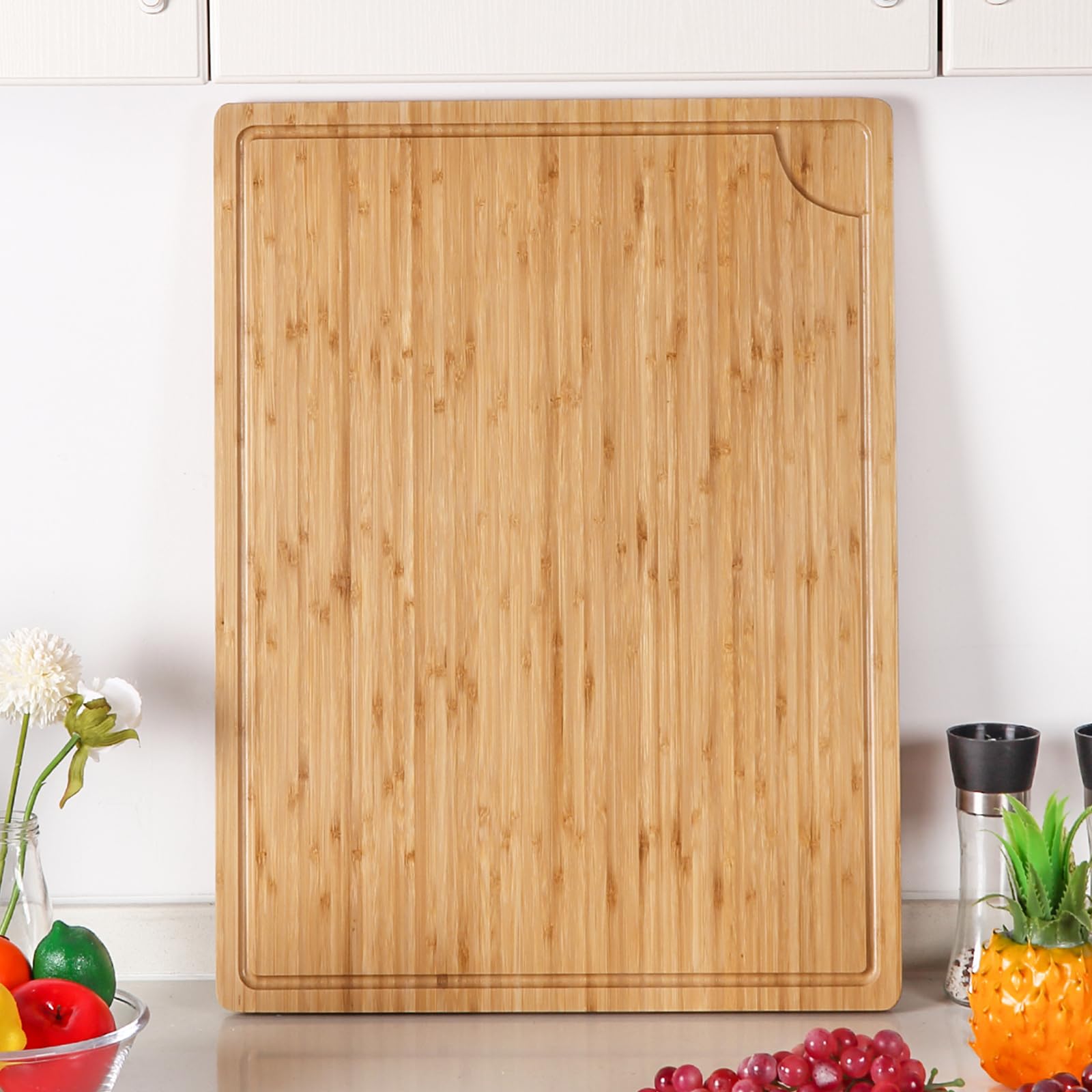
The GAOMON bamboo board is the only product in this lineup specifically designed to sit over a double kitchen sink. At 24 x 18 inches with a 0.8-inch thickness, it spans most standard sink basins without sagging or tipping. This is a game-changer for small kitchens: you instantly reclaim an extra 432 square inches of counter space, and any chopped food scraps can be swept directly into the sink below. The board also fits flush on top of a gas stove for those who prefer a noodle-rolling or bread-kneading surface.
The bamboo construction is dense and well-sealed. The reversible design lets you assign one side for raw meat and the other for vegetables — essential when you are working over the sink and do not want to lift the board to flip it mid-prep. The juice groove is cut to a moderate depth, and some users have noted that the groove corners can trap food particles if not rinsed immediately after use. The board comes with silicone corner plugs that prevent it from sliding on smooth sink edges, though several owners have reported that the plugs fall out after a few weeks.
The 0.8-inch thickness is a compromise. It is thin enough to fit in a standard dishwasher on the top rack (though hand washing is still recommended for longevity) but thick enough to resist immediate warping from the steam and heat that rises from a sink full of hot water. Over time — especially in humid climates — the board may develop a slight bow. Regular oiling and storing it flat rather than leaning it against a wall will mitigate this. For its specific use case (sink cover and prep station in a cramped kitchen), this board is unmatched at this tier.
Why it’s great
- Spans double sinks cleanly, adding counter space in small kitchens
- Reversible sides keep raw meat and produce separated
- Fits on a gas stove top for a noodle-rolling or bread station
Good to know
- Silicone corner plugs can fall out and lose grip over time
- 0.8-inch thickness may bow slightly in high humidity without oiling
FAQ
Should I use the same cutting board for raw meat and vegetables?
How often should I oil my bamboo or acacia cutting board?
Why does my bamboo cutting board feel rough at the edges after a few months?
Final Thoughts: The Verdict
For most users, the cutting boards for meat and vegetables winner is the BETOLEAN Acacia Set because the 1.6-inch thickness gives you an actual butcher-block feel without the butcher-block price, and the three-board system lets you separate raw protein from produce without compromise. If you want a board that doubles as a serving platter and comes with a storage stand, grab the EDELHAUS Acacia Set. And for the dedicated meat carver who needs a 24-inch surface for whole turkeys and briskets, nothing beats the Fashionwu Extra Large Acacia Board.

Mo Maruf
I created WellFizz to bridge the gap between vague wellness advice and actionable solutions. My mission is simple: to decode the research and give you practical tools you can actually use.
Beyond the data, I am a passionate traveler. I believe that stepping away from the screen to explore new environments is essential for mental clarity and physical vitality.