Our readers keep the lights on and my smoothie glass nicely filled. As an Amazon Associate, I earn from qualifying purchases.
A scalp wound presents a unique challenge: you need a dressing that stays put on a curved, hair-bearing surface yet removes without tearing delicate healing tissue or pulling out strands. Standard bandages fail here, either sliding off or causing agony at change time. The right dressing balances gentle adhesion, moisture control, and secure coverage over an irregular contour.
I’m Mohammad Maruf — the founder and writer behind WellFizz. This guide is built on weeks of cross-referencing clinical dressing standards, real patient reviews, and material science data to pinpoint the options that actually work on the scalp without causing additional trauma.
Every recommendation here has been vetted for non-adherent properties, breathability, and secure fit on the scalp’s unique landscape. After thorough analysis, I’ve identified the true best dressing for scalp wound to simplify your recovery process.
How To Choose The Best Dressing For Scalp Wound
Selecting a scalp dressing is not about picking the biggest bandage. The wrong choice can delay healing, cause painful removal, or fail to stay on the head’s curved, often hair-bearing surface. Focus on these three factors to get it right.
Non-Adherent Wound Contact Layer
The dressing that touches the wound bed must not stick to the delicate tissue or hair follicles. Options like petrolatum-impregnated gauze or silicone contact layers create a barrier that allows exudate to pass through while preventing the dressing from adhering. This feature directly determines whether removal causes re-injury or is painless.
Adhesive Border vs. Securing Method
A scalp wound’s curvature makes a simple gauze pad and tape combination unreliable. Bordered island dressings or transparent film dressings with a strong, skin-friendly adhesive are far more secure. Look for a gentle silicone adhesive that can be lifted and repositioned without stripping the skin, especially on a fragile scalp.
Moisture Management and Breathability
The scalp can sweat, and trapped moisture under a non-breathable dressing invites maceration. A high moisture vapor transmission rate (MVTR) allows the skin to breathe while a waterproof backing protects from external moisture. For wounds with moderate drainage, a foam dressing with a superabsorbent core is needed to lock fluid away from the wound bed.
Quick Comparison
On smaller screens, swipe sideways to see the full table.
| Model | Category | Best For | Key Spec | Amazon |
|---|---|---|---|---|
| Medline Optifoam Gentle EX | Bordered Foam | Moderate drainage & pressure relief | 5-layer superabsorbent core | Amazon |
| Carbou Transparent Film Dressing | Transparent Film | Waterproof shower protection | 4″ x 4.75″ pre-cut film | Amazon |
| Dimora Silicone Wound Contact Layer | Silicone Contact | Pain-free dressing changes | 3 x 4 inch perforated layer | Amazon |
| EVERLIT Xeroform Petrolatum Dressing | Petrolatum Gauze | Burns & surgical incisions | 2 x 2 inch fine mesh gauze | Amazon |
| HEALQU Bordered Gauze Island Dressing | Bordered Island | Large area coverage | 4×10″ with 2×7.5″ pad | Amazon |
In‑Depth Reviews
1. Medline Optifoam Gentle EX Bordered Foam Adhesive Dressing

The Medline Optifoam Gentle EX is a premium solution for scalp wounds that require moderate drainage management. Its five-layer construction features a superabsorbent core that converts exudate into a gel, locking it away from the wound bed to prevent maceration on the sensitive scalp skin. The gentle silicone adhesive border is a standout—it can be lifted and reapplied during inspection without losing tack, and it adheres tenaciously to curved surfaces like the head.
Users with deep surgical wounds report that this dressing effectively wicks drainage and prevents leakage, even during showers. The low-profile design conforms well to the scalp’s shape, and the moisture vapor transmission rate adjusts to fluid levels, improving breathability. It is designed for up to seven days of wear, reducing the frequency of changes on a painful area.
The primary drawback is the cost, as this is the most expensive option in the lineup. However, its performance on fragile elderly skin—removing without tearing—makes it a worthwhile investment for complex scalp wounds where other dressings fail. It is not intended for third-degree burns.
Why it’s great
- Five-layer core absorbs and locks moderate drainage effectively.
- Gentle silicone adhesive allows repositioning without skin trauma.
- Waterproof backing permits showering while staying secure.
Good to know
- Premium price point compared to standard gauze options.
- Not suitable for third-degree burns per manufacturer guidelines.
2. Carbou Transparent Film Dressing

For post-surgical scalp incisions or wounds that need a waterproof barrier, the Carbou Transparent Film Dressing is a superb mid-range choice. This pack includes 50 individually wrapped 4″ x 4.75″ sheets, making it economical for long-term care. The transparent polyurethane film allows continuous wound inspection without removing the dressing—a major advantage for monitoring healing on the scalp.
The adhesive is hypoallergenic and latex-free, and user feedback consistently praises its ability to stay on for days through showers and sweat without causing irritation. It works as a secondary dressing to secure a non-adherent primary layer, or alone on shallow abrasions. The thin, conformable material moves with the scalp, preventing stress on the skin.
Be cautious with highly mobile areas; sweat and movement can cause the edges to lift on the scalp, especially near the hairline. For delicate or elderly skin, the adhesive can be strong enough to leave marks or cause slight pulling upon removal, so a gentle removal technique is advised.
Why it’s great
- Transparent for easy wound inspection without removal.
- Excellent waterproof performance for showering.
- Hypoallergenic and latex-free, suitable for sensitive skin.
Good to know
- Edges may lift on very mobile or sweaty areas of the scalp.
- Adhesive can be strong for thin or fragile skin upon removal.
3. Dimora Silicone Wound Contact Layer

For scalp wounds where pain-free dressing changes are the priority, the Dimora Silicone Wound Contact Layer is a specialized asset. This transparent 3″ x 4″ pad is gently tacky on one side, designed to be placed directly over the wound bed. Its perforated structure allows exudate to pass through into a secondary absorbent dressing while preventing the secondary dressing from sticking to the wound itself.
This is an excellent primary layer for scalp wounds that need a non-adherent interface before applying a gauze or foam secondary dressing. Users managing diabetic foot wounds praise its ability to keep medication in place and its completely painless removal. On the scalp, it minimizes the risk of pulling hair or disrupting fragile granulation tissue during changes.
The single-side adhesive can be an issue for those with highly sensitive skin who react to any adhesive contact. Additionally, the dimension is smaller than some full-scalp coverage needs, meaning you may need to cut or overlap pieces. It is designed for use under a secondary dressing, which adds a step to the application process.
Why it’s great
- Non-adherent silicone prevents trauma during dressing changes.
- Transparent for easy wound inspection while in place.
- Perforated structure allows exudate to drain into secondary dressing.
Good to know
- Requires a secondary absorbent dressing on top.
- One-side adhesive may irritate very sensitive skin.
4. EVERLIT Xeroform Petrolatum Dressing

The EVERLIT Xeroform Petrolatum Dressing is a clinical staple adapted for home use. Each 2″ x 2″ pad is impregnated with petrolatum on a fine mesh gauze, creating a non-adherent, occlusive barrier ideal for burns, lacerations, and post-surgical scalp incisions. The petrolatum keeps the wound bed moist, which accelerates epithelialization and reduces the risk of scabbing that can pull at hair follicles.
This dressing is self-adherent but not adhesive to the skin, meaning it stays in place under a secondary bandage without sticking to the wound itself. Users recovering from dog bites and surgical wounds report faster healing compared to topical antibiotics alone. On the scalp, the small size is perfect for targeted coverage of sutured incisions or localized trauma.
The 2″ x 2″ size is limiting for larger scalp wounds, and it lacks an adhesive border, so you will need medical tape or a secondary dressing to keep it secure on the head. The petrolatum can also be messy if not properly secured, and the fine mesh can fray slightly at the edges if cut.
Why it’s great
- Non-adherent, self-adherent fine mesh prevents wound sticking.
- Petrolatum keeps wound moist for faster healing.
- Orthopedic surgeon-recommended for wound care.
Good to know
- Small 2×2 size not suitable for large wounds without overlapping.
- Requires tape or secondary dressing to stay on the scalp.
5. HEALQU Bordered Gauze Island Dressing
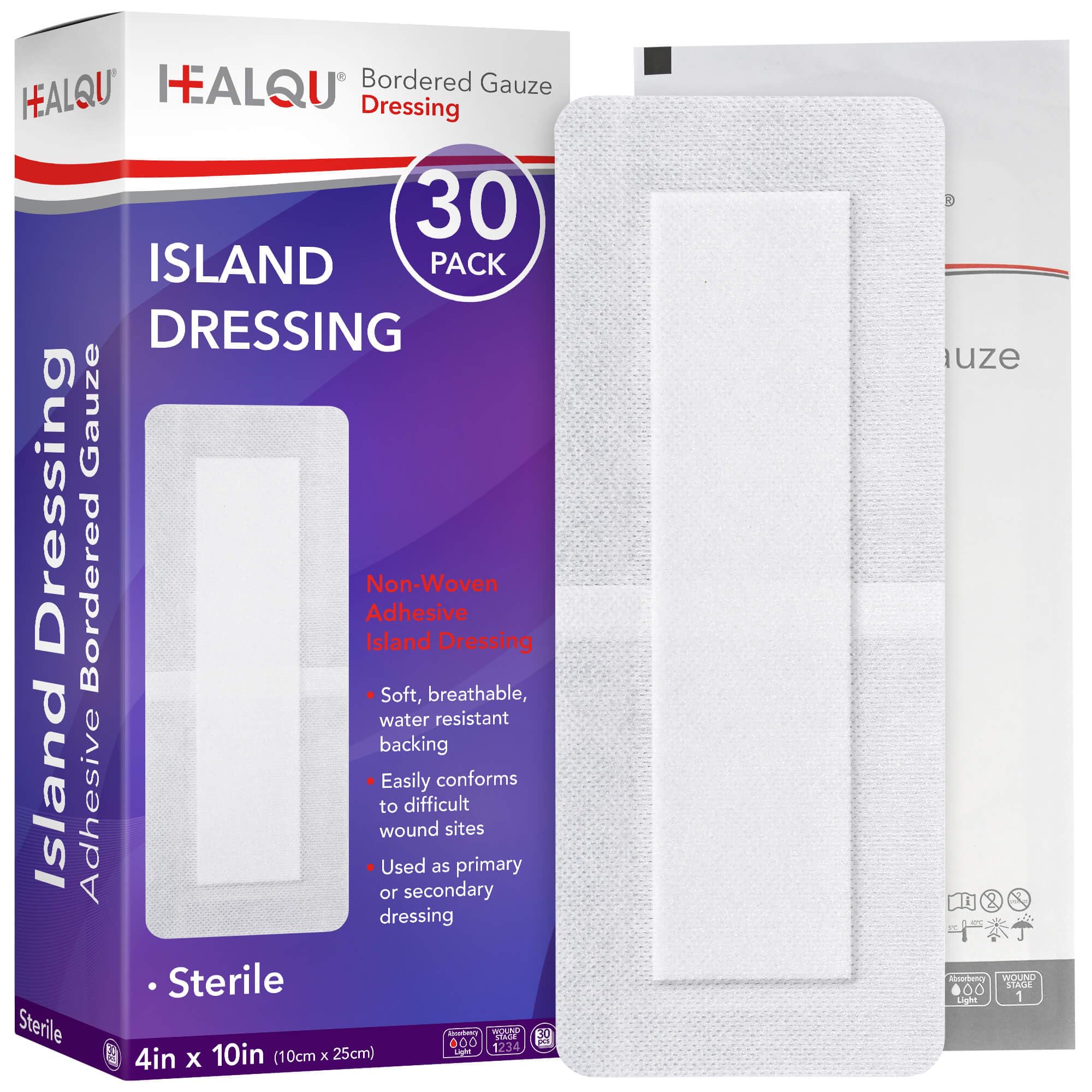
The HEALQU Bordered Gauze Island Dressing is a budget-friendly option that packs considerable utility for scalp wounds. Each dressing features a 4″ x 10″ outer border with a 2″ x 7.5″ absorbent pad in the center, offering generous coverage for larger scalp areas. The design is simple: a gentle adhesive around the edges holds the dressing in place while the pad stays dry and non-stick over the wound.
Users appreciate the ease of application—just peel and stick—and the water-resistant non-woven backing provides moderate protection against moisture. It is particularly useful for covering long surgical incisions on the scalp, such as those from tumor excisions or trauma repair. The large surface area distributes pressure well and stays put better than separate gauze and tape combinations.
Some users note that the adhesive can begin to peel after about a day, especially on curved surfaces like the head. While it is a good value for the count, the absorption capacity is lower than a dedicated foam dressing, so it is best for dry to lightly exuding wounds. For heavily draining scalp wounds, a more absorbent foam option like the Medline Optifoam would be preferable.
Why it’s great
- Large size covers extensive scalp wounds in one application.
- Water-resistant backing offers good protection during daily activities.
- Easy peel-and-stick application saves time.
Good to know
- Adhesive may start to peel after one day on curved surfaces.
- Lower absorption capacity not ideal for moderate to heavy drainage.
FAQ
Can I use a standard adhesive bandage on a scalp wound?
How do I keep a dressing on my head when I sleep?
What should I do if the dressing sticks to my hair?
Final Thoughts: The Verdict
For most users, the best dressing for scalp wound winner is the Medline Optifoam Gentle EX because it combines a superabsorbent core with a gentle, repositionable silicone adhesive that conforms to the head’s curve and manages moderate drainage without sticking. If you want a waterproof, transparent option for showering and wound inspection, grab the Carbou Transparent Film Dressing. And for a budget-friendly, large-area coverage solution for dry to lightly exuding wounds, nothing beats the HEALQU Bordered Gauze Island Dressing.

Mo Maruf
I created WellFizz to bridge the gap between vague wellness advice and actionable solutions. My mission is simple: to decode the research and give you practical tools you can actually use.
Beyond the data, I am a passionate traveler. I believe that stepping away from the screen to explore new environments is essential for mental clarity and physical vitality.