Our readers keep the lights on and my smoothie glass nicely filled. As an Amazon Associate, I earn from qualifying purchases.
A workpiece that shifts mid-drill isn’t just frustrating—it’s dangerous and ruins your material. A solid drill press vise is the difference between clean, repeatable holes and a scrap bin full of marred parts. Most new buyers grab the cheapest clamp they see, only to find it twists under load or lacks the grip to hold round stock steady.
I’m Mohammad Maruf — the founder and writer behind WellFizz. I’ve spent hundreds of hours analyzing drill press vises across dozens of brands, digging into cast iron density, screw thread pitch, jaw squareness specs, and real owner feedback to separate the precision tools from the casting rejects.
This guide breaks down the critical specs—jaw width, opening, throat depth, base slot pattern—so you can choose the right best drill press vise for your benchtop press or mill without wasting money on a model that can’t hold a straight line.
How To Choose The Best Drill Press Vise
A drill press vise is a simple machine—a screw-driven moving jaw pushing against a fixed jaw—but the quality of the castings, the precision of the ground surfaces, and the design of the base slots determine whether it holds your work securely or lets it wander under the bit. Prioritize three factors: jaw size, build material, and the presence of V-grooves for round stock.
Jaw Width and Opening
The jaw width determines how much of your workpiece the vise can cradle. A 4-inch jaw suits most benchtop drill presses and hobby tasks, while a 6-inch jaw gives you more surface contact for wider plates or assemblies. The jaw opening—how far the jaws separate—dictates the maximum thickness you can clamp. Measure your common workpiece sizes before buying; nothing is more frustrating than a vise that won’t open far enough to hold a bracket or pipe.
Base and Mounting Slots
The slotted base must align with the T-slots or bolt holes on your drill press table. Check the slot width and centerline distance against your table’s pattern. A vise with elongated slots gives you more adjustability for mounting on different machines. Also consider overall throat depth—how far from the front of the jaws to the back of the vise body—which limits how deep into a part you can drill before the vise body blocks the bit.
Jaw Design for Round Stock
If you drill pipes, rods, or dowels, look for hardened V-grooves cut into the jaws. These grooves grip round stock in two axes—horizontal (for drilling through the side of a pipe) and vertical (for drilling into the end of a rod). Without them, round workpieces tend to rotate under clamping pressure, causing off-center holes and potential binding of the drill bit.
Quick Comparison
On smaller screens, swipe sideways to see the full table.
| Model | Category | Best For | Key Spec | Amazon |
|---|---|---|---|---|
| Groz Unigrip 35121 | Precision | Machinist-level accuracy | Precision-ground base & bed | Amazon |
| Wilton LP4 | Low Profile | Limited vertical clearance | 4″ jaw, hardened V-grooves | Amazon |
| Wilton LP6 | Low Profile | Wider parts, industrial use | 6″ jaw, hardened V-grooves | Amazon |
| Yost LDPV-6 | Portable | General light-duty drilling | 6″ jaw, 5.75″ opening | Amazon |
| Forward Q196A | Value | Budget benchtop work | 6″ jaw, serrated steel plate | Amazon |
| VEVOR 6″ Lock Down | Milling Grade | Heavy milling and drilling | 6″ jaw, alloy steel body | Amazon |
| Happybuy 6″ Lock Down | Milling Grade | Precision parts finishing | 6″ jaw, flame-hardened bed | Amazon |
In‑Depth Reviews
1. Groz Unigrip Drill Press Vise (35121)
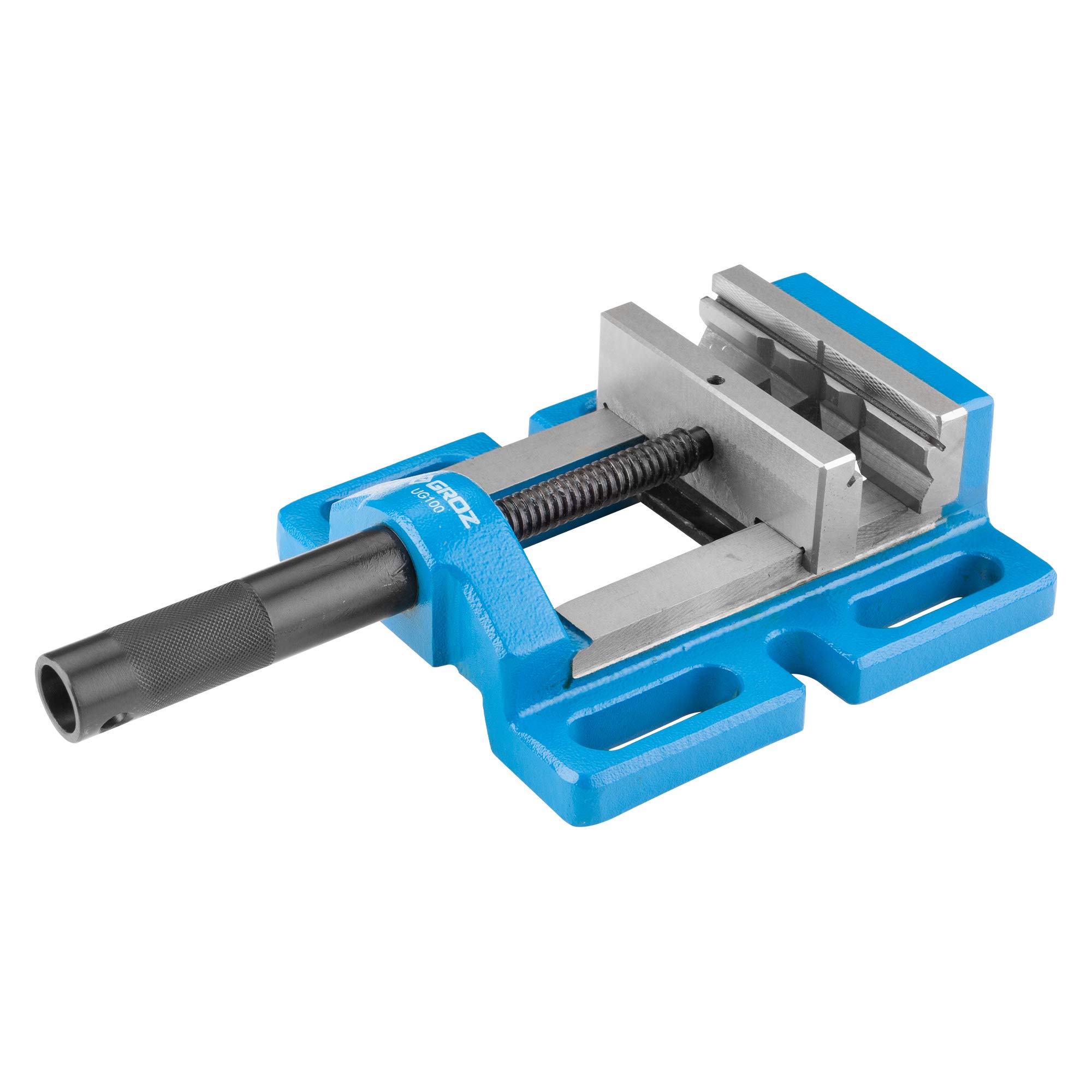
The Groz Unigrip stands out for its exceptional machining accuracy. The base and bed are precision-ground to a flatness that rivals vises costing twice as much—reviewers measured under 0.001 inch parallelism on a granite plate. The fixed jaw has three longitudinal and one transversal prism, giving you rock-solid grip on round bar and tube in both horizontal and vertical orientations.
The clever design of the lead screw sets this apart: the bearing rotates while the worm screw stays stationary, eliminating the wandering action common in cheaper vises. The ledged jaws act as built-in parallels, gripping thin workpieces by the bottom edge without needing separate shims. The elongated clamping slots make mounting fast and adaptable to different table patterns.
At 4 inches of jaw width and a 3-5/8-inch opening, the Groz fits most benchtop presses while offering machinist-level precision. The cast iron body is rugged without being excessively heavy, and the spindle running inside the hollow hand grip lets you orient the vise in any position on the table. This is the vise to buy if you care about hole location accuracy.
Why it’s great
- Precision-ground surfaces provide flatness within 0.001″
- Unique lead screw design prevents jaw wander during clamping
- Ledged jaws act as built-in parallels for thin stock
Good to know
- 4-inch jaw width limits large workpiece capacity
- Premium price tier for a 4-inch vise
2. Wilton Low-Profile Drill Press Vise (LP4)

The Wilton LP4 is engineered for applications where vertical clearance is tight. Its low-profile design adds working room between the chuck and the workpiece, letting you drill deeper without bottoming out the quill. The fine-grain cast iron castings and hardened steel jaws deliver durability that hobbyists and light-industrial users have trusted for decades.
Hardened V-grooves on both jaws allow you to clamp round stock securely in two orientations—vertically for drilling into the end of a rod, or horizontally for drilling through the side of a pipe. The 4-inch jaw width opens to 4 inches and has a 1.5-inch jaw depth, giving you enough reach for most small to medium workpieces on a benchtop press.
Wilton backs this vise with an industry-leading limited lifetime warranty, a testament to the build quality. While the 4-inch size is ideal for hobby tables, some users note the handle balls may need re-gluing over time. The mounting slot pattern is standard for most drill presses, but you’ll need to supply your own hex bolts and washers for installation.
Why it’s great
- Low-profile design maximizes vertical clearance under the chuck
- Hardened V-grooves grip round stock in two axes
- Fine-grain cast iron and hardened steel jaws for long life
Good to know
- Handle balls may require re-gluing after extended use
- Mounting hardware not included
3. Wilton Low-Profile Drill Press Vise (LP6)

The Wilton LP6 is the big brother of the LP4, offering a full 6-inch jaw width and 6-inch jaw opening with a 2-inch jaw depth. This extra capacity makes it suitable for larger workpieces, wider plates, and assemblies that won’t fit in a 4-inch vise. At 30 pounds, it provides substantial mass that helps dampen vibration during heavy drilling or tapping operations.
The low-profile design is preserved even at this larger size, meaning you don’t sacrifice vertical clearance as you scale up. The hardened V-grooves are integrated into the jaws, giving you the same round-stock gripping capability as the LP4 but with more surface area. Users report that it fits an 8-inch Harbor Freight drill press table with standard 7/16-inch hardware.
The lifetime warranty gives this vise an edge over many competitors in the same size class, especially for users who plan to use it daily. One trade-off is that the larger size and weight make it a permanent fixture rather than a portable tool. The cast iron construction is robust, though some owners note the handle balls are press-fit and may eventually loosen.
Why it’s great
- 6-inch jaw capacity handles large workpieces
- Low-profile design maintains chuck clearance at larger size
- 30-pound mass dampens vibration effectively
Good to know
- Heavy weight makes relocation difficult
- Handle balls may loosen over time
4. Yost Vises LDPV-6 Drill Press Vise

The Yost LDPV-6 delivers solid value for the price with a 6-inch jaw width and a 5.75-inch jaw opening. Built from cast iron, it strikes a balance between durability and portability—light enough to move between workstations but rigid enough to hold most general-purpose drilling jobs. The serrated textured jaws provide good grip on flat stock and prevent rotation under load.
Some users note that the vise is larger than expected, so check the dimensions against your drill press table before committing. The mounting slots have a 0.6-inch width with a 7.15-inch centerline, which fits many standard benchtop presses. Yost includes a 1-year limited warranty, and the company offers lifetime tech support for any setup questions.
The main compromise is in surface finish precision—the base and bed are not precision-ground like the Groz or Wilton models. For light-duty drilling, tapping, and even TIG welding fixture work, the Yost performs admirably. It’s a good entry point for new drill press owners who need a capable vise without investing in a premium machinist-level tool.
Why it’s great
- Wide 6-inch jaws for larger parts at a reasonable cost
- Serrated jaws provide solid grip on flat stock
- Light enough for occasional repositioning
Good to know
- Not precision-ground, may have minor surface variations
- Larger than expected for some benchtop tables
5. Forward Q196A 6 Inch Drill Press Vise
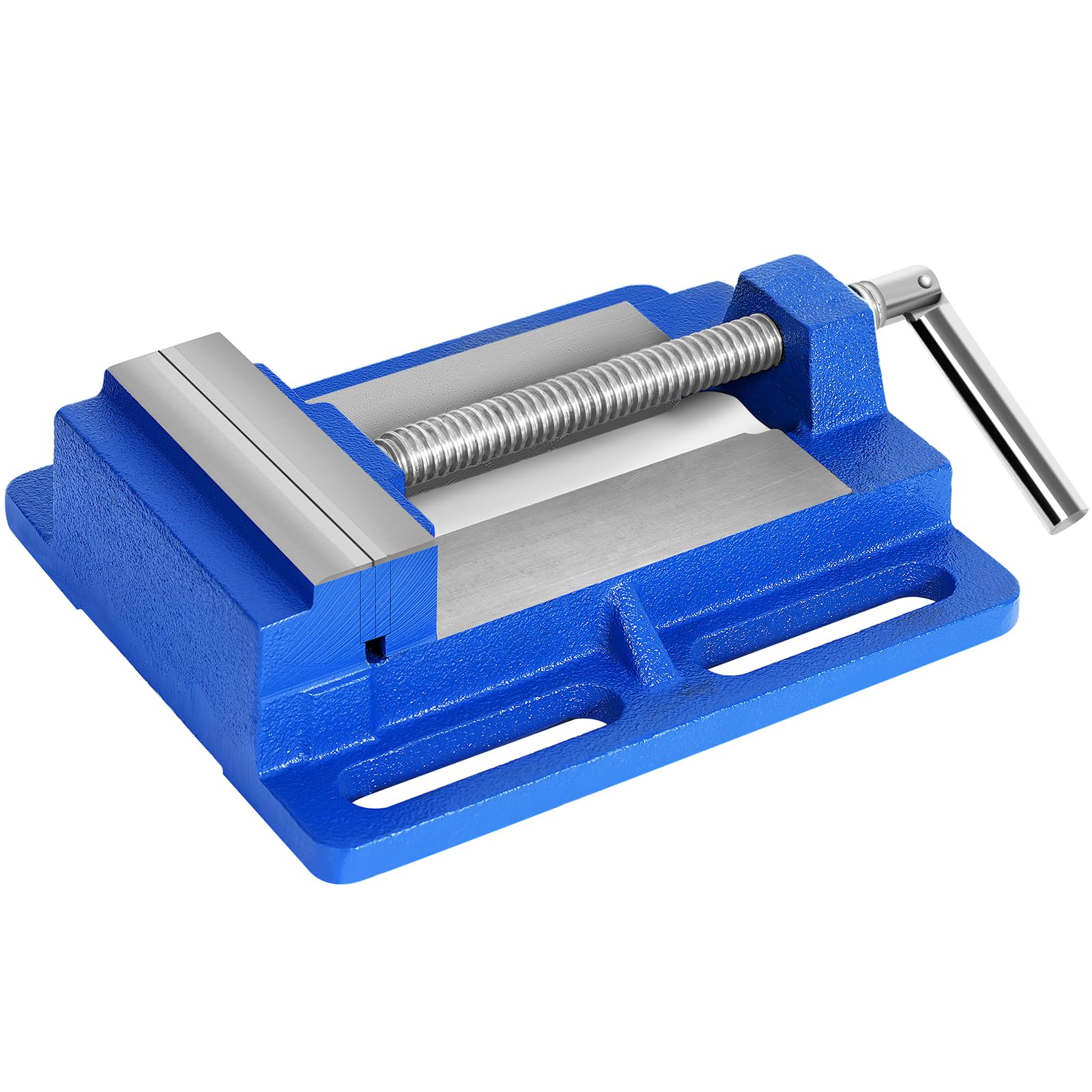
The Forward Q196A brings a 6-inch jaw width and an 11-pound weight that makes it highly portable without feeling flimsy. The ductile cast iron body is rated at 30,000 PSI tensile strength, and the serrated jaw plate delivers about 2640 pounds of clamping force. This is enough to hold small metal projects and pipe stock securely during light to medium drilling tasks.
The slotted base is designed for easy installation on most drill presses, and users report it fits benchtop models without modification. The jaw opening of 5.43 inches gives you decent capacity for 1.5-inch pipe or rectangular stock. Several owners mention it works well for Dremel workstations and soldering fixtures with some minor edge filing.
At the entry-level price point, some compromises appear: the finish may have sharp edges that require deburring, and the overall precision is not at machinist-grade levels. For the do-it-yourselfer who needs an affordable, functional vise for occasional projects, the Forward Q196A gets the job done without straining the budget.
Why it’s great
- Very affordable entry into a 6-inch jaw vise
- 2640 lb clamping force for secure workpiece hold
- Lightweight and portable for multi-station use
Good to know
- Sharp edges may need filing before use
- Cast iron casting not precision-ground
6. VEVOR 6 Inch ACCU Lock Down Vise
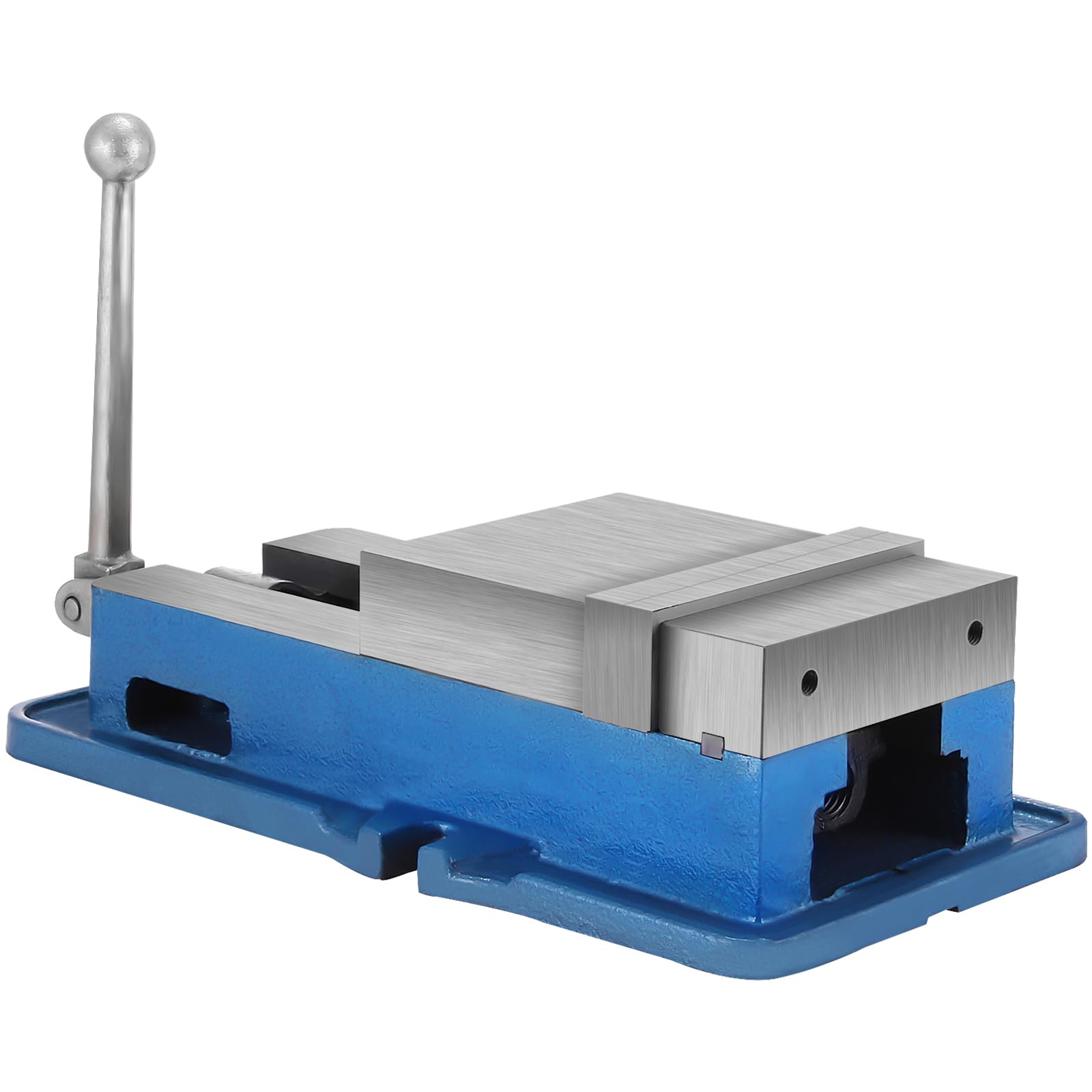
The VEVOR 6 Inch ACCU Lock Down Vise bridges the gap between a standard drill press vise and a precision milling vise. The alloy steel body provides higher stiffness than cast iron, reducing deflection under heavy clamping loads. It is ground to within 0.002 inch on parallelism and squareness, which is adequate for most drill press and light milling work.
At 49.4 pounds, this vise is a permanent installation piece. The screw rod is made from high-strength material that resists deformation and achieves smooth rotation. Users report tramming in to under 0.001 inch total indicator runout, which speaks to the quality of the machining. The 6-inch jaw width and 5.9-inch opening accommodate medium to large workpieces.
The VEVOR is not a Kurt replacement, but for the price, it offers impressive fit and finish. The lead screw operates smoothly out of the box, and the clamping force keeps workpieces stable even during aggressive cuts. For drill press owners who occasionally use a mill or who want the option to upgrade later, this vise is a step up from basic cast iron models.
Why it’s great
- Alloy steel body offers higher rigidity than cast iron
- Ground to 0.002″ parallelism for precision work
- Smooth lead screw and strong clamping force
Good to know
- Very heavy at nearly 50 pounds
- Not at the precision level of Kurt or premium milling vises
7. Happybuy 6 Inch ACCU Lock Down Vise

The Happybuy 6 Inch ACCU Lock Down Vise shares many DNA traits with the VEVOR, but its distinguishing feature is the flame-hardened sliding bed surface. This hardening treatment increases wear resistance on the bed, extending the vise’s service life in high-use settings. The jaw width measures 6 inches, with a 5.9-inch opening and a 1.75-inch jaw height.
Accuracy is rated to 0.002 inch on parallelism and squareness, and users confirm that machined surfaces check out within spec after initial cleanup. The vise ships well-oiled but requires disassembly to file sharp edges and remove burrs. The mounting slots are about 0.82 inches wide, which is wider than standard 1/2-inch studs, requiring some adaptation for certain tables.
This vise is particularly strong for firearm work and precision parts finishing, where jaw squareness and repeatable clamping are critical. The 49.38-pound weight makes it a permanent shop fixture. The lead screw may feel stiff initially, but after cleaning and applying way oil, the operation smooths out significantly. For the hobbyist who wants milling-grade performance without milling-grade cost, the Happybuy is a compelling option.
Why it’s great
- Flame-hardened bed surface for long-term wear resistance
- Rated to 0.002″ parallelism and squareness
- Strong clamping force for precision work
Good to know
- Sharp edges and burrs require initial cleanup
- Mounting slots wider than standard 1/2″ studs
FAQ
Can I use a drill press vise on a milling machine?
How do I mount a vise without T-slots on my drill press table?
What does the serrated jaw pattern do for grip?
Final Thoughts: The Verdict
For most users, the best drill press vise winner is the Groz Unigrip 35121 because its precision-ground surfaces, ledged jaws, and unique lead screw design deliver machinist-level accuracy at a mid-range price. If you want a low-profile design with hardened V-grooves and a lifetime warranty, grab the Wilton LP4. And for large workpieces or milling-grade rigidity, nothing beats the VEVOR 6 Inch Lock Down Vise.

Mo Maruf
I created WellFizz to bridge the gap between vague wellness advice and actionable solutions. My mission is simple: to decode the research and give you practical tools you can actually use.
Beyond the data, I am a passionate traveler. I believe that stepping away from the screen to explore new environments is essential for mental clarity and physical vitality.