Our readers keep the lights on and my smoothie glass nicely filled. As an Amazon Associate, I earn from qualifying purchases.
If your tap water leaves white crust on your kettle and has a heavy, metallic mouthfeel, you already know the problem: hard water loaded with dissolved calcium and magnesium. The real discomfort isn’t just the scale — it’s the dull taste and the worry about what else is clinging to those mineral deposits. A dedicated filtration system targeting this specific water profile changes everything.
I’m Mohammad Maruf — the founder and writer behind WellFizz. I spent hundreds of hours cross-referencing independent lab data, filter certifications, and customer long-term usage reports to rank which drinking water filters actually hold up against high mineral content without clogging every two weeks.
This guide walks you through the seven most capable models on the market, breaking down the real-world tradeoffs between sediment capacity, flow rate, and scale inhibition. If you are shopping for the best drinking water filter for hard water, the table below gives you a direct comparison of what matters most.
How To Choose The Best Drinking Water Filter For Hard Water
Hard water filtration isn’t just about grabbing any carbon block off the shelf. The dissolved calcium and magnesium carbonates that cause scale require a filter that either physically removes those ions (reverse osmosis) or chemically sequesters them to prevent precipitation (scale inhibitor media). The wrong choice means rapid clogging, minimal taste improvement, and a constant replacement cycle that frustrates more than it helps.
Sediment capacity and micron rating
Hard water often carries visible sediment and fine particulates that wear down activated carbon blocks quickly. Look for a system with a sediment pre-filter stage or a high-surface-area carbon block rated at 1 micron or finer. A 0.5-micron block, for example, catches more of the microscopic mineral crystals before they reach the main filter media, extending the usable life of the cartridge by weeks.
Scale inhibition versus complete demineralization
Some filters include a phosphate-based or polyphosphate scale inhibitor that binds to calcium and magnesium ions, keeping them suspended in water so they don’t precipitate as scale. These systems preserve beneficial minerals and maintain a neutral pH. Reverse osmosis, on the other hand, physically removes the vast majority of dissolved solids, yielding very low TDS water that is scale-free but also stripped of minerals. The choice boils down to whether you want mineral-balanced water with spotting reduction or ultra-pure water with zero scale risk.
Flow rate and filter life under high TDS load
Filters carrying a 10,000+ gallon rating are tested under ideal municipal water conditions. When your source water TDS is above 300 ppm, that rating drops significantly. A system rated for 11,000 gallons may only deliver 6,000-7,000 gallons before saturation. Prioritize models with replaceable pre-filters and inline scale inhibitor cartridges — these allow you to swap the sediment stage without discarding the entire assembly, lowering your long-term operating cost.
Quick Comparison
On smaller screens, swipe sideways to see the full table.
| Model | Category | Best For | Key Spec | Amazon |
|---|---|---|---|---|
| iSpring RCC7AK | RO + Alkaline | Complete mineral stripping + remineralization | 75 GPD RO membrane + remineralization | Amazon |
| DREO Countertop RO | Countertop RO | Installation-free hard water TDS removal | 3:1 pure-to-drain ratio | Amazon |
| APEC CS-2500P | Under Sink + Scale Inhibitor | Scale reduction without RO | Integrated scale inhibitor cartridge | Amazon |
| Waterdrop ED01W | Electric Pitcher | Instant filtered water on a countertop | 0.5-micron carbon block filter | Amazon |
| Waterdrop 10UA | Under Sink Carbon Block | High-flow hard water taste improvement | 1.33 GPM flow rate | Amazon |
| ZeroWater 32-Cup | Pitcher / Ion Exchange | TDS reduction to zero for small households | 5-stage ion exchange + TDS meter | Amazon |
| Amazon Basics Under Sink | Under Sink Carbon Block | Entry-level hard water taste and odor fix | 11,000-gallon capacity | Amazon |
In‑Depth Reviews
1. iSpring RCC7AK

The iSpring RCC7AK is a full 6-stage reverse osmosis system that hits hard water from every angle. The semi-permeable RO membrane rejects 93-98% of total dissolved solids, which means the calcium and magnesium that cause scale are physically flushed to the drain rather than building up in your pipes or glassware. The addition of an alkaline remineralization stage — the AK in its name — restores calcium and magnesium carbonates after the RO stage, producing a balanced pH around 7.5-8.5 that avoids the flat taste typical of stripped water.
Installation requires under-sink space for the 2.6-gallon storage tank, but the patented top-mounted faucet design eliminates the struggle of tightening the nut from below the sink. The transparent first-stage housing lets you visually inspect sediment buildup, a critical feature when your source water carries high mineral load that clogs standard opaque housings without warning. NSF 58 certification covers the complete system, not just individual components, giving you independent verification of contaminant reduction including fluoride, lead, chromium, and PFAS.
Customer reports consistently note TDS drops from 400+ ppm to below 30 ppm after installation, with users describing the water as crisp and clean without the metallic bite that hard water imparts to coffee and tea. The annual replacement filter set extends the life of the membrane and pre-filters, and iSpring’s Atlanta-based support team answers technical questions promptly.
Why it’s great
- Full RO rejection of up to 98% of dissolved solids eliminates scale formation entirely
- Alkaline remineralization restores pH balance and essential minerals after stripping
- NSF 58 certified for the entire system, not just the membrane
Good to know
- Requires significant under-sink space for the tank and filter housings
- Installation takes 2-3 hours for those unfamiliar with push-to-connect fittings
2. DREO Countertop RO Water Filter
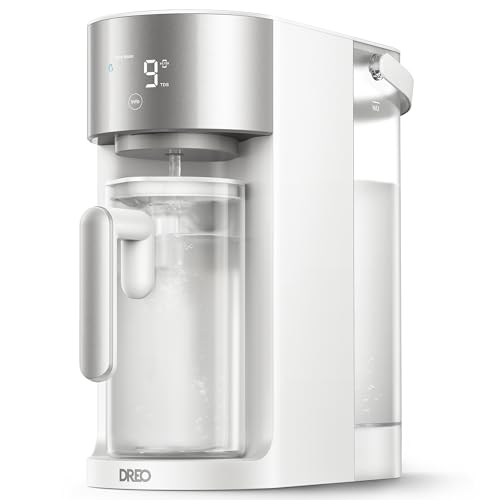
The DREO Countertop RO is a rare beast: a reverse osmosis system that requires zero under-sink plumbing. You fill the 3-liter tank from your faucet, press a button, and the unit does the rest — pumping water through its RO membrane and storing purified water in a 1.1-liter pitcher. For renters or anyone who cannot drill through countertops, this is the most direct route to near-zero TDS water without a permanent installation commitment.
The 3:1 pure-to-drain ratio is better than many traditional under-sink RO systems that waste 4 gallons for every 1 gallon produced. The self-cleaning feature auto-flushes the internal tubes each cycle, preventing biofilm growth that can occur in warm countertop environments. Real-time TDS monitoring on the front panel shows both raw water and pure water readings, giving you immediate feedback on how effectively the membrane is handling your local hard water load.
Real-world TDS readings from users with hard water in the 375-450 ppm range dropped to 12-22 ppm after filtration. The compact footprint — 14.5 inches deep by 6.7 inches wide — fits next to a coffee maker, and the auto-fill sensor stops dispensing when the pitcher is full. Filter replacement is a simple twist-to-install operation, and the 265-gallon filter life translates to about 3-4 months for a two-person household.
Why it’s great
- Zero installation required — just plug in and fill the tank
- 3:1 water efficiency reduces waste compared to traditional RO
- Real-time TDS display confirms filtration performance for high-mineral water
Good to know
- Slow fill rate; 1.1-liter pitcher may run out quickly in larger households
- Filter life decreases under very high TDS above 500 ppm
3. APEC Ultra High Capacity CS-2500P

The APEC CS-2500P takes a different approach to hard water than the RO systems above: rather than removing dissolved minerals, it uses an integrated scale inhibitor cartridge to bind calcium and magnesium ions so they stay in solution and cannot precipitate as limescale. This means you keep the beneficial minerals in your water while eliminating the white crust on your kettle and the spotting on your glassware. It also connects directly to your existing kitchen faucet — no separate spout required.
The filter assembly is a two-stage design: a 5-micron sediment pre-filter catches larger particulates, followed by a high-capacity carbon block that reduces chlorine, taste, and odor. The scale inhibitor cartridge sits in the same housing and is rated for approximately 1,000 gallons, while the carbon block lasts up to 5,000 gallons depending on your water quality. Users with moderately hard water (150-300 ppm TDS) report a noticeable reduction in kettle scale after 2-3 weeks of use.
Installation takes about 10 minutes with the included 3/8-inch hoses that connect directly to your cold water shut-off valve. The twist-and-lock connection design makes filter changes fast, and the all-polypropylene construction avoids the BPA concerns of some plastic housings. Assembly and filters are made in the USA, which customers frequently cite as a reason for repeat purchases.
Why it’s great
- Scale inhibitor prevents limescale while retaining healthy minerals
- No separate faucet needed — uses existing kitchen tap
- USA-made filter media with reliable quality control
Good to know
- Scale inhibitor cartridge requires more frequent replacement than the carbon block
- Does not reduce TDS or remove dissolved metals like RO would
4. Waterdrop ED01W Electric Pitcher
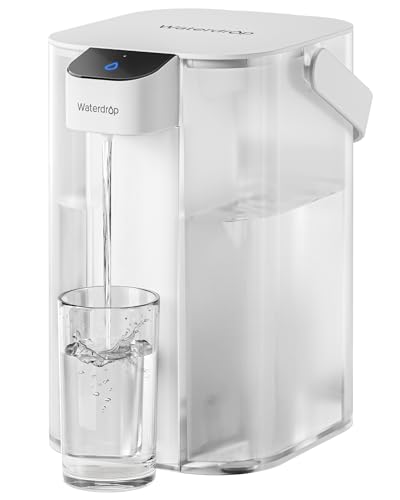
The Waterdrop ED01W is an electric countertop pitcher that dispenses filtered water on demand with a single touch — no tipping, no waiting. Inside, a 0.5-micron premium carbon block filter provides 10x the filtration efficiency of standard pitcher filters, removing chlorine, lead, mercury, microplastics, and 45+ other impurities. The battery lasts up to 30 days on a single charge, and the USB-C charging port eliminates the need for a dedicated outlet near your pitcher.
Each filter is rated for 200 gallons or roughly 3 months of use, and the system retains essential minerals rather than stripping them. This makes it a strong fit for hard water areas where you want to remove the metallic taste and chlorine odor without losing the calcium and magnesium that contribute to water’s mouthfeel. The NSF/ANSI 42, 53, 401, and 372 certifications cover contaminant reduction claims and material safety.
The dispenser holds 15 cups of water and fits comfortably on a kitchen counter or coffee station. One-touch operation works for all ages, from children to elderly family members who struggle with traditional pitcher lifting. Replacement filters are easy to find online, and the battery indicator prevents unexpected shutdowns.
Why it’s great
- Instant electric dispensing with no tipping or waiting for gravity filtration
- 0.5-micron carbon block catches fine particulates from hard water
- Retains beneficial minerals while removing taste and odor impurities
Good to know
- Does not lower TDS; designed for taste and contaminant reduction only
- Battery needs recharging every 30 days with regular dispensing
5. Waterdrop 10UA Under Sink System
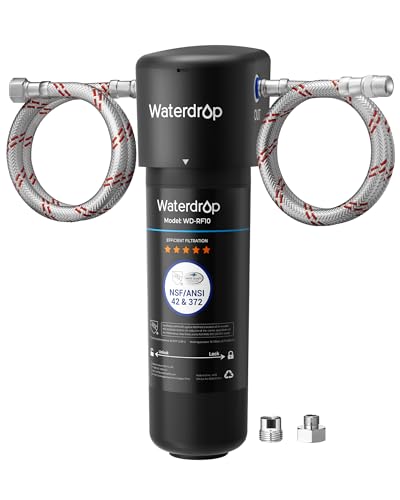
The Waterdrop 10UA is an under-sink carbon block system optimized for high flow rates. Its upgraded 3/8-inch outlet delivers 1.33 gallons per minute at 60 psi, which means you can fill a large pot without the trickle effect common to many inline filters. The 0.5-micron carbon block removes chlorine, bad taste, and odor while keeping essential minerals intact — a good match for hard water where the primary complaint is taste rather than visible scale.
The system uses a 20x larger dirt adhesion area than standard filters, which helps resist clogging when municipal water carries higher sediment loads. Installation is a straightforward inline process with push-to-connect fittings and a 3/8-inch to 1/2-inch converter included. The filter lasts up to 12 months or 11,000 gallons under normal municipal water conditions, though heavy hard water use may shorten that lifespan to 8-10 months.
Customers consistently praise the taste improvement over tap water, with many noting that it makes hard water taste comparable to bottled spring water. The compact 12.3-inch height fits under most sinks without crowding the disposal or storage area. Replacement filters are affordable, and the system is backed by Waterdrop’s prorated performance service for quality issues.
Why it’s great
- Fast 1.33 GPM flow rate fills pots and pitchers quickly
- 20x larger dirt adhesion area resists clogging from sediment-heavy water
- Compact under-sink footprint leaves room for storage
Good to know
- Not designed for well water or hot water sources
- Does not reduce TDS or prevent calcium scale buildup
6. ZeroWater 32-Cup 5-Stage Dispenser

The ZeroWater 32-Cup pitcher uses a 5-stage ion exchange filtration process that pulls virtually all dissolved solids out of the water, delivering a TDS reading of 0 ppm when the filter is fresh. The built-in TDS meter lets you verify performance instantly — no guesswork about whether the filter has exhausted. For hard water areas where TDS routinely exceeds 300-500 ppm, this is the most aggressive non-RO option available in a pitcher format.
The 32-cup (7.5-liter) capacity is the largest in its class, meaning fewer refill trips to the sink. The 5-stage process includes a coarse filter screen, foam distributor, activated carbon and oxidation reduction alloy, ion exchange media, and a fine filter screen. This combination targets lead, chromium, mercury, PFOA/PFOS, and the dissolved mineral solids responsible for hard water scale. IAPMO certification backs the contaminant reduction claims.
In high-TDS hard water environments, filter life drops significantly — users with 400+ ppm TDS report replacement every 3-4 weeks rather than the 2-3 months seen in low-TDS areas. While the operating cost is higher in these conditions, the water quality is unmatched by carbon-only pitchers, producing water that tastes softer and cleaner than bottled brands.
Why it’s great
- Achieves 0 TDS readings, removing the minerals that cause hard water scale
- Largest 32-cup capacity reduces frequency of refills
- Built-in TDS meter confirms filter effectiveness at a glance
Good to know
- Filter life is short in high-TDS water, increasing annual replacement cost
- Slow gravity filtration rate compared to electric or under-sink systems
7. Amazon Basics Under Sink Water Filter System
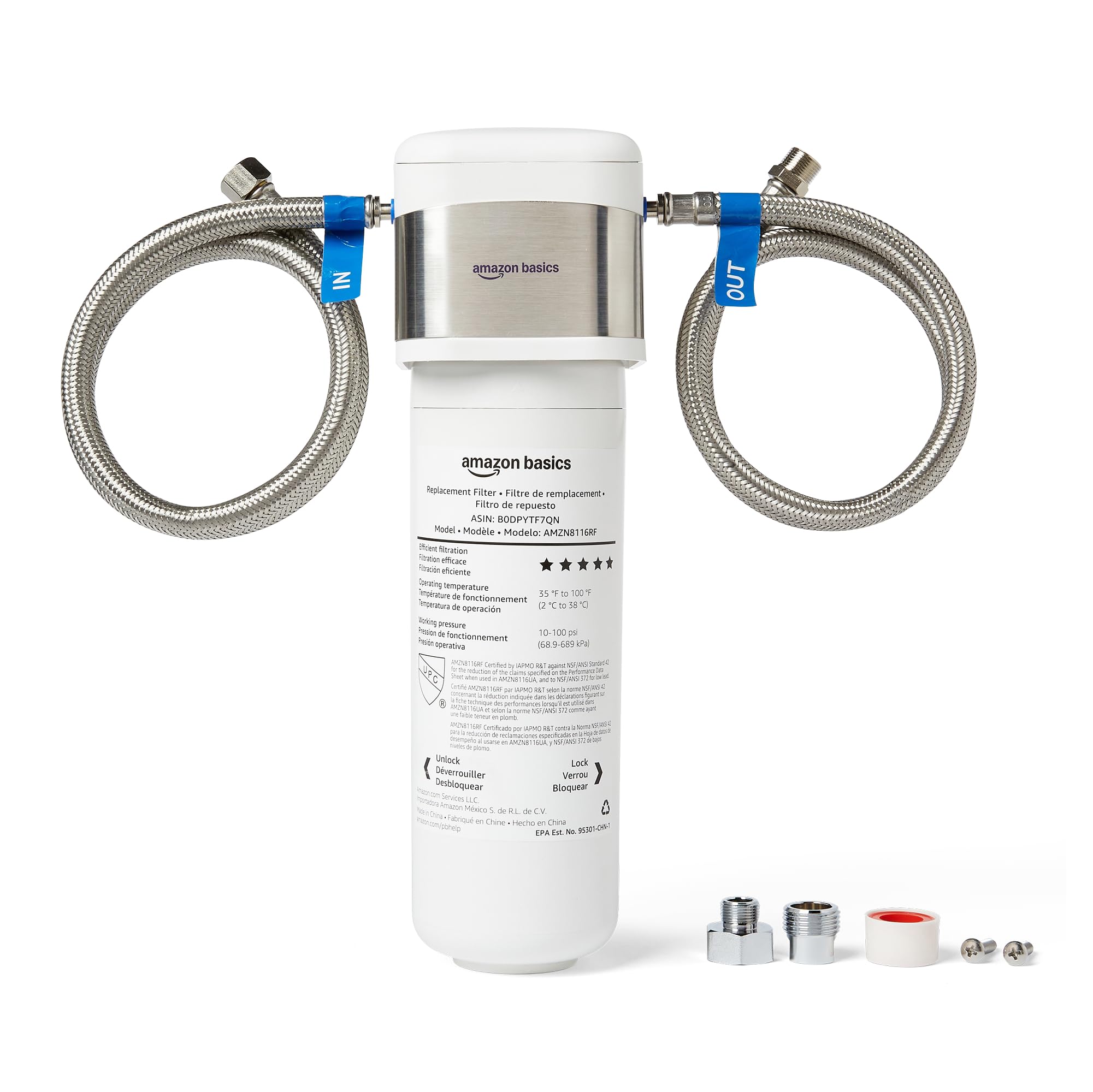
The Amazon Basics Under Sink Filter is a no-frills entry point for anyone looking to improve hard water taste and odor without breaking the bank. The polypropylene and activated carbon block reduces chlorine, bad taste, and odor while leaving dissolved minerals in place. NSF/ANSI 42 and 372 certifications confirm material safety and chlorine reduction performance, giving budget buyers independent verification rather than marketing claims.
Installation is genuinely quick — the twist-and-lock housing mounts with two screws, and the push-to-connect fittings attach to standard 3/8-inch cold water lines in about three minutes. The included 3/8-inch to 1/2-inch converter accommodates different valve sizes. Each filter is rated for 11,000 gallons or 12 months, whichever comes first, providing enough capacity for an average family without frequent changeouts.
Customers note that water pressure drops slightly after installation, a common tradeoff with denser carbon blocks, but the improvement in taste is significant. The compact size — roughly the dimensions of a can of household cleaner — fits easily in tight under-sink spaces. Replacement filters are inexpensive, making this one of the lowest long-term cost options for improving hard water taste.
Why it’s great
- Very affordable entry price with low-cost replacement filters
- 3-minute installation with twist-and-lock and push-to-connect fittings
- NSF 42 certified for chlorine, taste, and odor reduction
Good to know
- Slightly reduces water flow rate compared to unfiltered tap
- Does not reduce TDS or prevent limescale formation
FAQ
Will a carbon block filter remove limescale from my hard water?
How often do I need to replace filters in hard water areas?
Is reverse osmosis necessary for hard water or is a pitcher good enough?
What does NSF 42 vs. NSF 58 certification mean for hard water filters?
Final Thoughts: The Verdict
For most users, the best drinking water filter for hard water winner is the iSpring RCC7AK because it combines full RO stripping with an alkaline remineralization stage, delivering scale-free water that does not taste flat. If you want installation-free operation with real-time TDS feedback, grab the DREO Countertop RO. And for those who prefer to keep their beneficial minerals while stopping limescale buildup, nothing beats the APEC CS-2500P with its integrated scale inhibitor.

Mo Maruf
I created WellFizz to bridge the gap between vague wellness advice and actionable solutions. My mission is simple: to decode the research and give you practical tools you can actually use.
Beyond the data, I am a passionate traveler. I believe that stepping away from the screen to explore new environments is essential for mental clarity and physical vitality.