Our readers keep the lights on and my smoothie glass nicely filled. As an Amazon Associate, I earn from qualifying purchases.
The audio circuitry inside a typical PC case is a noisy, electrically polluted environment. Fans, GPU coils, and data buses inject a constant layer of low-level static and interference that masks the texture of your music and the subtle positional cues in your games. An external digital-to-analog converter physically separates the conversion process from that electrical chaos, delivering a black background and precise imaging that no internal sound card can match.
I’m Mohammad Maruf — the founder and writer behind WellFizz. I’ve spent hundreds of hours mapping the technical specifications, chipset architectures, and real-world feedback of modern desktop DACs to identify which designs actually deliver measurable improvements over motherboard audio and which ones are just marketing wrapped in an aluminum box.
The mechanical hum of a spinning hard drive and the squeal of a GPU can ruin an otherwise immersive listening session.
How To Choose The Best DAC For PC
Selecting a DAC is not about buying the highest number on a spec sheet. The real goal is to solve the specific audio bottleneck in your setup — whether that is electrical noise from your PC, insufficient power for your headphones, or limited format support for high-resolution streaming. The three decision points below will narrow your options faster than any comparison chart.
Output Topology: Single-Ended vs Balanced
If you own headphones with a 4.4mm or XLR balanced cable, a DAC with a true balanced amplifier stage will double the voltage swing, effectively increasing power delivery and improving channel separation. For standard 3.5mm or 6.35mm single-ended headphones, the sonic advantage of balanced circuitry is minimal — many ears cannot hear the difference outside of a quiet listening room. Evaluate your current headphone cable before paying a premium for balanced outputs.
DAC Chip & Implementation
The chipset does not determine the sound quality alone; the analog output stage surrounding it matters as much. ESS Sabre chips (ES9038Q2M, ES9039Q2M) deliver higher measured dynamic range and lower distortion, but a poorly implemented Sabre design can sound harsh. AKM Velvet Sound chips (AKM4493SEQ) are often described as warmer and more natural with less treble fatigue. The XMOS XU208 or XU316 USB controllers are the industry standard for stable USB audio on Windows — avoid DACs that rely solely on generic USB chips if you need reliable ASIO driver support.
Power Requirements & Headphone Impedance
A DAC/amp combo must have enough current to drive your specific headphones. For high-impedance headphones (250Ω or above), look for output power above 200mW into 32Ω via single-ended, and preferably 500mW or more via balanced. Low-impedance sensitive IEMs require a low noise floor — below 2μV — to avoid audible hiss at quiet volumes. A 3-level gain switch is a practical feature that lets you match the amplifier’s output range to your headphone’s sensitivity.
Quick Comparison
On smaller screens, swipe sideways to see the full table.
| Model | Category | Best For | Key Spec | Amazon |
|---|---|---|---|---|
| Topping DX5 II | Premium All-in-One | High-end desktop audiophile setups | 7600mW x2 balanced output | Amazon |
| Fosi Audio ZH3 | Mid-Range All-in-One | Versatile desktop systems needing bass/treble EQ | 2570mW @32Ω via 4.4mm | Amazon |
| SMSL DO100 PRO | Premium Desktop DAC | Studio monitors and home theater integration | Dual ES9039Q2M chips, HDMI ARC | Amazon |
| iFi Zen DAC 3 | Mid-Range Premium | Clean USB bus-powered setup with neutral sound | TrueBass / PowerMatch features | Amazon |
| Creative Sound Blaster G8 | Mid-Range Gaming | PC gaming with virtual surround sound | 120 dB SNR, Acoustic Engine software | Amazon |
| Topping D10s | Entry-Level Desktop | Pure line-out DAC for active speakers | ES9038Q2M, THD+N 0.0002% | Amazon |
| Fosi Audio DS1 | Portable Budget | On-the-go high-res listening from laptop or phone | 220mW output, 4.4mm + 3.5mm | Amazon |
In‑Depth Reviews
1. TOPPING DX5 II
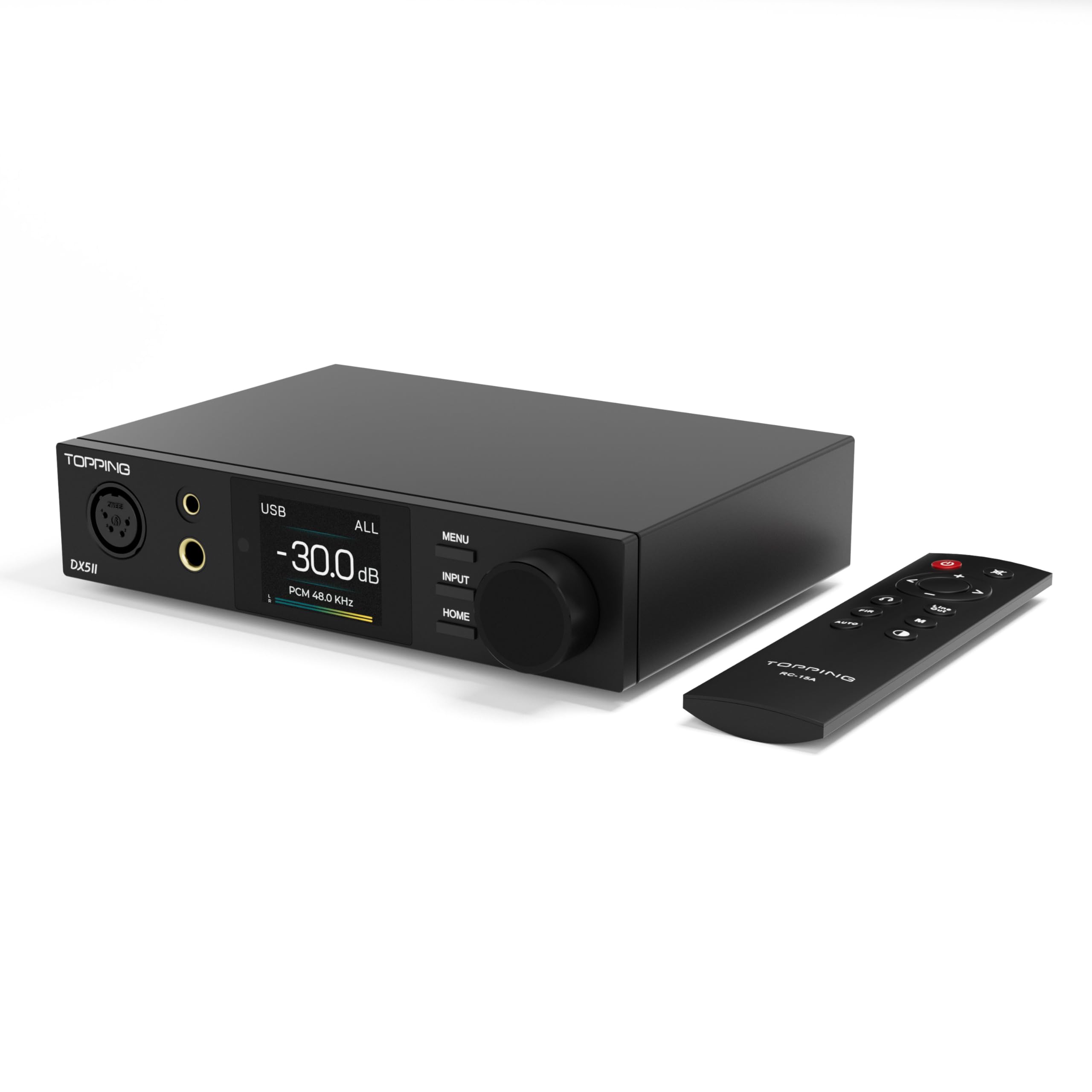
The DX5 II is the most complete single-box solution for a demanding desktop audiophile. Dual ES9039Q2M DAC chips handle PCM768kHz/32bit and DSD512 with extremely low distortion, and the X-Hybrid balanced amplifier stage delivers a staggering 7600mW per channel into 32Ω via 4.4mm. That is enough clean current to drive planar magnetic headphones like the Hifiman Susvara without breaking a sweat, while the noise floor remains low enough for sensitive IEMs when you use the single-ended output.
The 10-band parametric EQ lets you correct for room modes or personal taste directly in the digital domain — a feature typically reserved for software suites or vastly more expensive units. The Aurora UI color display and pressable knob make navigation intuitive, and the inclusion of LDAC Bluetooth 5.1 means you can stream wirelessly from your phone without sacrificing bit-perfect quality. The 12V trigger input/output allows seamless integration with active speakers and amplifiers in a full HiFi chain.
Some users have reported that the headphone jacks lack protection against hot swapping, and a small number of units exhibited distortion after repeated plug/unplug cycles. This is a known design quirk rather than a widespread failure, but it is worth noting if you frequently swap between headphones. For anyone building a long-term desktop rig around high-impedance or planar headphones, this is the most future-proof choice at this tier.
Why it’s great
- Massive 7600mW balanced output power drives virtually any headphone on the market.
- 10-band PEQ provides advanced sound customization without external software.
- Dual ESS chip architecture delivers outstanding channel separation and low noise.
Good to know
- Headphone jacks are not electrically protected against hot swapping; power down before plugging.
- Firmware update required to change the on-screen language from default Chinese.
- Large footprint compared to smaller desktop DACs like the D10s.
2. Fosi Audio ZH3

The ZH3 is a fully balanced DAC, preamp, and headphone amplifier in a compact desktop chassis that punches well above its price class. The AKM4493SEQ DAC chip delivers the warm, natural tonality that AKM Velvet Sound architecture is known for — less analytical than ES9038-based designs but more musical for long listening sessions. The 4.4mm balanced output pushes 2570mW into 32Ω, which is sufficient for most 300Ω headphones like the Sennheiser HD 660 S2 or Beyerdynamic DT 1990 Pro.
What sets the ZH3 apart from similarly priced competition is the inclusion of analog bass and treble EQ knobs and six selectable digital filters. You can add low-end weight without resorting to software EQ, and the 3-level gain switch ensures that sensitive IEMs remain hiss-free on low gain. The remote control is functional, and the circular OLED display shows input, volume, and filter settings clearly from a typical desk distance.
The RCA and XLR preamp outputs are intended for feeding active speakers or a separate power amplifier. Note that the EQ only affects the headphone output, not the line outputs — a limitation that is clearly documented but easy to overlook. The external 12V power supply is slightly bulky for a desktop device, and the switching between UAC modes for game consoles requires a manual power cycle. For a versatile mid-range system that integrates headphones, powered monitors, and a turntable preamp, the ZH3 delivers exceptional value.
Why it’s great
- Analog bass and treble EQ on headphone output for instant tonal adjustment.
- AKM4493SEQ chip provides natural, fatigue-free sound signature.
- Wide connectivity includes USB, optical, coaxial, and analog RCA input.
Good to know
- EQ controls do not apply to the RCA and XLR preamp outputs.
- External power brick adds clutter to the desktop.
- UAC mode switching for game consoles requires manual power cycling.
3. SMSL DO100 PRO

The DO100 PRO is optimized for users who prioritize line-out performance over headphone amplification. Dual ES9039Q2M DAC chips in a fully balanced topology produce exceptionally low crosstalk and a measured dynamic range that rivals standalone DACs costing twice as much. The XLR balanced outputs deliver 5.2Vrms, which is ideal for feeding studio monitors or a separate amplifier — just be aware that this hot output may require gain reduction if your speakers are unusually sensitive.
Input flexibility is the DO100 PRO’s strongest card. In addition to USB, optical, and coaxial, the HDMI ARC input allows direct connection from a TV, consolidating your home theater and desktop audio into one DAC. The QCC5125 Bluetooth module supports LDAC at 24bit/96kHz, giving you CD-quality wireless streaming from your phone. The USB1.1 driver-free mode makes this DAC plug-and-play with the PS5 and Switch without additional configuration.
Some users report that the HDMI ARC implementation occasionally drops sync, and the CEC control is non-functional — features that matter less if you primarily use optical or USB. The remote control buttons are unlabeled, which requires memorization, and the display flashes the sample rate after every volume adjustment, which can be distracting. If you need a clean line-out DAC with versatile inputs and do not require a built-in headphone amplifier, the DO100 PRO is a top contender.
Why it’s great
- HDMI ARC input enables seamless TV integration with the desktop HiFi system.
- Dual ES9039Q2M chips provide outstanding channel separation and wide dynamic range.
- Bluetooth 5.1 with LDAC offers high-quality wireless streaming from any device.
Good to know
- 5.2Vrms XLR output is too hot for some active speakers; gain must be reduced.
- HDMI ARC may drop sync — optical input is more reliable for consistent playback.
- Remote control buttons are unmarked, requiring a learning curve.
4. iFi Zen DAC 3
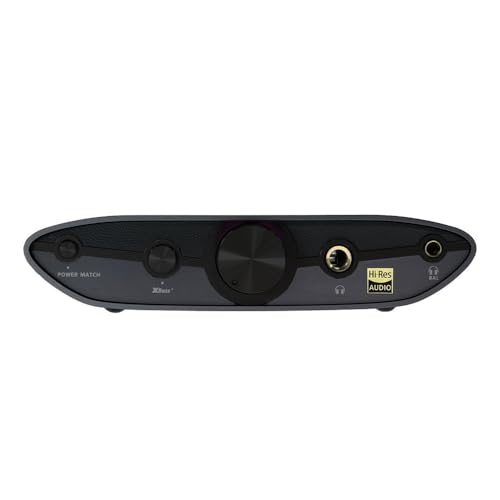
The Zen DAC 3 is iFi’s third-generation entry-level DAC that draws power entirely from USB-C. The Burr-Brown True Native chipset runs a native multibit architecture that avoids the internal oversampling found in many delta-sigma designs, resulting in a natural, smooth, and slightly warm presentation that is easy to listen to for hours. PCM support reaches 32-bit/768kHz and DSD512, making it ready for Tidal Masters and high-res local files.
The PowerMatch switch adjusts gain in two stages to match headphone sensitivity, and the TrueBass (now called XBass in this generation) adds low-end presence without muddying the midrange. The 4.4mm balanced output delivers 300mW into 32Ω, which is sufficient for most dynamic headphones under 300Ω, though planar magnetic headphones may feel slightly underpowered. The all-aluminum matte black chassis feels dense and premium, and the volume knob has a satisfying weighted resistance.
A notable limitation is that the Zen DAC 3 plays audio through all outputs simultaneously — there is no way to mute the line-out while using headphones. If you leave your active speakers powered on, you will hear audio from both at once. The headphone output power is also noticeably lower than the previous Zen DAC V2 (210mW unbalanced vs 280mW), which may matter if you drive high-impedance headphones. For a clean, bus-powered desktop DAC with a refined sound signature, this is a strong mid-range pick.
Why it’s great
- Burr-Brown True Native chipset delivers natural, non-fatiguing sound.
- TrueBass feature adds controlled low-end without bloat.
- Compact, bus-powered design eliminates the need for a separate power supply.
Good to know
- No way to mute line-out when using headphones — both play simultaneously.
- Headphone output power is lower than the previous Zen DAC V2.
- Requires official driver for correct DSD/PCM playback on Windows.
5. Creative Sound Blaster G8

The Sound Blaster G8 bridges the gap between pure audiophile DACs and gaming sound cards. The 120 dB signal-to-noise ratio ensures a clean background, while the Acoustic Engine software provides virtual surround sound, equalizer presets, and voice morphing that competitive gamers rely on for positional audio. The USB-C input handles up to PCM384kHz/32bit, and the hardware platform is compatible with PC, Mac, PlayStation, and Nintendo Switch.
In terms of raw power, the G8 drives demanding headphones like the Audeze LCD-2 and Sennheiser HD 599 without strain. The default stereo mode is surprisingly competent for music listening, with good separation and a neutral tonal balance that avoids the harshness typical of older gaming DACs. The compact form factor fits neatly under a monitor or next to a laptop, and the acoustic engine software is powerful once you configure it to your preferences.
Quality control reports are more mixed than on the DAC-only alternatives. Several users have reported audio dropouts that require physically re-plugging the USB-C cable, and the volume knob is digital, meaning it can produce sudden bursts of loud sound when switching gain modes. A small number of units malfunctioned after a few weeks of use. For buyers who need built-in surround sound processing for competitive gaming and are willing to handle potential software quirks, the G8 offers features that no pure audiophile DAC can match.
Why it’s great
- Acoustic Engine software provides virtual surround sound for competitive gaming.
- Drives high-impedance headphones like Audeze LCD-2 with authority.
- Compact and compatible with PC, Mac, and game consoles via USB-C.
Good to know
- Some units experience audio dropout requiring USB re-plug.
- Digital volume knob can produce sudden loud bursts on gain switch.
- Quality control is inconsistent; a percentage of units malfunction early.
6. Topping D10s

The D10s is the purest distillation of what a desktop DAC should be: a clean line-out converter that takes USB audio from your PC and outputs it via RCA or coaxial with minimal coloration. The ES9038Q2M DAC chip is the same Sabre reference chip used in many far more expensive units, and Topping’s implementation keeps total harmonic distortion plus noise at just 0.0002% — a spec that is genuinely transparent to the human ear. It supports PCM up to 384kHz/32bit and DSD256 via DoP or native mode.
The XMOS XU208 USB controller with Thesycon driver ensures stable, glitch-free playback on Windows, and the D10s automatically powers on and off in sync with your computer — a small convenience that saves you from reaching for a power button. The small aluminum enclosure fits in one hand and generates no noticeable heat during extended sessions. The swappable op-amp socket allows DIY tinkerers to roll different operational amplifiers to tune the sound signature, a feature rarely seen at this entry-level price.
This is a line-out DAC only — there is no headphone amplifier built in. You will need to connect it to active speakers, a receiver, or a separate headphone amplifier. The front-panel LCD shows the current sample rate being fed by the operating system, not the source file’s original resolution, which can be confusing if you are comparing bit-perfect vs resampled playback. For a straightforward, no-nonsense upgrade from your PC’s 3.5mm jack to a clean analog output, the D10s is the most cost-effective option available.
Why it’s great
- ES9038Q2M chip delivers reference-grade 0.0002% THD+N at this lowest tier.
- Swappable op-amp socket enables DIY sound tuning without soldering.
- Automatic power sync with PC eliminates manual on/off.
Good to know
- No headphone amplifier — requires active speakers or a separate amp.
- LCD shows OS sample rate, not source file resolution, which misleads some users.
- Single-chip design lacks the channel separation of dual-chip implementations.
7. Fosi Audio DS1

The DS1 packs desktop-grade component choices into a dongle form factor that fits in your pocket. The ESS ES9038Q2M DAC chip is the same chip used in many full-size desktop units, and the dual headphone outputs — 3.5mm single-ended and 4.4mm balanced — give you flexibility for both standard and balanced cables. Output power reaches 220mW into 32Ω, which is enough to drive 150Ω headphones like the Beyerdynamic DT 880 on low gain with headroom to spare.
The signal-to-noise ratio exceeds 120dB with a noise floor below 1.6μV, meaning sensitive IEMs remain black-silent at low volumes. The volume rocker on the side provides independent control from the source, a significant usability improvement over earlier thumb-drive DACs that relied entirely on the phone or PC volume slider. The DS1 supports DSD512 and 32-bit/768kHz PCM, and it is compatible with Android, iOS, Windows, and macOS with the appropriate adapter cables.
Build quality is solid for the price — the aluminum housing feels dense, though it weighs only 1.28 ounces. The USB-C to Type-C cable and USB-A adapter are included, but an iOS user will need a separate Lightning to USB-C camera adapter. Some Android phones, particularly the Google Pixel 8 series, have reported static or compatibility issues due to power draw. As a travel companion for laptop audio improvement or a secondary DAC for a work PC, the DS1 delivers an impressive feature set for its size.
Why it’s great
- ESS ES9038Q2M chip provides desktop- grade DAC performance in a portable dongle.
- Independent volume rocker gives precise local control away from the source.
- 4.4mm balanced output drives higher-impedance headphones with cleaner power.
Good to know
- May draw too much power for some Android phones, causing static or disconnection.
- No Lightning cable included — iOS users need a separate adapter.
- Housing gets warm after extended use; not ideal for pocket carry in summer.
FAQ
Does a DAC improve sound quality for gaming?
Can I use a DAC with a gaming console like the PS5 or Xbox?
Do I need a DAC if I already have a good motherboard?
What is the difference between USB1.1 and USB2.0 modes on a DAC?
How important is the headphone amplifier section when choosing a DAC?
Final Thoughts: The Verdict
For most users, the dac for pc winner is the TOPPING DX5 II because it combines dual ESS DAC chips, massive balanced output power, and a 10-band parametric EQ in a single box that will drive virtually any headphone without requiring additional components. If you want the warmth and natural tonality of AKM Velvet Sound plus analog bass/treble EQ, grab the Fosi Audio ZH3. And for a compact, bus-powered setup that upgrades your PC audio without adding clutter to your desk, nothing beats the iFi Zen DAC 3.

Mo Maruf
I created WellFizz to bridge the gap between vague wellness advice and actionable solutions. My mission is simple: to decode the research and give you practical tools you can actually use.
Beyond the data, I am a passionate traveler. I believe that stepping away from the screen to explore new environments is essential for mental clarity and physical vitality.