Our readers keep the lights on and my smoothie glass nicely filled. As an Amazon Associate, I earn from qualifying purchases.
Kitchen and bathroom cabinets take a daily beating — grease splatters, steam, sticky fingers, and constant opening and closing. The wrong paint chips, yellows, or shows every single brushstroke, leaving your kitchen looking worse than before you started. This guide cuts through the marketing noise to deliver the formulas that actually hold up on vertical surfaces, resist moisture, and self-level into a factory-like finish.
I’m Mohammad Maruf — the founder and writer behind WellFizz. I spend my time analyzing real-world performance data, digging into resin chemistry, adhesion ratings, and cure cycles to separate true cabinet-grade paints from diluted craft-store alternatives.
Whether you are painting dated oak cabinets or giving a bathroom vanity a fresh look, finding the right best cupboard paint means matching the right binder system and finish sheen to your surface and lifestyle.
How To Choose The Best Cupboard Paint
Cabinet paint is not the same as wall paint. It must resist moisture, stand up to daily contact, and cure into a hard film that does not stick or peel when doors open and close. You need a formula designed for vertical surfaces and high-traffic kitchen environments.
Binder System: Urethane Acrylic vs. Acrylic vs. Chalk Paint
Urethane acrylic enamels (like INSL-X Cabinet Coat) crosslink as they dry, creating a tougher film that resists scuffs, grease, and cleaning chemicals. Standard acrylics offer good adhesion but lower block resistance — the paint can stick to itself when doors shut. Chalk-style paints are beginner-friendly because they need minimal prep, but they require a wax or poly topcoat to survive cabinet use, adding steps and future maintenance.
Sheen Selection: Satin, Semi-Gloss, or Matte
Satin finishes hide minor surface imperfections while still being wipeable — ideal for most kitchens. Semi-gloss reflects more light and resists staining better, but it reveals every ridge and roller texture. Matte finishes look modern but show grease fingerprints more easily and are harder to clean without leaving shiny patches. For cabinets that see daily cooking, satin or semi-gloss is the practical choice.
Cure Time vs. Dry Time
Touch-dry in 30 minutes does not mean the paint is fully hardened. Most cabinet paints need seven days to reach full cure — that means no heavy scrubbing, no leaning wet objects against doors, and no slamming drawers during the first week. Cure time is the number that matters for long-term durability, not just dry-to-touch time.
Quick Comparison
On smaller screens, swipe sideways to see the full table.
| Model | Category | Best For | Key Spec | Amazon |
|---|---|---|---|---|
| INSL-X Cabinet Coat | Urethane Acrylic | Factory-like finish on kitchen cabinets | Self-levels; 350-450 sq ft/gal | Amazon |
| Heirloom Traditions ALL-IN-ONE | Acrylic Blend | No-sanding project on varied surfaces | Built-in primer & top coat; 140 sq ft/qt | Amazon |
| DWIL Acrylic Wood Paint Kit | Acrylic | Budget-friendly full kit with tools | Semi-gloss; 50-60 sq ft/32 oz | Amazon |
| Jungarian Furniture Paint Kit | Water-Based Acrylic | Outdoor-rated wood cabinets | Waterproof; 16 oz kit with applicator | Amazon |
| Rust-Oleum Chalked Paint | Chalk Paint | Quick, entry-level refresh for low-wear spots | Ultra matte; 150 sq ft/30 oz | Amazon |
In‑Depth Reviews
1. INSL-X Cabinet Coat

The INSL-X Cabinet Coat is engineered specifically for kitchen and bathroom cabinetry, and it shows in the self-leveling behavior. The urethane acrylic binder system flows out brush and roller marks as it dries, leaving a smooth satin surface that mimics a factory spray finish. Real customers consistently report that even amateur painters get professional-looking results with no visible streaks.
Coverage lands at 350 to 450 square feet per gallon, making the gallon tub the most economical choice for whole-kitchen projects. The paint resists chipping, food stains, grease, and moisture — exactly what cabinet doors endure daily. Users noted that hiding heavy oak grain required three to four coats, but the end result was uniform and durable across all reviews.
Full cure takes 24 hours, which is faster than many water-based enamels, and the paint accepts light cleaning after that window. The only real caveat is the gallon size — it is overkill for a single vanity or a small bookshelf, but if you are doing a full kitchen or multiple rooms, the value is unmatched.
Why it’s great
- Self-leveling eliminates brush strokes for a smooth finish
- High resistance to grease, scuffs, and food stains
- Quick 24-hour cure time for cabinet-grade paint
Good to know
- Gallon size is best for full kitchen projects, not small touch-ups
- Oak grain may need up to four coats for full hide
2. Heirloom Traditions ALL-IN-ONE Paint

Heirloom Traditions positions its ALL-IN-ONE formula as the ultimate time-saver: no sanding, no priming, and no top coat required. The low-luster velvet sheen sits between a matte and satin finish, offering a soft look that still handles light wiping. The quart covers 140 square feet — enough for a medium set of cabinet doors or a single dresser.
Users highlight the scratch resistance after the full cure cycle, which takes longer than the typical acrylic. Several reviewers moved from chalk paint to this formula specifically because they wanted durability without waxing. The paint blends well if you are overlapping wet edges, which is critical on large door panels where lap marks can ruin the look.
The built-in primer does reduce adhesion on glossy surfaces — customers who scuffed lightly still reported better results than those who skipped any prep entirely. The formula thinner than some competitors, so expect three coats on dark-to-light color changes. The included color card helps visualize shades in your home lighting, which removes guesswork from the selection process.
Why it’s great
- True no-sanding, no-priming, no-top-coat application
- Scratch-resistant once fully cured
- Works on interior and exterior surfaces including tile and metal
Good to know
- Thinner consistency requires multiple coats for dark hides
- Needs longer cure time for maximum durability
3. DWIL Acrylic Wood Paint Kit

DWIL packs its furniture paint with a full accessory set — gloves, brush, roller, film, masking tape, and sandpaper — making it a strong pick for first-time painters who do not want to buy tools separately. The semi-gloss finish provides a clean, reflective surface that resists moisture well, especially on kitchen cabinets that face steam and splashes daily.
The 32-ounce can covers roughly 50 to 60 square feet per two coats, which translates well to a mid-sized cabinet set or a single dresser. Customers noted that the paint dries to the touch in about 30 minutes and recoat-ready in two hours. The formula self-levels reasonably well for a semi-gloss acrylic, though applying thin coats is essential to avoid drips on vertical door panels.
One consistent observation is that the paint is thick straight out of the can — brushing delivers better coverage than rolling on detailed cabinet fronts. After seven days of curing, the finish passed fingernail scratch tests in multiple reviews. The low-odor, water-based composition makes indoor work comfortable even without perfect ventilation.
Why it’s great
- Complete kit saves time sourcing individual tools
- Thick formula provides good coverage on dark surfaces
- Low-VOC and nearly odorless for indoor use
Good to know
- Brush outperforms roller for cabinet detail work
- Thin coats required to prevent drips on vertical surfaces
4. Jungarian Furniture Paint Kit
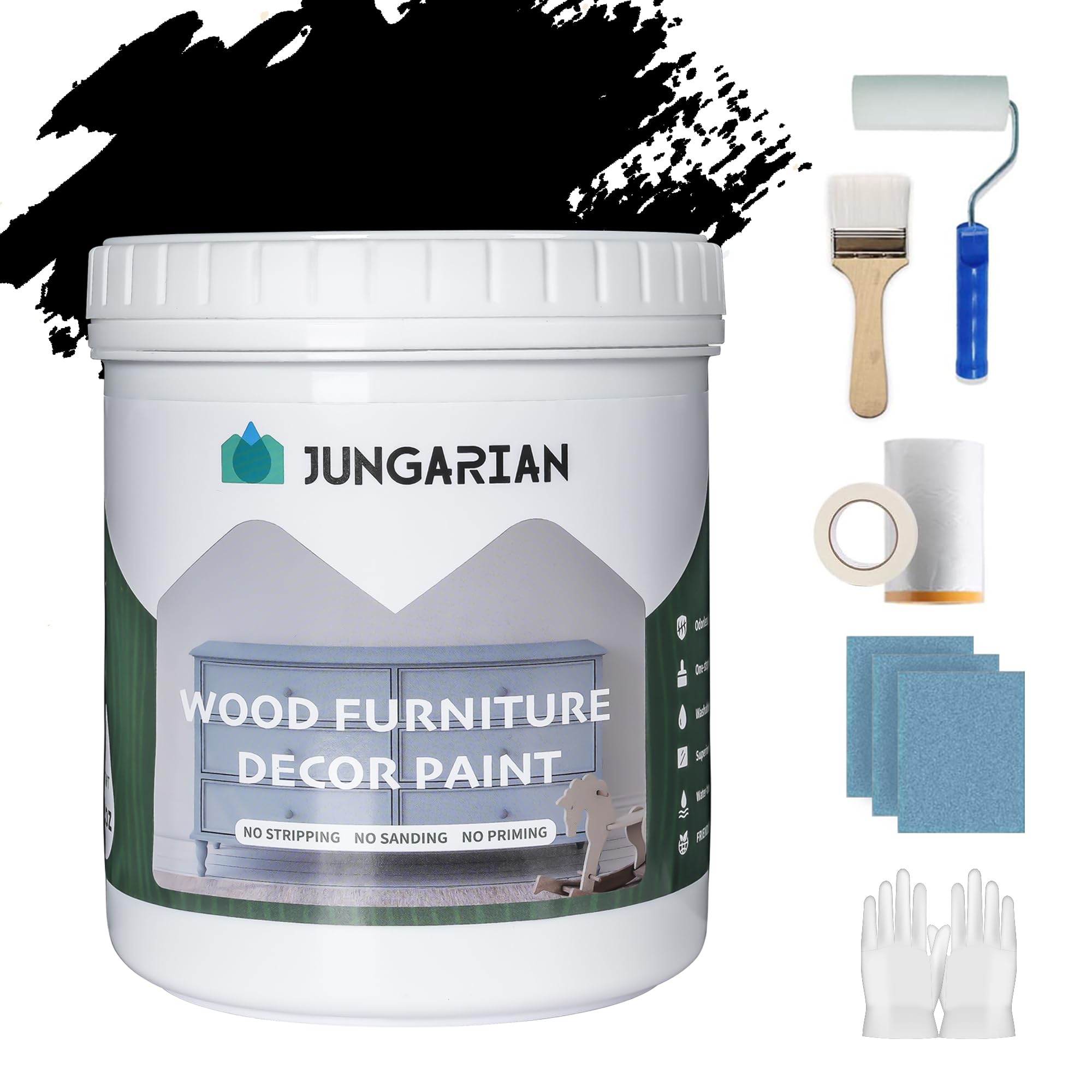
The Jungarian kit focuses on simplicity and portability, packing 16 ounces of black acrylic paint with a small applicator into a single box. The formula is water-based and low-odor, which makes it suitable for indoor cabinetry where ventilation is limited. It is also rated for outdoor use, meaning it handles humidity and temperature shifts better than basic craft acrylics.
Coverage is modest — roughly 4.7 to 5.7 square meters per coat — so it is best suited for smaller projects like a bathroom vanity, a single bookshelf, or a set of nursery cabinets. Users emphasized that light sanding helps the first coat grip, but the paint builds quickly into a matte finish that requires no primer. The kit includes tape and plastic wrap, which adds value for impulse projects.
Customers who painted full kitchens reported using less than one 16-ounce container for a standard set of doors, thanks to the paint dense pigmentation. The waterproof claim held up in user tests, with no peeling or blistering from damp sponges. The main trade-off is the limited color range available compared to larger brands.
Why it’s great
- Waterproof formula suitable for humid bathrooms and outdoor cabinets
- Complete kit includes tape and wrap for quick setup
- Dense pigmentation covers well in fewer coats
Good to know
- 16-ounce size is limited to small or medium projects
- Color selection is narrow compared to mainstream brands
5. Rust-Oleum Linen White Chalked Paint

Rust-Oleum Chalked paint is the gateway product for anyone who wants to test cabinet painting with minimal commitment. The ultra-matte finish gives furniture a trendy, velvety look that photographs well, and the formula bonds to wood, metal, ceramic, and canvas without sanding or primer. The 30-ounce can covers 150 square feet, enough for a single dresser or small cabinet bank.
Customer reviews consistently praise the ease of use — the paint goes on smoothly, dries to the touch in 30 minutes, and most surfaces need only one coat for full hide. However, chalk paint in cabinet applications requires a wax or polyurethane top coat to survive daily use. Without that added step, the finish stays porous and will mark from moisture and friction.
The color Linen White is a warm, subtle off-white that works well in farmhouse and cottage kitchens. Users who followed up with a furniture wax reported good durability, while those who skipped the top coat saw scuffing on high-contact door edges. For low-wear spots like decorative shelving or bedroom nightstands, the chalk finish is fine on its own.
Why it’s great
- No sanding, priming, or stripping required for application
- Fast 30-minute dry-to-touch time for quick projects
- Ultra-matte finish gives a trendy, modern aesthetic
Good to know
- Requires a wax or poly top coat for cabinet-level durability
- Porous finish can show grease marks in kitchen use
FAQ
Can I paint laminate cabinets without sanding?
How many coats of cabinet paint do I need for oak?
Should I use a roller or a brush on cabinet doors?
Can I paint cabinets with chalk paint and not wax them?
Final Thoughts: The Verdict
For most users, the best cupboard paint winner is the INSL-X Cabinet Coat because it self-levels to a factory-quality satin finish and resists grease and scuffs better than any other formula tested. If you want a no-sanding, no-priming all-in-one experience for smaller projects, grab the Heirloom Traditions ALL-IN-ONE Paint. And for a budget-friendly entry point with a full tool kit, nothing beats the DWIL Acrylic Wood Paint Kit.

Mo Maruf
I created WellFizz to bridge the gap between vague wellness advice and actionable solutions. My mission is simple: to decode the research and give you practical tools you can actually use.
Beyond the data, I am a passionate traveler. I believe that stepping away from the screen to explore new environments is essential for mental clarity and physical vitality.