Our readers keep the lights on and my smoothie glass nicely filled. As an Amazon Associate, I earn from qualifying purchases.
On a bass boat, the starting battery has one job: convert a key turn into an instantaneous explosion of power, regardless of whether it’s a humid summer morning or a frosty pre-dawn tournament launch. Anything less means missed fishing time and a tow back to the ramp.
I’m Mohammad Maruf — the founder and writer behind WellFizz. I’ve spent hundreds of hours dissecting marine battery specifications, analyzing cold cranking amp (CCA) curves, reserve capacity (RC) ratings, and real-world owner experiences to separate the batteries that deliver reliable starts from the ones that leave you stranded.
This guide breaks down the nine most capable options on the market to help you find the best cranking battery for bass boat that matches your outboard’s displacement and your fishing style, from lithium-lightweight builds to heavy-duty AGM units.
How To Choose The Best Cranking Battery For Bass Boat
Choosing a starting battery for a bass boat isn’t about finding the biggest amp-hour number. It’s about matching a battery’s discharge profile to your outboard’s compression ratio and your tournament-day electrical load. Three factors dictate whether your engine fires instantly or cranks slowly: CCA (Cold Cranking Amps), RC (Reserve Capacity), and the physical group size that fits your tray.
CCA: The Instant Power Metric
Cold Cranking Amps measure the current a battery can deliver at 0°F for 30 seconds while maintaining at least 7.2 volts. A 150hp or larger outboard needs a minimum of 800 CCA to spin the flywheel freely on a cold morning. Lower CCA ratings are fine for small tiller motors, but for a bass boat with a high-compression V6 or V8 outboard, never compromise here.
Reserve Capacity: Your Safety Net
Reserve capacity tells you how many minutes a fully charged battery can deliver 25 amps before dropping below 10.5 volts. A battery with 100+ minutes of RC ensures you can run your livewell pumps, fish finder, and bilge blower for a while if your trolling motor battery dies, without sacrificing starting capability.
Group Size and Terminal Configuration
BCI group numbers like 24, 27, or 31 define the physical footprint. Group 31 batteries are taller and wider, packing more lead (or lithium cells) for higher CCA and RC. Always measure your existing battery tray and check terminal orientation (positive on left or right) before purchasing.
Quick Comparison
On smaller screens, swipe sideways to see the full table.
| Model | Category | Best For | Key Spec | Amazon |
|---|---|---|---|---|
| Optima RedTop 34 | Premium AGM | Instant starts, high vibration | 800 CCA, 100 min RC | Amazon |
| Odyssey ODS-AGM28L | Premium AGM | Long cycle life, extreme reliability | 24.5 lbs, AGM | Amazon |
| Weize BCI Group 31M | Dual Purpose AGM | High CCA + deep cycle backup | 825 CCA, 240 RC | Amazon |
| Litime 12V 100Ah Group 31 | Premium Lithium | Lightweight, trolling motor combo | 100Ah, 22 lbs | Amazon |
| Power Queen 12V 100Ah | Mid-Range Lithium | Compact Group 24 fitment | 100Ah, 22 lbs | Amazon |
| FLLYROWER 100Ah LiFePO4 | Mid-Range Lithium | Budget-friendly lithium upgrade | 100Ah, 22 lbs | Amazon |
| SUPER EMPOWER 12V 100Ah | Mid-Range Lithium | Cold-weather safety, value | 100Ah, 21.6 lbs | Amazon |
| HRBEENERGY 12.8V 100Ah | Value Lithium | Lightweight, IP67 waterproof | 100Ah, 19.4 lbs | Amazon |
| Newport 12V50Ah Deep Cycle | Entry-Level AGM | Small trolling motors, kayaks | 50Ah, 32 lbs | Amazon |
In‑Depth Reviews
1. Optima RedTop 34

The Optima RedTop 34 uses SpiralCell technology, which wraps 99.99% pure lead plates into a tight, vibration-resistant spiral. For a bass boat bouncing across choppy water at 60 mph, that construction is a massive reliability advantage over flat-plate flooded batteries. With 800 CCA and 100 minutes of reserve capacity, this 37.9-pound AGM delivers the instant cranking power a large outboard demands without any risk of acid spills from a jostled hull.
Owners routinely report lifespans of 7 to 9 years in daily-driver trucks and boats, with multiple units lasting through harsh winters and humid summers without a single failure. The sealed, maintenance-free design means you never add water, and the SAE posts accept standard ring terminals or side-post adapters. It charges noticeably faster than a traditional flooded battery, recovering quickly after a series of short cranking cycles at the ramp.
Warranty support has been a sticking point for a small number of buyers—claims are handled through Amazon rather than local distributors, which can create delays if a unit fails prematurely. The RedTop is also a strictly starting-focused battery; deep cycling it for trolling motor use will shorten its life considerably. For a pure starter battery that never hesitates, this is the benchmark.
Why it’s great
- SpiralCell design withstands severe boat vibration
- Reliable 800 CCA for instant cold starts
- Long 7-9 year service life reported by owners
Good to know
- Not designed for deep-cycle trolling motor use
- Warranty support can be slow via Amazon
- Heavier than comparable lithium units
2. Odyssey ODS-AGM28L Extreme Series
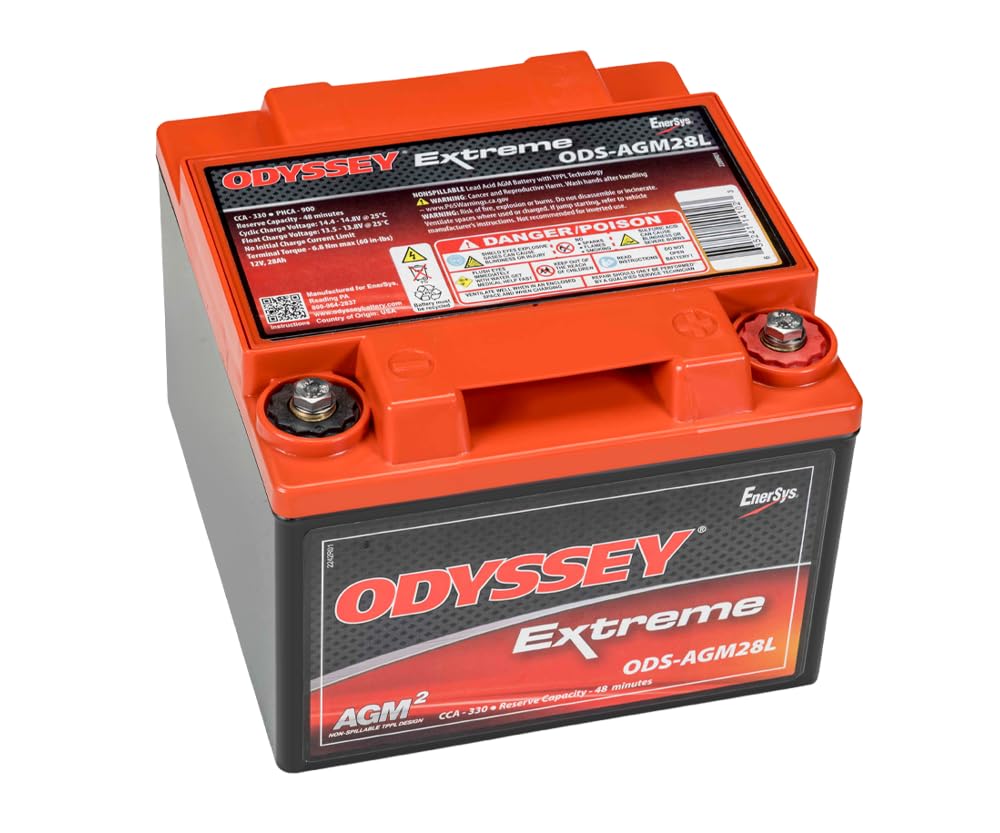
Odyssey batteries are built with a thick, pure-lead plate design that delivers 70% longer cycle life than conventional deep-cycle AGM units. The ODS-AGM28L is a compact 24.5-pound battery that punches well above its weight class for starting applications, offering high stable voltage under load that keeps your outboard spinning fast even when temperatures drop. Its sealed, non-spillable construction makes it safe for mounting in any orientation except inverted.
Real-world owner reports show these batteries routinely lasting 7 to 9 years in performance vehicles and boats. One owner documented 8 years of service in a 5.0L Coyote V8 before noticing any weakness. The deep cycle capability here is genuine—you can run the battery down and recharge it hundreds of times without the plate damage that kills standard starting batteries.
The warranty experience has been inconsistent. Several owners report that the 2-year manufacturer warranty was not honored after early failures, with claims rejected for “over-discharge” despite normal use. The battery’s M6 terminals may require an adapter for some factory cable ends. For those who prioritize longevity and don’t mind the risk on warranty support, the Odyssey offers exceptional lead-acid performance.
Why it’s great
- Extremely long service life (7-9 years typical)
- High stable voltage for consistent cranking
- True deep-cycle capability in a starting battery
Good to know
- Warranty support can be difficult to claim
- M6 terminals may need adapters
- Compact size means lower CCA than big Group 31s
3. Weize BCI Group 31M Dual Purpose AGM
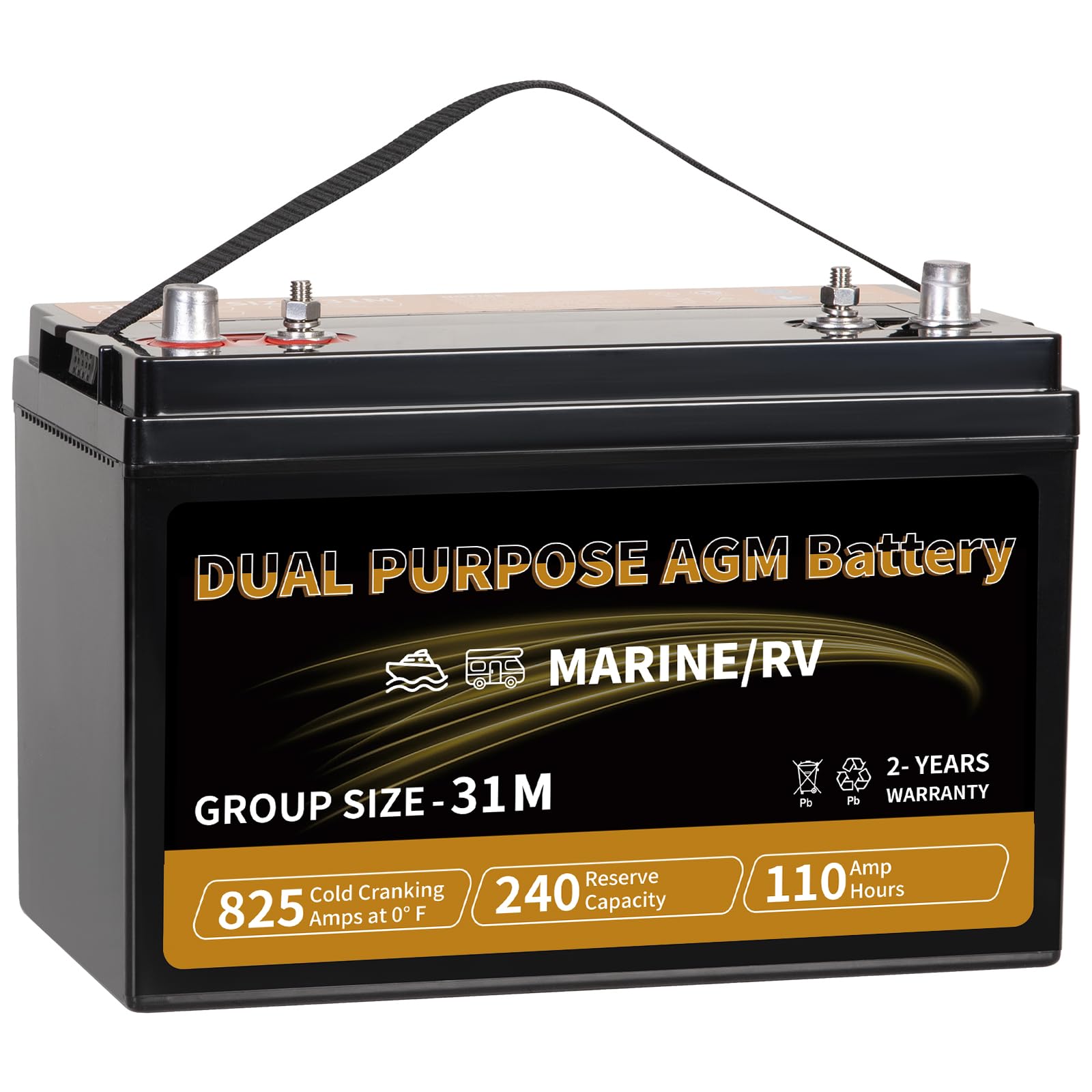
The Weize BCI Group 31M is a true dual-purpose AGM battery that delivers massive 825 CCA for starting while also offering deep-cycle muscle with 240 minutes of reserve capacity. That RC number means you can run bilge pumps, livewells, and sonar for hours after the motor is off without draining the battery below starting voltage. Its AGM construction doubles the cycle life of a standard flooded battery and provides 20 times the vibration resistance.
At 67.5 pounds, this is a heavy unit—the weight comes from the thick lead plates that deliver the high CCA and deep-cycle endurance. Owners using it as a starter battery in large diesel RVs and big-block inboards report effortless cranking even with 8.1L engines. The charging speed is a standout feature; the AGM chemistry accepts a charge up to five times faster than flooded batteries, so a brief run between fishing spots tops it off quickly.
Quality control has been an occasional issue. A few buyers received batteries that failed within weeks, though the 2-year warranty generally resolves this. The sheer weight makes installation a two-person job in tight battery compartments, and the DT/SAE/M8 terminal combo requires attention to ensure you connect the correct post to your outboard’s positive cable. For the combination of starting power and backup run time, the Weize is unmatched at this tier.
Why it’s great
- Exceptional 825 CCA for big outboards
- 240-minute reserve capacity for electronics
- Fast charging, five times quicker than flooded
Good to know
- Very heavy at 67.5 lbs
- Occasional quality control issues reported
- Large footprint needs Group 31 tray
4. Litime 12V 100Ah Group 31 LiFePO4
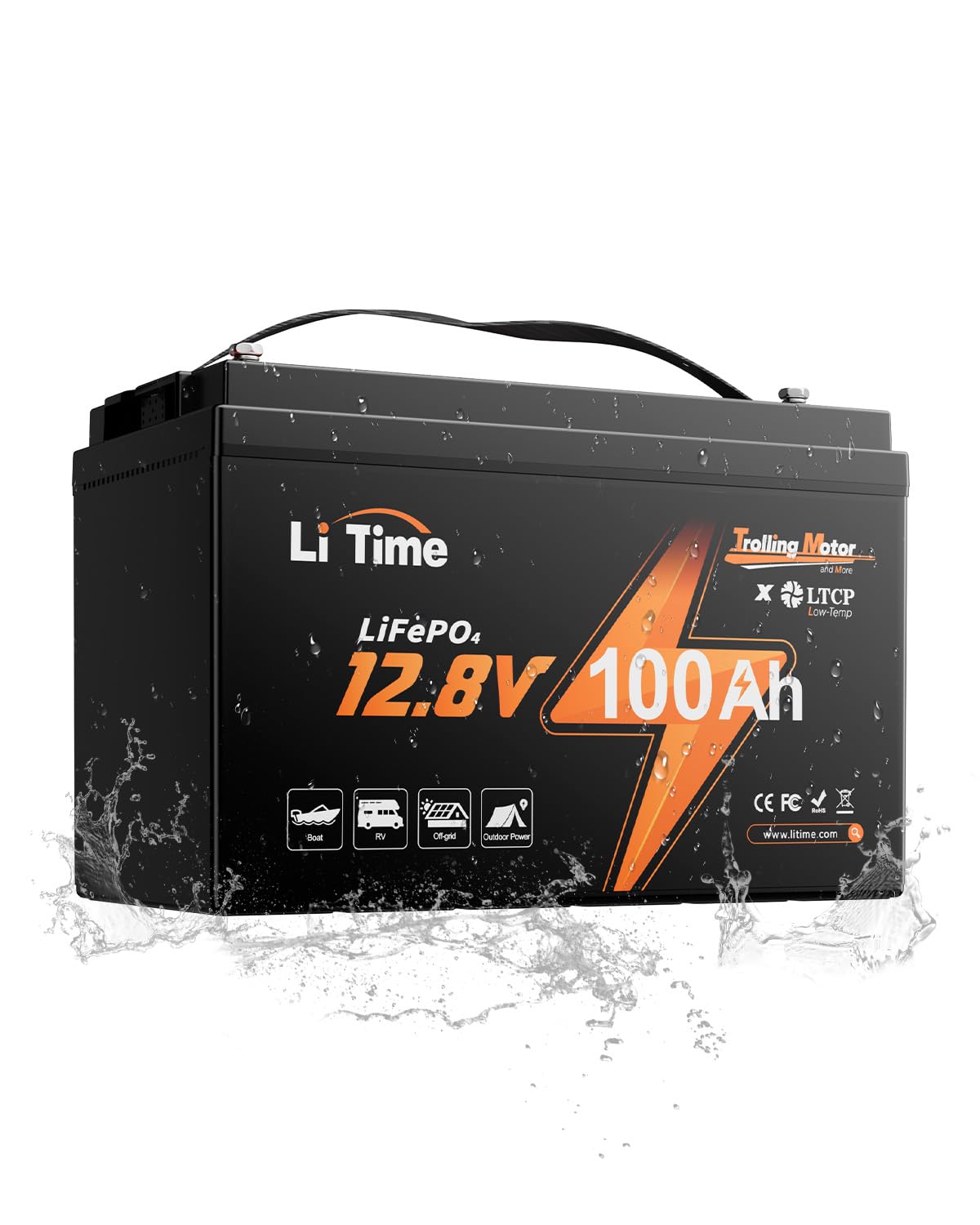
The Litime 12V 100Ah LiFePO4 battery is built specifically for the marine environment, meeting the ABYC E-13 standard with extra BMS protection against dust, water ingress, and salt spray. Its built-in TVS (transient voltage suppression) shields trolling motors from voltage spikes, which is critical for modern GPS-equipped Minn Kota and Motorguide units. The smart low-temperature cutoff stops charging below 32°F and discharging below -4°F, preventing cell damage in cold-weather storage.
At only 22 pounds, it shaves nearly 50 pounds off a comparable Group 31 AGM battery—weight savings that translate directly to better hole-shot performance on a bass boat. Owners report that it powers 12V and 36V trolling motors for full tournament days without significant voltage sag. The Bluetooth monitoring app lets you check state of charge, remaining cycles, and cell balance from your phone, which is a huge advantage over blind lead-acid batteries.
The first charge out of the box can be tricky. Some units arrive with the BMS in a deep-sleep state, requiring a “hard charge” by holding the mode button until the red light turns solid. The built-in charger included with some configurations is slow (7A), taking up to 14 hours for a full charge. For pure starting duty, you’ll want a dedicated LiFePO4 charger for faster turnaround between trips.
Why it’s great
- Meets ABYC E-13 marine standard
- Extremely light at 22 lbs
- Bluetooth BMS monitoring via app
Good to know
- BMS can enter deep sleep, needs hard charge
- Low temp cutoff may stop charging in winter
- Higher upfront cost than AGM
5. Power Queen 12V 100Ah Group 24 LiFePO4
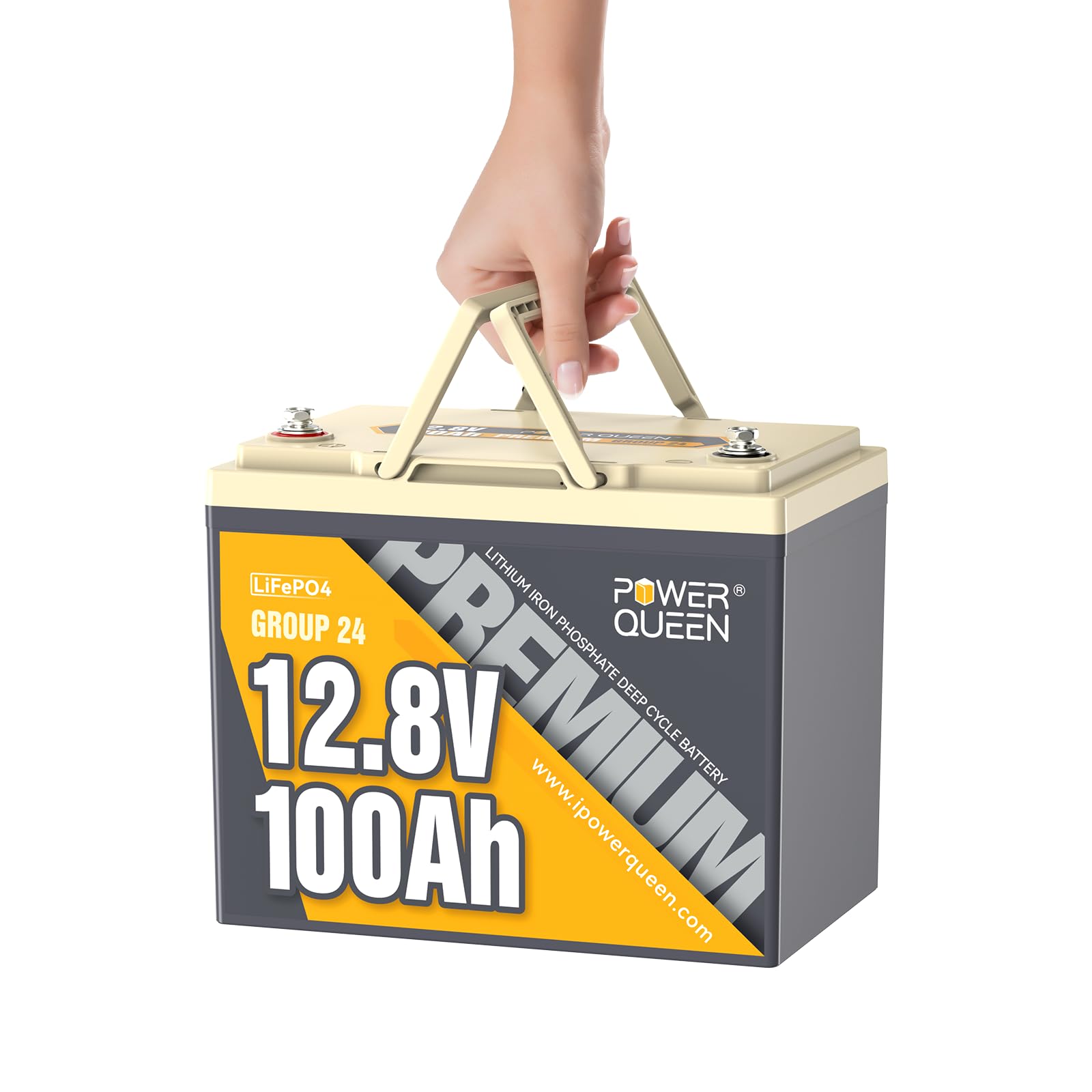
The Power Queen 12V 100Ah LiFePO4 battery is designed to slip into a standard BCI Group 24 battery tray, making it an ideal drop-in replacement for boats with limited compartment space. Despite the compact footprint, it delivers a true 100Ah of capacity with an upgraded 100A BMS that guards against overcharge, over-discharge, over-current, and short circuits. Grade-A LiFePO4 cells ensure consistent voltage output under load, which helps your outboard’s starter motor spin at full torque.
Owner reports show this battery outperforming its rated capacity in amp-hour testing, with some measurements exceeding 100Ah when new. It has proven reliable in fishing kayaks and small bass boats, running Motorguide Xi3 GPS trolling motors for extended offshore trips without voltage sag. The compact size also fits well in Group 27 and 31 battery boxes with simple spacers, giving you flexibility if you upgrade trays later.
The BMS lacks low-temperature charging cutoff protection, meaning if you store the boat in an unheated garage during freezing months, the battery can be damaged if a charger turns on automatically. Power Queen is explicit that this is an energy storage battery, not a dedicated starting battery, so it lacks the instant burst of CCA that a pure cranking AGM provides. For mixed starting and trolling duty on a smaller bass boat, it works well, but serious tournament anglers should pair it with a dedicated starter battery.
Why it’s great
- Compact Group 24 size fits tight trays
- Tested above rated capacity by owners
- Lightweight at 22 lbs
Good to know
- No low-temp charging cutoff protection
- Not a dedicated cranking battery
- Need to disconnect for winter storage
6. FLLYROWER 12V 100Ah LiFePO4

The FLLYROWER 12V 100Ah LiFePO4 battery brings a practical package for bass boat owners looking to shed weight without breaking the bank. Grade A cells and a BMS with low-temperature protection make it safe for year-round use, and the included 7A AC charger is a thoughtful addition that many lithium batteries skip. It weighs only 22 pounds, offering the same 40% weight reduction over lead-acid as the premium brands while maintaining the same 100Ah capacity.
Owners using it with Minn Kota trolling motors report consistent all-day power for ocean rockfish trips and bass tournaments, with no performance drop even after a year of saltwater exposure. The capacity test results are accurate, with one owner measuring 103Ah on a bench test. The built-in dual USB ports are a nice convenience for charging phones or sonar units directly from the battery, though the USB-A standard feels dated in 2026.
The charger that ships with this battery is functional but slow at 7A, requiring over 14 hours for a full recharge from empty. More importantly, there is no way to check the state of charge without a separate monitor—no Bluetooth, no built-in display. This means you’re guessing at your remaining capacity, which is risky for tournament fishing where every minute of trolling motor time counts. It’s a strong value option, but you give up visibility into your battery’s status.
Why it’s great
- Accurate 100Ah capacity tested by owners
- Includes functional 7A AC charger
- Low-temp cutoff protection
Good to know
- No state-of-charge display or Bluetooth
- Included charger is slow at 7A
- USB-A ports, not USB-C
7. SUPER EMPOWER 12V 100Ah LiFePO4
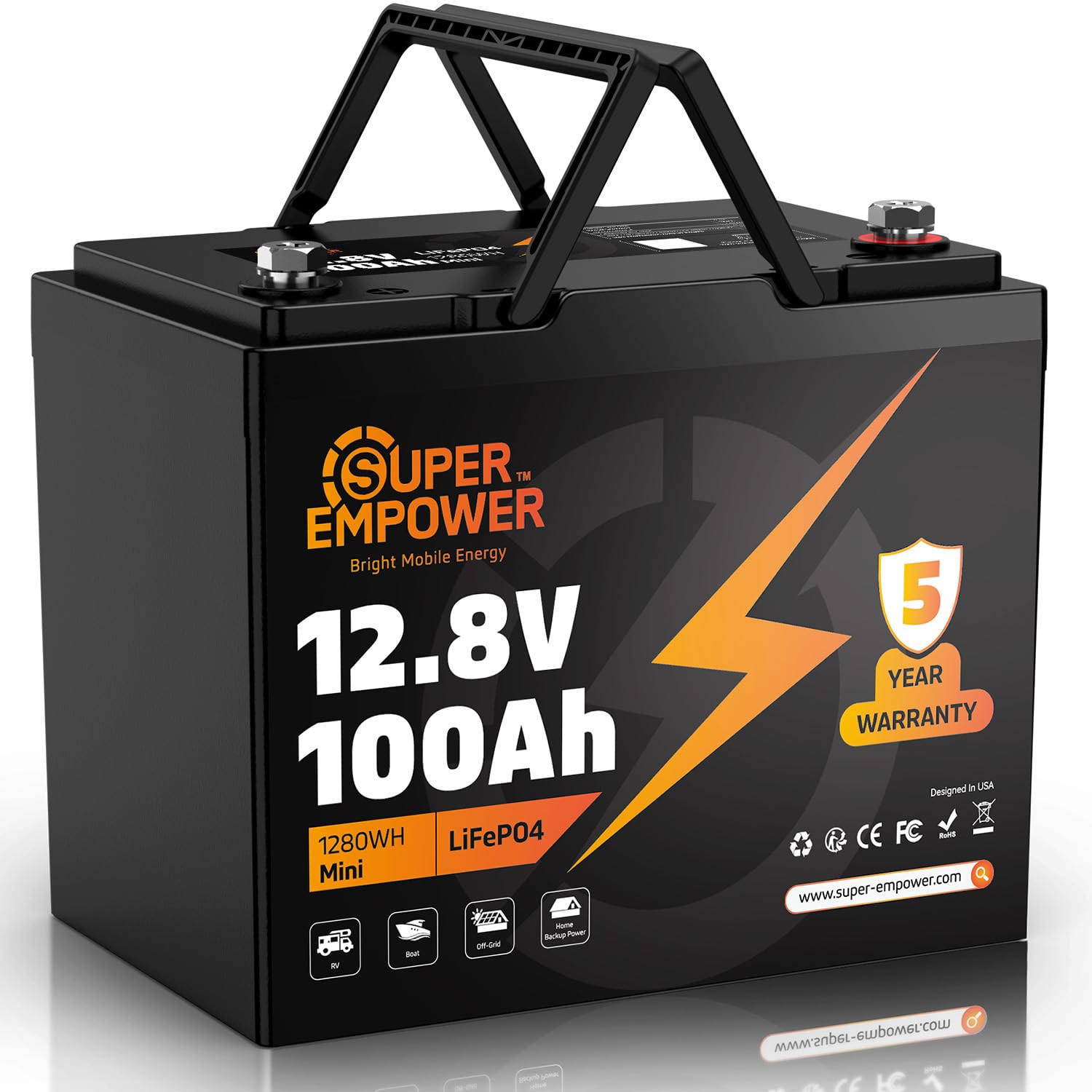
The SUPER EMPOWER 12V 100Ah LiFePO4 battery is designed with a specific focus on low-temperature safety, automatically halting charging below 32°F and disabling discharge at -4°F. For bass anglers who fish through the winter or store boats in unheated garages, this built-in protection is essential—it prevents the permanent cell damage that occurs when lithium batteries charge in sub-freezing conditions. At 21.6 pounds, it fits the BCI Group 24 footprint with M8 terminals for straightforward installation.
Owners have tested this battery with 55lb trolling motors on pontoon bass buggies, reporting a solid 4 hours of run time with plenty of charge remaining for another full day. The Grade A+ cells hold voltage steady under load, and the BMS handles multi-battery configurations up to 4S4P for users who want to build a larger bank later. The 5-year warranty is a solid safety net for a mid-tier lithium purchase.
This battery is explicitly labeled as an energy storage battery, not a starting battery, and the manufacturer states it is not suitable for engine cranking. Using it as a primary starter battery for a large outboard could trigger the BMS overcurrent protection during the high-draw starter engagement. It excels as a lightweight trolling motor battery or a house battery for electronics, but if you need pure cranking power, look at the dedicated starting options in this guide.
Why it’s great
- Strong low-temperature charging protection
- Lightweight Group 24 footprint
- 5-year warranty for peace of mind
Good to know
- Not rated for engine starting/ cranking
- No battery percentage indicator
- Charging pauses below 32°F
8. HRBEENERGY 12.8V 100Ah LiFePO4

The HRBEENERGY 12.8V 100Ah LiFePO4 battery is the lightest in this guide at just 19.4 pounds, which matters enormously for solo anglers who load and unload their gear every trip. The IP67 waterproof case allows it to sit in a wet bilge or open battery compartment without concern for water intrusion, and the BCI Group 24 dimensions let it drop into most standard trays without modification. The built-in 100A BMS protects against all six major failure modes, including high and low temperature cutoffs.
Owners using this battery for trolling on 30lb thrust Minn Kota motors report running 3 hours with barely any drain, recharging in about an hour with a proper lithium charger. The 8000+ cycle rating is significantly better than the 300-500 cycles you get from a lead-acid AGM, making the per-use cost dramatically lower over the battery’s lifespan. The Grade A cells deliver slightly over 100Ah when new, according to owner bench tests.
The M8 terminals are smaller than the standard SAE posts found on most marine starting batteries, so your existing ring terminals may need drilling or swapping. The BMS voltage cutoff is low (around 9.5V), and the battery can re-enable itself after a low-voltage shutdown, which can confuse some chargers. For pure starting duty, the lower CCA output of a lithium battery compared to a high-end AGM means it’s better suited as a house battery or dual-purpose backup rather than a primary starter.
Why it’s great
- Extremely light at 19.4 lbs
- IP67 waterproof case for wet compartments
- Long lifespan with 8000+ cycles
Good to know
- M8 terminals may need adapter for SAE cables
- Low voltage cutoff re-enables unexpectedly
- Lower CCA than premium AGM starters
9. Newport 12V50Ah Deep Cycle AGM
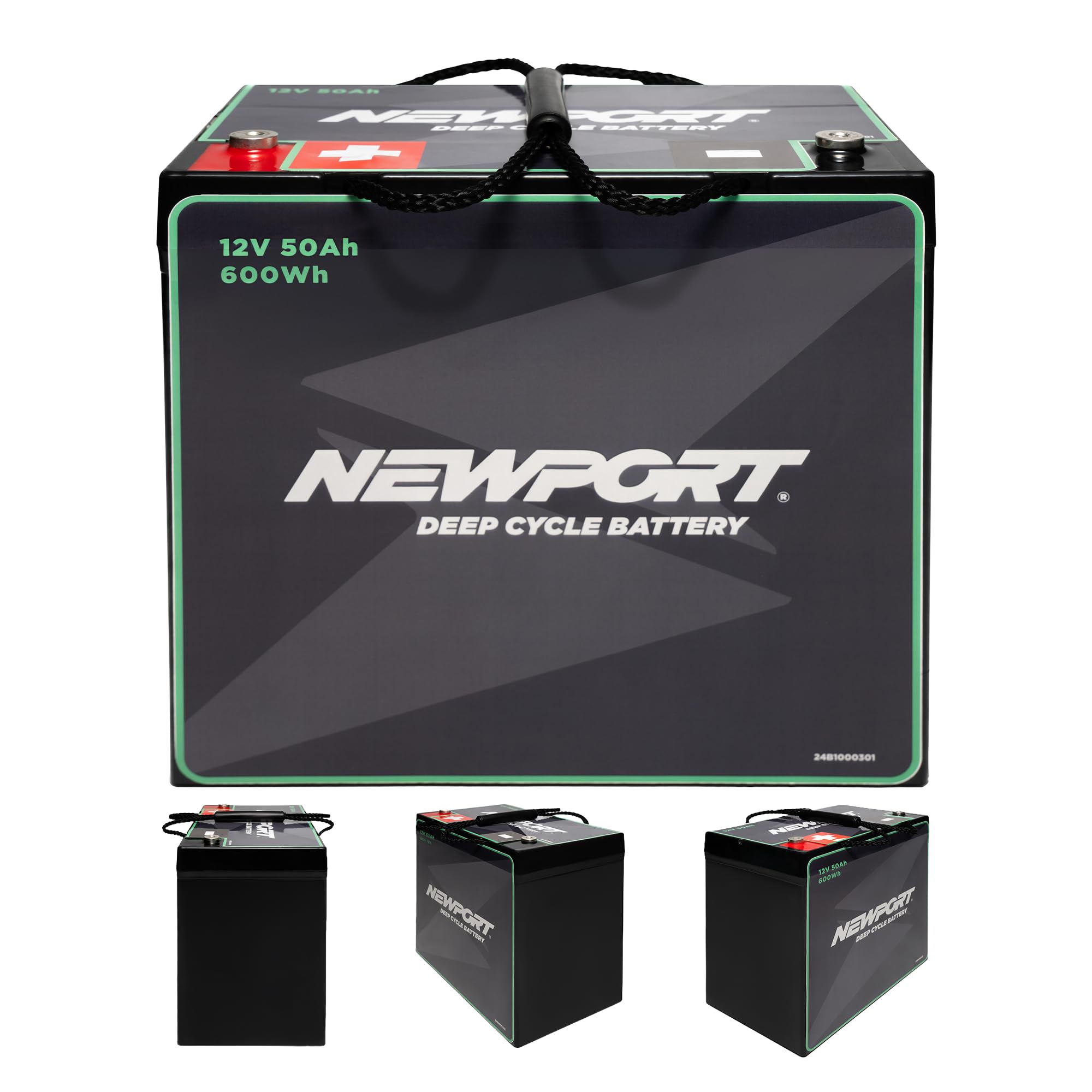
The Newport 12V50Ah AGM battery is a compact, budget-friendly option aimed at smaller watercraft like kayaks, jon boats, and lightweight bass boats with low-horsepower outboards. At 32 pounds, it’s heavier than a lithium unit of the same capacity, but the sealed AGM construction makes it spill-proof and vibration-resistant for bouncing through wakes. The marine terminal design accepts standard trolling motor clips and ring terminals without any adapters.
Owner reviews highlight surprising durability—one survived a 20 mph fall from a truck bed onto asphalt with only cosmetic damage and continued working perfectly. For a 25lb trolling motor on a kayak, users report roughly 7 hours of run time at full speed, which covers a solid day of fishing on smaller waters. The battery works reliably as a deep-cycle trolling motor power source and is compatible with standard lead-acid chargers.
This battery’s 50Ah capacity is less than half of the lithium options in this guide, so it won’t power a large 55lb thrust motor all day on a full-size bass boat. It also lacks a built-in charge indicator, meaning you’ll need a separate voltmeter or battery monitor to know your remaining capacity. For a small trolling motor or as a backup house battery for electronics, it’s a solid entry-level choice, but it cannot replace a dedicated high-CCA starting battery for a big outboard.
Why it’s great
- Extremely durable, survived truck-bed fall
- Sealed AGM, no maintenance required
- Good 7-hour run time on small trolling motors
Good to know
- Only 50Ah capacity, limited run time
- No built-in charge indicator
- Heavier than equivalent lithium options
FAQ
Can I use a lithium trolling motor battery to start my outboard?
What BCI group size fits most bass boat battery trays?
How many CCA do I need for a 150hp outboard?
Final Thoughts: The Verdict
For most users, the best cranking battery for bass boat is the Optima RedTop 34 because its SpiralCell construction delivers instant 800 CCA starts while surviving the bone-rattling vibration of a bass boat running wide open across a chop. If you want the dual-purpose flexibility of massive starting power plus hours of emergency reserve capacity, grab the Weize BCI Group 31M. And if you want to shed 40 pounds from your transom while keeping full cranking juice for your outboard and trolling motor combo, nothing beats the Litime 12V 100Ah Group 31.

Mo Maruf
I created WellFizz to bridge the gap between vague wellness advice and actionable solutions. My mission is simple: to decode the research and give you practical tools you can actually use.
Beyond the data, I am a passionate traveler. I believe that stepping away from the screen to explore new environments is essential for mental clarity and physical vitality.