Our readers keep the lights on and my smoothie glass nicely filled. As an Amazon Associate, I earn from qualifying purchases.
A loose connection in a critical wire—whether in your car, solar array, or home panel—doesn’t just mean a dead circuit; it means heat buildup, voltage drop, and a failure waiting to happen. The hand tool you choose dictates whether that terminal becomes a permanent, gas-tight bond or a weak point that pulls apart under vibration. The difference lives entirely in the jaw design, the ratchet mechanism, and the range of dies or self-adjusting guides it offers.
I’m Mohammad Maruf — the founder and writer behind WellFizz. I’ve spent countless hours dissecting the mechanical advantage, die geometry, and material tolerances of these tools to match the right crimper to the exact conductor size and terminal type.
From heavy-duty battery lugs to delicate ferrule terminations, the best crimping tool must deliver repeatable, corrosion-resistant connections without crushing the conductor strands inside the barrel.
How To Choose The Best Crimping Tool
Selecting the right crimper goes beyond matching the brand of your connectors. You need to match the jaw profile to the terminal barrel shape, the ratchet strength to the wire gauge, and the overall cycle life to your workload. A mismatch at any of these points leads to unreliable connections that fail under load or vibration.
Jaw Profile & Die Shape
Four-sided (square) crimps are common on budget-oriented tools, but they apply pressure unevenly, often leaving gaps at the corners. A hexagonal (six-sided) die wraps around the barrel more uniformly, creating a near-circular cross-section that maximizes contact between the conductor strands and the terminal wall. For battery lugs, the hex profile is the standard for low-resistance, high-strength connections. For insulated ferrules, a precision hex die prevents the insulation collar from cracking under uneven pressure.
Ratcheting vs. Non-Ratcheting Action
A ratcheting crimper locks the handles and prevents release until the full crimp cycle is complete. This guarantees the jaws reach the specified closure depth every time, eliminating the variation that comes from hand fatigue. Non-ratcheting tools are faster for light-gauge work or occasional use, but they rely entirely on the user’s squeeze force, which leads to inconsistent results. For terminal sizes from AWG 10 upward, a ratchet mechanism is the safer choice for repeatable, code-compliant connections.
AWG Capacity & Die Interchangeability
Check whether the tool offers fixed dies, a rotating turret head with multiple stations, or interchangeable die sets. Fixed dies limit the tool to a narrow AWG window. A rotating selector knob or a set of loose dies lets you cover a wider range—from delicate 24 AWG signal wires up to 1/0 AWG battery cables—without needing a second tool. If you work across automotive, solar, and industrial control panels, a tool with at least six die stations (covering AWG 10 through 1/0) is the practical minimum.
Quick Comparison
On smaller screens, swipe sideways to see the full table.
| Model | Category | Best For | Key Spec | Amazon |
|---|---|---|---|---|
| DXCRIMP GX25-6-20 | Self-Adjusting Hex Ferrule Kit | Panel wiring & 12V electrical | 760 ferrules (AWG 24-4) | Amazon |
| haisstronica HX1544 | Ferrule Crimper Kit | Professional electrician work | 2500 ferrules (AWG 22-7) | Amazon |
| Solsop Battery Cable Crimper | Rotating Head Battery Lug Set | Automotive & solar cable lugs | 6 dies (AWG 10 to 1/0) | Amazon |
| FGBNM 328ft Wire Rope Kit | Cable Rope Crimper Set | Decking & picture hanging cable | 1/16″ cable & aluminum sleeves | Amazon |
In‑Depth Reviews
1. DXCRIMP GX25-6-20 Self-Adjusting Hex Ferrule Crimper Kit
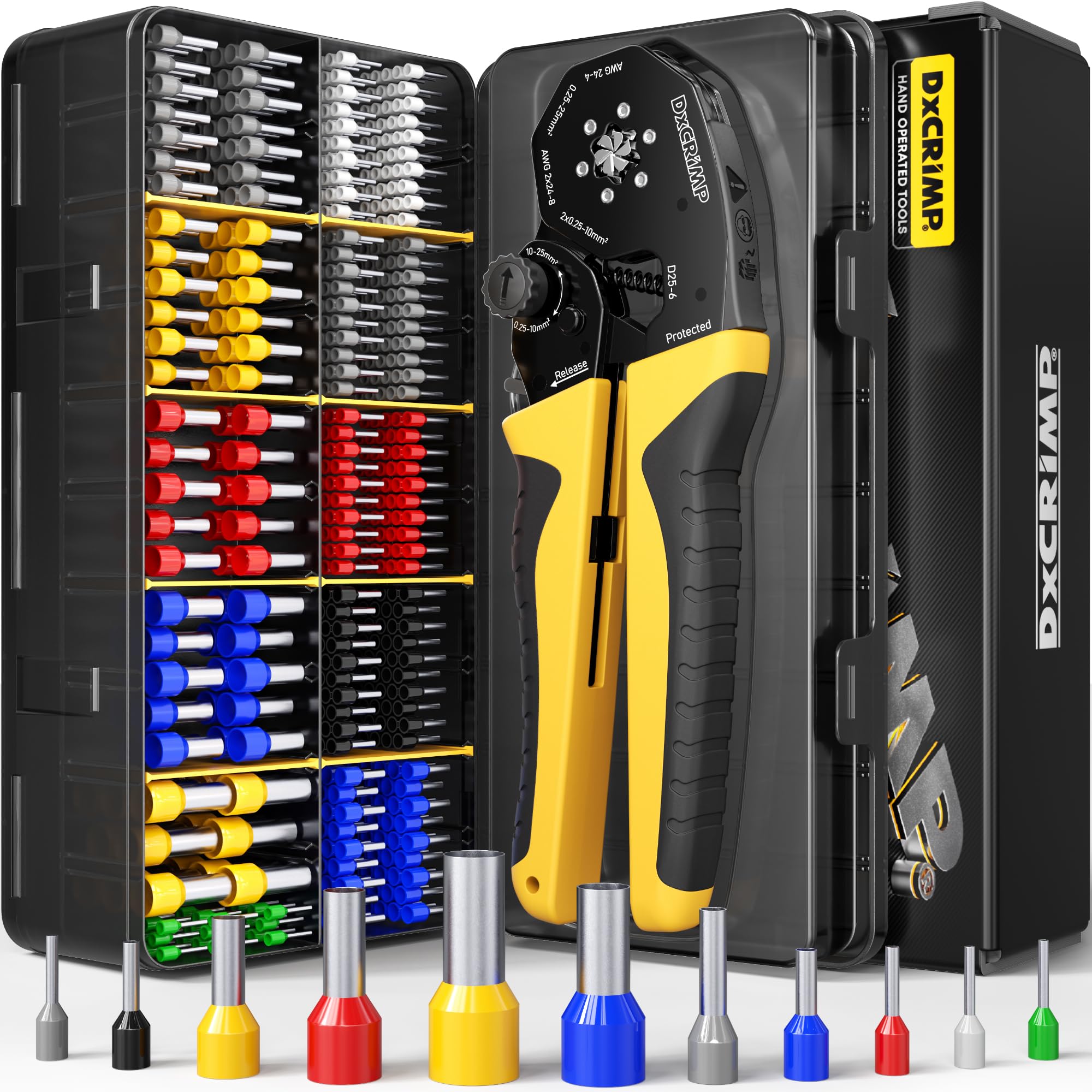
This kit earns the top spot because its self-adjusting jaw automatically adapts to the ferrule barrel diameter, eliminating guesswork and the need to swap dies for every change in wire gauge. The selector knob expands the range into two zones: AWG 24-8 for control panels and audio wiring, then AWG 8-4 for heavier power circuits in inverters and battery banks. The German color-coded ferrule system makes size identification instant, which saves real time on a crowded workbench.
The hexagonal crimp profile applies uniform pressure across all six sides, forming a tight near-circular bond that maximizes conductivity and resists pull-out under vibration. The ratchet mechanism ensures the handles don’t release until the full cycle completes, so every crimp reaches the same depth regardless of hand strength. The 760-piece included assortment covers eleven terminal types, enough for multiple projects before needing a refill.
In real-world use, the action is smooth and the ergonomic TPE handles reduce fatigue during repetitive crimps. The hard case keeps ferrules organized and protected, though it adds some bulk to the tool bag. For any technician working with terminal blocks, automotive connectors, or solar junction boxes, this is the most versatile crimper-to-ferrule ratio available at this level.
Why it’s great
- Self-adjusting jaw eliminates die swapping for most ferrule sizes
- Precision hex profile forms low-resistance, high-strength connections
- Generous 760-piece ferrule assortment in a well-organized case
Good to know
- Selector knob change between zones requires a manual twist—not fully automatic
- Case latches could be more robust for heavy site use
2. haisstronica HX1544 Ferrule Crimping Tool Kit

What sets this kit apart is the sheer volume of connectors—2500 pieces spanning AWG 22 to 7—which means it can serve as a standalone wiring station without immediate restocking. The crimper itself uses a ratchet adjustment structure, so the tool advances through the stroke only when sufficient force is applied, locking the jaw closed until the crimp is fully seated. This prevents the user from releasing partway and leaving an undersized connection.
The included wire stripper handles AWG 20-10 cable and doubles as a cutter, saving a separate trip into the toolbox. The ferrules are constructed from tinned copper with nylon insulation collars, which resist corrosion and provide visible color-coding aligned with standard wire gauge markings. The four-sided crimp profile is adequate for insulated terminals in control wiring and low-current applications, though it lacks the full wrap of a hex die for heavy power connections.
The molded case keeps the ferrules divided by size, which is helpful when you are making repeated terminations on a production line or running multiple home automation circuits. Some users note the case latches feel light, but the tool itself holds up well under professional use. For electricians who need a massive consumable supply paired with a ratcheting crimper, this bundle is hard to beat for the price.
Why it’s great
- Massive 2500-count ferrule assortment covers a wide AWG range
- Ratcheting mechanism ensures consistent crimp depth every cycle
- Includes a functional wire stripper for AWG 20-10
Good to know
- Four-sided crimp profile rather than hexagonal—sufficient for ferrules but not ideal for bare lugs
- Case latches can be finicky during transport
3. Solsop Battery Cable Crimper Tool Kit
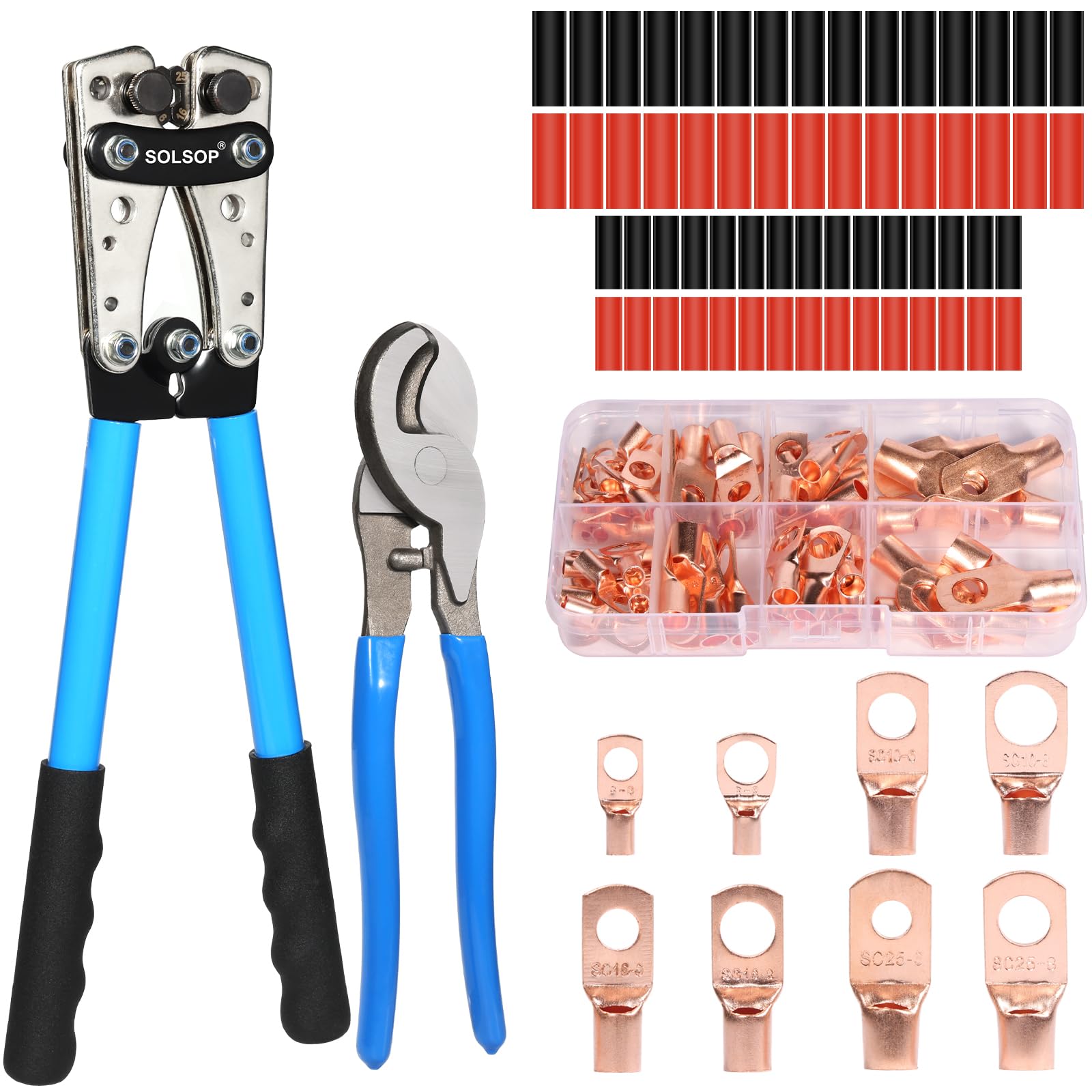
This tool is purpose-built for terminating heavy battery cables and solar lugs where circular crimp consistency directly affects current-carrying capacity. The rotating turret houses six hexagonal dies ranging from 6mm² up to 50mm² (covering AWG 10 through 1/0), and switching between them is a simple twist rather than fumbling with loose parts. The hexagonal crimp forms a nearly round barrel that grips the conductor strands tightly without creating stress risers at the corners.
The carbon steel frame and rubber-coated handles provide enough leverage to close the dies fully on 1/0 gauge lugs without excessive hand strain. The compound joint design multiplies applied force, so the tool feels solid but not punishing during repetitive use. The kit also includes a separate cable cutter and sixty copper ring terminals with matching heat shrink tubing, giving you a complete wiring station for battery banks, inverters, or marine electrical systems.
Some users report that the included lugs are shorter than premium industrial-grade terminals, which may require the insulation to be stripped to a tighter tolerance for full barrel insertion. For typical automotive and off-grid solar projects, however, the connections hold well and show low resistance after crimping. If your primary need is terminating AWG 6 to 1/0 battery cables with a single tool that doesn’t require die changes at a separate bench, this is the most efficient solution in the lineup.
Why it’s great
- Rotating turret head lets you switch between six dies in seconds
- Hexagonal crimp profile delivers low-resistance, high-strength lug connections
- Includes copper lugs, heat shrink, and a cable cutter for immediate use
Good to know
- Included lugs are shorter than premium industrial-long barrels
- Tool is sized for battery cables; not ideal for very small AWG 22-18 ferrules
4. FGBNM Wire Rope Crimping Tool Kit

This is a specialized kit for wire rope rather than insulated electrical wire—it crimps aluminum sleeves onto stainless steel cable for structural tension applications like railing, decking, and picture hanging. The tool body is constructed from heavy-duty steel with four fixed crimp positions (0.1mm up to 2.2mm) and an integrated wire cutter that slices through 1/16-inch cable cleanly. The self-locking mechanism keeps the jaws engaged during the squeeze, preventing the sleeve from slipping out mid-crimp.
The included 328 feet of 7×7 strand 304 stainless steel cable has a breaking strength of 368 pounds, which is sufficient for light to moderate tension loads such as shade sails, garden lamp lines, and dog leashes. The aluminum sleeves and stainless steel thimbles are sized specifically for 1/16-inch cable, so there is no guesswork about compatibility. The thimbles protect the eye of the loop from abrasion against hooks or brackets, which extends the service life of the assembly.
For electrical crimping tasks, this tool is not the right choice—the fixed dies are designed for malleable aluminum sleeves, not copper lugs or insulated terminals. Within its intended domain of cable rigging and light marine use, the kit delivers everything needed in one box. The commercial-grade finish holds up to outdoor exposure, and the compact profile makes it easy to carry up a ladder or into a crawlspace for installing suspension cables.
Why it’s great
- Complete kit with cable, sleeves, thimbles, and crimper—no extra purchases needed
- Self-locking mechanism ensures full compression without slipping
- 304 stainless steel cable resists corrosion in outdoor installations
Good to know
- Fixed dies are designed for aluminum sleeves only—not for electrical lugs or ferrules
- 1/16-inch cable is suitable for light tension but not load-bearing railing if local codes require larger diameters
FAQ
Can I use a wire rope crimper for electrical ferrules?
What is the practical difference between a four-sided and six-sided crimp for battery lugs?
How do I know which die size matches my wire gauge?
Does a self-adjusting crimper work for all ferrule sizes?
Final Thoughts: The Verdict
For most users, the best crimping tool winner is the DXCRIMP GX25-6-20 because its self-adjusting hexagonal jaw and 760-piece ferrule assortment cover the widest range of electrical terminations with the fewest compromises. If you need to terminate heavy battery lugs from AWG 10 to 1/0, grab the Solsop Battery Cable Crimper with its rotating turret head. And for cable rope rigging on decks, railings, or sunshades, nothing beats the all-in-one convenience of the FGBNM Wire Rope Kit.

Mo Maruf
I created WellFizz to bridge the gap between vague wellness advice and actionable solutions. My mission is simple: to decode the research and give you practical tools you can actually use.
Beyond the data, I am a passionate traveler. I believe that stepping away from the screen to explore new environments is essential for mental clarity and physical vitality.