Our readers keep the lights on and my smoothie glass nicely filled. As an Amazon Associate, I earn from qualifying purchases.
That moment when you get shot from behind because your motherboard’s audio chipset couldn’t separate the footsteps from the explosions is the moment you realize your setup is failing you. A dedicated DAC amp for gaming pulls individual sound layers apart, giving you the directional clarity to react before you see the threat. This is not about music fidelity — it is about turning auditory chaos into a usable battlefield map.
I’m Mohammad Maruf — the founder and writer behind WellFizz. I’ve spent countless hours dissecting DAC chipsets, amplifier topologies, and real-world gaming performance across dozens of units to separate marketing noise from genuine hardware advantages.
This guide examines nine of the best options currently available, from compact desktop units to premium workstation-grade stacks, helping you choose the right dac amp for gaming based on your headphone impedance, platform, and competitive priorities.
How To Choose The Best DAC Amp For Gaming
Choosing the right DAC amp for gaming goes beyond looking at wattage numbers. You need to match the device’s output power and impedance range to your specific headphones while considering platform compatibility and the audio processing features that actually improve competitive awareness.
Output Power and Headphone Impedance
High-impedance headphones (250 ohms and above) require significantly more voltage to reach adequate volume levels. A DAC amp rated for 1400mW into 32 ohms may only deliver 50mW into 300 ohms. Check the power rating at your headphone’s impedance, not the maximum number printed on the box. Sensitive in-ear monitors need low noise floors below 2.0 microvolts to avoid hissing.
DAC Chipset and Processing Features
Chips like the AK4493S, ES9039Q2M, or CS43131 determine the theoretical noise floor and distortion ceiling. For gaming, the more important factor is the device’s implementation — power supply filtering, clock jitter reduction, and output stage design matter more than the chip model number. Features like Scout Mode, SXFI BATTLE Mode, or 10-band PEQ provide tangible competitive audio cues that raw DAC performance alone cannot deliver.
Connectivity and Platform Support
USB-C with UAC2 support ensures compatibility with PC, Mac, and game consoles. Optical input is essential for older consoles that lack USB audio support. Check whether the unit supports simultaneous multi-platform input switching if you play across PC and console. Driver-free operation on Windows 11 and macOS saves setup headaches.
Quick Comparison
On smaller screens, swipe sideways to see the full table.
| Model | Category | Best For | Key Spec | Amazon |
|---|---|---|---|---|
| Fosi Audio ZH3 | Balanced Preamp | HiFi gaming & speaker systems | 2570mW@32Ω balanced | Amazon |
| TOPPING DX5 II | Desktop Flagship | High-impedance headphones & PEQ tuning | 7600mW balanced, dual ES9039Q2M | Amazon |
| iFi xDSD Gryphon | Portable Flagship | On-the-go gaming & audiophile listening | 1000mW balanced, LDAC Bluetooth | Amazon |
| Creative Sound Blaster GC7 | Gaming Soundcard | Competitive FPS with Scout Mode | AKM4377 DAC, 7.1 virtual surround | Amazon |
| FiiO K11 | Desktop Entry | Balanced output on a budget | 1400mW@32Ω, VA display | Amazon |
| SteelSeries GameDAC Gen 2 | Console Gaming | Xbox & PS5 multipoint switching | 96KHz/24-Bit, ESS Sabre Quad-DAC | Amazon |
| S.M.S.L DS100 | Compact DAC | Clean MQA decoding & desktop simplicity | CS43131 chip, 0.00017% THD+N | Amazon |
| Topping DX1 | USB-Powered | Entry-level IEMs & low-impedance headphones | 280mW@32Ω, AK4493S chip | Amazon |
| Osee GoStream Deck | Video Switcher | Live streaming production | 4x HDMI input, multi-platform streaming | Amazon |
In‑Depth Reviews
1. Fosi Audio ZH3

The Fosi Audio ZH3 is an all-in-one desktop solution that combines a DAC, headphone amplifier, and preamp with fully balanced circuitry. Powered by the AKM4493SEQ chip and XMOS XU316 processor, it decodes PCM up to 768kHz and DSD512, placing it firmly in high-resolution territory. The balanced 4.4mm output delivers 2570mW per channel into 32 ohms, enough to drive planar magnetic headphones and high-impedance dynamics without breaking a sweat.
For gamers, the ZH3 shines with its 3-level gain switch that accommodates everything from sensitive IEMs to 300-ohm headphones without introducing noise or distortion. The bass and treble EQ adjustments let you tune in-game audio signatures — boosting footstep frequencies or reducing explosive peaks — directly from the front panel. The 12V trigger input and XLR preamp outputs make this a genuine centerpiece for a desktop gaming and music system.
Build quality is outstanding with a full metal chassis and a crisp display that shows input, volume, and filter settings. The inclusion of six digital filter types and swappable op-amps provides customization depth that competing units at this tier simply do not offer. The external power supply is the only concession to its compact footprint, but the noise floor stays impressively low at 1.9 microvolts.
Why it’s great
- Fully balanced architecture with massive 2570mW power output
- AKM4493SEQ DAC delivers clean, detailed sound with low distortion
- Bass, treble, and filter EQ for game-specific tuning
Good to know
- External power supply adds desktop clutter
- RCA and XLR output levels differ significantly
2. TOPPING DX5 II
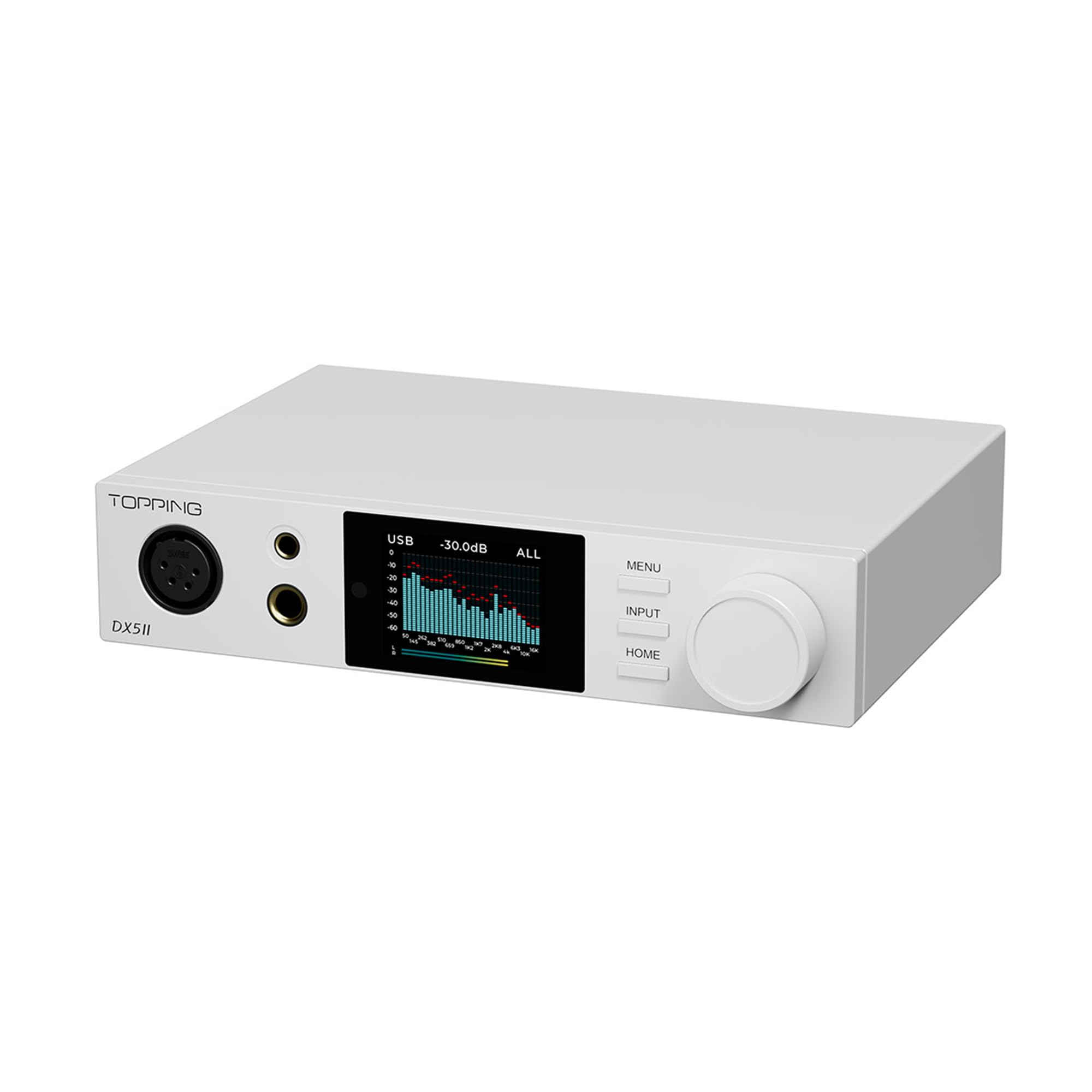
The TOPPING DX5 II is a desktop powerhouse that pairs dual ESS ES9039Q2M DAC chips with an X-Hybrid balanced amplifier circuit. The headline number is 7600mW per channel through the 4.4mm balanced output, which is enough to drive even the most power-hungry planar headphones like the Hifiman Susvara to meaningful levels. The XMOS XU316 interface handles PCM up to 768kHz and DSD512 natively.
What sets the DX5 II apart for gaming is its 10-band parametric EQ, which allows surgical adjustment of frequency response. You can boost the 2kHz to 4kHz region where footsteps and vocal cues live while cutting sub-bass rumble that masks environmental sounds. The Bluetooth 5.1 module with LDAC support also lets you connect wirelessly without sacrificing audio quality for casual listening sessions.
The 2.0-inch Aurora UI display is bright, responsive, and customizable with nine themes. The pressable knob provides tactile volume control with excellent channel matching — a common weakness in cheaper potentiometers. Note that the headphone jacks lack physical protection, and hot-swapping cables on a powered unit can cause damage, so always power down before changing headphones.
Why it’s great
- Massive 7600mW balanced output for very demanding headphones
- 10-band PEQ enables game-specific frequency tuning
- LDAC Bluetooth adds wireless flexibility
Good to know
- No headphone jack protection — avoid hot-swapping cables
- Firmware update required for language changes
3. iFi xDSD Gryphon

The iFi xDSD Gryphon is a portable balanced DAC and headphone amplifier that brings desktop-grade performance to a battery-powered form factor. The 16-core XMOS processor handles full MQA decoding and PCM up to 768kHz via USB. The PureWave balanced circuit with OptimaLoop feedback delivers 1000mW into 32 ohms, sufficient for most full-sized headphones including the Hifiman Arya on balanced output.
Gamers who switch between PC, console, and mobile will appreciate the Bluetooth 5.1 connectivity with LDAC, aptX Adaptive, and HWA codecs. The XBass and XSpace analog processing circuits let you enhance low-end impact and widen the soundstage without digital artifacts. These are particularly useful for single-player games where atmosphere and immersion matter more than raw competitive accuracy.
The military-grade aluminum chassis houses a SilentLine OLED display and intuitive controls. The iEmatch circuitry auto-adjusts gain for sensitive IEMs, eliminating background hiss. Battery life sits around eight hours, but desktop mode bypasses the battery for extended sessions. The endless-spinning volume knob takes some getting used to, but overall build and sound quality justify the premium positioning.
Why it’s great
- Truly portable with Bluetooth LDAC and balanced output
- XBass and XSpace analog processing for immersive single-player audio
- Drives sensitive IEMs to high-impedance headphones without noise
Good to know
- Premium price positions it above most dedicated gaming DACs
- Volume knob has no end stop — can be disorienting
4. Creative Sound Blaster GC7

The Sound Blaster GC7 is built around the AKM4377 audiophile DAC and combines Super X-Fi and Sound Blaster audio processing technologies. Unlike standard DACs that merely convert digital to analog, the GC7 applies real-time processing through Scout Mode and SXFI BATTLE Mode. Scout Mode amplifies faint audio cues and brings them closer, making footsteps from distant enemies audible, while BATTLE Mode uses head-tracking-calibrated holography to convey both direction and distance.
The physical controls are the GC7’s standout feature for competitive gamers. The GameVoice Mix knob lets you balance game audio and chat volume without tabbing out of your match. Four fully programmable buttons can store custom EQ profiles, Scout Mode toggles, or macro commands for streaming. The ergonomic angled design keeps all controls within reach during intense gameplay sessions.
Connectivity includes USB-C, optical input and output, and a headphone jack that comfortably drives 300-ohm headphones like the Sennheiser HD 6XX to satisfying levels. The software suite provides deep customization but requires three separate applications and account registration — a frustrating setup process that eventually delivers excellent results. The plastic chassis feels less premium than metal alternatives, but the feature density is unmatched at this tier.
Why it’s great
- Scout Mode and SXFI BATTLE Mode provide genuine competitive advantages
- GameVoice Mix knob for on-the-fly chat balance
- 4 programmable buttons for instant profile switching
Good to know
- Setup requires three apps and account creation
- Plastic build feels less premium than metal competitors
5. FiiO K11

The FiiO K11 brings balanced 4.4mm output to the budget-friendly desktop segment without sacrificing build quality. Rated at 1400mW into 32 ohms, it comfortably drives headphones up to 350 ohms, covering the vast majority of gaming headsets and audiophile cans on the market. The aluminum alloy chassis weighs in at just over two pounds and occupies minimal desk space while feeling solid and premium.
The high-definition VA display shows sampling rate, volume level, gain setting, and output mode at a glance — a feature typically reserved for more expensive units. Input options include USB-C, coaxial, and optical, giving you flexibility to connect to PC, console, or TV. The RCA line-out also allows you to connect powered speakers, turning the K11 into a compact desktop hub for both gaming and music.
Sound signature is clean and neutral with excellent stereo separation compared to motherboard audio. The digital filters let you fine-tune the transient response, with Filter 4 offering the most natural presentation for gaming. The volume knob action is smooth with no channel imbalance, and the lack of any software requirement means true plug-and-play operation across Windows, Mac, and Linux.
Why it’s great
- Balanced 4.4mm output rarely seen at this price point
- Clean VA display with real-time status information
- Versatile inputs plus RCA line-out for speakers
Good to know
- USB-C power cable orientation matters — check your cable type
- Some users find Filter 4 most natural for gaming
6. SteelSeries GameDAC Gen 2

The SteelSeries GameDAC Gen 2 is a console-first DAC amplifier that works seamlessly with Xbox, PS5, PC, and Nintendo Switch. It uses an ESS Sabre Quad-DAC array to deliver 96KHz/24-bit resolution with 78 percent purer signal than the previous generation. The result is a noticeably cleaner soundstage with improved instrument separation and reduced background noise.
Multi-system connectivity is the GameDAC’s strongest feature for gamers with multiple platforms. Plug in two sources simultaneously — for example, PC and Xbox — and switch between them with a single button press. The ClearCast AI noise cancellation works on the microphone side, filtering out keyboard clicks and ambient noise from your voice chat on PC. The 360-degree spatial audio is fully compatible with Tempest 3D Audio on PS5 and Microsoft Spatial Sound on Xbox.
The physical design is compact and functional with a single volume dial and OLED display for EQ profiles and audio settings. It works with any headset using a 3.5mm cable, not just SteelSeries products, though the Sonar software integration is deepest with Arctis Nova headsets. Some users report needing a 3.5mm extension cable for certain SteelSeries headsets to reach comfortably.
Why it’s great
- True multi-platform support with one-button switching
- ClearCast AI noise cancellation cleans up microphone audio
- ESS Sabre Quad-DAC delivers clean 96KHz/24-bit output
Good to know
- Designed primarily for Arctis Nova headsets
- Xbox version needed for Xbox compatibility
7. S.M.S.L DS100

The S.M.S.L DS100 packs the Cirrus Logic CS43131 DAC chip into a compact 3.5-inch aluminum enclosure, making it one of the smallest desktop DAC amps with both 6.35mm and 4.4mm outputs. The THD+N rating of 0.00017 percent (-115dB) is remarkably low for its size, meaning the DS100 adds virtually no coloration or distortion to your game audio. The third-generation XMOS XU316 controller handles PCM up to 32-bit/768kHz and DSD256.
For gaming, the dual headphone jacks let you keep one pair of high-impedance headphones on the 6.35mm output and a pair of IEMs on the 4.4mm balanced output without swapping cables. The 7Vrms output into 600-ohm loads gives you headroom for high-impedance dynamics, while the 61mW into 16 ohms works cleanly with low-impedance IEMs. The CK-03 clock processing keeps jitter low, preserving spatial accuracy in competitive shooters.
Setup is straightforward with USB, optical, and coaxial inputs. The four LED indicators show volume level and active input clearly. Note that Windows requires a driver download from the SMSL website before the DS100 functions properly — it is not fully plug-and-play on PC. Once configured, the unit is transparent, reliable, and completely silent between tracks.
Why it’s great
- Remarkably low 0.00017% THD+N for clean, uncolored audio
- Dual headphone jacks (6.35mm and 4.4mm) for flexible listening
- Ultra-compact footprint saves valuable desk space
Good to know
- Windows driver must be downloaded separately
- No analog input for mixing external sources
8. Topping DX1
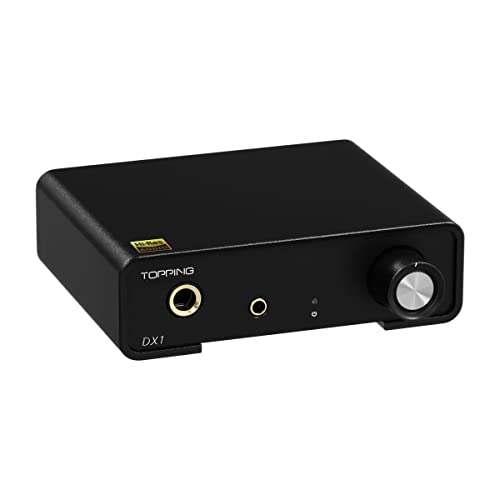
The Topping DX1 is a USB-powered DAC and headphone amplifier that serves as an ideal entry point for gamers upgrading from onboard audio or basic USB dongles. The AKM AK4493S sub-flagship DAC chip delivers 120dB dynamic range and decodes up to 32-bit/384kHz PCM. The discrete LNRD circuit filters USB power noise below 2.0 microvolts on the DAC side and 1.0 microvolts on the amp side, keeping sensitive IEMs hiss-free.
With 280mW per channel into 32 ohms and 51mW into 300 ohms, the DX1 comfortably drives low to medium-impedance headphones like the DT 990 Pro 80-ohm or HD 560S. Users report excellent results with the Drop PC38X gaming headset, with noticeably better clarity and bass control compared to standard motherboard outputs. The two-stage gain switch lets you toggle between low gain for IEMs and high gain for full-size headphones.
Plug-and-play compatibility extends across Windows 10/11, Mac, Linux, iOS, and Android without driver installation for most applications. The 6.35mm and 3.5mm outputs provide flexibility, though the 3.5mm line-out has fixed volume when used as a pure DAC. Some gaming applications like Fortnite may not recognize the DX1 at its native 32-bit depth without adjusting Windows sound settings — a minor hiccup with a simple fix.
Why it’s great
- USB-powered convenience with no wall wart needed
- AK4493S chip delivers excellent dynamic range for the price
- Ultra-low noise floor works perfectly with sensitive IEMs
Good to know
- Limited power output struggles with 250+ ohm headphones
- Some games need audio format adjustment to recognize device
9. Osee GoStream Deck

The Osee GoStream Deck is a live production video mixer that integrates audio control capabilities alongside its primary video switching function. It features four HDMI inputs, two HDMI outputs, two USB-C ports, and an Ethernet port for RTMP streaming to up to three platforms simultaneously. While not a traditional gaming DAC amp, it fills a specific niche for streamers who need unified audio and video management.
The audio section includes two analog inputs, a headphone output, and professional audio effects including EQ, limiter, and fader controls. The built-in SD card slot records program audio and video directly, while the media player can queue MP4 files for intros and intermissions. The upstream keyer supports green screen and chroma key for professional podcast-style production.
Operationally, the GoStream Deck replaces the need for a separate audio interface and capture card in many streaming setups. The PVW/PGM bus layout and T-Bar transition make live switching intuitive. Note that the unit only accepts 1080p input without 4K downscaling, and the plastic chassis runs hot during extended use. Setup involves a learning curve, but for the price, the feature density is exceptional.
Why it’s great
- Combines video switching, audio mixing, and streaming in one box
- Built-in recorder and media player for professional production
- Multi-platform RTMP streaming with simultaneous output
Good to know
- Limited to 1080p input with no 4K support
- Runs hot and has a learning curve for setup
FAQ
Will a DAC amp improve my gaming performance in competitive shooters?
Can a DAC amp designed for music work for gaming?
Do I need a balanced 4.4mm connection for gaming?
How do I connect a DAC amp to my gaming console?
What power output do I need for 300-ohm headphones?
Final Thoughts: The Verdict
For most users, the dac amp for gaming winner is the Fosi Audio ZH3 because it combines balanced 4.4mm output, AKM4493SEQ DAC performance, and versatile EQ tuning at a mid-range price that outperforms its competition. If you want the absolute best competitive audio processing with Scout Mode and SXFI, grab the Creative Sound Blaster GC7. And for a portable option that works across PC, console, and mobile without compromise, nothing beats the iFi xDSD Gryphon.

Mo Maruf
I created WellFizz to bridge the gap between vague wellness advice and actionable solutions. My mission is simple: to decode the research and give you practical tools you can actually use.
Beyond the data, I am a passionate traveler. I believe that stepping away from the screen to explore new environments is essential for mental clarity and physical vitality.