Our readers keep the lights on and my smoothie glass nicely filled. As an Amazon Associate, I earn from qualifying purchases.
Your car’s speakers are trying to do everything at once—blasting bass through a tweeter or forcing a sub to squeak out vocals is how distortion, muddiness, and outright speaker damage happen. A dedicated crossover car audio processor fixes this by splitting the signal so each driver handles only the frequencies it was built for, transforming a cluttered mess into a stage where every note lands clean.
I’m Mohammad Maruf — the founder and writer behind WellFizz. I’ve specced out dozens of multichannel DSPs, passive filters, and electronic line converters across this narrow price tier to find which units actually deliver measurable slope accuracy and noise-free signal routing for real installations.
Whether you need a DSP with 15-band graphic EQ, a passive 2-way filter for a component set, or a line converter that eliminates alternator whine, this guide breaks down each option so you know exactly what you’re buying with a crossover for car audio.
How To Choose The Best Crossover For Car Audio
Every car audio system has one job: sound reproduction. Without a proper crossover, woofers try to play frequencies they physically cannot, tweeters cook themselves on bass, and the whole result is fatiguing. The right unit is defined by slope steepness, signal integrity, and channel count that matches your speaker layout.
Active DSP vs Passive Crossovers
An active crossover sits between your head unit and amplifiers, processing low-level line signals before amplification. This lets you set exact high-pass and low-pass points, select filter types (Butterworth, Linkwitz-Riley, Bessel), and apply EQ per channel. A passive crossover mounts between your amplifier and speakers, using capacitors and inductors to filter already-amplified current. Active units offer infinitely more tuning control; passive units are simpler for plug-and-play component sets.
Slope Rate and Filter Topology
The slope is measured in dB per octave — a 12 dB/octave filter rolls off frequencies gradually, while a 48 dB/octave slope creates a sharp cutoff. Steeper slopes protect speakers better near crossover points but also introduce more phase shift. For subwoofer-to-midbass transitions, 24 dB/octave Linkwitz-Riley is the industry standard because it sums flat through the crossover region.
Input and Output Voltage Range
Factory head units often output only 2-4 volts of signal, which forces amplifiers to operate at higher gain levels — raising noise floor and hiss. A crossover with 8 to 9 volts of output capability acts as a line driver, letting you feed your amps a strong clean signal and turn their gain knobs way down. This single spec makes more difference in system clarity than the brand name on the unit.
Quick Comparison
On smaller screens, swipe sideways to see the full table.
| Model | Category | Best For | Key Spec | Amazon |
|---|---|---|---|---|
| Taramp’s Pro 2.4S | Active DSP | Full 4-channel tuning | 48 dB/oct slop BW/LR/Bessel | Amazon |
| PRV AUDIO DSP 2.4X | Active DSP | Real-time EQ & SEQUENCER | 15-band graphic + 12 presets | Amazon |
| Taramps Crx4 | Electronic 4-Way | 4-channel analog control | 8V RMS max RCA output | Amazon |
| PRV EX4.6 PRO | Electronic 4-Way | 4-in 6-out flexibility | 9V RMS / 12 dB Butterworth | Amazon |
| DS18 PRO-CFX 2-Way | Passive 2-Way | Component set filtering | 300W RMS / 2-pack | Amazon |
| Timpano TPT-360 | Electronic 3-Way | Front/rear/sub systems | 3-way point selection | Amazon |
| AudioControl LC1i | Line Converter | Factory integration + boost | 400W/40V speaker-level input | Amazon |
In‑Depth Reviews
1. Taramp’s Pro 2.4S DSP

The Taramp’s Pro 2.4S is a full digital signal processor that gives you both a 15-band graphic equalizer and a parametric EQ with adjustable bandwidth — plus a crossover section where you can pick Butterworth, Bessel, or Linkwitz-Riley filters in slopes from -6 all the way up to -48 dB per octave. That -48 dB/octave setting is rare at this level and lets you carve frequencies with surgical precision, which matters most when you’re blending a subwoofer against midbass drivers that need a sharp guardrail.
You also get 12 built-in preset EQ curves including a dedicated Competition preset — handy for quick A/B testing in the driver’s seat. The sequencer function can trigger other devices up the chain, making system expansion cleaner. The small chassis (7.8 x 4.45 inches) fits under seats or in glove boxes without forcing you to sacrifice trunk space.
The only real tradeoff is that the menu navigation takes a few sessions to memorize — the encoder-based interface isn’t as intuitive as a touchscreen app. But once the curves are dialed, the soundstage clarity and noise floor are noticeably better than any analog unit near this budget.
Why it’s great
- Up to -48 dB/oct slope with three filter topologies
- 12 programmable EQ presets plus parametric band
- Compact metal chassis for tight install spaces
Good to know
- Encoder menu takes time to learn without a software editor
- No Bluetooth or remote control for quick gain changes
2. PRV AUDIO DSP 2.4X

The PRV DSP 2.4X mirrors the 15-band graphic EQ and 12 preset approach of the Taramp’s, but adds an LCD screen (16×2 characters) that shows real-time adjustments as you scroll. This makes on-the-fly tuning faster because you can see the frequency band and gain level without counting encoder clicks. The unit accepts 2 audio inputs (A and B) and lets you assign each of the 4 output channels to A, B, or A+B independently — useful if you run different sources for SQ competitions versus daily listening.
Its parametric EQ includes a single band with adjustable center frequency, Q width, and gain, which works well for cutting a specific resonance peak in a vehicle’s cabin. The sequencer feature and remote trigger output let you daisy-chain additional PRV processors or power relays without an extra distribution block. Build quality feels solid for the weight — the metal enclosure protects the internal circuit against vibration.
Some users note the initial learning curve: the interface requires reading the manual to understand how to lock channels into stereo or summed modes. Once configured, the sound quality is excellent — several reviews describe it as “more precise than any crossover” they’d used at twice the price. Just budget an extra hour for setup.
Why it’s great
- LCD display for real-time EQ and crossover adjustments
- Independent A/B input assignment per output channel
- Strong value for DSP features at its price tier
Good to know
- No remote control included for driver-seat adjustment
- Parametric EQ is only single-band on input side
3. PRV Audio EX4.6 PRO

The PRV EX4.6 PRO is an analog electronic crossover that takes 2, 3, or 4 RCA inputs and sends them to 6 filtered outputs — giving you flexibility to run a full front-stage plus subwoofer without a DSP. Maximum output hits 9 volts RMS, which is high enough to drive any amplifier’s input section clean and keep the gain knobs low. The crossover slope is fixed at 12 dB per octave Butterworth, which is gentler than the 24 dB Linkwitz-Riley that purists prefer, but works well for systems where the speakers have natural roll-off overlap.
It includes a bass boost circuit adjustable from 0 to 12 dB centered at 45 Hz, plus individual quick on/off buttons per channel so you can mute a specific band during tuning. The mechanical knobs feel robust and provide tactile feedback — much easier to adjust while driving than a menu tree. Channel routing allows 2-way, 3-way, or 4-way configurations depending on how you bridge the inputs.
This unit excels in setups that don’t need digital time alignment or parametric EQ. It’s simply a clean, analog signal router. Some customers report receiving units that appeared lightly used, but performance out of the box has been consistently clean. You’ll want a decent head unit to get full fidelity from its capabilitie.
Why it’s great
- 9V RMS output reduces amplifier gain and noise floor
- 4-input to 6-output flexibility for complex builds
Good to know
- Only 12 dB/oct Butterworth slope, not adjustable
- No digital EQ or time alignment features
4. Taramps Crx4

The Taramps Crx4 is a 4-way electronic crossover that operates entirely in the analog domain — no digital menus, no presets, just RCA inputs and outputs with adjustable high-pass and low-pass filters per channel. Its maximum output of 8 volts RMS is excellent for driving aftermarket amplifiers with low input sensitivity, a feature that directly reduces the hiss and background noise typical in budget builds. Each channel’s crossover point can be dialed in with screwdriver-adjusted potentiometers, making it ideal for a “set once and forget” install.
The unit includes a bass boost function for subwoofer outputs, though it’s a fixed-center boost rather than a parametric curve. The chassis is compact enough to mount behind a radio or inside a center console, and the 560-gram weight won’t strain wiring looms. Build quality is what you’d expect from Taramps — functional metal casing, clean PCB layout, and no rattling parts.
Its biggest limitation is the lack of any display or remote control. If you want to tweak crossover points after installation, you’ll need to physically access the unit and turn a screwdriver. The sound quality, once dialed, is praised for being clear and noise-free, especially in systems where a DSP would be overkill.
Why it’s great
- 8V RMS output for clean amplifier signal
- Simple analog setup with low noise floor
Good to know
- No digital display or remote tuning capability
- Bass boost is fixed-center rather than parametric
5. DS18 PRO-CFX 2-Way Passive

The DS18 PRO-CFX is a 2-way passive crossover that uses actual resistors for tweeter attenuation (0, -3, or -6 dB) rather than cheap ceramic capacitors — and that single detail separates it from most budget passive units. Rated for 300 watts RMS per crossover, each unit can handle a full-range signal from a single amplifier channel and split it between a tweeter and a midrange (or midbass) driver. The screw-down terminal blocks are well labeled and accept up to 8-gauge wire, making installation clean without soldering.
The crossover network uses an air-core inductor and polypropylene capacitor combination that delivers a flat phase response through the crossover region — something you can hear as a lack of harshness around 2-4 kHz where most passive filters introduce smear. The physical size is substantial (6.3 x 3.5 inches), which reflects the quality of the wound components. You cannot mount these directly behind small tweeters; plan to install them near the amplifier or under the dash.
The primary downside is the size — they are physically large enough that installation location needs thought. Also, some buyers wish DS18 used slightly better capacitors in the signal path, though for the price, the audio quality is well ahead of generic inline filters. This pair is ideal if you have a high-power component set and want to keep a simple, all-analog signal path.
Why it’s great
- Selectable tweeter attenuation with real resistors
- Air-core inductor and polypropylene cap design
Good to know
- Large footprint complicates near-speaker mounting
- No mounting screws included in the package
6. Timpano TPT-360 Electronic 3-Way

The Timpano TPT-360 is a dedicated 3-way electronic crossover that separates front, rear, and subwoofer signals with independent high-pass and low-pass controls for each band. Unlike a DSP, this is purely analog — you adjust frequencies using potentiometers on the front panel, and the unit provides labeled bandwidth ranges for every output. It can also be configured as a 2-way system with front/rear fade capability if you don’t need the third band.
The chassis is one of the larger units in this comparison at 10.6 x 7.5 inches, requiring dedicated mounting space. Build quality feels sturdy, and the screw terminals are clearly marked. Most positive reviews highlight its effectiveness in DIY builds where a simple, no-menu crossover is preferred. The frequency selection range is broad enough to handle most 2-way or 3-way active configurations.
There is a consistent complaint about a low-level buzzing or noise on certain RCA jacks, with one reviewer warning it may be defective out of the box. This may be unit-specific, but if you purchase, test immediately upon arrival and be prepared to swap if you hear a floor noise. For those who get a clean unit, the TPT-360 is a functional and affordable way to separate a front-stage and sub system without digital complexity.
Why it’s great
- Full 3-way frequency distribution for complex builds
- Dual configuration as 2-way with fade option
Good to know
- Some units reported with RCA jack noise or buzzing
- Large chassis requires careful mounting space planning
7. AudioControl LC1i Line Driver
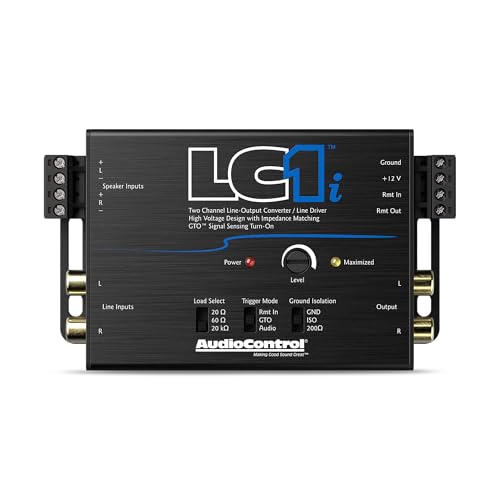
The AudioControl LC1i is not a traditional crossover, but it is the most important supporting component for anyone adding a subwoofer to a factory stereo. It converts speaker-level signals (up to 400 watts / 40 volts per channel) into clean low-level RCA outputs, and its built-in line driver boosts output to a level that can match aftermarket amp sensitivity. It includes a ground isolation switch that eliminates alternator whine — a common nightmare when integrating aftermarket gear with OEM head units.
Onboard load selection switches let you choose between 20 ohms, 60 ohms, or 20k ohms to trick late-model factory amplifiers into staying active and passing audio. The GTO (Great Turn-On) signal sense feature automatically wakes the unit when it detects audio, so you don’t need to run a remote turn-on wire. Dimensions are tiny (4.8 x 3 x 1 inches), allowing it to tuck behind the radio or under the dash easily.
One caveat: the LC1i does not provide actual crossover filtering on its own — it’s a line driver and converter, not a high-pass or low-pass unit. You will still need a crossover in your amplifier or a separate processor. Owners overwhelmingly report cleaner bass and much higher signal voltage compared to passive LOC units, especially with low-output radios.
Why it’s great
- Ground isolation switch kills alternator noise for good
- Boosts weak factory signals to amp-friendly levels
Good to know
- No built-in crossover filters — requires amp or separate unit
- Optional ACR-1 remote knob sold separately
FAQ
Should I buy an active DSP or a passive crossover for my first car audio build?
What does dB per octave mean and which slope should I use?
Can I use a line converter like the AudioControl LC1i as my only crossover?
Final Thoughts: The Verdict
For most users, the crossover for car audio winner is the PRV AUDIO DSP 2.4X because it combines a 15-band graphic EQ, parametric input EQ, 12 presets, and a clear LCD interface at a price that undercuts most DSPs with similar features. If you need a high-output analog solution without digital tuning, the Taramps Crx4 delivers 8-volt clean output in a compact chassis. And for integrating a subwoofer into a factory system, nothing beats the AudioControl LC1i for killing ground noise and boosting weak signals before they hit your amp.

Mo Maruf
I created WellFizz to bridge the gap between vague wellness advice and actionable solutions. My mission is simple: to decode the research and give you practical tools you can actually use.
Beyond the data, I am a passionate traveler. I believe that stepping away from the screen to explore new environments is essential for mental clarity and physical vitality.