Our readers keep the lights on and my smoothie glass nicely filled. As an Amazon Associate, I earn from qualifying purchases.
That tight, painful feeling after washing your hands or the sandpaper texture of your heels when you slip into bed — it’s a cycle of moisture loss that typical lotions never break. You need a specific concentration of actives like urea, ceramides, or dimethicone to repair the moisture barrier, not just coat the skin.
I’m Mohammad Maruf — the founder and writer behind WellFizz. I’ve spent hundreds of hours analyzing ingredient decks, cross-referencing dermatologist research, and filtering through thousands of verified buyer reports to separate the creams that actually rebuild compromised skin from those that just sit on the surface.
This guide breaks down the five formulas that earn their place in your routine by fixing the root cause — not just masking symptoms. Whether you are researching the best cream for hands and feet, this deep-dive covers the composition and clinical rationale behind every pick.
How To Choose The Best Cream For Hands And Feet
Hands and feet share a common enemy — a thin or absent lipid barrier that accelerates transepidermal water loss. But the approach differs: feet have thicker stratum corneum that needs keratolytic action, while hands need barrier repair without irritation. Selecting the right cream means matching the active ingredient level to the skin thickness of the target area.
Urea Concentration — The Deciding Factor
Urea is a humectant and mild exfoliant. Below 10% it hydrates without disrupting the skin surface. Levels between 20% and 40% soften callus and physically break down the protein bonds holding dead skin cells together. For cracked heels, you need the higher bracket. For dry hands, the lower bracket works better to avoid overexfoliation and stinging.
Occlusive vs Humectant Base
Humectants (urea, glycerin, hyaluronic acid) pull water into the outer skin layer. Occlusives (petrolatum, dimethicone, lanolin) seal that water in. An effective formula for hands and feet uses both — a humectant to restore moisture content and an occlusive to prevent re-evaporation within minutes. The wrong ratio leaves skin either dehydrated or greasy.
Targeted Delivery — pH and Absorption Speed
The ideal pH range for a hand and foot cream is between 4.5 and 6.0 to match the skin’s acid mantle. Absorption speed matters for compliance — thick waxy pastes work overnight but discourage daytime use. A fast-absorbing non-greasy finish improves consistency of application, which directly impacts long-term repair.
Quick Comparison
On smaller screens, swipe sideways to see the full table.
| Model | Category | Best For | Key Spec | Amazon |
|---|---|---|---|---|
| O’Keeffe’s Healthy Feet 6.4 oz | Foot Cream | Severe cracked heels | Dimethicone 4.5% barrier | Amazon |
| Eucerin Advanced Repair 16.9 oz | Body Lotion | Daily full-body + hands | 5% Urea + Ceramide-3 | Amazon |
| O’Keeffe’s Hand & Foot Duo | Combo Pack | Dual-use travel set | Two separate formulas | Amazon |
| Aquaphor Healing 14 oz | Ointment | Extreme crack repair | 41% Petrolatum base | Amazon |
| VREKEF Urea 40% 5.29 oz | Exfoliating Cream | Callus softening | 40% Urea + 2% SA | Amazon |
In‑Depth Reviews
1. O’Keeffe’s Healthy Feet Foot Cream 6.4 oz

O’Keeffe’s Healthy Feet hits the sweet spot between potency and practicality. The cream uses a high-concentration dimethicone (4.5%) base to form a semi-occlusive film that locks moisture into cracked heel fissures without suffocating the skin. Multiple verified reviews report visible softening of deep cracks within 48 to 72 hours of nightly application, with full heel smoothness achieved after one week of consistent use.
The formulation is fragrance-free and clinically tested for diabetic foot safety — an important distinction given that many heavy creams risk maceration on compromised skin. The 6.4-ounce jar provides roughly 80 to 100 applications at a pea-sized dose per foot, making it a mid-range option that outlasts smaller tubes from competing brands.
A key design element is the thick, solid texture that melts slightly at body temperature. This prevents the cream from running into sock fibers or pooling between toes. The trade-off is a brief cooling sensation upon application that some users find slightly tacky for the first minute before full absorption.
Why it’s great
- Clinically proven barrier repair for extremely cracked feet within one week
- Fragrance-free and non-greasy, safe for diabetes under medical guidance
- Concentrated formula means a small amount goes a long way
Good to know
- Initial tackiness lasts about a minute before absorbing fully
- Designed primarily for feet — less effective on callused palms
2. Eucerin Advanced Repair Lotion 16.9 oz
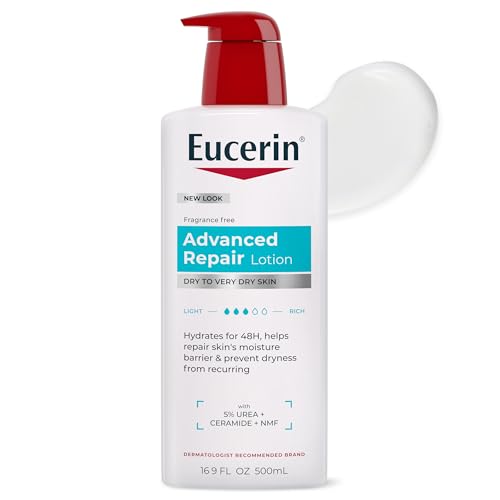
Eucerin Advanced Repair bridges the gap between a body lotion and a dedicated hand cream through its 5% urea and ceramide-3 combination. Urea at this level acts as a humectant without exfoliating, making it safe for daily use on hands where the barrier is already thin. Customers with chronic dryness reported that the flakiness on their knuckles and the rough skin around cuticles resolved within three days of twice-daily application.
The Triple Moisturizing Complex — urea, ceramide, and natural moisturizing factors (NMFs) — targets the lipid matrix between skin cells rather than just coating the surface. This explains the 48-hour hydration claim: the ceramide component rebuilds the barrier while the NMFs hold water in the stratum corneum. The lightweight pump format also makes it viable for daytime use without leaving an oily residue on keyboards or steering wheels.
At 16.9 ounces, this is the highest volume entry in the lineup. The medium-weight consistency absorbs within 30 seconds, which reduces friction for frequent hand washers. However, users on humid climates noted that the formula feels slightly tacky during the first minute in high humidity conditions, and some with breakout-prone facial skin reported that it was too heavy for their face.
Why it’s great
- Ceramide-3 actively repairs the moisture barrier, not just hydrates
- Large pump bottle delivers excellent volume for full-body + hand use
- Fast-absorbing non-greasy texture suits daytime application
Good to know
- 5% urea is too mild for advanced callus or heel cracking
- Pump may clog on the final 10% of product
3. O’Keeffe’s Working Hands & Healthy Feet Combo Pack

The O’Keeffe’s duo pack solves the dilemma of using a foot cream on hands and vice versa. Working Hands uses a dimethicone concentration optimized for thinner hand skin — it forms a moisture-locking film that survives repeated hand washing without leaving a waxy layer. Customers who wash hands more than twenty times daily reported that a single application after each wash maintained flexibility in their knuckles and prevented cracking between fingers.
Healthy Feet uses a thicker dimethicone base with a higher water-resistant profile designed for the thicker stratum corneum of the heel and ball of the foot. The two jars are physically different in texture: the hand cream is a soft semi-solid that disappears into skin within 15 seconds, while the foot cream remains slightly tacky for two minutes to allow deeper penetration into callused areas. Both are unscented and hypoallergenic.
The total combined weight of 6.6 ounces (3.4 + 3.2) delivers roughly 120 applications total. The separate formulas ensure each area gets the exact occlusivity it needs. The main drawback is the jar format — dipping fingers into both containers repeatedly can introduce bacteria over time, and the cream can harden slightly if the jar is not sealed tightly after use.
Why it’s great
- Two distinct formulations tailored to hand vs foot skin thickness
- Survives frequent hand washing without washing off completely
- Hypoallergenic and safe for sensitive skin with no added fragrance
Good to know
- Jar format is less hygienic than a pump over multiple months of use
- Foot cream requires two minutes for full absorption before putting on socks
4. VREKEF Urea Cream 40% with Salicylic Acid 2%
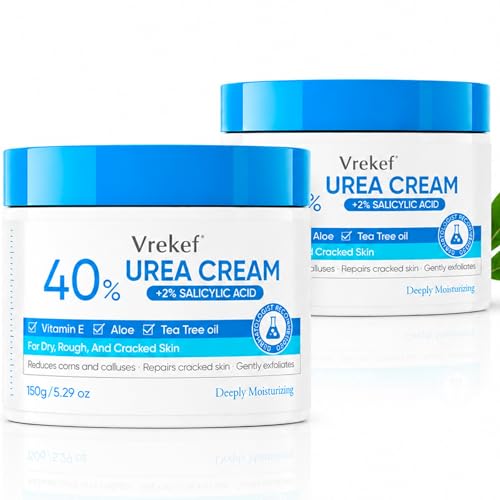
VREKEF’s Urea 40% cream brings prescription-level keratolytic power to over-the-counter foot care. At 40% urea, the formula physically dissolves the protein bonds in dead skin cells, sloughing off the thick callus layers that lower-concentration creams cannot penetrate. The addition of 2% salicylic acid accelerates desquamation and reduces inflammation in cracked fissures, creating a dual-action exfoliating system.
Verified buyers with chronic heel cracking — those whose skin splits to the point of bleeding — reported that daily application for 7 to 10 days completely eliminated the cracks and revealed new smooth skin underneath. The non-greasy texture is surprising for such a high urea content; the cream absorbs within 60 seconds and leaves no sticky residue, which makes it viable for daytime wear under socks or shoes.
The 5.29-ounce two-pack provides 10.58 ounces total, making this the highest concentration option at a moderate volume per jar. However, the high urea percentage causes a mild stinging sensation on open cracks during the first two applications, and some users with eczema reported irritation on areas where the skin barrier was already broken. The included glycerin and avocado oil partially offset this, but patch testing is essential before full application.
Why it’s great
- 40% urea plus 2% salicylic acid provides medical-grade callus softening
- Fast absorption with no sticky residue despite high active concentration
- Two jars in the pack offer significant volume for long-term treatment
Good to know
- Stings on broken skin and open heel cracks during initial applications
- Too potent for hands — best reserved for feet and elbows only
5. Aquaphor Healing Ointment 14 oz Value Jar
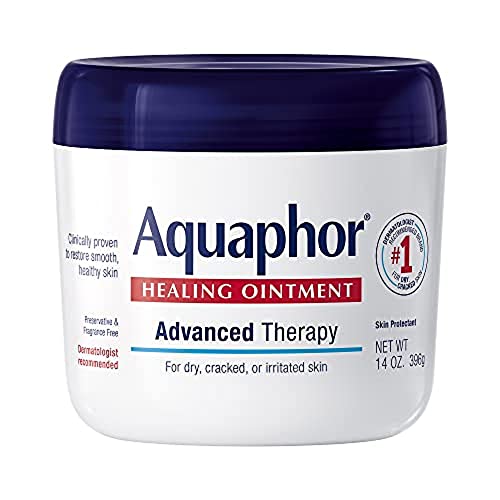
Aquaphor is not a cream but an ointment — and that distinction is critical for extreme repair. With 41% petrolatum as the primary ingredient, it creates a semi-permeable barrier that traps moisture against the skin while allowing oxygen exchange. This makes it effective for deep heel cracks that weep or for hands so dry that the skin splits at the knuckles. Dermatologists frequently prescribe it for post-procedure aftercare precisely because the barrier function reduces infection risk while accelerating re-epithelialization.
Verified reviews from cosmetologists and frequent hand washers highlight how a single overnight application under cotton gloves or socks transformed sandpaper-like soles and cracked cuticles by morning. The presence of bisabolol (chamomile extract) plus panthenol provides mild anti-inflammatory support that reduces redness around cracks. Unlike petroleum jelly, Aquaphor includes mineral oil and lanolin alcohol to improve spreadability, so the texture is softer and easier to apply than Vaseline.
The 14-ounce jar is the largest in this guide and maintains its value over months of use. The main functional trade-off is exclusivity: Aquaphor remains greasy on the skin for 10 to 15 minutes after application, making it impractical for daytime use unless used in minimal amounts. The occlusive nature also means it does not add hydration — it locks in whatever moisture is already present, so it must be applied to damp skin for optimal results.
Why it’s great
- Clinically proven semi-permeable barrier for severe cracked skin and minor wounds
- Contains soothing bisabolol and panthenol for anti-inflammatory action
- Massive 14-ounce jar provides extreme value for long-term nightly use
Good to know
- Greasy texture requires 10 to 15 minutes to absorb, best for overnight routines
- Does not add moisture — must be applied to damp skin for best effect
FAQ
Is a higher urea percentage always better for cracked feet?
Can I use a foot cream on my hands every day?
What is the best time to apply cream for maximum absorption?
Final Thoughts: The Verdict
For most users, the cream for hands and feet winner is the O’Keeffe’s Healthy Feet 6.4 oz because it delivers measurable heel crack repair within a week without the sting of high-urea formulas. If you want a single product for both hands and face plus body, grab the Eucerin Advanced Repair 16.9 oz. And for extreme cracked skin that needs an overnight barrier shield, nothing beats the Aquaphor Healing Ointment 14 oz.

Mo Maruf
I created WellFizz to bridge the gap between vague wellness advice and actionable solutions. My mission is simple: to decode the research and give you practical tools you can actually use.
Beyond the data, I am a passionate traveler. I believe that stepping away from the screen to explore new environments is essential for mental clarity and physical vitality.