Our readers keep the lights on and my smoothie glass nicely filled. As an Amazon Associate, I earn from qualifying purchases.
Spray foam insulation cuts energy loss by sealing every crack and crevice standard batts leave open, but the wrong kit can leave you with sticky mess, poor expansion, or a false sense of security. The difference between a drafty attic and a temperature-stable home often comes down to which closed-cell formula you choose and how smoothly your application gun delivers it.
I’m Mohammad Maruf — the founder and writer behind WellFizz. I’ve spent countless hours analyzing polyurethane foam formulations, R-value claims, fire ratings, and real-world application feedback to separate the consumer-grade cans from the true contractor-level kits.
After combing through hundreds of verified buyer reports and technical spec sheets, I’ve narrowed the market down to the seven strongest performers for the best diy spray foam insulation you can buy without hiring a crew.
How To Choose The Best DIY Spray Foam Insulation
Jumping into a spray foam project without understanding the three key variables — cell structure, fire rating, and coverage math — almost always leads to wasted material or inadequate sealing. The following criteria will help you match the foam type to your specific wall, attic, or rim-joist application.
Closed-Cell vs. Open-Cell Density
Closed-cell foam, typically around 2 lb. per cubic foot density, delivers a higher R-value per inch (R-6 to R-7) and acts as a vapor barrier. Open-cell foam is lighter, cheaper, and expands more aggressively, but it requires greater thickness to match the same thermal resistance and does not block moisture. For rim joists, basements, and exterior walls where moisture intrusion is a risk, closed-cell is the safer long-term choice.
Fire Rating and Code Compliance
Class A fire-rated foams (ASTM E84, flame spread under 25) are required by most building codes when the foam is left exposed on the interior side of a wall or attic. Kits without this certification may still be legal when covered by drywall or an approved thermal barrier, but paying for the Class A rating upfront saves the cost of an additional fire-blocking layer.
Board-Foot Coverage and Can Yield
A single 27 oz can of closed-cell foam typically yields 20 board feet at 1-inch thickness. That means a 12-pack covers roughly 240 board feet — or 240 square feet at one inch deep. Many customers report getting 50-70% of the advertised yield when spraying overhead or into deep wall cavities because of overspray and the foam’s natural off-gassing loss. Buying a kit with a quality gun and proper nozzles reduces this waste significantly.
Quick Comparison
On smaller screens, swipe sideways to see the full table.
| Model | Category | Best For | Key Spec | Amazon |
|---|---|---|---|---|
| Vega Bond V200 | Two-Component | Large wall & roof projects | R-7 per inch, 200 BF coverage | Amazon |
| Froth Pak 630 | Two-Component | Whole-room insulation | 630 BF, cures in 30 sec | Amazon |
| STANLEY F 990P Supercoat | Single-Component | Included PPE & easy start | R-5.66 per inch, 240 BF | Amazon |
| BEEST FullStop 12pk | Single-Component | Walls & attics | R-8.24 at 2″, 240 BF | Amazon |
| Sprayman Spraycoat | Single-Component | Fire-rated budget kit | R-5.66 per inch, 240 BF | Amazon |
| Vega Bond Purplecoat | Single-Component | Versatile multi-surface seal | R-5.66 per inch, 240 BF | Amazon |
| BEEST FullStop 24pk | Single-Component | Large-area coverage | R-8.24 at 2″, 480 BF | Amazon |
In‑Depth Reviews
1. Vega Bond V200 Closed Cell Spray Foam Insulation Kit

The Vega Bond V200 is a true two-component closed-cell system that skips the single-can compromise altogether. With a 2 lb. density and a measured R-7 per inch, it outperforms every single-component kit in this lineup for pure thermal resistance. The low-GWP formulation ships to all 48 contiguous states without hazmat surcharges, and the quick cure — foam sets in 20 to 30 minutes — means you can move on to the next bay without waiting overnight.
Coverage is rated at 200 board feet at one-inch thickness, and the included 9.5-foot gun hose, fan nozzles, and cone tips give you the reach to handle wall cavities and rim joists without repositioning the tanks constantly. Users report that warming the canisters to 75–85°F before spraying dramatically improves the creamy consistency and reduces waste from sputtering.
The kit includes a Tyvek suit, gloves, and safety glasses, though you will need to supply your own respirator rated for organic vapors. A small number of early buyers experienced gun leaks, but customer service was responsive with free replacements. For anyone insulating a basement, crawl space, or new-construction wall system, the V200 delivers contractor-grade results without the contractor.
Why it’s great
- True R-7 per inch in a 2 lb. closed-cell formulation
- Low-GWP formula ships to all U.S. states without restrictions
- Fast 20-30 minute cure time speeds up multi-bay projects
- Includes fan and cone nozzles plus basic PPE
Good to know
- Requires surface temperature and canister warm-up for best flow
- Some early reports of gun-leak issues resolved by support
- Respirator not included; must supply your own organic vapor mask
2. Froth Pak 630 Spray Foam Insulation Kit
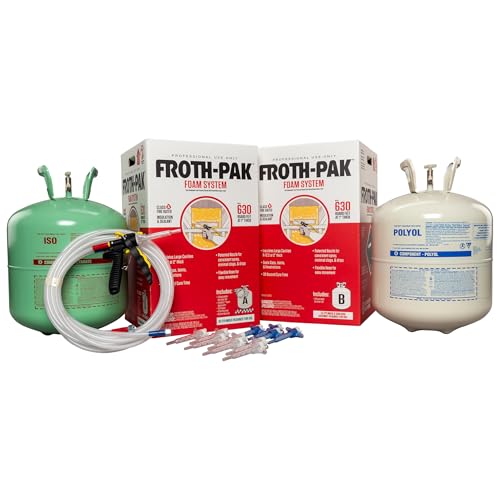
The Froth Pak 630 is the heavy lifter of this list, yielding up to 630 board feet from a single two-tank system. The closed-cell formulation delivers an R-value of 6.2 at one inch and jumps to R-12.2 at two inches, making it the clear choice for large attic floors or full-room insulation where you want to avoid the waste of multiple single-component kits. The foam cures in roughly 30 seconds, and with proper ventilation, occupants can re-enter the space within an hour.
This kit is Class A fire-rated up to two inches thick, meaning the foam can remain exposed in many code situations without an additional thermal barrier. The 15-foot hose and Insta-Flo gun give you significant freedom of movement, and the 12 included nozzles (eight cone, four fan) let you switch patterns quickly between wide cavities and narrow cracks. Users do note a learning curve — the first minute of spray often looks uneven until you find the right trigger rhythm and distance from the surface.
PPE is not included, so you will need a Tyvek suit, nitrile gloves, and a full-face respirator with organic vapor cartridges. The tanks are heavy and require a signature on delivery, so plan for a shipping appointment. For anyone tackling a whole-room or rim-joist perimeter that demands speed and consistent density, the Froth Pak 630 is the most efficient path to a sealed envelope.
Why it’s great
- 630 board-foot yield covers large areas in one kit
- R-12.2 at two inches with Class A fire rating
- Fast 30-second cure and one-hour re-entry time
- 15-foot hose provides wide range without moving tanks
Good to know
- PPE not included; requires full respirator and suit
- Heavy tanks require signature on delivery
- Notable learning curve for first-time two-component users
3. STANLEY F 990P Supercoat Spray Foam Insulation Kit
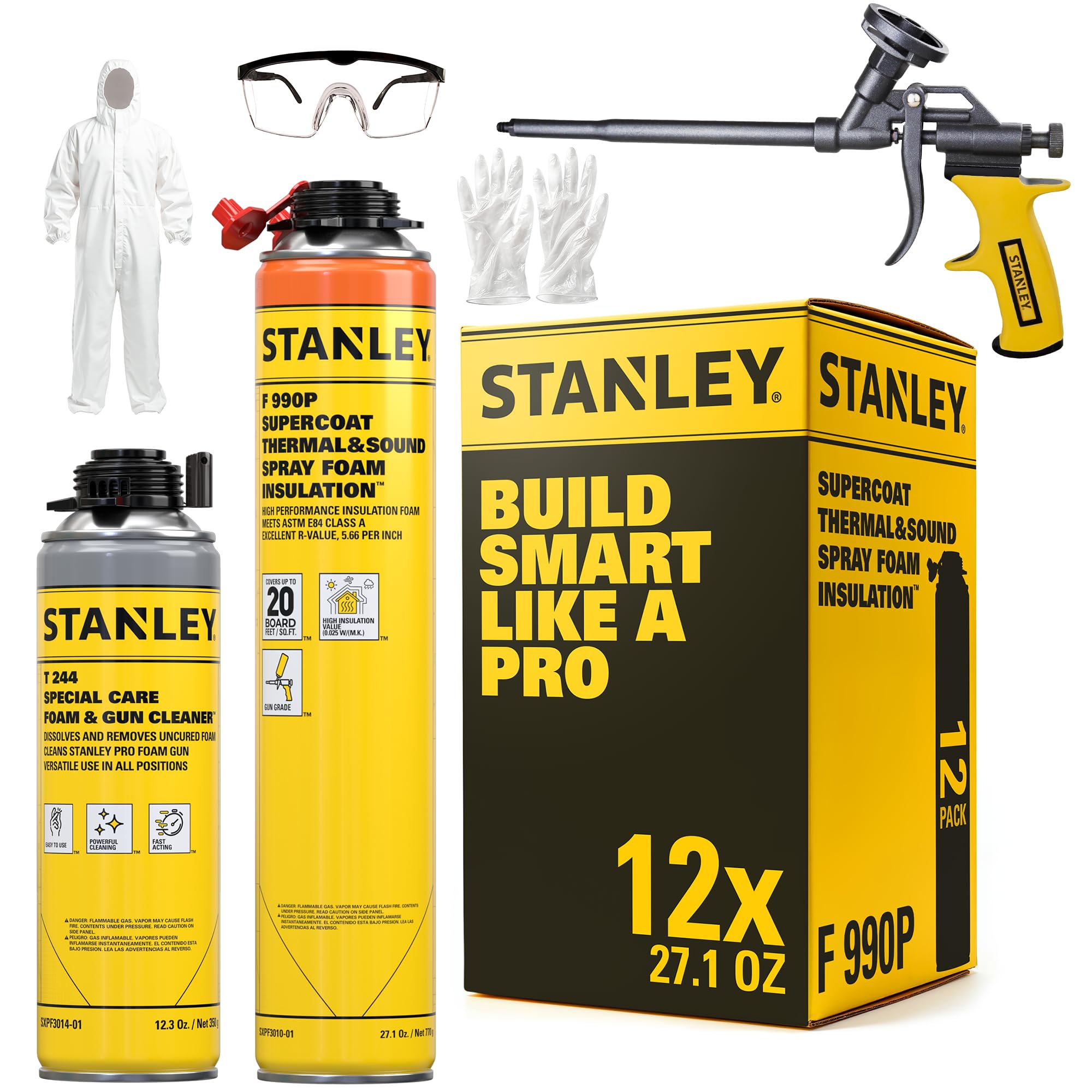
The STANLEY Supercoat kit wraps twelve 27.1 oz cans of closed-cell foam with a gun, foam cleaner, gloves, glasses, and a disposable suit — everything you need for a first-time installation in one box. The foam is Class A fire-rated per ASTM E84, and its R-5.66 per inch provides adequate thermal resistance for standard 2×4 walls. The included gun features a 45-degree elbow connector that makes overhead attic spraying noticeably easier than straight-nozzle alternatives.
Coverage is rated at 240 board feet at one-inch thickness, though several users observed that the second half of each can loses pressure and sprays a lighter pattern. This is common across single-component aerosol cans, but the STANLEY gun’s design minimizes sputtering better than most. The cleaner can included in the kit is a genuine time-saver — a quick flush after each can prevents the cured foam from ruining the gun mid-project.
Where the Supercoat really earns its spot is the convenience factor for someone insulating a storage building, shed, or a few wall bays. You do not need to source extra gloves or tape; everything arrives in the box. The foam trims easily with a handsaw, though you must avoid overfilling cavities because the cured foam is dense enough to bow drywall if you pile it on too thick.
Why it’s great
- Complete kit with gun, cleaner, and full PPE included
- Class A fire-rated closed-cell foam
- 45-degree elbow gun improves overhead application
- Easy to trim and paint after curing
Good to know
- Loses spray pressure in the second half of each can
- Overfilling cavities can cause drywall to bow
- Some users report cleaner can loses pressure before empty
4. BEEST FullStop Fire-Rated Spray Foam Insulation (12 Pack)
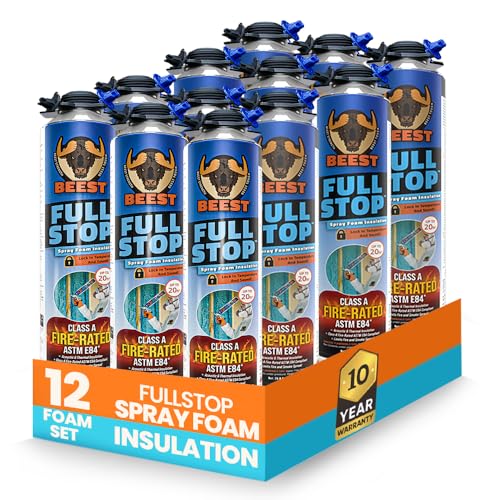
The BEEST FullStop 12-pack offers a hybrid formulation that creates a closed-cell outer skin for moisture resistance while the core expands like an open-cell foam for gap-filling flexibility. At two inches of thickness, it reaches an R-value of 8.24, and the Class A fire rating gives you peace of mind for exposed rim joist applications. The blue color is not just branding — it genuinely helps you spot thin spots and missed gaps in low-light attic conditions.
Coverage is rated at 240 board feet, and real-world feedback from users spraying metal roofs and cabin walls confirms the foam bonds aggressively to wood, metal, and concrete without priming. The application window is 68-77°F; spraying outside that range can cause the foam to expand less consistently. Several reviewers praised the U.S.-based customer service, specifically mentioning quick replacements for defective cans.
The main trade-off is the expense per square foot compared to bargain aerosols. BEEST is not the cheapest per can, but the consistency of expansion and the adhesion strength reduce waste, making the effective cost closer to budget options than the sticker suggests. For attics and wall cavities where you want one product that bridges the gap between sealing and structural rigidity, the FullStop delivers reliably.
Why it’s great
- Hybrid closed-cell skin with open-cell core for flexible expansion
- Blue color reveals coverage gaps during application
- Class A fire-rated with R-8.24 at two inches
- Strong adhesion to wood, metal, concrete, and drywall
Good to know
- Best expansion only within 68-77°F temperature range
- Higher per-can cost than entry-level generic foams
- Some cans may require replacement if nozzle clogs
5. Sprayman Spraycoat Fire Rated Spray Foam Insulation Kit
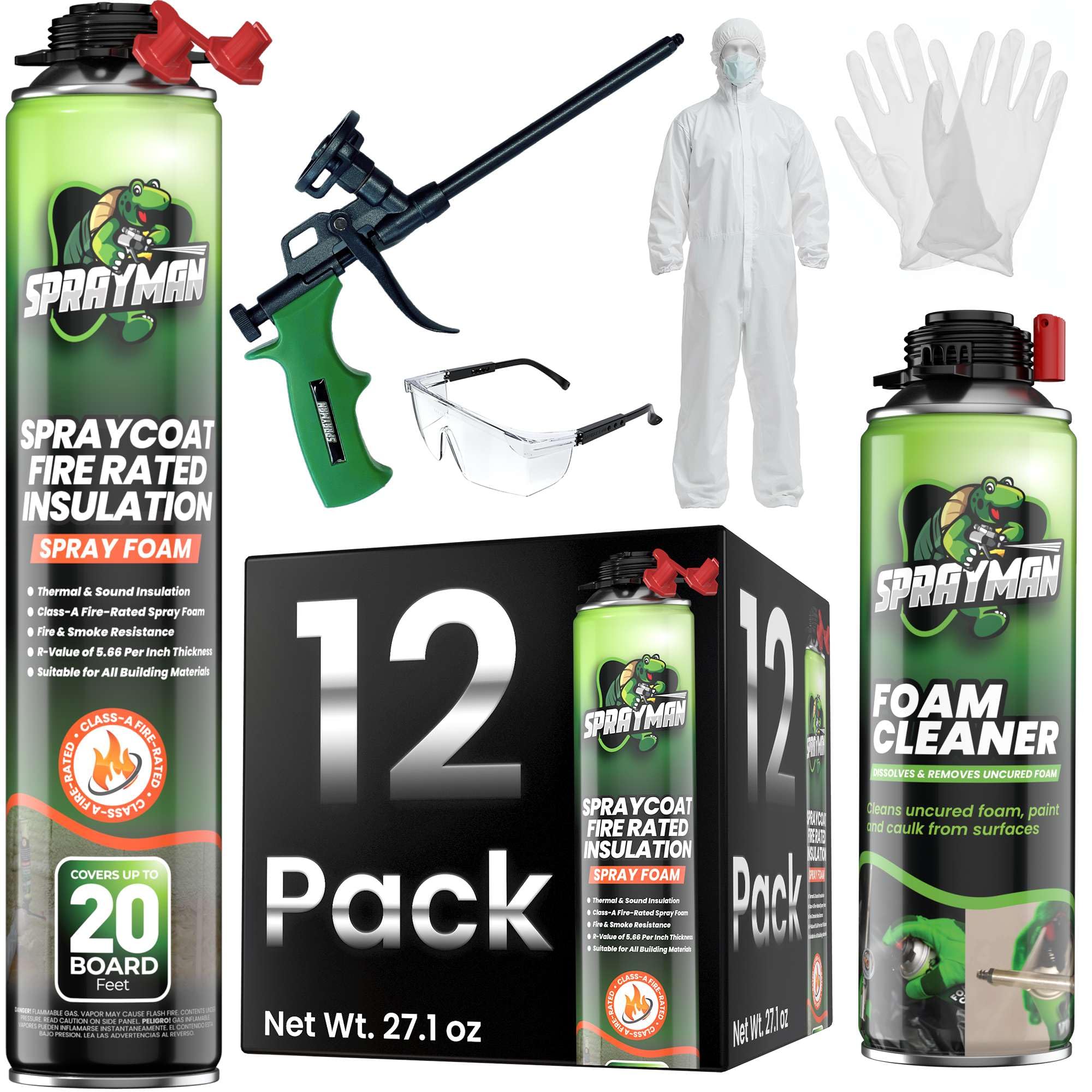
The Sprayman Spraycoat kit brings Class A fire-rated closed-cell foam at an entry-level price point that makes DIY insulation accessible for smaller budgets. The twelve 27.1 oz cans cover 240 board feet at one inch, and the included dual-nozzle system — one for vertical walls, one for overhead — is straightforward enough for a first-time user. The gun and cleaner are included, which removes the need to buy a separate applicator.
Users report that the foam dries very fast, often tack-free within minutes, which helps when layering in deep cavities. The adhesion works across drywall, wood, metal, concrete, and even glass, making this a versatile option for sealing around window frames and pipe penetrations. The R-value per inch is listed at 5.66, placing it in the typical range for single-component closed-cell formulas.
The biggest variable with the Sprayman kit is consistency between cans. While many customers had a smooth experience, a small subset reported cans that would not spray fully or clogged mid-use. The user manual insists on warming cans to room temperature and shaking them for a full 60 seconds before each use, and those who follow the instructions strictly have far fewer problems. If you are willing to adopt a careful preparation routine, the Spraycoat delivers fire-rated performance for less.
Why it’s great
- Class A fire rating at a budget-conscious price
- Dual-nozzle system for vertical and overhead spraying
- Very fast drying time helps multi-layer applications
- Bonds to a wide range of building materials
Good to know
- Occasional reports of cans not spraying or clogging
- Strict preparation routine needed for consistent results
- Coverage falls short of advertised claims for some users
6. Vega Bond Single Component Purplecoat Closed Cell Insulation Spray Foam
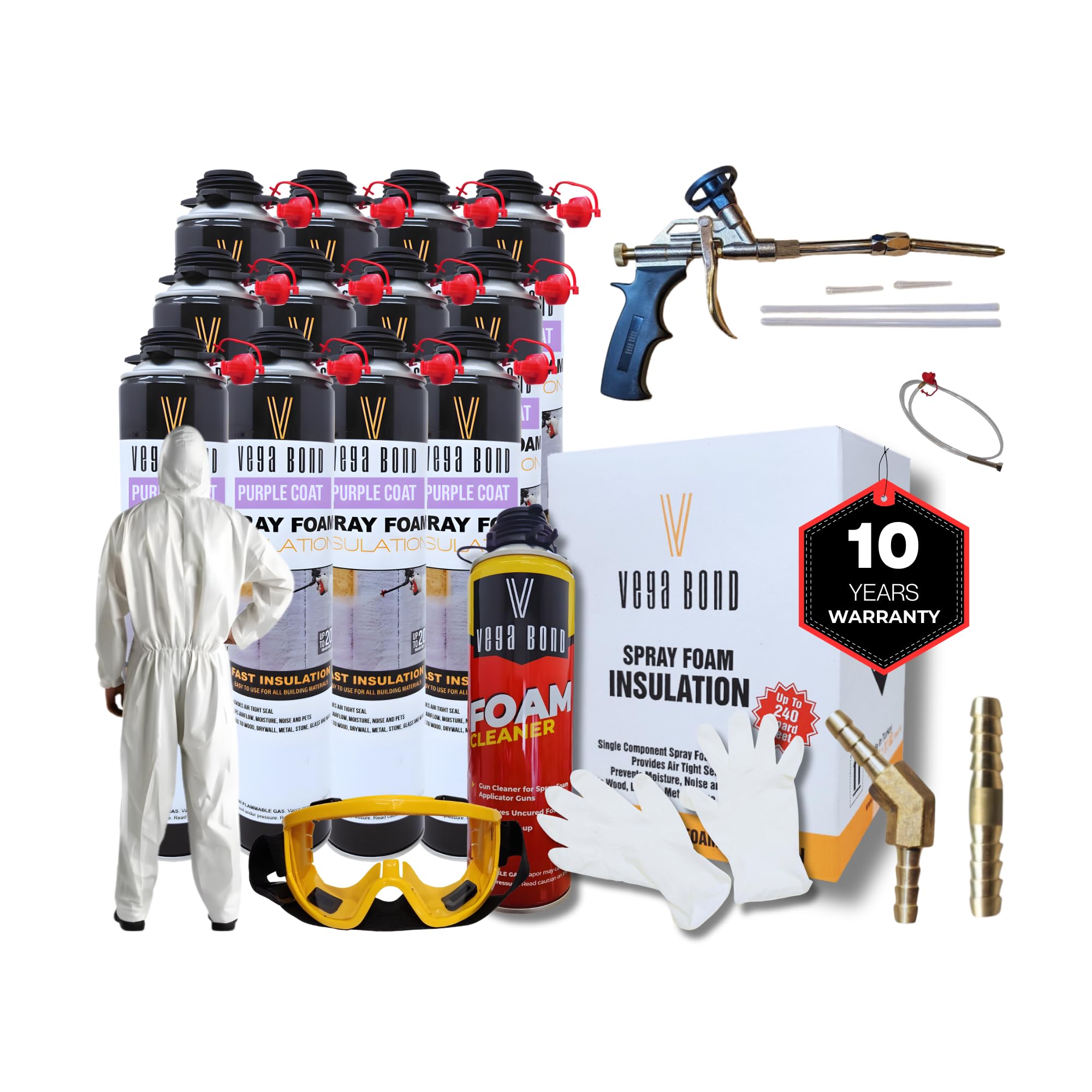
The Vega Bond Purplecoat uses a larger 29 oz can than most competitors, yielding roughly 20 board feet per can at one-inch thickness for a total of 240 board feet across the twelve-pack. The purple tint is a practical advantage — it stands out against wood and drywall, so you can immediately see where you have missed or under-applied foam. The R-value of 5.66 per inch is standard for single-component closed-cell, but the included gun and 45-degree elbow give you better control when spraying above shoulder height.
Users who warmed the cans in water baths before application reported a creamy, consistent spray pattern with minimal sputtering. The foam bonds well to wood, brick, stone, concrete, and metal, and it holds up well in crawl spaces and basements where moisture is a concern. Several reviewers noted that swapping the nozzle tip between each can prevents clogging and extends the life of the applicator gun.
Where the Purplecoat sometimes falls short is the advertised coverage — several measured applications produced closer to half the claimed board footage, especially when spraying overhead. Vega Bond’s customer support was responsive to these complaints, but the mismatch is worth factoring into your quantity planning. For above-grade walls and rim joists where you want a color-coded visual confirmation of full coverage, this is a solid mid-range pick.
Why it’s great
- Purple color provides clear visual feedback on coverage
- Larger 29 oz cans reduce can-change frequency
- Included elbow connector improves overhead spraying
- Good adhesion to stone, brick, and concrete substrates
Good to know
- Real-world coverage often half of advertised rate overhead
- Must swap nozzle tips per can to prevent clogging
- Warming cans in water is recommended for best spray quality
7. BEEST FullStop Fire-Rated Spray Foam Insulation (24 Pack)
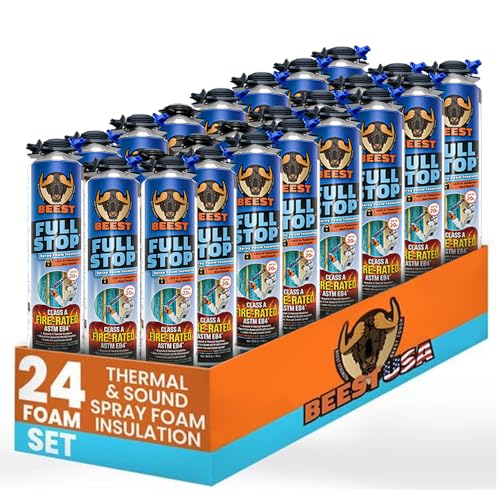
The BEEST FullStop 24-pack effectively doubles the 12-pack’s coverage to 480 board feet, making it the most economical way to buy this hybrid formulation for large-area projects. The same closed-cell skin / open-cell core technology applies, giving you an R-8.24 at two-inch thickness with Class A fire rating. The blue foam color aids coverage inspection, and the cans are identical to the 12-pack version, so any gun and nozzle you already own will work without modification.
Real-world coverage from the 24-pack aligns closely with the 12-pack experience — users spraying metal roofs for sheds and campers achieved about 800 square feet of coverage from the full kit at roughly one-inch depth. The adhesion is strong enough to bond directly to bare metal without surface prep, and the foam added noticeable rigidity to thin gauge roofing panels. Customer support for replacement cans has been consistently praised, particularly the responsiveness of the U.S.-based team.
The primary drawback is the sheer number of cans you must cycle through — 24 cans means 24 nozzle swaps and 24 gun-cleaning cycles if you are diligent about preventing buildup. The per-can cost is lower than buying two 12-packs separately, but the dimensional weight of the shipment means you will want to plan your installation in one extended session to avoid storing half the kit indefinitely.
Why it’s great
- Best per-can value for large-area DIY projects
- Class A fire-rated hybrid foam with R-8.24 at two inches
- Blue foam makes coverage inspection easy
- Adheres strongly to metal, wood, and concrete without primer
Good to know
- 24 cans require frequent nozzle changes and gun cleaning
- Large box is heavy and requires delivery planning
- Best performance depends on 68-77°F application temperature
FAQ
Can I spray closed-cell foam directly onto electrical wiring?
How long does spray foam insulation last before it degrades?
What happens if I spray foam in temperatures below the recommended range?
Do I need a special respirator for spray foam fumes?
Can I paint over spray foam after it cures?
Final Thoughts: The Verdict
For most users, the best diy spray foam insulation winner is the Vega Bond V200 because it combines true two-component performance, R-7 per inch, and low-GWP shipping in a kit that does not require hazmat fees. If you want the largest single-kit coverage for a whole-room project, grab the Froth Pak 630. And for a first-time user who wants every piece of PPE in the box and a gun that handles overhead bays well, nothing beats the convenience of the STANLEY F 990P Supercoat.

Mo Maruf
I created WellFizz to bridge the gap between vague wellness advice and actionable solutions. My mission is simple: to decode the research and give you practical tools you can actually use.
Beyond the data, I am a passionate traveler. I believe that stepping away from the screen to explore new environments is essential for mental clarity and physical vitality.