Our readers keep the lights on and my smoothie glass nicely filled. As an Amazon Associate, I earn from qualifying purchases.
The difference between a cold solder joint and a flawless connection is often invisible to the naked eye. Whether you are reworking a smartphone motherboard or assembling a DIY drone, a dedicated inspection tool removes the guesswork, protecting both your work and your eyesight.
I’m Mohammad Maruf — the founder and writer behind WellFizz. This guide comes from hundreds of hours comparing digital microscopes, analyzing their sensor performance, stand stability, and lighting systems for precision soldering tasks.
Every model here was selected based on real-world usability for electronics work. Read on for the definitive breakdown of the best digital microscope for soldering reviews, comparisons, and expert analysis to guide your purchase.
How To Choose The Best Digital Microscope For Soldering
Not all digital microscopes handle soldering well. Devices designed for stamp or coin inspection often lack the working distance, stand stability, or sensor speed needed for electronics work. Focus on these factors to find a tool that fits your soldering station.
Working Distance and Stand Flexibility
Soldering requires space to hold an iron, tweezers, and wire cutters under the lens. A microscope with a short working distance forces you to hunch over and limits tool movement. Look for a stand that offers at least a 10-inch column height and an adjustable arm that swings out of the way when not in use. A boom or flex arm stand provides the most freedom for electronics repair.
Display Resolution and Sensor Sensitivity
Fine solder joints and tiny SMD components demand clear, lag-free imaging. A 1080P display is the minimum acceptable standard, but 4K UHD sensors and screens deliver the sharpness needed for inspecting QFN packages and 0201 resistors. Higher megapixel counts also matter for capturing detailed photos of your work for documentation. A high frame rate (60 FPS) keeps the image smooth as you move the board.
Lighting System
Shadow-free illumination is critical for soldering. A ring light around the lens provides even, diffused light that highlights solder pads and component legs. Adjustable brightness is essential, and gooseneck side lights help eliminate glare from reflective boards and metallic surfaces. Bottom lights are a bonus for inspecting through-hole components or biological slides.
Lens Versatility
Some soldering microscopes offer a rotating turret or interchangeable lenses to switch between wide-area viewing and high-magnification inspection. A lower magnification lens (around 15X-60X) is ideal for placing components and soldering, while a medium lens (100X-250X) works for checking joint quality. Avoid microscopes with only a single fixed lens if you plan to handle different PCB sizes.
Quick Comparison
On smaller screens, swipe sideways to see the full table.
| Model | Category | Best For | Key Spec | Amazon |
|---|---|---|---|---|
| LINKMICRO LM210S | Premium | True 4K 60FPS Video | 64MP sensor, 4K 60FPS | Amazon |
| Elikliv EM4K-AF Flex | Premium | Auto-Focus Convenience | Autofocus, flex arm stand | Amazon |
| Andonstar AD249S-M | Premium | Multi-Lens Flexibility | 3 lenses, 2160P video | Amazon |
| Elikliv EM4K | Mid-Range | 4K Imaging at Mid Price | 52MP, 4K UHD video | Amazon |
| TOMLOV TriL110 | Mid-Range | Versatile Triple Lens | 3 rotating lenses, 2K | Amazon |
| TOMLOV DM9 Max | Mid-Range | Large Screen Value | 10.1″ IPS, 20MP sensor | Amazon |
| Elikliv EDM9 Max | Mid-Range | High Magnification Zoom | 20MP sensor, 1500X zoom | Amazon |
| Andonstar AD210 | Budget | Entry-Level Soldering | 260X, 10.1″ IPS screen | Amazon |
| LINKMICRO LM210 | Budget | Complete Kit Starter | 260X, 12.6″ metal stand | Amazon |
In‑Depth Reviews
1. LINKMICRO LM210S
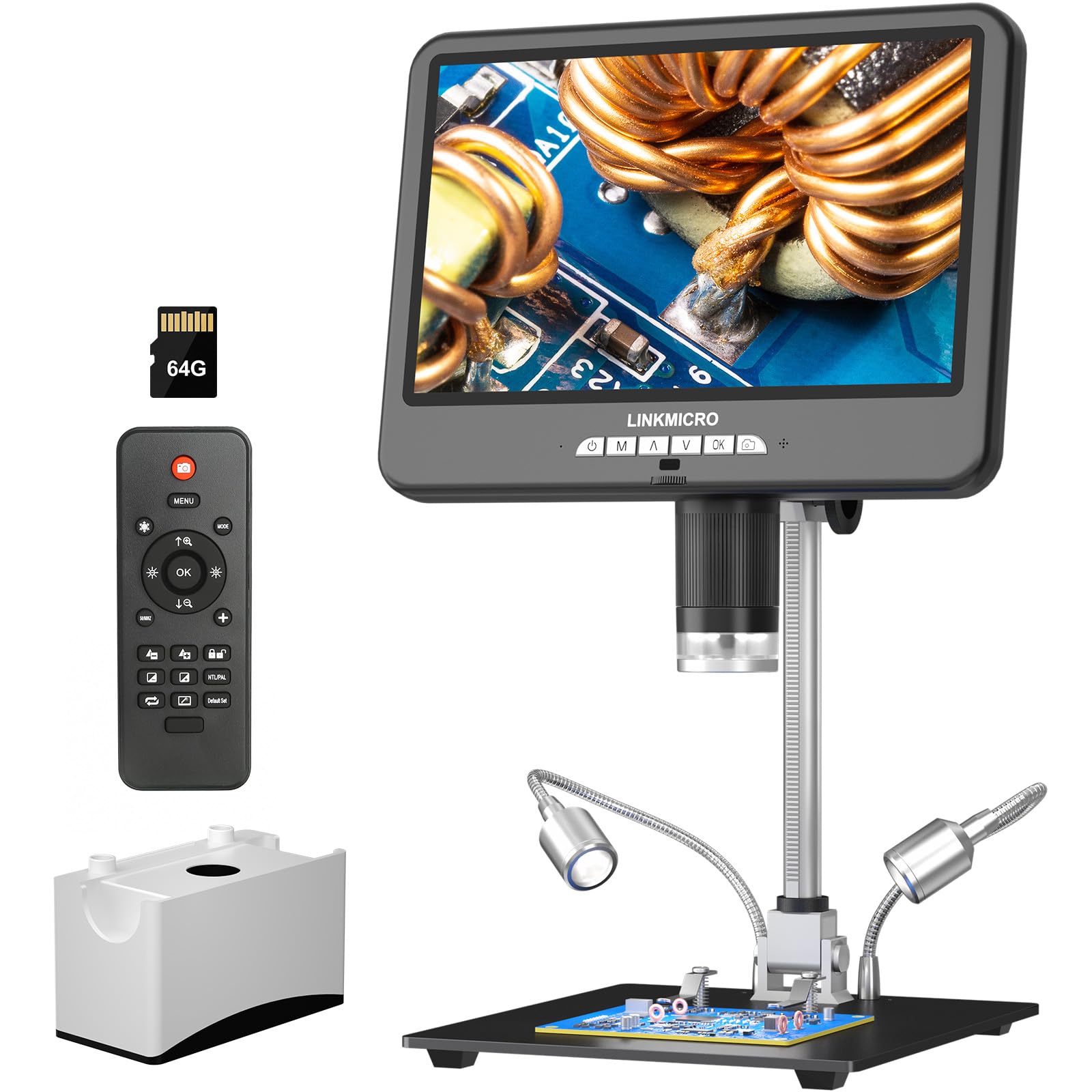
The LM210S pushes the boundaries for soldering inspection with true 4K at 60 FPS, a spec typically reserved for much more expensive industrial gear. The 64MP sensor delivers extremely crisp stills, and the 10.1-inch IPS screen provides a smooth, lag-free view even when you are moving the PCB quickly under the lens. This is a serious upgrade if your soldering work requires documenting high-density boards.
A built-in microphone is a thoughtful addition for tutorial creators, letting you record narration directly alongside 4K video of your rework. The remote control helps eliminate camera shake, and the 1760X magnification range (with digital zoom on HDMI output) is more than adequate for even the smallest SMD components. The tall 12.6-inch stand gives you ample room to work.
On the downside, the USB cable that powers the lights is short, and the HDMI output behaves oddly if you switch TV inputs, sometimes cycling power. The stand is sturdy enough for stationary use but not built for frequent repositioning without loosening bolts. Still, for professional electronics repair and content creation, the LM210S offers exceptional imaging performance.
Why it’s great
- True 4K 60FPS recording and live view
- 64MP sensor for extremely detailed stills
- Built-in microphone for tutorial video
Good to know
- Short power and USB cables
- HDMI behavior can be quirky with TV switching
2. Elikliv EM4K-AF Flex
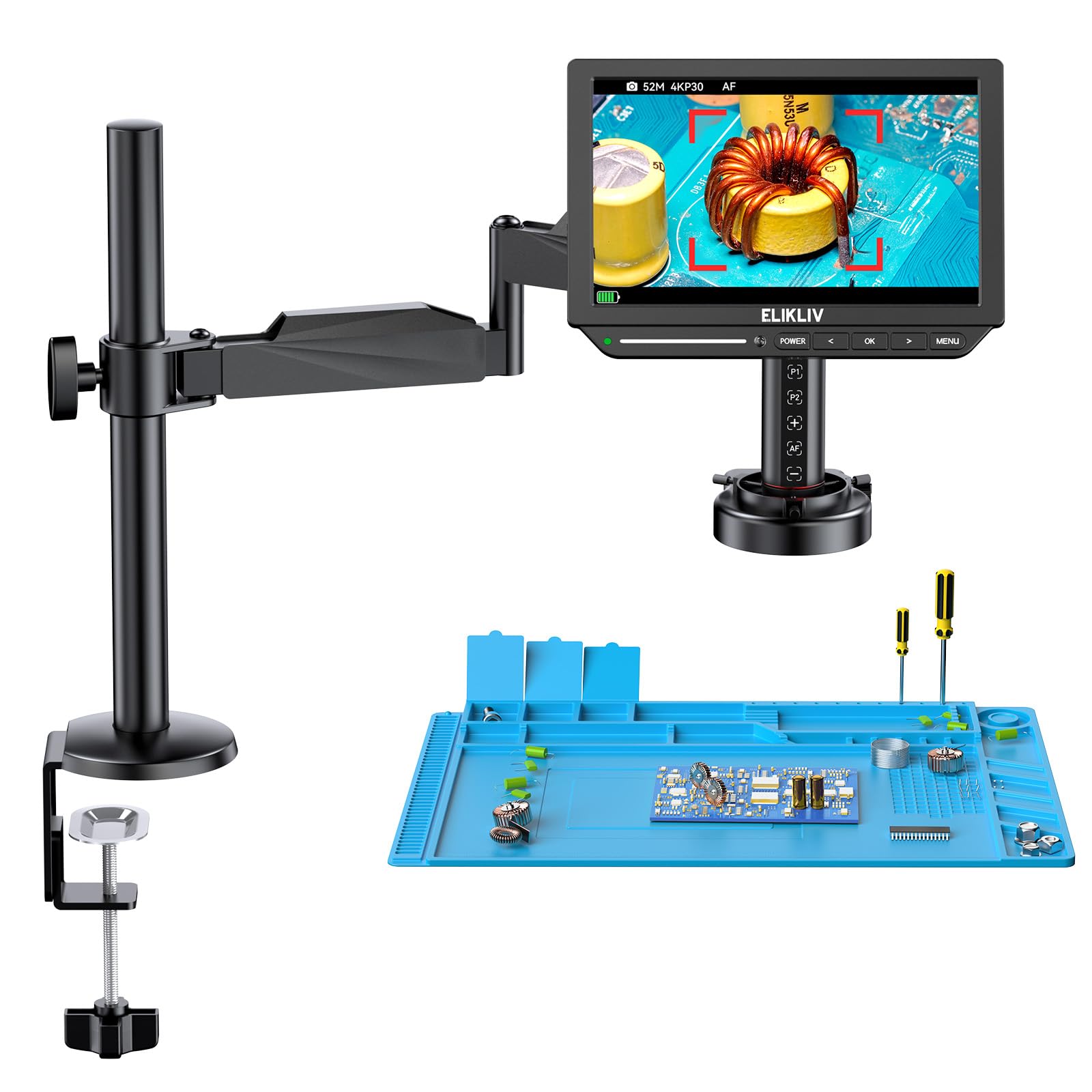
The EM4K-AF Flex removes one of the biggest frustrations in soldering microscopy: constant manual focusing. Its TOF sensor autofocus system locks onto your board within two seconds and maintains clarity as you move the workpiece. This is a genuine time-saver when you are switching between multiple PCB zones or checking different component heights.
The flex arm stand is a standout feature, allowing you to position the camera at nearly any angle, including overhead for large boards and horizontal for side views of through-hole solder joints. The included ring light delivers even, diffused illumination that reduces harsh shadows, and the 52MP imaging provides 4K UHD video. A heat-resistant silicone soldering mat is also bundled, adding further bench-side value.
Build quality is decent but not industrial-grade; the main post can dent if over-tightened, and the ring light mount may require a 3D-printed adapter for optimal fit. The screen runs warm after extended use, and the power cord could be longer. However, for repair technicians who value speed and flexibility, the autofocus and arm design make this a compelling mid-range option.
Why it’s great
- Fast TOF autofocus reduces fiddling
- Flex arm with 360° rotation
- Includes a soldering mat and ring light
Good to know
- Ring light mount may need aftermarket fix
- Main post can dent if over-tightened
3. Andonstar AD249S-M

The AD249S-M brings three interchangeable lenses to the soldering bench, covering wide-area work all the way to high-magnification inspection. The L lens is specifically designed for soldering and repair, with a 15X-60X range that offers a comfortable working distance for holding an iron. The A lens provides up to 180X for component verification, and the D lens hits 2000X for inspecting the tiniest traces.
2160P UHD video recording and HDMI output to a larger monitor free your eyes from a small screen during long repairs. The pro boom arm stand is a major upgrade over fixed-pole desks; it swings, extends, and rotates to give you unobstructed workspace. The kit also includes a measurement software suite for Windows, making it suitable for professional quality control and documentation.
Swapping lenses is a manual screw process, not a quick turret switch, which slows workflow if you need to change magnification often. The software works only on Windows, leaving Mac users out. The included accessories are generous, but the unit runs on DC power, meaning you need a wall outlet nearby. For serious electronics repair requiring flexible magnification and a stable boom arm, this is a top-tier choice.
Why it’s great
- Three lenses dedicated to soldering (L lens) and inspection
- Pro boom arm stand for flexible positioning
- Includes Windows measurement software
Good to know
- Lens swapping requires unscrewing each one
- Software is Windows-only
4. Elikliv EM4K
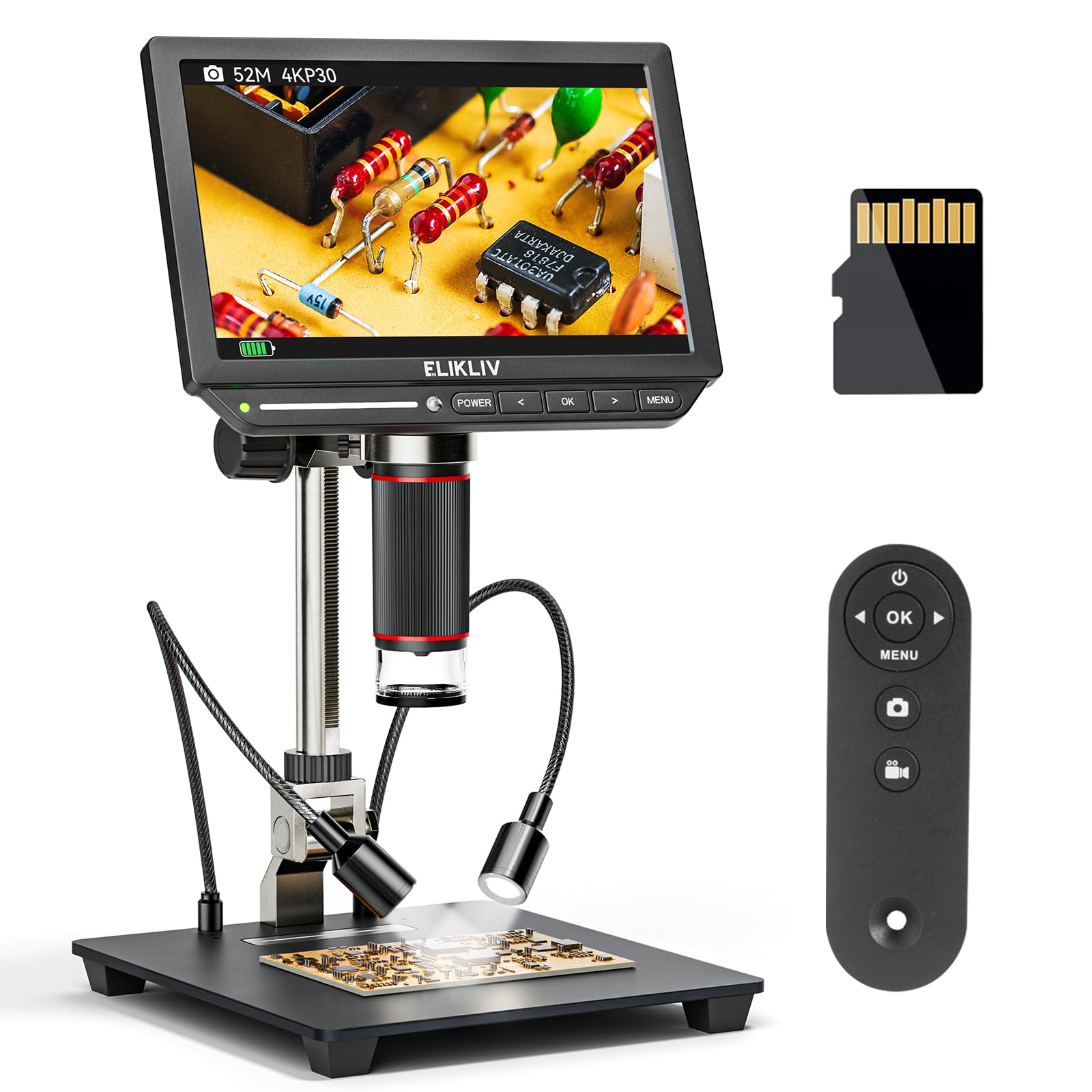
The Elikliv EM4K brings true 4K UHD video and 52MP still capture to a price point that undercuts many 1080P competitors. Its 8-inch IPS screen is smaller than the 10-inch models, but the 1280x800P resolution still provides crisp detail for identifying cold joints and bridging. The color accuracy is impressive, covering 100% sRGB, which helps when you are matching solder paste colors or inspecting PCB mask defects.
The wide base and 10-inch stand accommodate larger boards, and the remote control allows zoom, capture, and recording without touching the screen. The rechargeable battery adds portability, letting you move the microscope to different workstations. Users report the image quality is excellent for both coin grading and electronics repair, with adjustable LED lighting that minimizes glare from shiny surfaces.
On the downside, the SD card slot is positioned inconveniently behind the stand pole, making it hard to access. The included power and USB cables are shorter than ideal, and the stand lacks the fine-adjustment gears found on higher-priced models. The battery life is limited, so you will want it plugged in during long sessions. For the price, the EM4K offers remarkable 4K imaging performance.
Why it’s great
- True 4K UHD video at a mid-range price
- Wide color gamut for accurate viewing
- Rechargeable battery for portability
Good to know
- SD card slot is awkward to reach
- Stand lacks fine-focus gears
5. TOMLOV TriL110
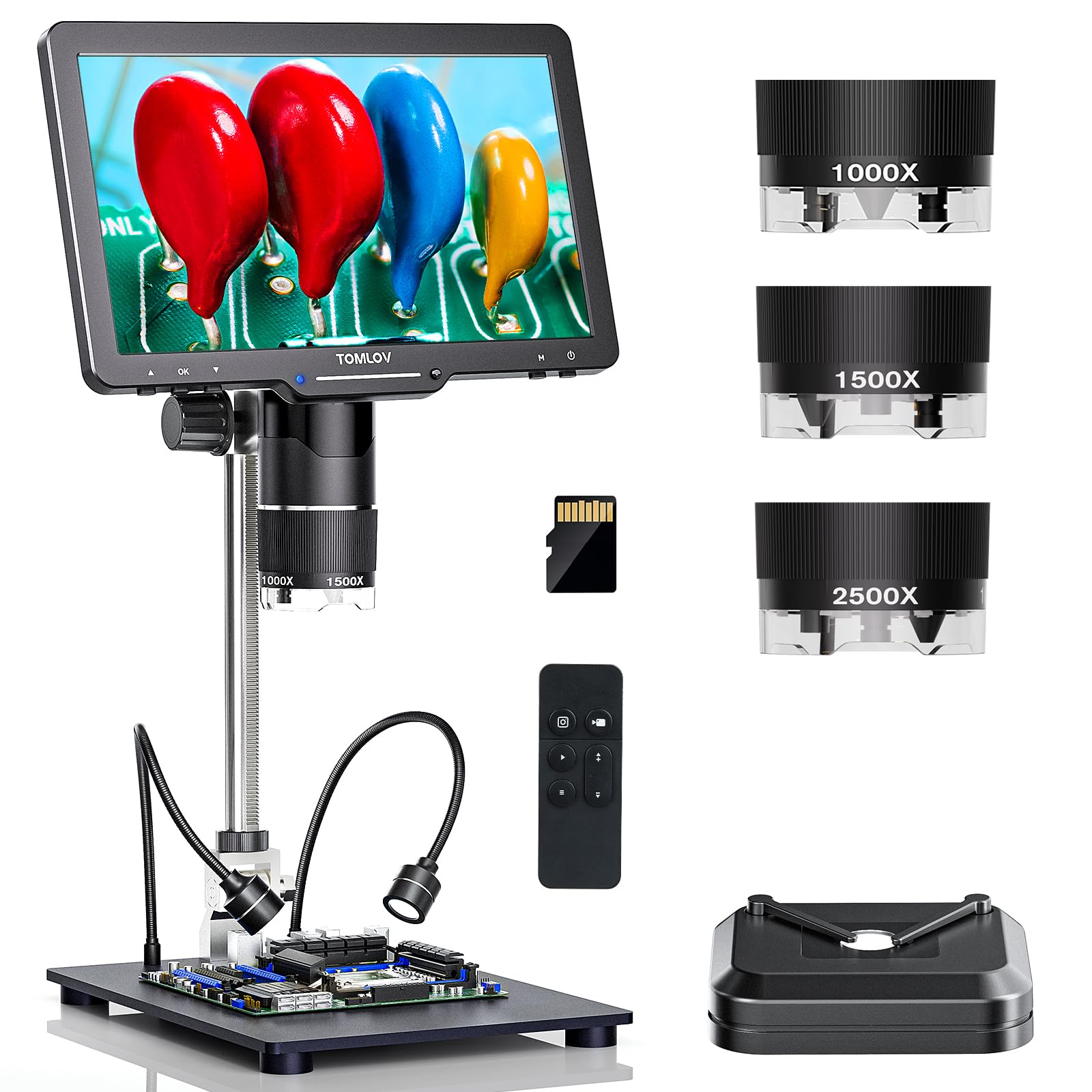
TOMLOV’s TriL110 solves the lens-swapping problem with a rotating barrel that lets you switch between three dedicated lenses without unscrewing anything. The 1500X soldering lens is paired with a 1000X whole-coin lens and a 2500X biological lens, giving you a wide range of working distances and magnification levels. The 2K video resolution and 24MP sensor produce clean, sharp images on the 10.1-inch IPS screen.
The 12.6-inch stand and larger base provide a stable platform for precision soldering, and the 14-LED lighting system (12 around the lens plus two gooseneck side lights) delivers excellent coverage and shadow control. The remote control works reliably, and the included bottom light stage is useful for inspecting transparent slides. The ability to capture 2K photos and videos directly to the microSD card makes documentation simple.
A few users report the magnification wheel feels finicky, requiring careful adjustment to get a sharp focus. The HDMI port had compatibility issues with some cables, and the threading on the lenses isn’t standard, so third-party add-ons are not easily attached. The rotating lens design is a genuine workflow improvement over screw-in alternatives, making this a strong choice for anyone who needs multiple magnification ranges at a soldering station.
Why it’s great
- Rotating barrel for fast lens switching
- Dedicated soldering lens (1500X) with good working distance
- Excellent 14-LED illumination system
Good to know
- Magnification wheel can feel imprecise
- Non-standard lens threading limits upgrades
6. TOMLOV DM9 Max
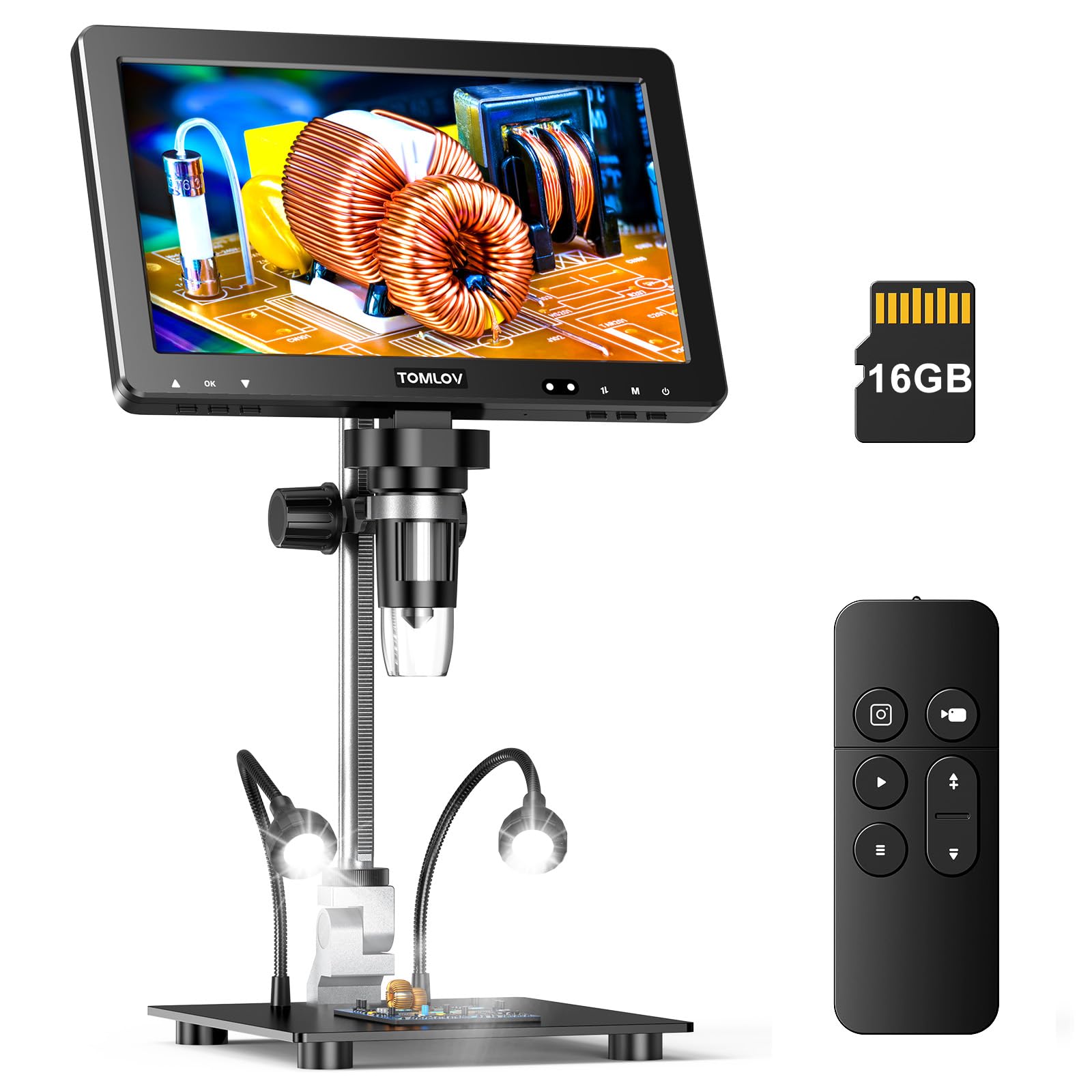
The DM9 Max strikes a balanced position between cost and capability for soldering inspection. The 10.1-inch IPS display with a 178-degree viewing angle is easy on the eyes during extended sessions, and the 20MP sensor captures good detail for documenting rework. The zoom range from 5X to 1500X covers both broad board inspection and fine joint analysis, and the included 16GB SD card is enough for hundreds of captures.
This model features 10 adjustable LED lights — eight around the lens and two gooseneck side lights — that you can dim individually to manage reflections from solder joints. The wireless remote helps reduce shake, and the taller 12.6-inch stand provides a comfortable working space. Users consistently praise its clarity for watch repair, coin inspection, and PCB work.
The battery life is modest, lasting around an hour on the screen and longer in the base, so it is best used plugged in. The power and USB cables are short, and the instructions could be clearer for first-time users. The image quality, however, is consistently rated as unbelievably good for the price, making it a reliable workhorse for hobby-level and intermediate soldering tasks.
Why it’s great
- Very clear 20MP imaging with good depth of field
- 10 adjustable LEDs for shadow-free work
- Large, stable stand with fine adjustments
Good to know
- Short power and USB cables
- Battery life is limited; best kept plugged in
7. Elikliv EDM9 Max
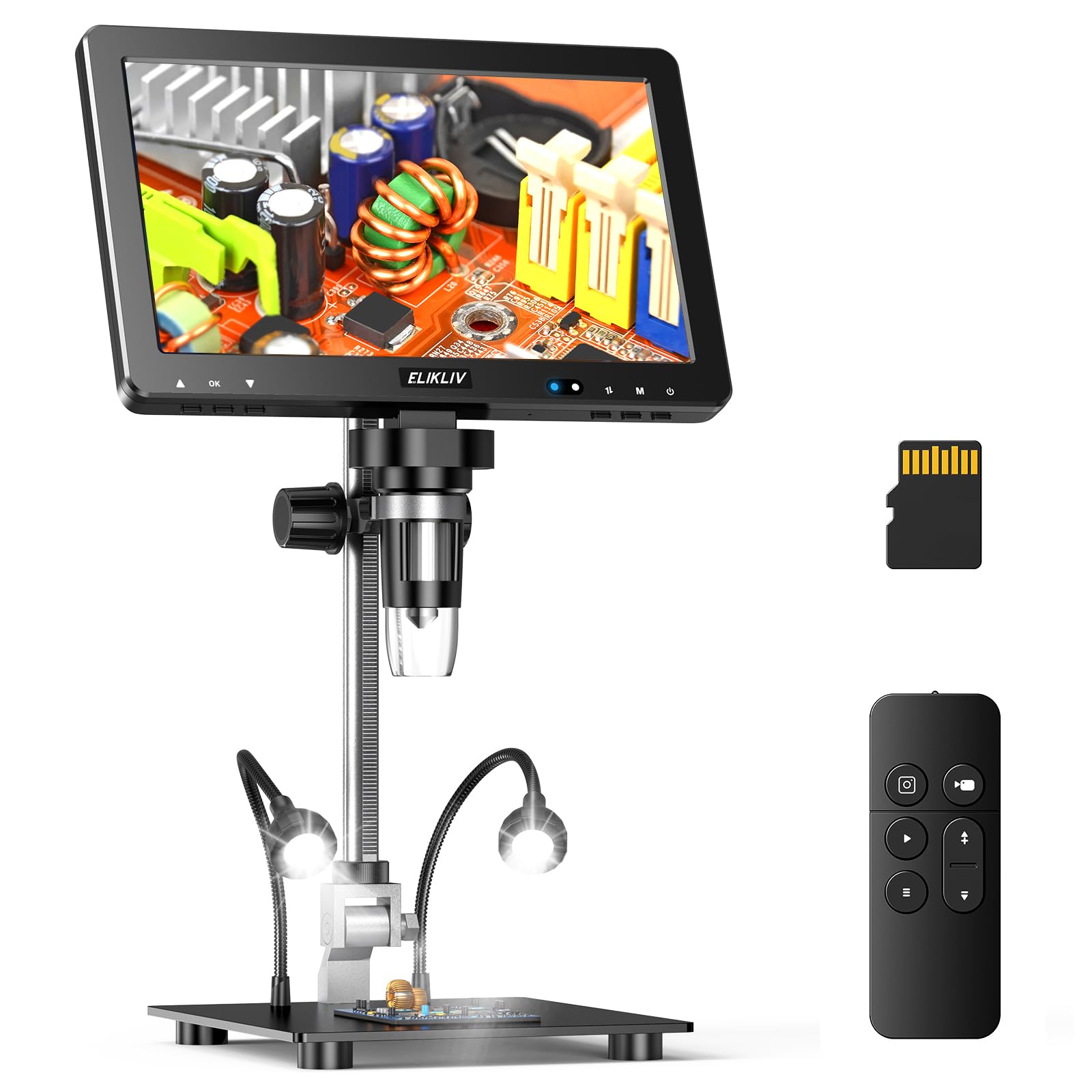
The EDM9 Max offers the widest magnification range in this tier, from 5X to 1500X, giving soldering technicians the flexibility to view an entire PCB or zoom in on a single pad. The 20MP sensor and 10.1-inch HD IPS screen deliver vivid color and crisp edges, which is helpful when you are trying to spot whiskers or inclusion defects. The aluminum alloy enclosure feels durable and adds weight to the stand for stability.
Like the DM9 Max, this model includes a remote control and a light barrier to reduce glare. The dual gooseneck side lights are flexible and can be aimed precisely to illuminate tight areas around tall components. It connects to a PC or TV via USB or HDMI, making it easy to share the image on a larger monitor during collaborative work.
Some users note the stand base could benefit from a bushing for smoother height adjustments, and the mode selection can be finicky when the SD card is inserted. The PC camera software integration works well with Windows, but Mac users will need third-party apps. For buyers seeking the highest digital zoom in a mid-range soldering microscope, the EDM9 Max delivers expansive magnification range at a reasonable price.
Why it’s great
- Extremely wide 5X-1500X zoom range
- Aluminum alloy build for extra stability
- Dual flexible side lights for targeted illumination
Good to know
- Stand base may need a bushing mod for smooth height changes
- Mode selection can be finicky with the SD card
8. Andonstar AD210

The Andonstar AD210 is a strong entry point for anyone new to soldering microscopes. Its 10.1-inch IPS display, 1080P video, and 12MP photo capture are more than adequate for inspecting through-hole joints, checking component orientation, and identifying common soldering defects. The 260X maximum magnification is lower than the higher-end models, but it covers the typical range needed for hobbyist PCB work (0603 SMD parts and larger).
This model comes with a generous accessory kit: a 32GB SD card, remote control, and a bottom light stage for biological slides. The upgraded strong stand uses a large metal base with a 12.6-inch maximum height, giving you enough vertical clearance for most repair tasks. Three types of LED illumination (top, side, and bottom) can be adjusted independently to reduce shadows and glare.
The digital zoom only works in video mode, which can be confusing when trying to capture still images, and the included prepared slides are underwhelming at this magnification. The plastic components for the display and remote feel less durable than the metal stands found on the premium options. For the price, however, the AD210 is a capable, all-in-one starter kit that will serve casual soldering and coin inspection well.
Why it’s great
- Complete starter kit with 32GB SD card and slides
- Stable 12.6-inch metal stand
- Three adjustable LED lighting modes
Good to know
- Digital zoom only available in video mode
- Some plastic parts feel less robust
9. LINKMICRO LM210

The LINKMICRO LM210 is the most affordable option on this list that still includes a large 10.1-inch display and a dedicated metal stand. With 260X magnification and 12MP stills, it is well-suited for basic soldering inspection — identifying large cold joints, checking component polarity, and inspecting solder bridges on through-hole boards. The 12.6-inch metal stand provides generous working space for hobbyist work.
What sets this model apart at the budget tier is the advanced lighting system: eight adjustable top LEDs, dual flexible side lights, and a bottom-lit slide holder. This versatility helps illuminate circuit boards from multiple angles, reducing the need for a separate desk lamp. The included 32GB SD card and remote control add further value, and the kit includes a slide holder and prepared slides for biological exploration.
The main trade-off is image quality compared to the 4K and high-megapixel models. The 1080P video is serviceable but lacks the fine detail needed for inspecting the smallest SMD components (0201 packages). The UI is basic, with zoom only adjustable in video mode, which can be frustrating. For a beginner or budget-conscious maker who wants a functional soldering microscope with a large screen, the LM210 is a solid starting point.
Why it’s great
- Affordable entry with a large 10.1-inch screen
- Advanced 3D lighting with flexible side lights
- Complete kit including 32GB SD card and remote
Good to know
- 1080P video limits fine-detail inspection
- Zoom only works in video mode
FAQ
What magnification do I need for soldering circuit boards?
Is a boom arm stand better than a fixed pole for soldering?
Final Thoughts: The Verdict
For most users, the best digital microscope for soldering winner is the Elikliv EM4K-AF Flex because it combines true autofocus convenience with an incredibly flexible arm stand that makes day-to-day electronics work faster and less fatiguing. If you want the highest imaging fidelity for professional documentation and tutorial creation, grab the LINKMICRO LM210S. And for a multi-lens system with a dedicated soldering lens and a pro boom stand, nothing beats the Andonstar AD249S-M.

Mo Maruf
I created WellFizz to bridge the gap between vague wellness advice and actionable solutions. My mission is simple: to decode the research and give you practical tools you can actually use.
Beyond the data, I am a passionate traveler. I believe that stepping away from the screen to explore new environments is essential for mental clarity and physical vitality.