Our readers keep the lights on and my smoothie glass nicely filled. As an Amazon Associate, I earn from qualifying purchases.
A flip screen is a gateway to better composition, not just a selfie tool. When you are framing a shot from a low angle or capturing a vlog on the move, the ability to tilt, swivel, or rotate the display away from the camera body determines whether you nail the moment or miss it entirely. A rigid screen forces awkward body contortions; a versatile articulating screen keeps your eye on the action and your framing sharp.
I’m Mohammad Maruf — the founder and writer behind WellFizz. I’ve spent hundreds of hours analyzing sensor specifications, autofocus systems, stabilization architectures, and lens ecosystems to help you find the digital camera with flip screen that genuinely fits the way you shoot.
Whether you are a vlogger tracking your own movement or a travel shooter composing from a tripod, the ideal flip-screen camera balances a responsive tilting display with a class-leading sensor, fast autofocus, and reliable stabilization.
How To Choose The Best Digital Camera With Flip Screen
Every camera with a flip screen solves a specific shooting problem, but the way the screen moves — up, down, out to the side, or a combination — changes your workflow more than the resolution of the display panel itself. Understanding the screen articulation type first will narrow your options dramatically.
Screen Articulation: Vari-Angle vs. Tilt-Only vs. Flip-Down
A vari-angle screen that swings out on a side hinge and rotates 270 degrees gives you the most flexibility for high-angle, low-angle, and front-facing selfie framing without blocking your hot shoe or ports. Tilt-only screens are thinner and more durable but force you to stand directly behind them. Flip-down screens unlock a tripod-free selfie setup and let the camera sit low in your palm, ideal for run-and-gun vloggers who shoot handheld.
Sensor Size, Stabilization, and Low-Light Performance
A 1-inch or APS-C sensor paired with in-body image stabilization or sensor-shift IBIS delivers usable footage in dim interior light without a tripod. Cameras with micro four thirds sensors also offer excellent IBIS in a compact body. If you plan to shoot video after sunset or in shaded rooms, prioritize a camera with a sensor that is physically larger than a smartphone image processor and at least a 5-axis stabilization system.
Autofocus That Tracks You When You Face the Lens
When the screen is flipped toward you, the camera needs real-time eye detection and object tracking to keep you in focus. Sony’s Real-Time Eye AF, Canon’s Dual Pixel CMOS AF II, and DJI’s ActiveTrack 6.0 all lock onto a face reliably in 4K. Look for models that maintain contrast detection or phase detection coverage across a high percentage of the sensor area — 425 points or more is a solid baseline.
Quick Comparison
On smaller screens, swipe sideways to see the full table.
| Model | Category | Best For | Key Spec | Amazon |
|---|---|---|---|---|
| DJI Osmo Pocket 3 Creator Combo | Gimbal Camera | Pocket vlogging, run-and-gun | 1-inch CMOS, 4K/120fps, 2-inch rotatable touchscreen | Amazon |
| Canon EOS R50 Kit | Mirrorless | Beginners, family content | APS-C, 4K oversampled, vari-angle touchscreen | Amazon |
| Sony Alpha a6400 | Mirrorless | Fast AF, street photography | 24.2MP APS-C, Real-Time Eye AF, 180° flip screen | Amazon |
| Sony RX100 VII | Compact | Travel, pocket zoom | 20.1MP 1-inch, 24-200mm zoom, pop-up EVF | Amazon |
| Fujifilm X100VI | Fixed Lens | Street, stills-first users | 40.2MP X-Trans, 6-stop IBIS, flip-down screen | Amazon |
| Canon EOS RP | Full Frame | Entry full frame, portraits | 26.2MP full-frame, vari-angle LCD, RF mount | Amazon |
| Insta360 GO 3S | Action Cam | Hands-free POV, pet vlogging | 39g body, 4K, 2.2-inch flip screen via Action Pod | Amazon |
| Panasonic LUMIX G85 | Mirrorless | Budget video, IBIS value | 16MP MFT, 5-axis IBIS, 3-inch tilt/touch LCD | Amazon |
| Nikon Z 30 | Mirrorless | Vloggers, streamers | APS-C, unlimited 4K, flip-out selfie screen | Amazon |
| OM SYSTEM E-M10 Mark IV | Mirrorless | Stylish walkaround, retro feel | 20MP MFT, 5-axis IBIS, flip-down selfie mode | Amazon |
| Nikon COOLPIX P1000 | Superzoom | Wildlife, moon photography | 125x zoom, 16MP, vari-angle LCD, 4K video | Amazon |
In‑Depth Reviews
1. DJI Osmo Pocket 3 Creator Combo

The 1-inch CMOS sensor records 4K video at up to 120 frames per second, and the 3-axis mechanical stabilization keeps handheld footage stable without a gimbal rig. The 2-inch touchscreen rotates for horizontal or vertical framing, and the screen movement integrates with the gimbal to automatically switch between orientations. The Creator Combo includes the DJI Mic 2 transmitter, a wide-angle lens adapter, a battery handle that extends runtime to about 2.8 hours, and a mini tripod, making this a self-contained vlogging kit.
ActiveTrack 6.0 locks onto a face or subject and keeps it centered even when you walk, spin, or move the camera erratically. The D-Log M profile with 10-bit color depth gives editors room to grade footage without banding. The microphone audio is noticeably cleaner than in-camera mics on most mirrorless bodies, and the OsmoAudio feature connects directly to two DJI Mic 2 transmitters without an external receiver.
Low-light performance from the 1-inch sensor is usable up to ISO 3200 with minimal noise, and the stabilization compensates for handheld shake at shutter speeds as low as 1/15 second. The protective cover and carrying bag protect the gimbal mechanism during travel, which is important because the gimbal head is the most delicate part of the system. The built-in battery charges quickly over USB-C, and the battery handle supports hot-swapping for extended shoots.
Why it’s great
- Mechanical gimbal eliminates need for external stabilizers on most shots
- Included wireless transmitter delivers studio-quality audio without a separate recorder
- Rotating screen makes vertical and horizontal recording equally quick
Good to know
- Gimbal mechanism is not impact-resistant and requires careful handling
- Creator Combo price is a significant step up from the base model
- Fixed lens limits focal length options compared to interchangeable-sensor cameras
2. Sony Alpha a6400

The 24.2MP APS-C sensor paired with 425 phase-detection and 425 contrast-detection autofocus points covers roughly 84 percent of the sensor frame. The Real-Time Eye AF locks onto human and animal eyes instantly, and the tracking follows subjects even when they move erratically across the frame. The 180-degree flip-up screen faces forward cleanly for selfie framing without blocking the hot shoe or mic port.
Continuous shooting reaches 11 frames per second with full autofocus and auto-exposure tracking, making this camera reliable for capturing fast-moving subjects like kids or pets. The 4K video is oversampled from the full sensor width, delivering detail that holds up on large monitors. Picture profiles and S-Log gamma curves provide enough dynamic range for color grading without blowing out highlights.
The body is compact enough for street photography setups, and the E-mount ecosystem gives access to lenses from Sony, Sigma, Tamron, and Viltrox at multiple price points. Battery life is about 410 shots per charge, and the micro USB port supports in-camera charging. The lack of a headphone jack is a real limitation for serious videographers, and the rolling shutter in 4K is noticeable during fast pans unless you use a gimbal.
Why it’s great
- Autofocus speed and tracking reliability are class-leading in this price tier
- Small body paired with a compact lens fits easily into an everyday bag
- Oversampled 4K video provides excellent sharpness for content creation
Good to know
- No in-body stabilization — rely on OSS lenses or a tripod for smooth handheld footage
- Rolling shutter in 4K video requires careful panning technique
- Menu system is complex and the rear touchscreen has limited functionality
3. Canon EOS R50 Kit with 18-45mm Lens
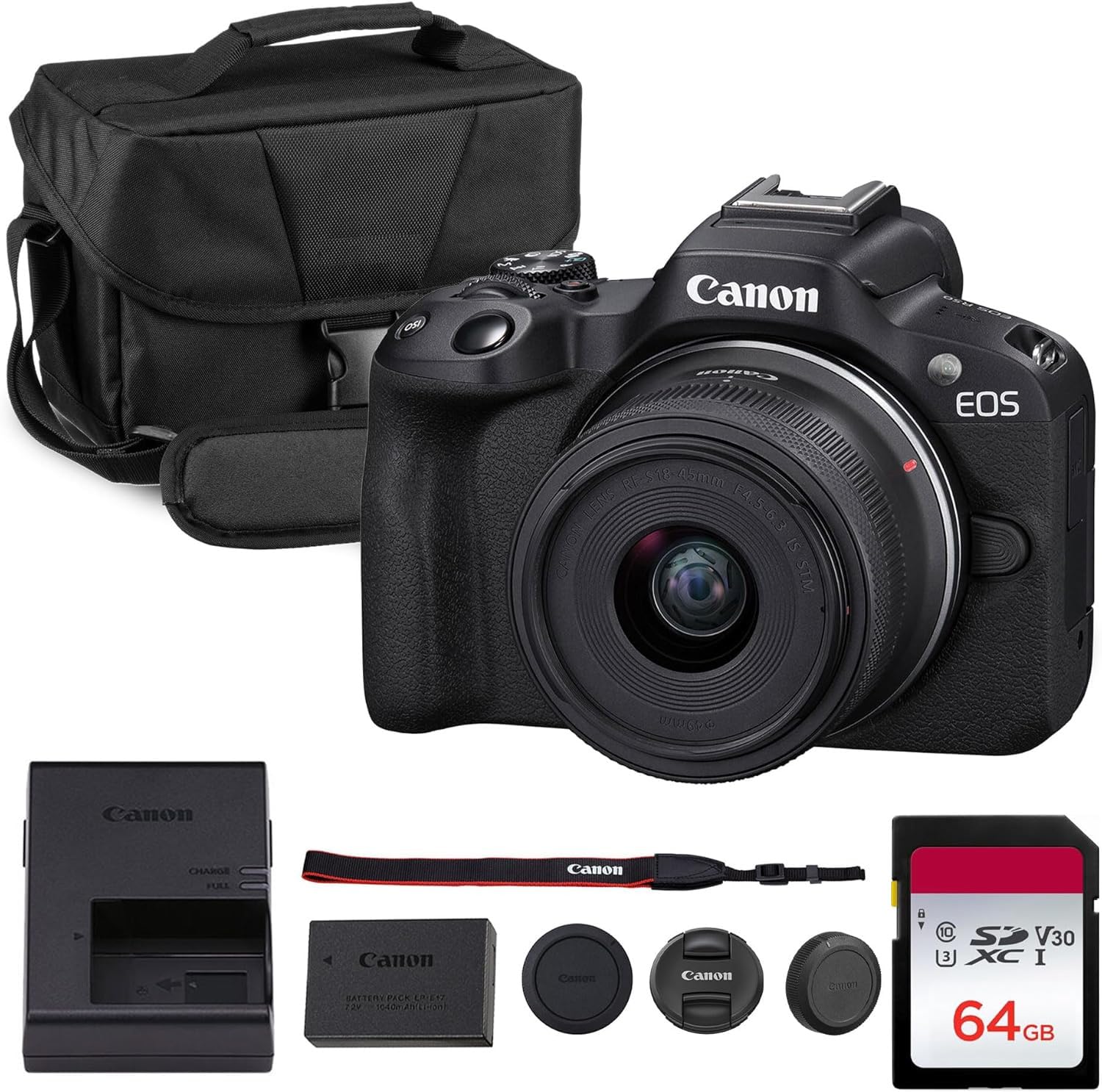
The APS-C sensor with Dual Pixel CMOS AF II delivers fast face and eye detection in both photo and video modes, and the autofocus coverage extends across a large portion of the frame. The vari-angle touchscreen swings out to the side and rotates to any viewing angle, which is especially useful for shooting over crowds or from ground level. The kit includes the RF-S 18-45mm f/4.5-6.3 IS STM lens, a compact zoom with image stabilization that pairs well with the body for steady handheld clips.
Video capture tops out at 4K 30p oversampled from 6K, producing detailed footage with minimal moiré artifacts. Creative Assist mode provides in-camera guides for beginners, and vertical video support with a dedicated social-ready format makes sharing to mobile platforms simple. The camera body is one of the lightest APS-C options at the mid-range price point, weighing about 375 grams with the battery and card.
The included shoulder bag and 64GB UHS-I SDXC card add immediate usability out of the box, although the bag is not a Canon branded accessory. The kit lens is adequate for general use, but upgrading to the RF 50mm f/1.8 STM dramatically improves low-light performance and bokeh quality. Battery life is rated at about 370 shots per charge, and the camera charges directly over USB-C with a compatible PD charger.
Why it’s great
- Vari-angle screen provides full flexibility for overhead, low-angle, and selfie framing
- Oversampled 4K delivers crisp footage that grade well in post-production
- Very lightweight body reduces neck and wrist fatigue during all-day shoots
Good to know
- Kit lens maximum aperture is relatively slow for low-light indoor work
- No in-body stabilization — relies on lens stabilization for steady video
- Single card slot with UHS-I speed limits buffer clearing during long bursts
4. Sony RX100 VII
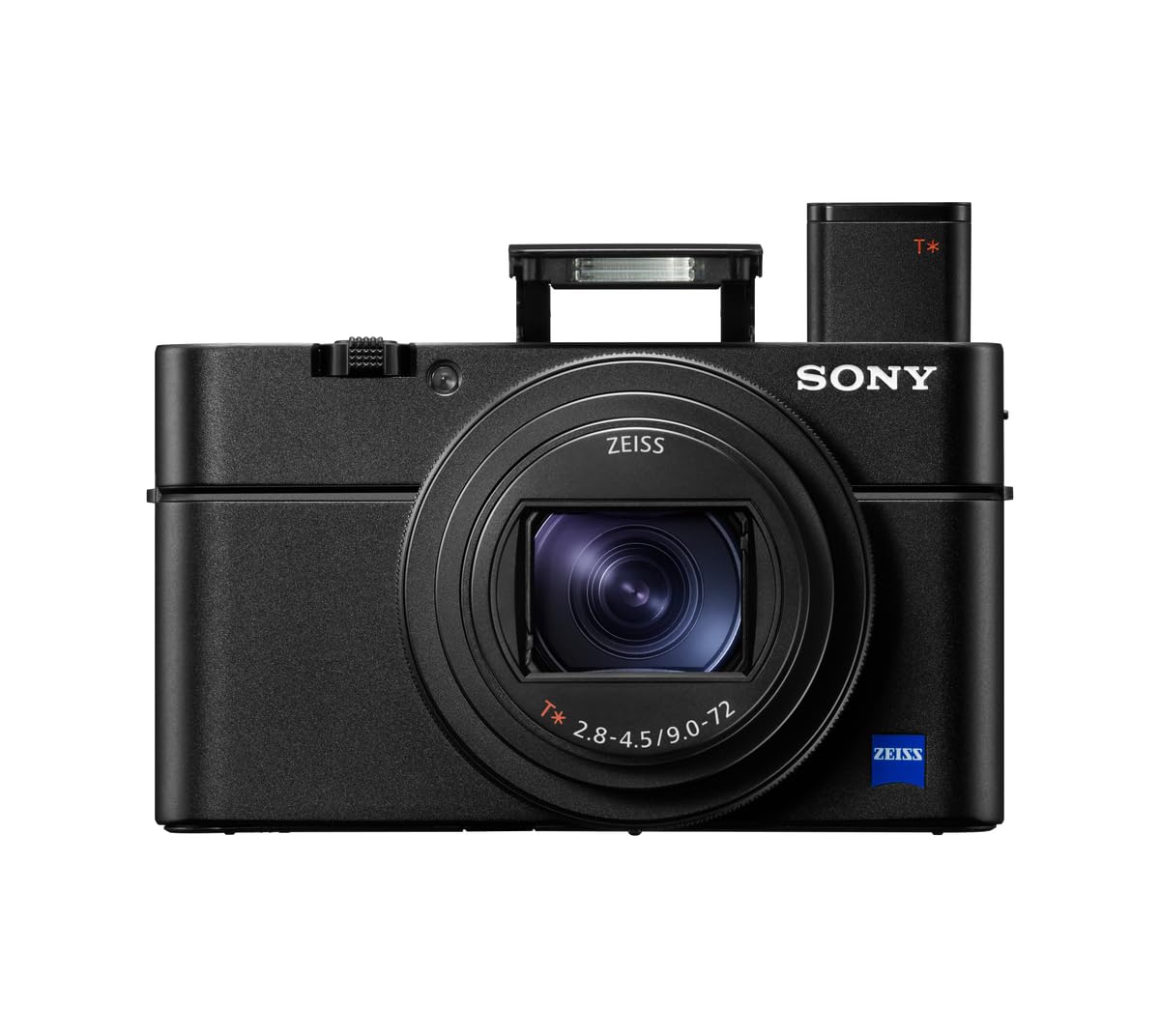
The 20.1MP 1-inch stacked CMOS sensor is paired with a Zeiss Vario-Sonnar T* 24-200mm f/2.8-4.5 lens that collapses into a body small enough for a coat pocket. The 357 phase-detection plus 425 contrast-detection autofocus points cover most of the sensor, allowing Real-Time Tracking and Real-Time Eye AF to maintain focus on moving subjects across the entire zoom range. The 3-inch tilting LCD flips up 180 degrees for selfies, and a built-in pop-up electronic viewfinder provides an eye-level alternative in bright sunlight.
Continuous shooting reaches 20 frames per second with blackout-free viewing, and the buffer handles about 90 JPEGs or 25 RAW frames before slowing down. 4K video records with full pixel readout without pixel binning, and the Active Mode image stabilization reduces rolling shutter during walking shots. The 4K HDR video profile using HLG captures extra highlight detail without clipping the sky or specular reflections.
The zoom lens covers wide-angle group shots through telephoto portraits without requiring a lens change, making this the most versatile pocketable option for travel. The built-in ND filter is noticeably absent, so shooting wide-open in bright sun requires a third-party magnetic ND adapter. Battery life is about 260 shots per charge, and the micro USB port charges the battery in-camera, but a spare NP-BX1 battery is nearly essential for a full day of shooting.
Why it’s great
- 24-200mm zoom range in a pocket-sized body avoids changing lenses on the go
- Autofocus and tracking performance rival much larger interchangeable-lens cameras
- Pop-up EVF provides a stable framing option in bright outdoor conditions
Good to know
- No built-in ND filter requires an external adapter for shallow depth of field in sunlight
- Battery life is below average for a day of heavy video or burst shooting
- Fixed lens means no upgrade path for wide-angle or telephoto beyond the optical zoom cap
5. Fujifilm X100VI

The 40.2MP X-Trans CMOS 5 HR sensor is paired with a fixed 23mm f/2 lens that covers a 35mm equivalent field of view, matching the classic street photography perspective. The 5-axis in-body image stabilization provides up to 6 stops of compensation, allowing handheld shooting at shutter speeds as low as 1/4 second without noticeable blur. The flip-down rear LCD enables waist-level selfie framing while keeping the retro dials and hybrid viewfinder accessible on top of the body.
The 20 film simulation modes, including REALA ACE, produce out-of-camera JPEGs with color science that reduces time in editing software. The digital teleconverter adds 1.4x and 2x crop options, giving you approximate 50mm and 70mm equivalent focal lengths from the same sensor area. The built-in 4-stop ND filter opens the f/2 aperture for shallow depth of field even in midday sun, a feature that matters for street portraits with blurry backgrounds.
The hybrid viewfinder switches between an optical bright-frame finder and a high-resolution OLED electronic display, letting you choose battery-efficient composition or full parameter review without raising the camera from your eye. The body is weather-resistant with a magnesium alloy frame, though the lens itself lacks official weather sealing without an additional filter adapter ring. The autofocus system can occasionally hunt in very low contrast scenes, and the internal battery is rated at about 305 frames per charge.
Why it’s great
- Film simulations produce ready-to-share color profiles that reduce editing time
- In-body stabilization allows usable handheld shots in dim light without a tripod
- Hybrid viewfinder gives optical and electronic framing options in one body
Good to know
- Fixed 23mm lens limits compositional flexibility compared to zoom or interchangeable systems
- Autofocus occasionally hunts in low contrast or backlit scenes
- Battery life is modest and a spare NP-W126S battery is recommended for full-day shoots
6. Canon EOS RP (Body Only)

The 26.2MP full-frame CMOS sensor with the DIGIC 8 image processor delivers a shallow depth of field and low-light performance that APS-C sensors cannot match at this price tier. The vari-angle touch LCD swings out to the side and rotates 270 degrees, making front-facing video framing, overhead shots, and extreme low-angle work equally intuitive. The RF mount provides native access to Canon’s RF lens lineup and works with EF and EF-S lenses when using the optional mount adapter.
Dual Pixel CMOS AF provides fast and accurate phase-detection autofocus across a wide area of the frame, and Eye Detection AF locks onto a human subject in both stills and video modes. 4K video records from a cropped 1.6x crop factor, which reduces the effective field of view and limits the wide-angle reach of your lenses. The 1080p mode uses the full sensor width and offers a higher quality image if you prioritize frame width over resolution.
The body is the lightest full-frame mirrorless camera at about 440 grams with battery and card, making it comfortable for extended handheld use with a compact lens. The vari-angle screen has a 1.04 million dot resolution that is clear enough for manual focus peaking. Battery life is about 250 shots per charge, and the camera uses the LP-E17 battery shared with the EOS M50 series, so spare batteries are easy to find at reasonable prices.
Why it’s great
- Full-frame sensor provides excellent detail and low-light performance for the price
- Vari-angle screen is fully adjustable for selfie, overhead, and tabletop shooting angles
- Very lightweight body reduces fatigue during all-day use with a standard lens
Good to know
- 4K video uses a heavy crop factor that removes the wide-angle advantage of full-frame lenses
- No in-body stabilization — relies on lens stabilization for handheld video
- Single SD card slot with UHS-I speed limits backup and high-burst buffer performance
7. Insta360 GO 3S (128 GB)

The main camera unit weighs only 39 grams and is about the size of a thumb, yet it records 4K video at 30fps through a new wide-angle lens with a MegaView FOV that minimizes barrel distortion. The Action Pod houses a 2.2-inch flip screen that rotates out from the body, providing a live preview and remote control for the detached camera. The magnetic mounting system and included accessories — pendant, easy clip, pivot stand — let you attach the camera to a pet collar, a bike handlebar, or a drone without needing separate adapters.
FlowState stabilization and Horizon Lock keep footage level even when the camera rotates 360 degrees during movement, which is essential for POV biking or running shots. The IPX8 waterproof GO 3S can go to 10 meters without a housing, and the Dive Case extends that depth to 60 meters. Battery life inside the Action Pod reaches about 140 minutes total, but the standalone camera records for about 30 minutes continuously before needing to return to the Pod for charging.
AI editing in the Insta360 app automatically detects highlights and syncs them to background music, reducing post-production time for social clips. The 128 GB internal storage is non-expandable, so you cannot swap cards between shoots. The camera does not have swappable batteries either, meaning a multi-day trip without charging requires a power bank and USB-C cable to recharge the Pod.
Why it’s great
- Extremely lightweight body with magnetic mounts captures angles no other camera can reach
- FlowState stabilization keeps handheld POV footage level without a gimbal
- Flip screen Action Pod provides live view and controls while the camera is detached
Good to know
- Standalone camera battery lasts only about 30 minutes of continuous recording
- Internal storage is non-expandable and cannot be swapped between shoots
- Video quality is slightly below traditional action cameras in low-light conditions
8. Panasonic LUMIX G85 with 12-60mm Lens

The 16MP micro four thirds sensor pairs with the 5-axis in-body dual image stabilization, which combines sensor-shift IBIS with the lens-based Power O.I.S. to eliminate camera shake in both photo and 4K video. The rear 3-inch tilt and touch LCD provides a touchscreen interface for focus points, and the tilt range is useful for waist-level and chest-level framing but does not swing out for front-facing selfie composition. The electronic viewfinder has 2360K dots with a fast refresh rate for comfortable eye-level shooting.
4K QFHD video records at 3840×2160 up to 30fps, and the 4K Photo mode captures still frames from the video stream at 30 fps with Post Focus that lets you change the focal point after pressing the shutter. The included 12-60mm f/3.5-5.6 Power O.I.S. lens covers a 24-120mm equivalent range with impressive sharpness across the frame. The magnesium alloy front plate and weather-sealed body provide durability against dust and light rain.
The battery life is about 320 shots per charge, which is below average for the mirrorless category, and the camera does not have a USB-C charging port — it uses the older micro USB standard. The autofocus system uses contrast detection with depth-from-defocus technology, which can hunt in low-light video scenarios compared to phase-detection systems. The included hot shoe flash provides fill light for indoor portraits, and the microphone input jack supports external audio recording.
Why it’s great
- Combined 5-axis IBIS and lens OIS provide incredibly smooth handheld 4K footage
- Weather-sealed body and lens offer durability for outdoor shooting
- Kit lens covers a versatile 24-120mm equivalent zoom range
Good to know
- Tilt screen does not swing out for front-facing selfie vlogging
- Autofocus in low-light video can hunt more than phase-detection systems
- No headphone jack and uses micro USB instead of USB-C for charging
9. Nikon Z 30 with 16-50mm Lens

The Z 30 is designed specifically for vloggers and streamers, with a flip-out touchscreen that swivels 180 degrees to face the subject and a red REC light on the top that signals recording status without looking at the screen. The 20.9MP APS-C sensor with hybrid autofocus uses contrast, phase, and eye detection for people and pets, and the autofocus locks onto a face quickly even when the camera is pointed toward you. The built-in stereo microphone has adjustable sensitivity settings to reduce wind rumble during outdoor recording.
4K video captures at up to 30fps with no recording time limit, and the USB-C port supports constant power delivery from a power bank, making this an ideal camera for long live streams or video calls. The Full HD 60p streaming over USB-C works as a plug-and-play webcam without additional software. The NIKKOR Z DX 16-50mm f/3.5-6.3 VR lens includes vibration reduction for steadier handheld footage, but the body itself does not have in-body stabilization.
The absence of an electronic viewfinder might be a drawback for traditional photographers, but it keeps the weight low and the body profile flat enough for compact storage. The lens has a retractable design that shrinks the entire kit to about the size of a large point-and-shoot. Battery life is rated at about 260 shots per charge, and the EN-EL25 battery is shared with the Z50, so spare batteries are widely available across retail channels.
Why it’s great
- Unlimited 4K recording with USB-C constant power makes it ideal for long streaming sessions
- Flip-out screen faces forward for selfie framing without blocking the hot shoe
- Very compact and lightweight body with retracting kit lens packs small for travel
Good to know
- No electronic viewfinder limits framing in bright outdoor sunlight
- No in-body stabilization — relies on VR lenses for smooth handheld video
- Kit lens maximum aperture is relatively slow for low-light indoor filming
10. OM SYSTEM Olympus E-M10 Mark IV with 14-42mm EZ Lens

The 20MP Live MOS sensor in the micro four thirds body combines with 5-axis sensor-shift image stabilization that provides up to 4.5 shutter speed steps of compensation, enabling sharp handheld shots at shutter speeds as slow as 1 second with a standard lens. The flip-down LCD monitor tilts 180 degrees downward to face the subject, and the camera automatically enters Selfie Mode when the screen reaches that position, activating face tracking and a soft shutter release. The compact design with the 14-42mm EZ pancake retracting lens fits into a jacket pocket when the camera is off.
4K DCI video records at 2160p with full pixel readout, and the 121 contrast-detection autofocus points cover a wide enough area to keep track of vlogging subjects in good light. The 16 Art Filters, including Instant Film, add a nostalgic aesthetic without editing in post. The aluminum top and bottom plates give the body a premium feel that matches the retro styling, and the paired Bluetooth and Wi-Fi connection allows background image transfer to the OI Share smartphone app.
The camera does not include a separate battery charger and does not use USB-C — it relies on a USB micro B cable for charging, which is slower and less common than modern standards. The app and Wi-Fi transfer speeds are slow compared to direct SD card reading, and the 8.6 fps continuous shooting with continuous autofocus is slower than newer competing bodies. The inclusion of a hot shoe but lack of a built-in flash means you need to buy an external unit for indoor fill lighting.
Why it’s great
- Flip-down screen with automatic Selfie Mode makes vlogging setup quick and intuitive
- 5-axis IBIS delivers sharp handheld shots at surprisingly slow shutter speeds
- Compact body with pancake lens fits easily into a jacket or small bag for daily carry
Good to know
- No USB-C charging — uses older micro USB which charges slowly
- No separate battery charger included in the box for fast off-camera charging
- Continuous autofocus burst speed of 8.6 fps is slower than some competing mirrorless options
11. Nikon COOLPIX P1000
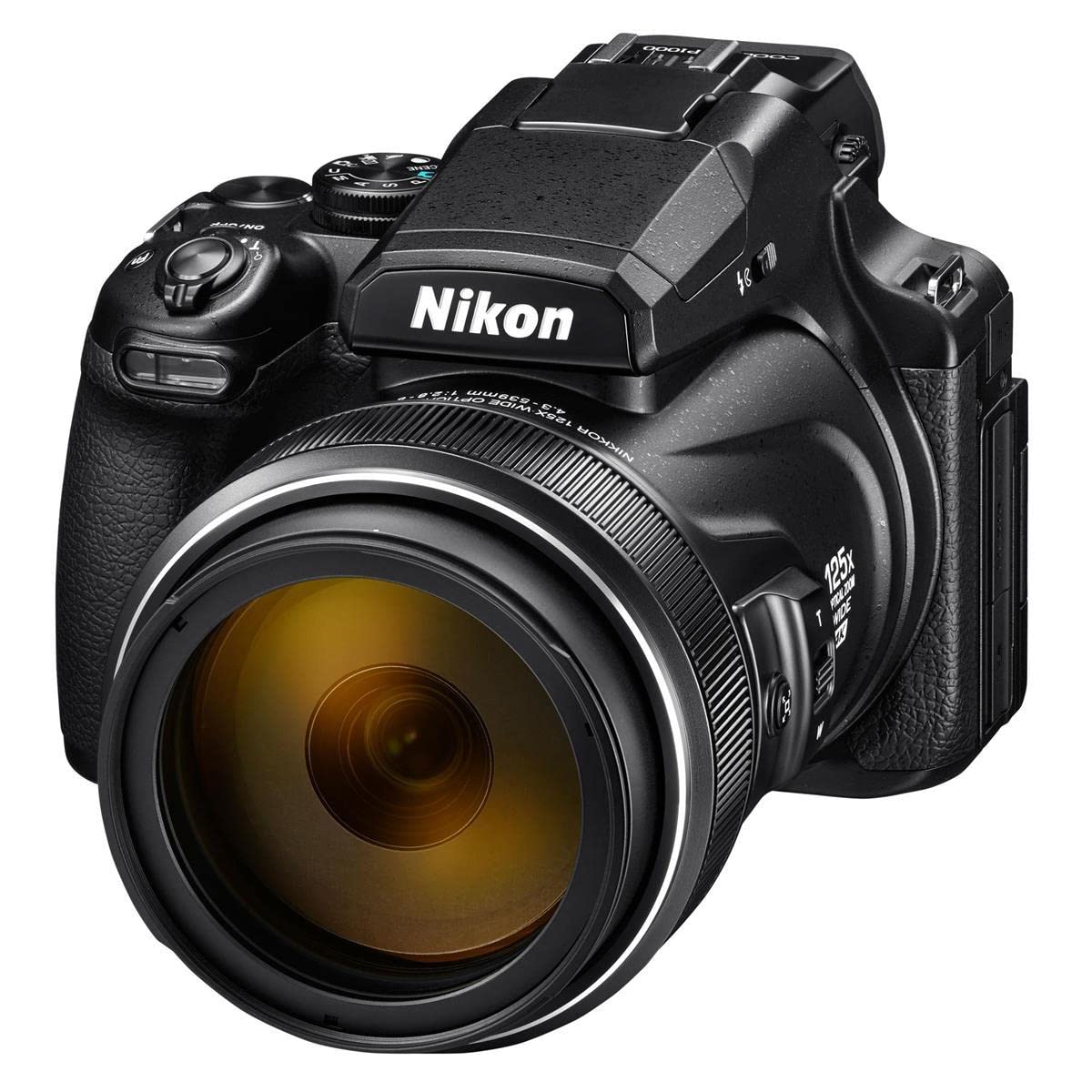
The 125x optical zoom lens reaches a 3000mm equivalent focal length at the long end, which is more telephoto reach than any other interchangeable lens system can achieve without a dedicated super-telephoto prime costing many times more. The 3.2-inch vari-angle TFT LCD swings out to the side and rotates for low- and high-angle wildlife framing, and the OLED electronic viewfinder provides a clear alternative in bright sun. The lens has a fast f/2.8 aperture at the wide end that drops to f/8 at the 3000mm extreme, but Dual Detect optical image stabilization with lens shift VR keeps the frame stable enough to handhold at lower shutter speeds with good technique.
4K UHD video captures at 30fps with stereo sound and offers a hot shoe for external microphone use during nature recording. The RAW (NRW) file format allows post-capture latitude for exposure adjustments, and the Time Lapse and Super Lapse modes produce accelerated clips in-camera without editing software. The manual controls, including full M, A, S, and P modes, give shooters the same level of exposure control as a DSLR, while the Easy Auto mode handles casual snapshots.
The 16MP 1/2.3-inch sensor is the weakest part of the system — image quality degrades noticeably past ISO 800, and the small pixel sites result in measurable noise in cloudy or shaded environments. The camera weight of about 1.4 kilograms and the front-heavy lens barrel make handheld shooting at full zoom challenging without a tripod or monopod. Battery life is rated at about 250 shots per charge, and the lens hood is included but adds length that makes the camera even more difficult to pack.
Why it’s great
- 125x optical zoom with 3000mm equivalent reach brings distant subjects impossibly close
- Vari-angle LCD supports creative framing angles without moving the entire tripod
- RAW file format provides editing flexibility despite the small sensor resolution
Good to know
- Small sensor produces noisy images above ISO 800 in low light
- Camera is heavy and front-heavy at full zoom — require a tripod for sharpest results
- Autofocus hunts at maximum focal length, particularly on birds against a blank sky
FAQ
Is a vari-angle screen better than a flip-down screen for vlogging?
Does a flip-screen camera need in-body stabilization for smooth video?
Can I use a flip-screen camera for professional live streaming?
Final Thoughts: The Verdict
For most users, the digital camera with flip screen winner is the DJI Osmo Pocket 3 Creator Combo because it combines a high-quality 1-inch sensor with mechanical stabilization and a screen that rotates for any framing, all in a package smaller than a can of soda. If you want interchangeable lenses and a vari-angle screen that works for both photography and vlogging, grab the Canon EOS R50 Kit. And for maximum portability with a flip screen that detaches for completely unique angles, nothing beats the Insta360 GO 3S.

Mo Maruf
I created WellFizz to bridge the gap between vague wellness advice and actionable solutions. My mission is simple: to decode the research and give you practical tools you can actually use.
Beyond the data, I am a passionate traveler. I believe that stepping away from the screen to explore new environments is essential for mental clarity and physical vitality.