Our readers keep the lights on and my smoothie glass nicely filled. As an Amazon Associate, I earn from qualifying purchases.
A zoom lens that brings a hawk at 200 yards into crisp view or captures a singer’s expression from the nosebleed section changes how you see the world. But not all zoom is equal—digital zoom crops a blurry mess, while optical zoom uses real glass to magnify without losing detail. The difference between a 30x and an 83x lens is the difference between seeing the moon as a dot and seeing its craters.
I’m Mohammad Maruf — the founder and writer behind WellFizz. For this guide, I analyzed the optical reach, sensor quality, stabilization systems, and real-world user feedback across 11 zoom-focused cameras to separate the specs that matter from the marketing hype.
Whether you need a compact travel companion or a superzoom for wildlife photography, finding the right digital camera with good zoom comes down to matching optical range, image stabilization, and sensor size to the subjects you shoot most.
How To Choose The Best Digital Camera With Good Zoom
Zoom cameras span a huge range—from pocketable 30x compacts to massive 125x superzooms that look like small telescopes. The right choice depends on what you’re shooting, how far away it is, and how much bulk you’re willing to carry. These three factors will guide your decision.
Optical Zoom Range: The Real Measure of Reach
Optical zoom is the only zoom that matters. A 50x optical zoom lens physically extends to magnify the image, preserving full resolution at every focal length. Digital zoom simply crops and enlarges the center of the frame, destroying detail. Check the “x” rating on the lens—30x is solid for general use, 60x reaches distant wildlife, and 83x or 125x puts the moon, mountains, and far-off birds within frame.
Image Stabilization: Your Handheld Safety Net
At 50x zoom and beyond, even the slightest hand tremor translates into major blur. Optical image stabilization (OIS) uses floating lens elements to counteract movement. Look for “Optical Image Stabilization” or “POWER O.I.S.” in the specs—these systems let you shoot handheld at extreme telephoto ranges where a tripod would otherwise be mandatory.
Sensor Size and Low-Light Capability
Most superzoom bridge cameras use a 1/2.3-inch sensor, which is small. That small sensor means grainier images in dim light, even at modest ISO settings. If low-light performance matters, a DSLR bundle with a large APS-C sensor and a telephoto lens delivers cleaner images, but with more weight and system complexity. For bright daylight shooting, the smaller sensor in a superzoom bridge camera is perfectly adequate.
Quick Comparison
On smaller screens, swipe sideways to see the full table.
| Model | Category | Best For | Key Spec | Amazon |
|---|---|---|---|---|
| Nikon COOLPIX P1000 | Superzoom Bridge | Extreme reach 125x zoom | 125x optical / 3000mm equiv. | Amazon |
| Nikon COOLPIX P950 | Superzoom Bridge | 83x zoom & birding modes | 83x optical / 2000mm equiv. | Amazon |
| Panasonic LUMIX FZ80D (60x) | Superzoom Bridge | 60x zoom & 4K video | 60x optical / 1200mm equiv. | Amazon |
| Panasonic LUMIX FZ80D Bundle | Superzoom Bridge | 60x zoom + accessories bundle | 60x optical / 1200mm equiv. | Amazon |
| Panasonic LUMIX TZ/ZS99 | Travel Zoom Compact | Pocketable 30x travel zoom | 30x optical / 720mm equiv. | Amazon |
| Canon EOS Rebel T7 (Double Zoom Kit) | DSLR Bundle | Interchangeable lens system | 24.1MP APS-C sensor | Amazon |
| Canon EOS Rebel T7 (18-55mm Kit) | DSLR Bundle | Entry-level DSLR kit zoom | 24.1MP APS-C sensor | Amazon |
| Canon EF-S 55-250mm Lens | Telephoto Lens | DSLR telephoto upgrade | 55-250mm / f/4-5.6 IS | Amazon |
| Minolta MN40Z | Budget Bridge | Budget-friendly 40x zoom | 40x optical / 20MP sensor | Amazon |
| Canon PowerShot SX530 HS | Mid-Range Superzoom | 50x zoom & WiFi sharing | 50x optical / 1200mm equiv. | Amazon |
| Kodak PIXPRO Astro Zoom AZ528 | Value Superzoom | 52x zoom & burst shooting | 52x optical / 24mm wide | Amazon |
In‑Depth Reviews
1. Nikon COOLPIX P1000
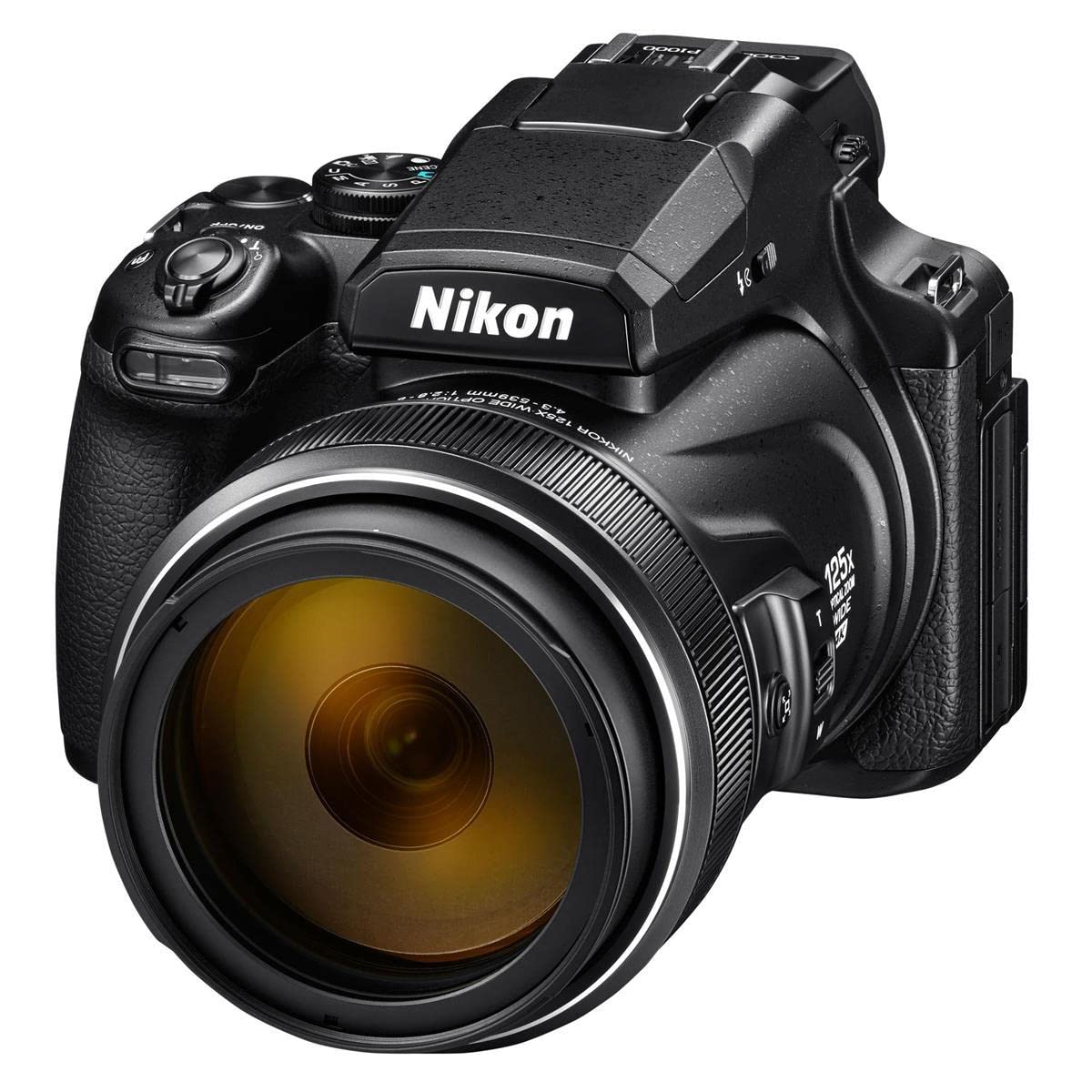
The Nikon P1000 holds the crown for raw optical reach—125x zoom delivering a 24-3000mm equivalent focal length. No other camera in this class gets you closer to the subject without changing lenses. The Dual Detect Optical Vibration Reduction helps steady the frame at extreme telephoto lengths, though at 3000mm a tripod is still your friend for tack-sharp shots.
Video shooters will appreciate the 4K UHD recording with stereo sound and an accessory hot shoe for an external mic. The vari-angle 3.2-inch LCD makes composing at awkward angles easier. Raw (NRW) format support gives you latitude for post-processing, while dedicated Moon and Bird scene modes simplify challenging subjects.
The main trade-offs are weight and low-light performance. At over 3 pounds, the P1000 is heavy for all-day carry, and the small 1/2.3-inch sensor produces grain above ISO 800. Autofocus can hunt at the long end of the zoom. For daylight wildlife, astrophotography, and anyone who needs the absolute maximum zoom in a single lens, this is the benchmark.
Why it’s great
- Unmatched 125x optical zoom (3000mm) reaches subjects miles away
- 4K video with stereo sound and external mic support
- Raw format capture for advanced editing flexibility
Good to know
- Heavy—over 3 pounds, requires a sturdy bag and tripod for best results
- Small sensor limits usable ISO to 800 for clean images
- Autofocus struggles at the extreme long end in low contrast
2. Nikon COOLPIX P950

The P950 gives you 83x optical zoom (24-2000mm) with a pair of dedicated scene modes—Bird and Moon—that optimize shutter speed, focus, and exposure for these specific subjects. The Dual Detect Optical Vibration Reduction works well enough that handheld shots at 2000mm are usable, though the small f/6.5 aperture at the tele end limits depth of field.
Image quality at 16 megapixels from the 1/2.3-inch CMOS sensor is solid in good light. The 4K UHD video captures at 30fps, and the vari-angle LCD makes low-angle wildlife shots easier. The built-in Wi-Fi and Bluetooth let you transfer images to your phone for quick sharing. The manual focus ring is conveniently placed on the lens barrel for fine-tuning when autofocus hunts.
Where the P950 falls short is low-light performance—images get noisy quickly above ISO 800, and the autofocus sometimes fails to lock onto birds against a cluttered background.
Why it’s great
- 83x zoom covers 24-2000mm—enough for most wildlife and moon shots
- Dedicated Bird and Moon scene modes make tricky subjects simple
- Dual Detect image stabilization works well handheld at 2000mm
Good to know
- Small sensor gets noisy above ISO 800 in dim conditions
- Autofocus can miss on birds against complex backgrounds
- Maximum aperture narrows to f/6.5 at telephoto end
3. Panasonic LUMIX FZ80D (Standalone)

The FZ80D packs a 60x optical zoom (20-1200mm equivalent) into a lightweight bridge body that weighs just 1.4 pounds—light enough for day hikes. The POWER O.I.S. (Optical Image Stabilizer) effectively cancels hand shake at the tele end, letting you shoot handheld at 1200mm with confidence. The 2,360K-dot OLED Live Viewfinder remains clear even in bright sunlight.
4K video recording is a standout feature at this price, and the 4K Photo mode lets you extract 8-megapixel stills from video clips. The Post Focus feature lets you change the focal point after taking a shot, which is genuinely useful for macro and nature work. The f/2.8 maximum aperture at the wide end helps in lower light.
Limitations include the 1/2.3-inch sensor, which produces grainy images at higher ISOs, and the lack of built-in Wi-Fi for easy image transfer. The interface can feel dated, and battery life is average. For the zoom range-to-price ratio, the FZ80D is one of the best bridge camera values available.
Why it’s great
- 60x zoom with effective POWER O.I.S. for handheld telephoto shots
- 4K video and 4K Photo extract mode for flexible shooting
- Lightweight at 1.4 pounds—easy to carry on trails
Good to know
- Small sensor limits low-light image quality
- No built-in Wi-Fi for direct phone transfers
- Battery drains faster when using zoom and video heavily
4. Panasonic LUMIX FZ80D (Bundle)
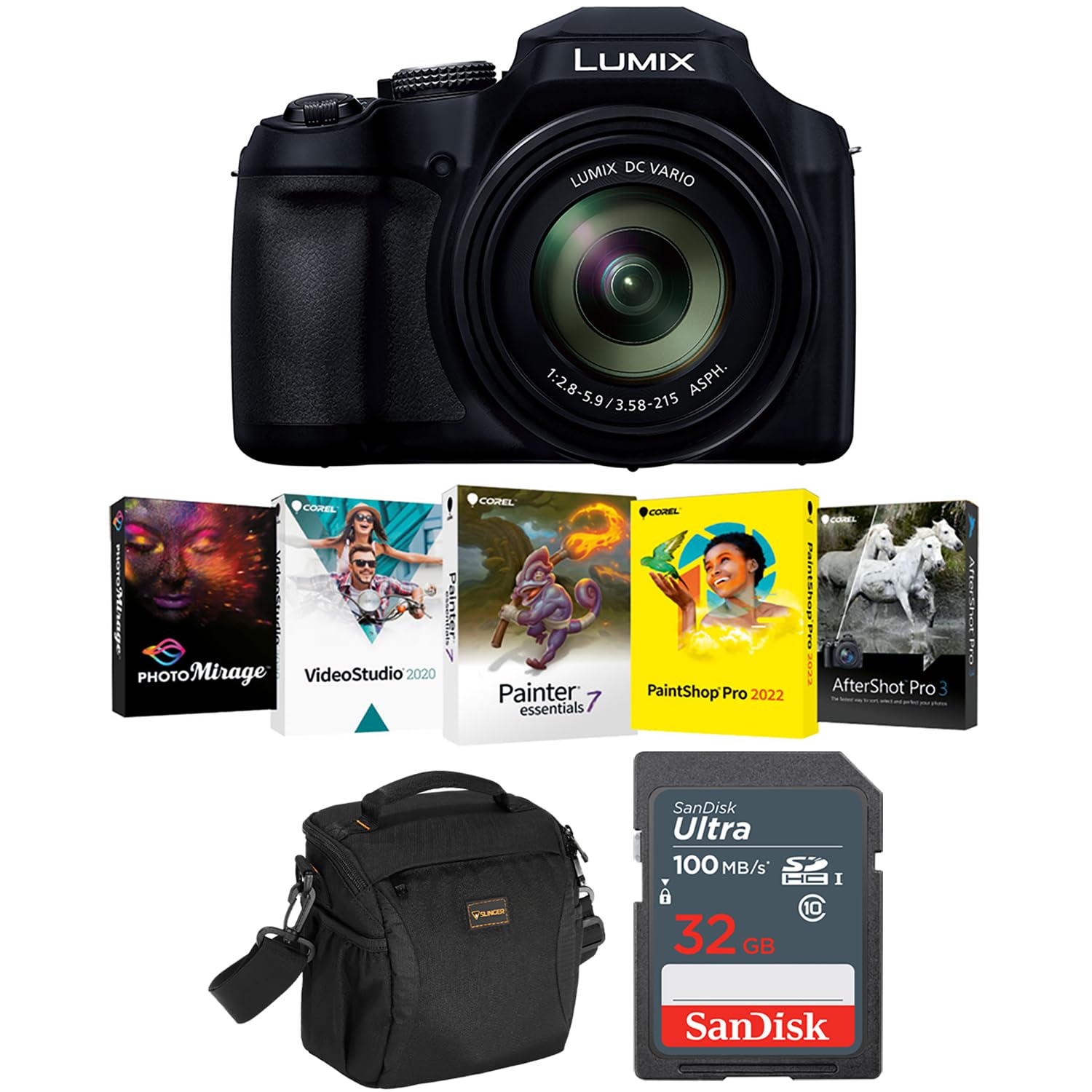
This bundle version of the FZ80D includes the same 18.1-megapixel MOS sensor and 60x zoom lens (20-1200mm) as the standalone model, but adds a 32GB UHS-I SDHC memory card, a slinger shoulder bag, and a software kit. The camera body features the same POWER O.I.S. stabilization and 2.36m-dot OLED viewfinder that make handheld superzoom shooting practical.
The 4K video recording at 30p and 4K Photo burst mode at 30fps give you multiple ways to capture fast action. The 10 fps continuous shooting speed is fast enough for sports and wildlife sequences. The aperture range of f/2.8-5.9 provides decent exposure flexibility, and ISO 80-3200 covers most daylight scenarios.
Beware that the included shoulder bag is basic and the software kit requires online downloads. The camera still lacks Bluetooth, and the fixed touchscreen can be limiting for overhead shots. For a first-time superzoom buyer who wants everything in one box, this bundle saves a few trips to the accessory store.
Why it’s great
- Same excellent 60x zoom and 4K video as standalone FZ80D
- Bundle includes SD card and bag for immediate use
- POWER O.I.S. works well at full 1200mm telephoto
Good to know
- No Bluetooth connectivity; WiFi setup can be finicky
- Software suite requires online download or paid subscription
- Bundled bag is basic quality—buy a hard case for travel
5. Panasonic LUMIX TZ/ZS99

The ZS99 squeezes a 30x Leica DC Vario-Elmar zoom lens (24-720mm equivalent) into a body that actually fits in a pants pocket. This is the camera you bring to concerts, family trips, and city breaks where a superzoom bridge camera would be too bulky. The 1,840k-dot tiltable touchscreen helps compose from awkward angles.
4K video at 30p and 4K Photo burst at 30fps are welcome features in a compact body. The Bluetooth v5.0 and dedicated Send Image button make transferring photos to your phone seamless. The Lens Position Resume function remembers your last zoom setting when the camera powers back on, a small but meaningful convenience for event shooters.
Image quality from the 20.3-megapixel BSI CMOS sensor is good in bright light but drops off noticeably in dim conditions—the small sensor and slow aperture (f/3.3-6.4) limit low-light performance. The 30x zoom is modest compared to bridge cameras, but for the pocketable form factor, it’s an excellent trade-off. Some users report the autofocus feels less snappy than competitors.
Why it’s great
- True pocketable design with a 30x Leica zoom lens
- Bluetooth v5.0 and dedicated Send Image button for quick sharing
- Tiltable touchscreen and 4K video in a compact body
Good to know
- Small sensor and slow aperture struggle in low light
- 30x zoom is less reach than bridge cameras offer
- Autofocus speed can feel sluggish in some situations
6. Canon EOS Rebel T7 (Double Zoom Kit)
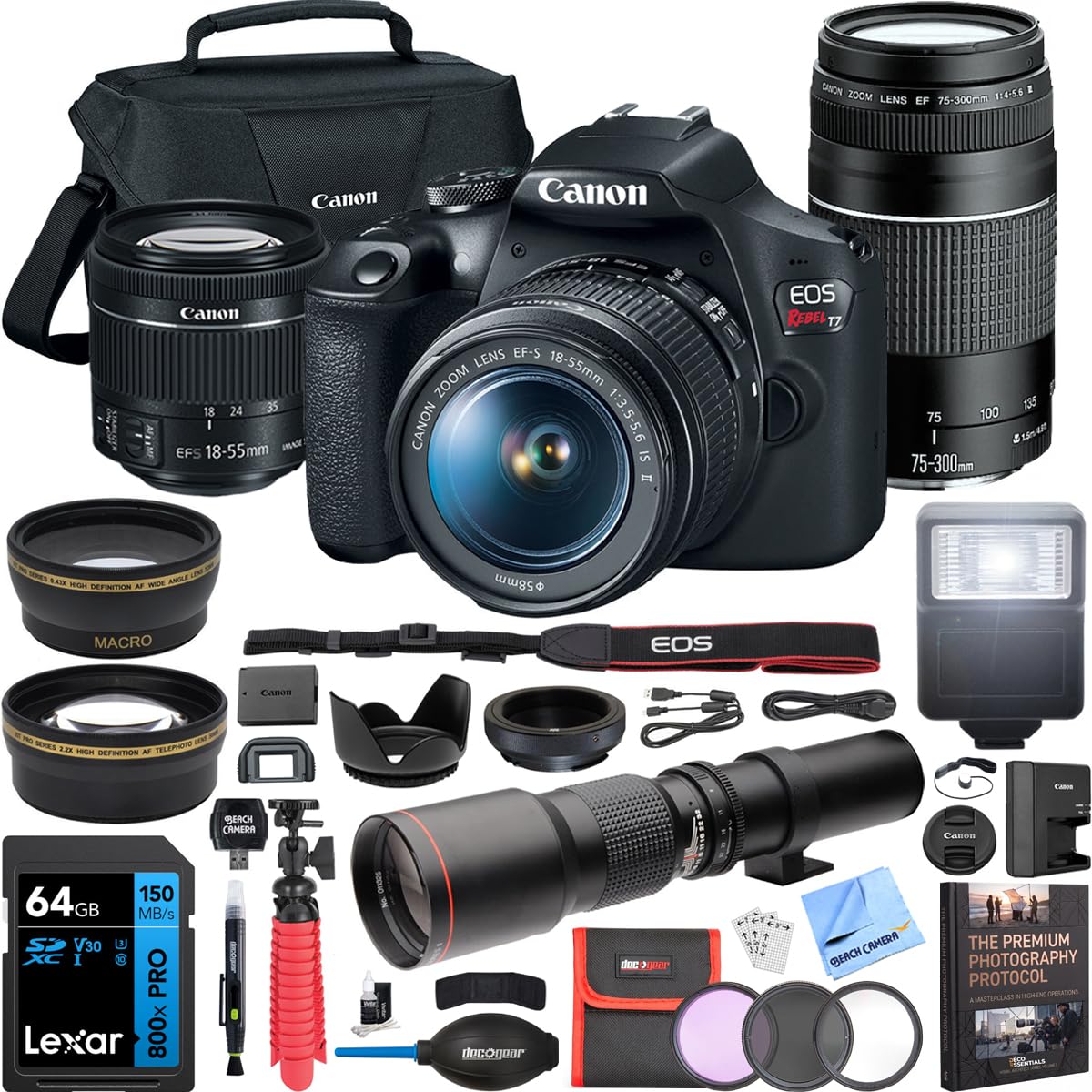
This Canon Rebel T7 bundle delivers zoom flexibility through interchangeable lenses rather than a single superzoom. The kit includes both an 18-55mm IS II lens for everyday shooting and a 75-300mm telephoto lens for distant subjects, plus a 500mm preset telephoto lens for extreme reach. The 24.1-megapixel APS-C sensor is dramatically larger than any bridge camera’s 1/2.3-inch chip, producing cleaner images at higher ISOs.
The 9-point autofocus system with AI Servo AF handles moving subjects reasonably well. The optical viewfinder provides a clear, real-time view without the lag of electronic viewfinders. Built-in Wi-Fi and NFC enable wireless image transfer and remote shooting. The bundle packs a ton of accessories including a 64GB memory card, camera bag, and filter kit.
The caveats: changing lenses in the field requires carrying extra glass, and the 500mm preset lens is a manual-focus-only accessory with fixed f/8 aperture—not great for fast action. The Canon T7 body shoots at only 3 fps, which is slow for sports. Battery life is also an issue; several users report the stock battery draining after just a handful of shots.
Why it’s great
- Large APS-C sensor delivers far better image quality than bridge cameras
- Interchangeable lenses let you build a system over time
- Double zoom kit covers 18-300mm with Canon’s reliable IS
Good to know
- Slow 3 fps burst rate misses fast action sequences
- Stock battery drains quickly—buy an extra LP-E10
- 500mm preset lens is manual focus only with fixed f/8 aperture
7. Canon EOS Rebel T7 (18-55mm Kit)
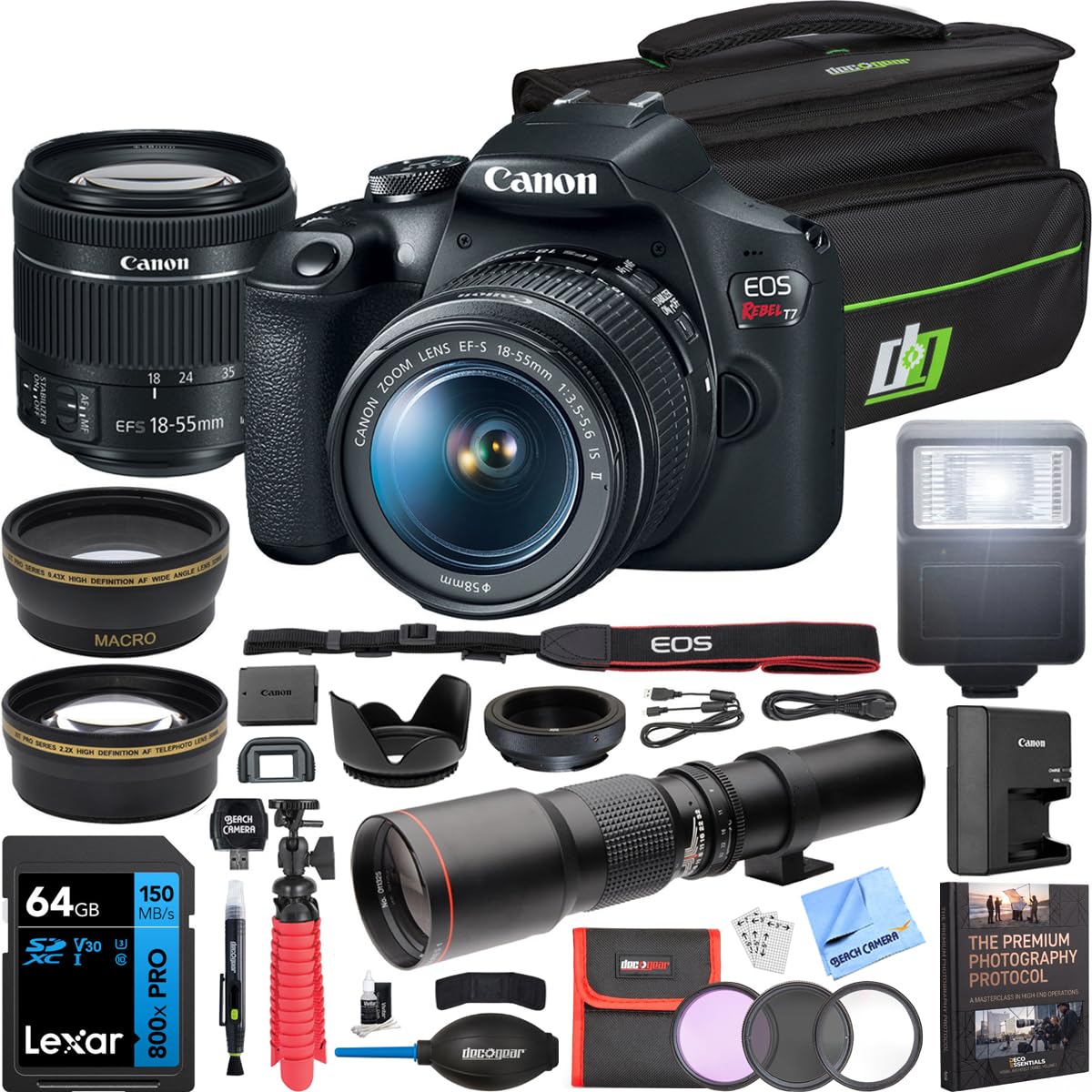
This version of the Canon Rebel T7 bundles the camera body with just the 18-55mm f/3.5-5.6 IS II kit lens, plus a 500mm preset telephoto lens and the same extensive accessory package as the double zoom kit. At 24.1 megapixels with the DIGIC 4+ processor, the Rebel T7 produces sharp, color-accurate images that exceed any bridge camera in this price range.
The Scene Intelligent Auto mode makes it easy for beginners to get good results without manual adjustments. The optical viewfinder covers 95% of the frame, and the 3-inch LCD with 920,000 dots is bright enough for review. The bundle includes flash, tripod, memory card, and cleaning kit, covering everything a first-time DSLR owner needs.
The same weaknesses apply: 3 fps continuous shooting is slow, and the included 500mm preset lens is manual-focus with f/8 aperture, requiring good light and a steady tripod. The 18-55mm lens offers only modest zoom (29-88mm equivalent after crop factor). For photographers who want to grow into an interchangeable lens system, this is an affordable entry point with room to upgrade glass later.
Why it’s great
- APS-C sensor produces clean, detailed images with great color
- Scene Intelligent Auto mode helps beginners shoot confidently
- Comprehensive accessory bundle covers tripod, flash, and memory
Good to know
- Short 18-55mm kit lens offers minimal zoom range
- Battery life is poor—plan to carry spares
- 500mm lens is manual focus only; 3fps burst is slow for action
8. Canon EF-S 55-250mm f/4-5.6 IS II Lens

The Canon EF-S 55-250mm f/4-5.6 IS II is a dedicated telephoto zoom lens for Canon APS-C DSLRs like the Rebel T7. When mounted, it provides an 88-400mm equivalent focal range, giving you real reach for sports, wildlife, and portraits without switching to a massive superzoom bridge camera. The image stabilization (rated for 4 stops) helps keep handheld shots sharp at 250mm.
The lens construction uses 12 elements in 10 groups, including one Ultra-low Dispersion (UD) glass element that reduces chromatic aberration. Autofocus is driven by a DC motor with gear-driven front focusing—quiet enough for candid shooting but not silent. At 390 grams (0.86 pounds), it’s light enough to carry as a second lens on day trips.
Weaknesses include a slow maximum aperture of f/4-5.6, which limits low-light and action shooting. Autofocus speed is adequate for static subjects but can struggle with fast-moving sports or birds in flight. The international version carries no US warranty from Canon, so check the return policy of the seller. For the price of a cheap bridge camera, this lens dramatically improves the reach of any Canon APS-C DSLR.
Why it’s great
- Lightweight telephoto that turns a kit DSLR into a wildlife setup
- Image stabilization delivers sharp handheld shots at 250mm
- UD glass element reduces color fringing for cleaner telephoto images
Good to know
- Slow f/4-5.6 aperture limits performance in low light
- Autofocus speed is moderate—misses fast-moving subjects
- International version may lack a US warranty
9. Minolta MN40Z

The Minolta MN40Z offers 40x optical zoom in a compact, lightweight bridge body at a price that undercuts most competitors. The 20-megapixel sensor captures adequate detail in bright daylight, and the 1080p Full HD video recording at 30fps is functional for casual clips. Built-in Wi-Fi lets you transfer images to a smartphone using the companion app.
The 3-inch LCD screen is bright enough for composing shots, and face, smile, and blink detection features make family photography simpler. The camera runs on AA batteries, which is a mixed blessing—easy to replace on the road but less convenient than a dedicated rechargeable pack. The ISO range of 100-6400 covers dim scenes, though image quality degrades rapidly above ISO 800.
Autofocus and stabilization both feel budget-tier; the camera occasionally freezes when switching modes or zooming rapidly, requiring a battery pull to reset. Low-light performance is poor, and the image stabilizer is less effective than the Panasonic or Nikon systems. For a first-time buyer on a strict budget who wants more zoom than a phone, the MN40Z is a functional starting point.
Why it’s great
- 40x optical zoom at a very accessible price point
- AA batteries are easy to find and replace anywhere
- Lightweight body and Wi-Fi sharing for beginners
Good to know
- Image stabilization is weak at the telephoto end
- Camera can freeze during mode switching
- Poor low-light performance limits versatility
10. Canon PowerShot SX530 HS

The Canon SX530 HS delivers 50x optical zoom (24-1200mm equivalent) in a proven body that has been a reliable choice for budget-conscious superzoom buyers. The 16-megapixel CMOS sensor combined with the DIGIC 4+ processor produces vibrant, natural-looking colors typical of Canon’s JPEG processing. The optical image stabilizer helps keep telephoto shots steady.
Built-in Wi-Fi and NFC make transferring images to your phone straightforward. The 1080p Full HD video recording with a dedicated movie button makes switching between stills and video seamless. The 3-inch LCD has 461,000 dots, which is adequate for composition but not as sharp as newer models. The camera supports ISO 100-3200.
Some users find the autofocus slightly slow when zooming quickly from wide to telephoto. The 1.6 fps continuous shooting is very slow by modern standards and unsuitable for fast action. The SX530 HS is a renewed/refurbished model, so condition and accessories vary by seller. For someone who wants proven 50x zoom at a budget price and is comfortable with a renewed unit, this camera delivers Canon’s reliable image processing.
Why it’s great
- 50x optical zoom with Canon’s excellent color processing
- WiFi/NFC for easy image sharing to smartphones
- Dedicated movie button for quick 1080p video switching
Good to know
- Renewed model—condition and included accessories vary by seller
- Slow 1.6 fps burst rate misses fast-action moments
- Autofocus can lag when zooming rapidly
11. Kodak PIXPRO Astro Zoom AZ528
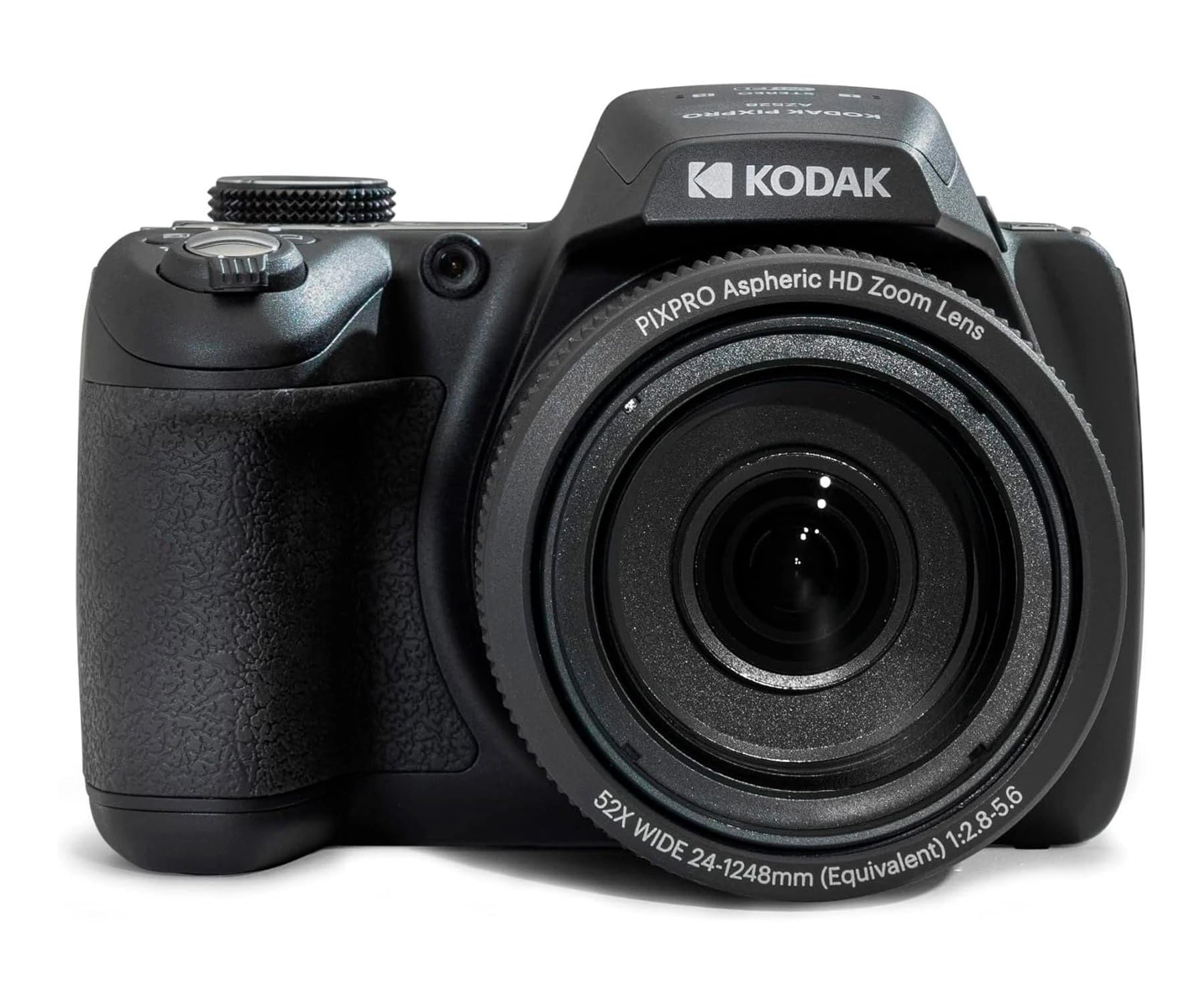
The Kodak PIXPRO AZ528 stands out with 52x optical zoom (24mm wide-angle to 1248mm equivalent) at a price that undercuts many 40x models. The 16-megapixel BSI CMOS sensor improves low-light sensitivity over standard CMOS sensors, and the optical image stabilization works well enough for handheld bird and wildlife shots at moderate zoom levels.
The 6 fps burst shooting is surprisingly fast for this price bracket, letting you capture sequences of birds in flight or sports action. The 1080p Full HD video records smooth footage, and built-in Wi-Fi connects to Kodak’s app for wireless transfer and remote control. The camera accepts SD, SDHC, and SDXC cards up to 512GB, giving you plenty of storage for extended shooting sessions.
Battery life is short—expect to need a spare for a full day of shooting. The camera body uses plastic construction that feels less durable than competitors, and the casing scuffs easily. The zoom is optical but requires steady hands and good light for the sharpest results at the telephoto end. For the price-to-zoom ratio, the AZ528 is an impressive value if you accept the build and battery trade-offs.
Why it’s great
- 52x optical zoom at a very competitive price
- 6 fps burst shooting captures fast-action sequences
- BSI CMOS sensor improves low-light performance over standard sensors
Good to know
- Battery life is short—purchase a spare for full-day shoots
- Plastic body scuffs easily and feels less premium
- Need steady hands and good light for sharp 52x telephoto shots
FAQ
What does the “x” in optical zoom really mean for a digital camera?
Is a 125x zoom on the Nikon P1000 worth the extra weight and cost?
Why do superzoom bridge cameras produce grainy photos at night?
Can I use a DSLR telephoto lens like the Canon 55-250mm on a Rebel T7 for wildlife?
How important is image stabilization for handheld superzoom photography?
Final Thoughts: The Verdict
For most users, the digital camera with good zoom winner is the Nikon COOLPIX P950 because it balances 83x optical reach with practical weight, dedicated wildlife scene modes, and effective image stabilization at a price that doesn’t break into luxury territory. If you want the absolute maximum zoom capability and don’t mind carrying extra weight, the Nikon COOLPIX P1000 offers 125x zoom and 4K video in a powerful all-in-one package. And for pocketable travel zoom that slips into a jacket, nothing beats the Panasonic LUMIX TZ/ZS99.

Mo Maruf
I created WellFizz to bridge the gap between vague wellness advice and actionable solutions. My mission is simple: to decode the research and give you practical tools you can actually use.
Beyond the data, I am a passionate traveler. I believe that stepping away from the screen to explore new environments is essential for mental clarity and physical vitality.