Our readers keep the lights on and my smoothie glass nicely filled. As an Amazon Associate, I earn from qualifying purchases.
Selecting a dive computer watch means trusting an algorithm with your decompression status, your surface interval, and your gas switches at depth — a choice that directly impacts safety on every dive. The difference between a watch-style unit that merely logs depth and one that genuinely manages your tissue load comes down to algorithm fidelity, display clarity under low visibility, and battery endurance across a multi-day trip.
I’m Mohammad Maruf — the founder and writer behind WellFizz. I’ve spent hundreds of hours cross-referencing manufacturer spec sheets, decompression model documentation, and real-world user reports to build this comparison of the market’s most capable dive computer watches.
This guide separates the serious dive computers from the novelties, focusing on measurable performance in algorithm sophistication, screen readability, battery life, and gas management — to help you find the best dive computer watches for your specific underwater needs.
How To Choose The Best Dive Computer Watches
Dive computer watches compress critical safety information into a wrist-mounted package that must be legible in murky water, reliable under pressure, and intuitive enough to operate with gloved fingers. Most recreational divers over-prioritize screen size while ignoring the decompression algorithm and gas-switching flexibility that define a dive computer’s true capability.
Algorithm and Gradient Factors
The decompression algorithm calculates how nitrogen absorbs into and releases from your tissues. The Bühlmann ZH-L16C is the industry standard, but its conservative gradient factor settings (controllable on many premium models) determine how close you ride to the no-deco limit. A computer that locks gradient factors to a max of 85, as some entry-level units do, restricts tech divers who want a calibrated backup. Always verify whether the algorithm offers adjustable gradient factors and how many gas mixes it can manage simultaneously — three is the minimum for serious recreational flexibility; five or more is needed for technical diving.
Display Readability and Battery Life
MIP (Memory in Pixel) color displays like those used on the Mares Sirius offer excellent visibility in bright overhead sunlight but can become unreadable in low-light underwater conditions without a backlight, which drains battery faster. AMOLED screens, found on the Suunto Ocean, deliver high contrast and vivid colors even in darkness but consume more power overall. Monochrome LCD panels, as used on the Suunto D5 and Garmin Descent G1, are the most power-efficient and remain readable under direct sunlight, though they lack the visual richness of color displays. Battery life varies widely: 25 to 40 hours of dive time is the minimum for a week-long liveaboard trip without recharging; mid-range options deliver between 25 and 30 hours, while premium units can push past 40 hours.
Air Integration and Connectivity
Hoseless air integration streams tank pressure data wirelessly from a transmitter attached to the first stage. This is a major safety upgrade because it provides real-time gas consumption rates and remaining air time calculations on the wrist display. The Garmin Descent Mk2i uses SubWave sonar technology to track up to five tanks simultaneously from a 10-meter range. On mid-range and entry-level computers, air integration is either absent or requires an optional module. If you dive with multiple tanks or lead a group, integrated monitoring adds a meaningful safety layer. Bluetooth connectivity for logbook transfer is now standard, but the ease of the companion app varies significantly between brands.
Quick Comparison
On smaller screens, swipe sideways to see the full table.
| Model | Category | Best For | Key Spec | Amazon |
|---|---|---|---|---|
| Garmin Descent Mk2i | Premium | Air integration & daily wear | 80h dive mode / SubWave | Amazon |
| Suunto Ocean | Premium | AMOLED display & GPS | 40h dive / Bühlmann 16 GF | Amazon |
| Shearwater Peregrine | Mid-Range | Color display & ease of use | 30h dive / Bühlmann GF | Amazon |
| Mares Sirius | Mid-Range | Multigas & digital compass | 30h dive / 5 gas mixes | Amazon |
| Garmin Descent G1 | Mid-Range | Fitness tracking & diving | 25h dive / 30+ sport apps | Amazon |
| Cressi Raffaello | Mid-Range | Large clear display | RGBM / 50-dive log | Amazon |
| Suunto D5 | Mid-Range | Color screen & strapless | Air integration optional | Amazon |
| Cressi Donatello | Budget | Entry-level simplicity | Single button / CR2430 | Amazon |
| Mares Puck 4 | Budget | Bühlmann at low cost | ZH-L16C / 3 gases | Amazon |
In‑Depth Reviews
1. Garmin Descent Mk2i

The Descent Mk2i is the most advanced watch-style dive computer in this lineup, combining a 1.4-inch color sunlight-readable display with the SubWave sonar air integration network that monitors up to five tanks within a 10-meter range. Its titanium case and sapphire lens provide the build quality expected for deep technical diving, while the 80-hour dive mode battery life covers extended trips where power outlets are scarce.
Six dive modes — including recreational, technical, free diving, and gauge mode — are paired with full Garmin multisport tracking, so this computer serves as a daily smartwatch that tracks sleep, heart rate, Pulse Ox, and over 30 sport profiles. Reviewers consistently note the precise GPS entry/exit marking and the detailed underwater compass as standout features that elevate situational awareness.
The only real limitation is the premium investment required, which positions it as a long-term tool for serious divers rather than a casual purchase. The companion Garmin Dive app handles logbook syncing and site search cleanly, though some users find the need for multiple Garmin apps slightly fragmented.
Why it’s great
- SubWave sonar air integration tracks 5 tanks simultaneously
- 80-hour dive mode battery for liveaboard trips
- Titanium case with sapphire lens for durability
- Full multisport and sleep tracking as a daily watch
Good to know
- Premium price point; T1 transmitter sold separately
- Multiple Garmin apps required for full functionality
- Bulkier on small wrists despite smaller Mk2 design
2. Suunto Ocean

The Suunto Ocean brings a 1.43-inch AMOLED touchscreen to dive computing, offering high contrast and vivid colors that remain readable underwater at various depths. Its dual-band GNSS supports underwater route tracking — a rare feature that allows you to replay your dive path in 3D within the Suunto App, adding a new layer of dive analysis beyond depth and time logs.
Powered by the Bühlmann 16 GF algorithm, the Ocean supports single and multigas diving with air and nitrox, plus freediving, snorkeling, and even mermaid diving modes. The wireless tank pressure pod compatibility gives real-time gas monitoring on the wrist, with mandatory safety alarms for depth, decompression, and ascent rate violations.
Battery life reaches 40 hours in dive mode and 26 days in daily use with all-day heart rate monitoring. The fast-charging circuit refills the battery in roughly one hour. Some users find the interface less customizable than expected, and the default tank pressure setting assumes an HP100 instead of the more common AL80, requiring a manual adjustment during setup.
Why it’s great
- 1.43-inch AMOLED display with excellent underwater contrast
- Underwater GPS route tracking with 3D replay
- 40-hour dive mode with fast charging
- 95+ sports modes for daily activity tracking
Good to know
- Interface can feel less intuitive than competitors
- Default tank pressure requires manual adjustment
- Altimeter fluctuates up to 60 feet at desk (software bug reported)
3. Shearwater Peregrine

The Shearwater Peregrine is widely regarded as the benchmark for recreational dive computers that prioritize algorithm integrity over flashy smartwatch features. Its full-color 2.2-inch LCD display is one of the largest and clearest in this class, offering exceptional low-light readability and a state-aware two-button menu that avoids the confusing nested submenus common on other units.
Shearwater’s implementation of the Bühlmann ZHL-16C algorithm with adjustable gradient factors gives divers complete control over their conservatism, a feature typically reserved for higher-end models. The Peregrine supports nitrox and single-gas diving, and its USB wireless charging station eliminates the hassle of battery covers and O-ring seals. The 30-hour battery life on medium brightness covers a full week of diving without charging.
It lacks GPS, air integration, and full technical gas support (trimix), which keeps it focused squarely on the recreational diver who values decompression accuracy and display clarity above all else. Many users note that the intuitive interface makes setup so simple that they rarely open the manual after the first use.
Why it’s great
- Large 2.2-inch full color display with excellent low-light readability
- Adjustable Bühlmann gradient factors for customized conservatism
- USB wireless charging — no battery compartments to flood
- 30-hour dive battery covers extended liveaboard schedules
Good to know
- No air integration or transmitter support
- No GPS for entry/exit marking
- Does not support trimix or full technical gas management
4. Mares Sirius

The Mares Sirius is built around the Bühlmann ZH-L16C algorithm with predictive multigas capability for up to five gas mixes, including nitrox and trimix, making it one of the most gas-flexible computers at its price point. The MIP color high-resolution display is designed for bright surface readability, though some users report that the screen becomes dim in low-light underwater conditions without strong ambient light.
Its full-tilt digital compass with bearing memory and integrated stopwatch provides reliable underwater navigation without the need for a separate instrument. The hoseless data integration supports up to five transmitters, allowing simultaneous tank pressure monitoring across multiple bottles — a feature typically found on more expensive units.
The smart battery management system claims 30 hours of dive time per charge, and the 100-dive logbook includes tissue saturation graphs and dive profile charts for post-dive analysis. A few reviewers noted that the display brightness does not match the promotional photos, with the MIP panel appearing dimmer than expected at normal viewing angles.
Why it’s great
- Predictive multigas with up to 5 gas mixes including trimix
- Full-tilt digital compass with bearing memory
- Wireless tank data integration for up to 5 transmitters
- Detailed 100-dive log with tissue saturation profiles
Good to know
- MIP display is dim in low-light underwater conditions
- Battery lasts only 6 days in watch-only mode
- Menu navigation can feel sluggish without graphics-based UI
5. Garmin Descent G1

The Garmin Descent G1 strips away the color screen and air integration of the Mk2i to deliver a rugged, monochrome-dive computer that integrates seamlessly with Garmin’s multisport ecosystem. Its 1.3-inch MIP display is easy to read in direct sunlight and provides 25 hours of dive time, 21 days of smartwatch mode, and 26 hours of GPS tracking — making it a genuine 24/7 wearable for active divers.
The G1 supports recreational, advanced, technical, free diving, and spear fishing modes, plus over 30 built-in sports apps including running, swimming, and hiking. Built-in GPS, GLONASS, and Galileo support mark surface entry and exit points, and the wrist-based heart rate and Pulse Ox sensors deliver health metrics comparable to Garmin’s fitness-focused watches.
The monochrome display lacks the visual depth of color screens, and there is no optional air integration module for tank pressure monitoring. Reviewers consistently praise the battery endurance and the Garmin Dive app’s ease of use, making the G1 a strong option for divers who want one watch for their entire outdoor lifestyle.
Why it’s great
- 25-hour dive mode battery with 21-day smartwatch standby
- Multi-GNSS for accurate surface entry/exit marking
- 30+ sports apps with full Garmin health monitoring
- Supports freediving and spear fishing modes
Good to know
- Monochrome display lacks color contrast for data grouping
- No air integration or transmitter support
- Sleep tracking accuracy varies; may misread phone scrolling
6. Cressi Raffaello

The Cressi Raffaello is designed around a big-screen concept that prioritizes data readability at a glance, featuring a large display that shows surface intervals, desaturation times, and oxygen toxicity indicators in a clear, uncluttered layout. Its built-in digital compass provides degree-precise navigation without needing a separate instrument, and the RGBM algorithm handles various air mixes with a conservative safety profile.
Diving programs include mixed gases, apnea, and gauge mode, giving recreational and novice technical divers room to grow their skills. The computer stores up to 50 dives per program, and Bluetooth or USB connectivity allows transfer to a smartphone or PC for deeper logbook analysis. The included 2-year warranty provides added peace of mind for a mid-range investment.
Some users find the single-button menu navigation cumbersome, requiring multiple passes through all options if a mistake is made mid-entry. The Bluetooth module is sold separately, which feels like an oversight on a unit at this price tier. The plastic case material is functional but does not convey the same premium feel as stainless steel or titanium alternatives.
Why it’s great
- Large, highly readable display with uncluttered data layout
- Built-in digital compass with degree-precise bearings
- RGBM algorithm with mixed gas, apnea, and gauge modes
- 2-year manufacturer warranty included
Good to know
- Bluetooth module sold separately
- Single-button menu requires cycling through all options
- Plastic case lacks premium feel of metal alternatives
7. Suunto D5

The Suunto D5 is a compact, colorful dive computer that focuses on style and simplicity without sacrificing core dive functionality. Its color screen is crisp in bright conditions, and the exchangeable strap system lets users customize the look for daily wear or underwater use. Vibration alarms provide tactile alerts for depth limits, deco obligations, and ascent rate, reducing reliance on audible tones that can be missed in noisy environments.
The D5 supports wireless tank pressure monitoring through Suunto’s POD transmitter, giving real-time air consumption data on the wrist. The digital compass integrates smoothly into the dive display, and the Bluetooth mobile connection handles logbook syncing with the Suunto app without requiring a separate cable.
A freedive instructor reviewer praised the D5’s display clarity and vibration feedback through a 3mm wetsuit, noting that the battery lasts about 11 hours in dive mode on low brightness. The main criticism centers on the limited air integration options — the POD system works reliably but lacks the multi-tank sonar capabilities of higher-end competitors.
Why it’s great
- Color screen with good brightness for surface readability
- Exchangeable straps for personalization and daily wear
- Vibration alarms work effectively through wetsuits
- Optional wireless air integration with Suunto POD
Good to know
- Battery life capped at 11 hours in dive mode
- Air integration limited to single tank POD system
- No multigas support beyond air and nitrox
8. Cressi Donatello

The Cressi Donatello is a no-frills dive computer designed for recreational divers who want a reliable depth and time tracker without the learning curve of advanced menu systems. Its single-button interface cycles through settings sequentially, and the high-definition display — while not color — delivers clear numeric readouts that remain legible in low visibility conditions.
The Donatello supports air and nitrox modes, user-selectable deep stops, and adjustable measurement units (imperial or metric). Power comes from a replaceable CR2430 coin cell battery, which avoids the need for proprietary charging cables but requires carrying spare batteries on extended dive trips. An optional IR interface enables Bluetooth or USB data transfer for logbook syncing.
Reviewers consistently report that the Donatello performs well for divers who complete around 20 dives per year, but the single-button navigation requires studying the manual multiple times before the menu logic sticks. A few units arrived with torn internal packaging, suggesting quality control issues with packaging freshness rather than product functionality.
Why it’s great
- Simple single-button interface for easy underwater navigation
- Replaceable CR2430 battery — no charging cable needed
- User-selectable deep stops for customizable safety
- Affordable entry point with nitrox support
Good to know
- Single-button navigation requires multiple passes through menus
- Optional IR interface needed for data transfer
- Some units arrived with packaging that appeared previously opened
9. Mares Puck 4
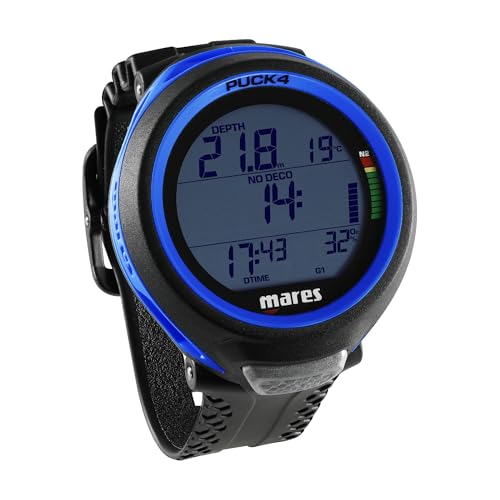
The Mares Puck 4 delivers the Bühlmann ZH-L16C algorithm — the same decompression engine used on computers costing several times more — in a compact, entry-level wrist package. The segment display uses chip-on-glass technology for a clean, readable interface, and the single-button operation is straightforward once users memorize the press sequence. Multigas support for up to three gases (air, nitrox, and bottom timer mode) makes it suitable for recreational and early-stage technical diving.
Integrated Bluetooth connectivity syncs dive data with the Mares app, the SSI app, and even Subsurface on iPhone, giving flexibility in logbook management. The adjustable gradient factors provide some control over conservatism, though the maximum custom gradient factor is limited to 85, preventing its use as a full backup computer for decompression diving. The decompression dive planner and resettable average depth are practical tools for trip planning.
A small number of units arrived with damaged straps, and Mares’ Italian-based customer service can be slow to respond for replacement parts. One reviewer noted that the gas-switching logic requires gas 2 to have a higher oxygen percentage than gas 1, which prevents using the Puck 4 with an air pony bottle as a deeper gas. These constraints limit the Puck 4 to recreational and basic tech applications.
Why it’s great
- Bühlmann ZH-L16C algorithm with adjustable gradient factors
- Bluetooth logbook sync with Mares, SSI, and Subsurface apps
- Multigas support for up to three gas mixes
- Decompression dive planner and resettable average depth
Good to know
- Gradient factors limited to max 85 — not full tech backup
- Gas-switching logic prevents use with air pony bottle
- Replacement straps difficult to source from Italian-based support
FAQ
Can I use a dive computer watch for freediving as well as scuba?
What does gradient factor mean and should I adjust it?
Do I really need air integration on a dive computer watch?
How many gas mixes should my dive computer support?
Can I wear a dive computer watch as a daily smartwatch?
Final Thoughts: The Verdict
For most users, the best dive computer watches winner is the Shearwater Peregrine because it combines a large, readable color display with the full Bühlmann gradient factor algorithm at a mid-range price that outperforms many more expensive competitors in decompression accuracy and ease of use. If you want integrated SubWave air monitoring with daily smartwatch functionality, grab the Garmin Descent Mk2i. And for the budget-conscious recreational diver who values algorithm integrity over smart features, nothing beats the Mares Puck 4 as a compact entry point with real Bühlmann power.

Mo Maruf
I created WellFizz to bridge the gap between vague wellness advice and actionable solutions. My mission is simple: to decode the research and give you practical tools you can actually use.
Beyond the data, I am a passionate traveler. I believe that stepping away from the screen to explore new environments is essential for mental clarity and physical vitality.