Our readers keep the lights on and my smoothie glass nicely filled. As an Amazon Associate, I earn from qualifying purchases.
Decent audio capture shouldn’t require a four-figure budget, especially when you need a reliable tool for lectures, meetings, or interviews. The challenge is sifting through dozens of tiny recorders, each promising studio-quality sound, to find one that actually delivers clear, usable audio at every price point.
I’m Mohammad Maruf — the founder and writer behind WellFizz. I’ve spent many hours analyzing battery specs, noise-reduction chips, and real user feedback to separate the signal from the noise in this category.
This guide breaks down the most reliable hardware for spoken-word capture, so you can confidently pick the best digital voice recorder under $50 without getting lost in marketing claims.
How To Choose The Best Digital Voice Recorder Under $50
Picking the right device means balancing battery life, storage format, and microphone quality. Here are the three specs that matter most for spoken-word capture under this price ceiling.
Battery Endurance and Power Type
A 500mAh rechargeable battery is common in entry-level units and gets you about half a day of continuous recording. Premium entries in this bracket often pack 1100mAh or more, pushing endurance to forty-plus hours. If you record all-day sessions or back-to-back interviews, prioritize higher milliampere-hour ratings over raw storage capacity.
Noise Reduction and Microphone Architecture
Basic models use a single omnidirectional mic that captures everything in a room equally. Units with dual microphones and digital signal processing—often labeled PCM or intelligent noise reduction—can suppress background hum and focus on a speaker’s voice. That difference matters a lot in a busy classroom or open-plan office.
Storage Format and Transfer Speed
Most recorders in this range save audio as MP3 or WAV files. WAV preserves higher fidelity but eats up space faster; MP3 at 192kbps is fine for voice clarity. Built-in memory between 8GB and 128GB is typical, with USB-C connections allowing quicker file transfers than older micro-USB ports.
Quick Comparison
On smaller screens, swipe sideways to see the full table.
| Model | Category | Best For | Key Spec | Amazon |
|---|---|---|---|---|
| Innioasis R1 | Touchscreen | Transcripts & Control | 8GB + microSD up to 1TB | Amazon |
| Vivaniir Magnetic Recorder | Long Endurance | Marathon recording sessions | 6000mAh battery | Amazon |
| EVISTR L357 | Metal Body | Everyday work & meetings | 64GB built-in + PCM | Amazon |
| DGFAN 128GB | Mass Storage | Long-term archiving | 128GB internal memory | Amazon |
| HoTiyan 64GB | Budget Entry | Quick notes & light recording | 64GB storage + 75hr record | Amazon |
In‑Depth Reviews
1. Innioasis R1 Full Touchscreen Recorder
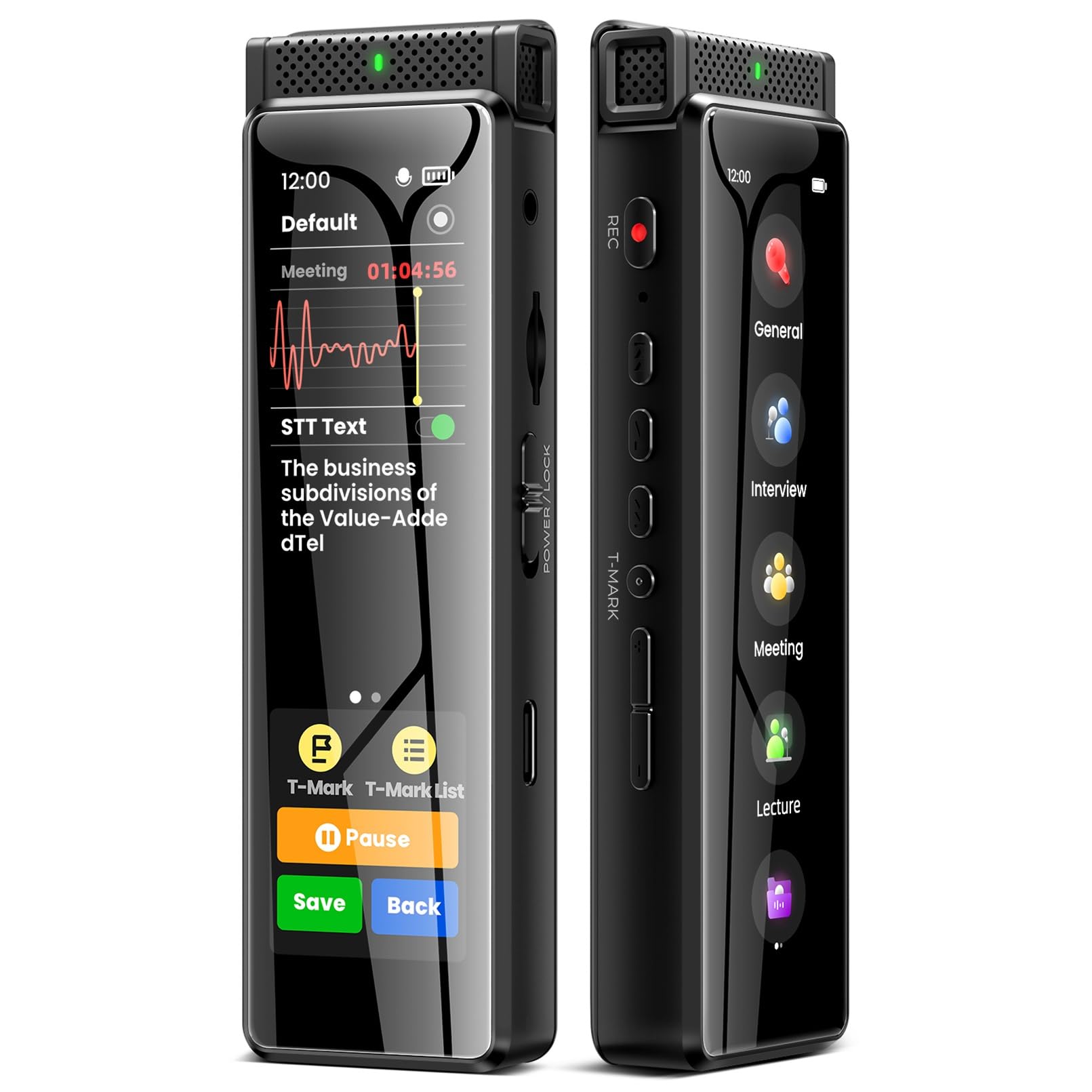
The R1 stands apart from every other entry in this price band thanks to its full 3.69-inch touchscreen and built-in offline speech-to-text transcription. That feature alone saves hours of manual typing during meetings or lecture reviews, even if the accuracy isn’t quite professional. Dual microphones with DSP noise reduction handle General, Interview, Meeting, Lecture, and Pocket presets automatically.
Storage comes from an SD card (not included) that supports up to 1TB, so you never worry about running out of space. The 1100mAh battery delivers long continuous sessions, and the 6-digit password lock keeps sensitive files secure. The only real trade-off is the 8GB internal buffer—you must add a card from day one for any meaningful recording library.
Buyers consistently praise the build quality and audio clarity during music jams and interviews, though the voice-to-text function is hit-or-miss for dictation-heavy workflows. For users who want modern controls and transcription assistance, this is the most advanced pick available in this budget tier.
Why it’s great
- Offline speech-to-text saves transcription time
- Expandable memory up to 1TB via microSD
- Five recording presets for different environments
Good to know
- Transcription accuracy is inconsistent
- No internal SD card included
- Requires conversion software for .aac files
2. Vivaniir Magnetic Voice Recorder
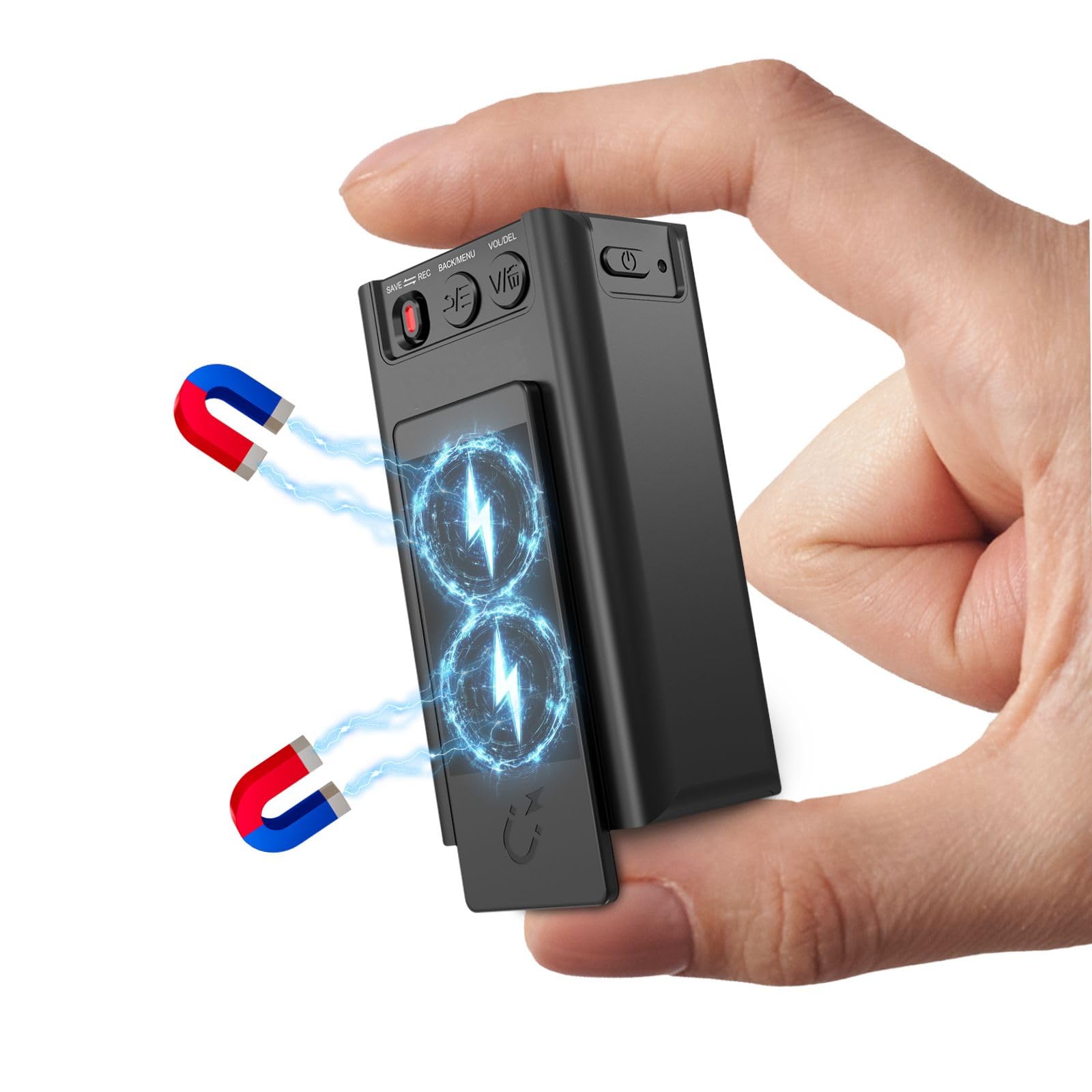
If battery anxiety is your primary concern, the Vivaniir eliminates it outright with a 6000mAh cell rated for 1200 hours of continuous recording—that’s fifty days of non-stop capture. The aluminum body feels dense in hand, and the magnetic backplate lets you stick the recorder to a whiteboard, filing cabinet, or any steel surface for hands-free positioning. AI triple-layer noise reduction keeps audio intelligible even in echo-prone conference rooms.
Operation is deliberately simple: slide up to record, slide down to save. The color screen shows battery level and file list at a glance. Voice activation is disabled by default, but once enabled, the unit pauses during silence and resumes when speech returns, preserving both storage and power. The 64GB internal memory isn’t expandable, but given the endurance, you’ll clear files faster than you’ll fill it.
Users note the all-metal construction feels premium well beyond its price category, though the interface takes a few minutes to learn. For anyone running back-to-back sessions, depositions, or day-long symposiums, this is the only recorder that genuinely lasts the entire event without a recharge.
Why it’s great
- 1200 hours of continuous recording on one charge
- Magnetic backplate for hands-free mounting
- AI noise reduction for busy environments
Good to know
- Internal memory is not expandable
- Voice activation is off by default
- Slightly heavier than plastic-bodied alternatives
3. EVISTR L357 64GB Recorder

The EVISTR L357 hits the sweet spot between price and performance with a machined metal body that feels surprisingly solid for its weight. It records in both MP3 and WAV formats at up to 1536kbps, and the 360-degree dynamic noise reduction microphone does a credible job of suppressing HVAC rumble and distant chatter. Seven levels of recording gain let you fine-tune sensitivity for a quiet interview or a large lecture hall.
Its 64GB internal memory holds up to 4660 hours at the lowest bitrate, and the 500mAh battery recharges fully in about three hours via USB-C for 32 hours of continuous recording. File naming uses real timestamps, making it easy to locate specific recordings later without manual labeling. The two-button interface—record and save—keeps operation intuitive even on the first use.
User reviews consistently highlight the audio clarity for meetings and the durable construction that survives pocket carry. A minority report that the on-board microphone sounds blown out on certain settings, so adjusting gain before each session is worth the habit. For a daily driver that balances size, build, and audio quality, this model is hard to beat at its price tier.
Why it’s great
- All-metal housing for durability
- 7-level gain adjustment for varied environments
- Timestamp-named files for easy organization
Good to know
- Microphone can sound distorted at high gain
- Small screen and buttons are hard to read
- Manual could be clearer for advanced functions
4. DGFAN 128GB Voice Recorder
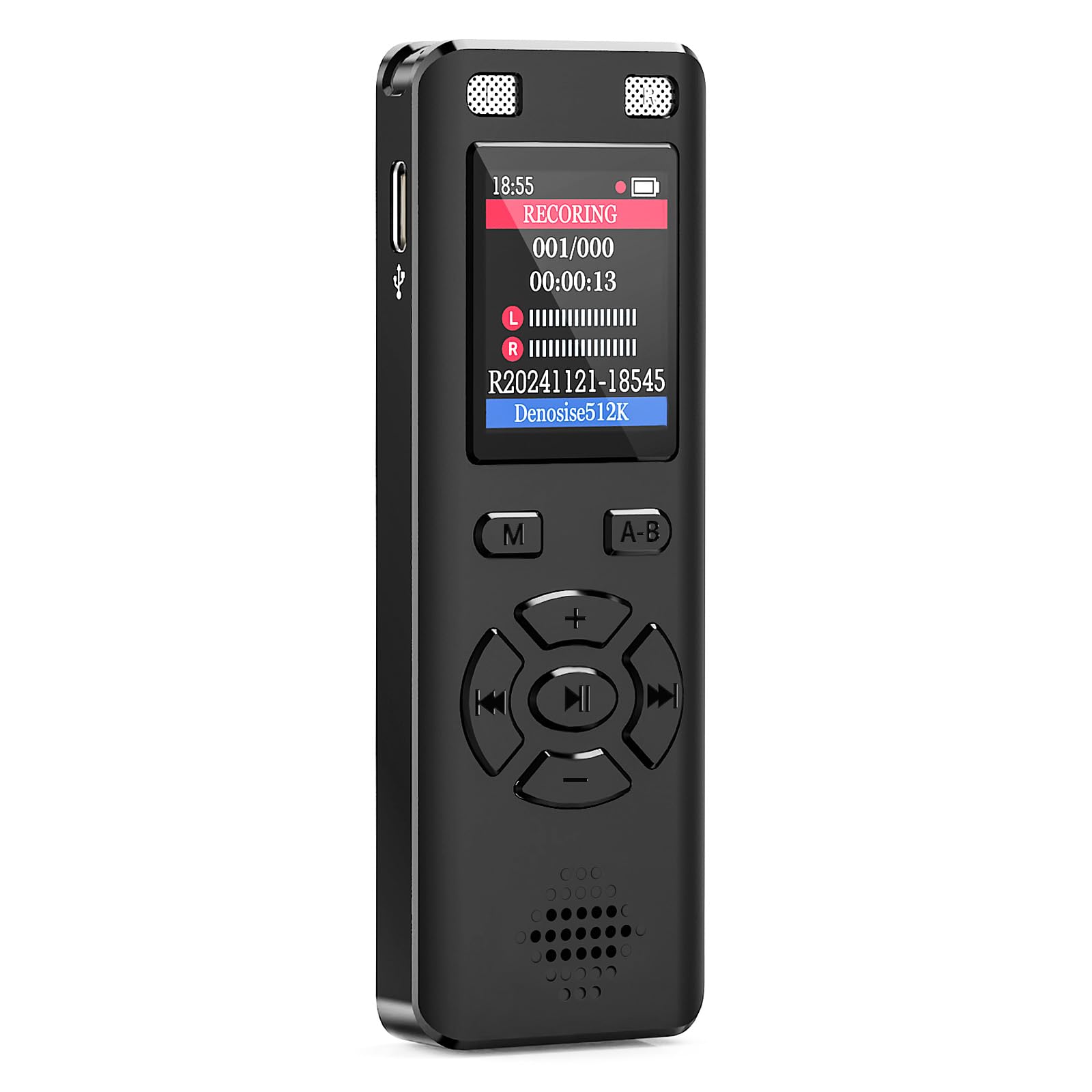
The DGFAN recorder makes a simple argument: more storage for the same price. Its 128GB internal memory stores up to 9000 hours of audio in MP3 or WAV format, enough to archive an entire semester of lectures or months of interviews without offloading. The 1100mAh battery delivers 45 hours of continuous recording, and USB-C transfer ensures you can pull files quickly when you eventually do run low on space.
Voice activation triggers automatically at a set decibel threshold, so you don’t waste memory on dead air. The device also includes password protection, A-B repeat for language study, timed recording, and variable speed playback. The sensitive microphone and intelligent noise reduction keep the capture clean even at 1536kbps in moderately busy rooms. Build quality is plastic but well-screwed together, and the sliding record switch makes operation error-proof.
Clinical users report dependable sound for therapy sessions, and students appreciate the ability to record multiple 90-minute classes without managing files daily. The only downside is the lack of a microSD slot—128GB is fixed, so when it’s full, it’s full until you delete or transfer. For anyone whose primary need is sheer capacity without needing to swap cards, this delivers maximum memory at a minimal trade-off.
Why it’s great
- 128GB internal storage holds thousands of hours
- 45-hour battery covers multi-day recording
- Auto voice activation saves space and battery
Good to know
- Storage is not expandable
- Plastic body feels less premium than metal rivals
- Menu navigation can be unintuitive at first
5. HoTiyan 64GB Voice Recorder

It measures just 3.3 by 1.4 by 0.55 inches, roughly the size of a pack of gum, and runs on a single AA battery (included) for up to 75 hours of recording. The 64GB internal memory stores plenty of MP3 audio without needing to transfer often, and the built-in microphone captures speech clearly in small rooms.
Playback is simple via the built-in speaker or the 3.5mm headphone jack, and the USB 2.0 Type-B port connects to any PC for file retrieval. Functionality is basic—record, save, playback, delete—which actually becomes an advantage for anyone who doesn’t want to navigate layered menus. The plastic casing is light and the sliding controls are easy to operate even without looking.
Real-world users confirm it works perfectly for recording seven-hour meetings or foreign language drills, with audio quality described as serviceable rather than excellent. The power button is a little finicky, and the lack of voice activation means you’ll manually start and stop each session. If you need a disposable-priced backup unit or a simple tool for occasional use, this covers the basics without wasting money on features you won’t use.
Why it’s great
- Extremely compact and pocketable
- AA battery provides 75 hours of run time
- Simplest operation—no menus to learn
Good to know
- No voice activation or noise reduction
- Build quality is plastic and feels light
- On/off switch feels delicate
FAQ
Does a higher bitrate always mean better audio from these recorders?
Can I use a voice recorder as a dictation device for transcription software?
Final Thoughts: The Verdict
For most users, the best digital voice recorder under $50 winner is the Innioasis R1 because its touchscreen, offline transcription, and expandable memory deliver modern features without crossing the budget line. If you want marathon battery endurance, grab the Vivaniir Magnetic Recorder. And for an all-metal daily driver with excellent audio controls, the EVISTR L357 is the balanced choice that keeps working session after session.

Mo Maruf
I created WellFizz to bridge the gap between vague wellness advice and actionable solutions. My mission is simple: to decode the research and give you practical tools you can actually use.
Beyond the data, I am a passionate traveler. I believe that stepping away from the screen to explore new environments is essential for mental clarity and physical vitality.