Our readers keep the lights on and my smoothie glass nicely filled. As an Amazon Associate, I earn from qualifying purchases.
Modern emergency services and public safety networks have moved to digital trunked systems, leaving analog scanners silent on most critical channels. Picking up a standard radio receiver no longer cuts it — you need a purpose-built unit that can decode P25, DMR, NXDN, and simulcast signals without garbling the conversation into digital hash.
I’m Mohammad Maruf — the founder and writer behind WellFizz. I’ve spent hundreds of hours analyzing the technical specifications, user reports, and real-world decode performance of digital trunking scanners across the full spectrum of price tiers.
Whether you are monitoring fire dispatch during severe weather, tracking EMS responses in your county, or listening to aviation on approach frequencies, this guide will help you choose the right unit. Here is our researched breakdown of the best digital radio scanner options for every monitoring need and budget level.
How To Choose The Best Digital Radio Scanner
Picking the right scanner goes far beyond price or brand. The single most important factor is the specific trunking protocol used by the agencies you want to monitor. If your local police department runs P25 Phase II on a simulcast system, even a mid-range scanner will fail if it lacks the proper receiver architecture. You must match the scanner’s decoding ability to your region’s radio infrastructure.
Matched Decoding: Phase I vs Phase II vs DMR vs NXDN
Not all digital scanners decode all protocols. P25 Phase I is the oldest digital standard and nearly every modern scanner handles it. P25 Phase II uses a more efficient time-division method and requires specific hardware — common in large metro areas. DMR and NXDN are commercial protocols used by private businesses and some public works. If you need those, confirm the scanner supports them natively or via paid upgrade keys; many entry-level units skip them entirely.
Simulcast Distortion: The Hidden Bottleneck
When multiple transmitter sites broadcast the same signal on the same frequency, standard scanners hear them slightly out of sync and produce garbled audio or silence — this is simulcast distortion. Only scanners with Software Defined Radio (SDR) or specialized I/Q receiver architectures can reconstruct the signal cleanly. If you live in a county with a single simulcast system (common for metro and suburban areas), an SDR-based unit is not optional; it is a requirement for intelligible listening.
Programming Method: Manual, Software, or Zip Code
Some scanners require entering trunking frequencies, talkgroup IDs, and control channel data by hand — a tedious process that can take hours. Others come pre-loaded with a national database and let you set your location by typing a zip code. If you want to be listening within minutes of opening the box, choose a model with database-based programming. If you enjoy customizing scan lists and fine-tuning every detail, a manually programmed unit offers more granular control.
Quick Comparison
On smaller screens, swipe sideways to see the full table.
| Model | Category | Best For | Key Spec | Amazon |
|---|---|---|---|---|
| Uniden SDS200 | Base/Mobile | Simulcast decoding | True I/Q SDR receiver | Amazon |
| Uniden SDS150 | Handheld | Portable scanning | Built-in GPS, IPX4 | Amazon |
| Uniden BCD536HP | Base | Large screen monitoring | Wi-Fi, 25-1300 MHz | Amazon |
| Whistler TRX-1 | Handheld | Multi-protocol scanning | DMR + NXDN built-in | Amazon |
| Whistler WS1065 | Desktop | Budget desktop monitoring | 1800 memory channels | Amazon |
| BTECH GMRS-PRO | Handheld | GMRS + NOAA scanning | IP67, Bluetooth, GPS | Amazon |
In‑Depth Reviews
1. Uniden SDS200 True I/Q™ TrunkTracker X Base/Mobile Digital Scanner

The SDS200 sets the industry benchmark for simulcast performance. Its True I/Q software-defined receiver architecture reconstructs overlapping control channel data from multiple tower sites, producing intelligible audio where every other scanner in its class outputs pure digital noise. For anybody living inside a simulcast zone — and that includes most metro and suburban counties now — this is the unit that actually works.
The 3.5-inch customizable color display is more than cosmetic. You can assign unique backlight colors to individual talkgroups, frequency ranges, or alert types, making it easy to glance across the room and know which agency is transmitting. The front-panel USB port and rear micro SD slot simplify firmware updates and recording, though accessing the SD card requires loosening the rear panel.
Paid upgrade keys for DMR, NXDN, and ProVoice are available but add significant cost on top of the already premium entry price. The included Sentinel software handles database updates and favorites list management cleanly, and the unit is GPS-ready for automatic location-based scanning during mobile use. Audio clarity through the internal speaker is excellent for a base unit, with no distortion even at high volume.
Why it’s great
- Industry-best P25 Phase II simulcast decoding
- Large, fully customizable color display with per-field backlight control
- GPS-compatible for automatic location-based scanning while travelling
Good to know
- DMR, NXDN, and ProVoice require separate paid upgrades
- Front LAN port placement blocks easy access to the micro USB port
- Micro SD card is somewhat awkward to remove for data transfer
2. Uniden SDS150 Advanced Digital Radio Scanner
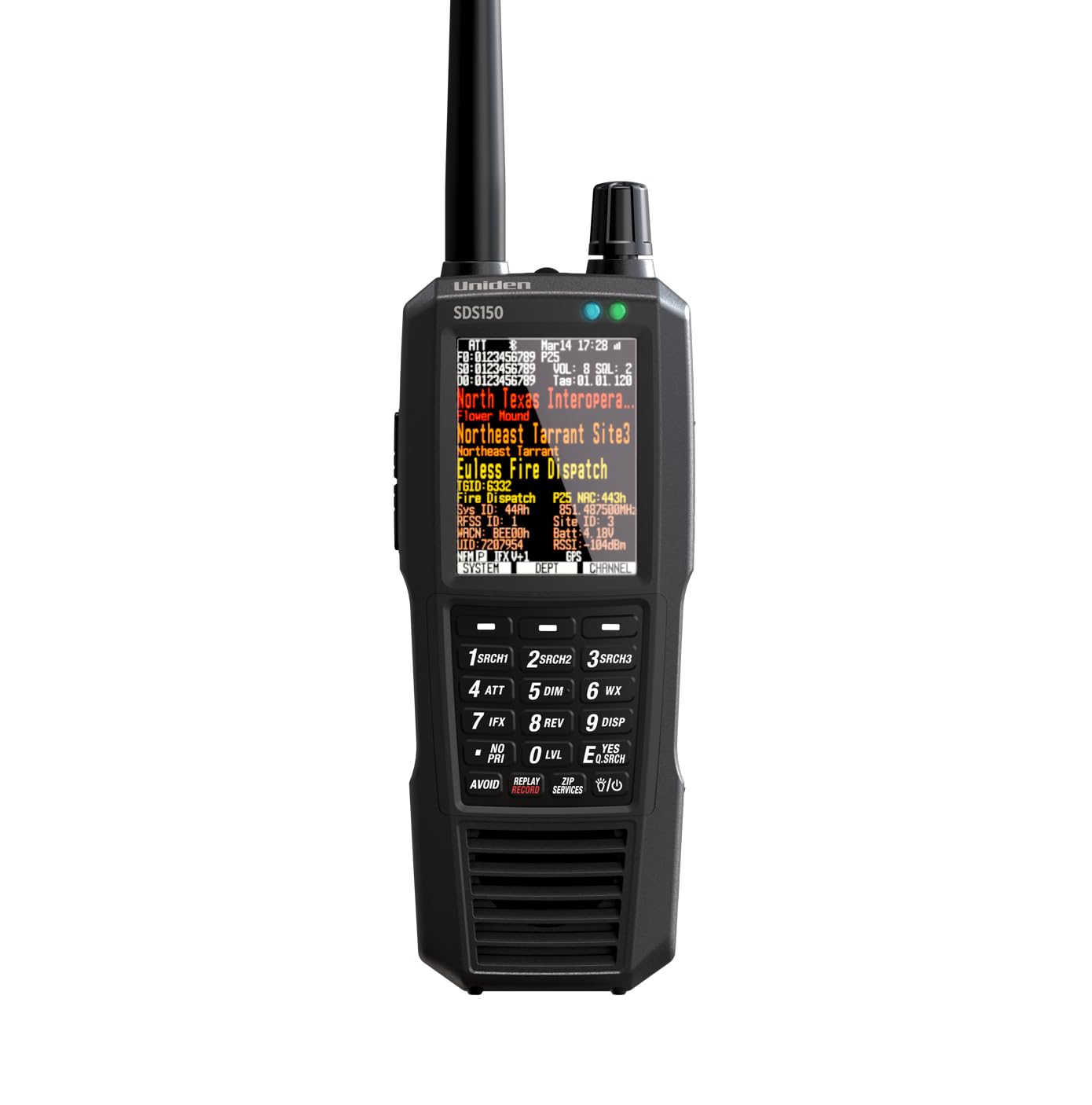
The SDS150 is Uniden’s newest flagship handheld and the first to integrate a true SDR front-end into a portable form factor. This design choice directly addresses the simulcast decoding problem that plagues traditional superheterodyne handhelds. In weak-signal environments and on congested P25 Phase II simulcast systems, the SDS150 pulls voice traffic cleanly where the BCD436HP or older Whistler handhelds drop into garbled silence.
The built-in GPS receiver is a major convenience upgrade. It automatically selects the correct radio systems, talkgroups, and service types based on your current coordinates — no manual zip code entry or database download required. The included charge cradle doubles as a desktop base and includes a spare battery charging slot, extending field time for long monitoring sessions. The IPX4 water resistance rating offers real peace of mind for outdoor use in wet conditions.
Bluetooth connectivity to the U/AWARE smartphone app is present but reception range is notably short — users report frequent disconnections beyond a few feet. The unit also feels slightly bulky in the hand compared to the TRX-1. For portable simulcast monitoring with zero programming friction, however, the SDS150 is currently unmatched in the handheld segment.
Why it’s great
- First handheld with true SDR for flawless simulcast decoding
- Built-in GPS enables completely automatic location-based scanning
- Charge cradle with spare battery slot and IPX4 water resistance
Good to know
- Bluetooth range to the u/Aware app is very short
- Bulky profile compared to competing handhelds
- Premium price reflects its advanced SDR hardware
3. Uniden BCD536HP HomePatrol Series Scanner

The BCD536HP strikes a strong balance between raw capability and user accessibility. The HomePatrol interface lets you type your zip code and immediately start scanning local police, fire, EMS, and air traffic without any frequency programming. The pre-loaded US/Canada database is updated weekly through the free Sentinel software, so you never have to manually enter trunking tables or control channels.
Wi-Fi connectivity is the standout feature here. You can stream received audio to a smartphone or tablet anywhere on your home network, place the scanner in a basement closet or attic near an antenna, and listen remotely without running long audio cables.
The large backlit LCD is readable across a room and the keypad is fully illuminated for dark monitoring environments. Recording and replay functions are built in, and the 25-1300 MHz frequency coverage includes civil aviation and military air bands. This unit is best suited for users who want a powerful desktop scanner with minimal technical overhead, as long as their local systems are not severe simulcast offenders.
Why it’s great
- Zip-code-based setup makes it the easiest scanner to use out of the box
- Built-in Wi-Fi for streaming audio to a phone or tablet
- Full 25-1300 MHz coverage including civil and military air bands
Good to know
- Simulcast decoding is noticeably weaker than SDR-based models
- Learning curve for advanced features like quick keys and favorites lists
- Premium price tag with no included DMR or NXDN support
4. Whistler TRX-1 Handheld Digital Police Scanner Radio
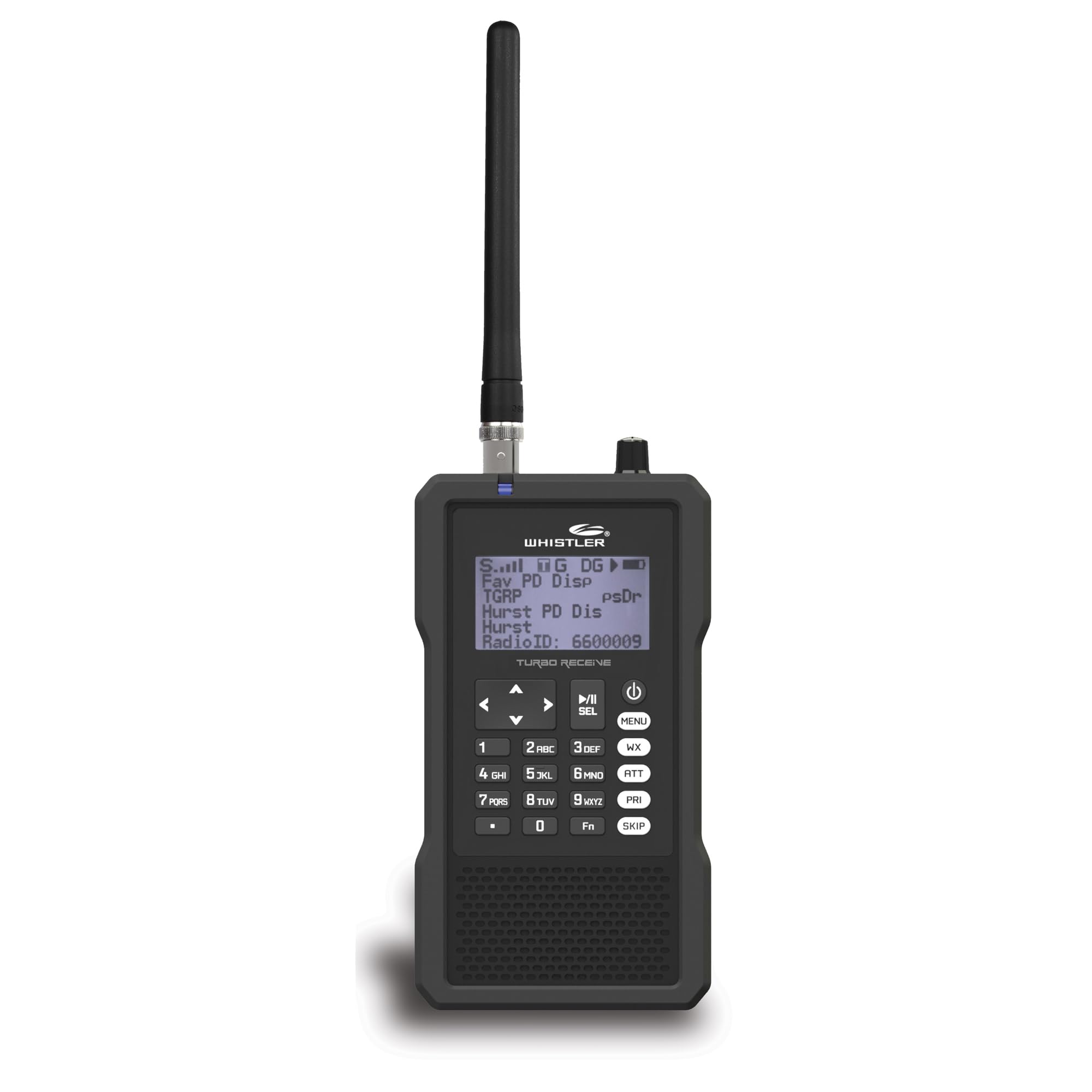
The TRX-1 is the most protocol-complete scanner available without paid upgrades. It ships with native support for P25 Phase I, Phase II, DMR, and NXDN — protocols that Uniden charges extra for on the SDS series. If you need to monitor commercial trucking fleets, school buses, utilities, or private security in addition to public safety, the TRX-1 eliminates the frustration of discovering a key protocol is locked behind a software key.
The object-oriented memory system stores millions of channels on the included 2GB micro SD card. You can group objects into up to 200 custom scanlists and assign the same object to multiple lists, creating complex scanning patterns without duplicating entries. The recording function captures up to 50 hours of audio directly to the SD card, and the raw discriminator output lets advanced users feed data to third-party decoding software.
The EZ-Scan PC software is powerful but has a dated, non-intuitive interface that takes time to learn. The boot time of roughly 30 seconds is slower than competing Uniden handhelds. Audio from the internal speaker is adequate but not as full as the SDS150. For users who need broad protocol coverage in a single portable unit, the TRX-1 delivers unmatched value on features-per-dollar.
Why it’s great
- Includes DMR and NXDN decoding at no extra cost
- Massive channel capacity with flexible object-oriented memory
- Raw discriminator output for third-party software integration
Good to know
- EZ-Scan programming software has a steep learning curve
- 30-second boot time is noticeably slow
- Internal speaker audio lacks bass and fullness
5. Whistler WS1065 Digital Trunking Desktop Scanner
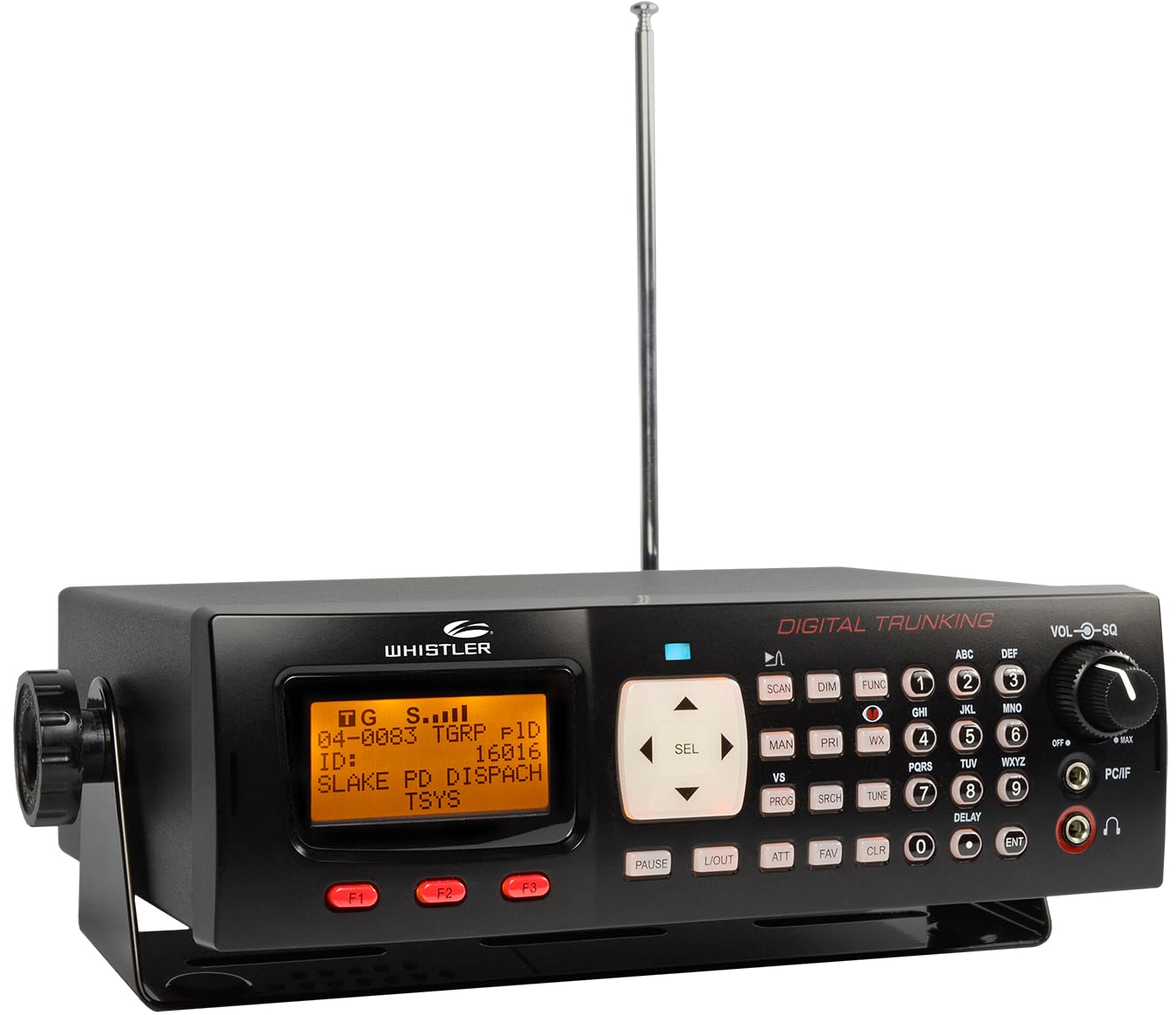
The WS1065 is a desktop trunking scanner that focuses on core P25 Phase I decoding without the bells and whistles of the premium models. It supports Motorola, EDACS, LTR, and P25 trunked systems with automatic adaptive digital tracking that adjusts fifty times per second to compensate for signal fading. For users monitoring older non-simulcast P25 systems, this unit delivers clean audio at a much lower entry point.
The free-form memory structure stores over 37,000 objects with no wasted channels, and the included USB programming cable enables fast PC-based configuration. The multi-color alert LED and programmable audible alarms provide good visual feedback for critical transmissions. The Spectrum Sweeper function automatically finds active frequencies in your area, which helps new users discover what is live without manual frequency research.
The WS1065 does not decode P25 Phase II, DMR, or NXDN, which limits its usefulness in areas that have upgraded to those protocols. Programming requires third-party software like PSREdit and a paid subscription to Radio Reference for frequency data — no zip-code-based database is included. The VHF front-end is notably weaker than the UHF and 800 MHz bands, so rural users on VHF-only systems may experience subpar reception.
Why it’s great
- Affordable desktop form factor with good P25 Phase I tracking
- Fast USB programming and cloning between units
- Spectrum Sweeper helps discover active local frequencies
Good to know
- No P25 Phase II, DMR, or NXDN support
- VHF front-end performance is noticeably weak
- Requires third-party software and subscription for easy programming
6. BTECH GMRS-PRO 5W Long-Range GMRS Radio

The GMRS-PRO is a licensed GMRS radio that also functions as a capable scanner for FRS, GMRS, and NOAA weather frequencies. It is not a full-spectrum trunking scanner — it will not decode P25 or public safety trunked systems — but it excels as a rugged outdoor communication tool with an integrated scanner for the GMRS band. The IP67 rating means it survives submersion, mud, and heavy rain without a protective case.
Bluetooth connectivity to the BTECH app enables easy channel management, contact syncing, and firmware updates without digging through the front-panel menu. The built-in GPS receiver provides location sharing and a digital compass, which is useful for group coordination on trails or job sites. NOAA weather scan with alert monitoring keeps you informed of changing conditions even when you are not actively listening.
Belt clip installation is frustratingly difficult, requiring a magnetized screwdriver and significant patience. The USB-C charging port only works with A-to-C cables, not C-to-C, which is an odd limitation for a modern device. For users who need a field-ready GMRS radio with scanning capability built in, the GMRS-PRO is a feature-dense option that covers its intended band very well.
Why it’s great
- IP67 dust and water resistance for serious outdoor use
- Built-in GPS, digital compass, and NOAA weather alerting
- Bluetooth app pairing for easy frequency management
Good to know
- Not a full-spectrum public safety trunking scanner
- Belt clip installation is unreasonably difficult
- USB-C charging limited to A-to-C cables only
FAQ
How do I find out if my local police use P25 Phase I or Phase II?
Can I listen to encrypted police communications with a digital scanner?
What is the difference between a handheld and a base/mobile scanner for home use?
Final Thoughts: The Verdict
For most users, the best digital radio scanner winner is the Uniden SDS200 because its True I/Q SDR receiver delivers clean intelligible audio on simulcast systems that defeat every other scanner on the market. If you need handheld portability, grab the Uniden SDS150. And for the broadest protocol support without paid upgrades, nothing beats the Whistler TRX-1.

Mo Maruf
I created WellFizz to bridge the gap between vague wellness advice and actionable solutions. My mission is simple: to decode the research and give you practical tools you can actually use.
Beyond the data, I am a passionate traveler. I believe that stepping away from the screen to explore new environments is essential for mental clarity and physical vitality.