Our readers keep the lights on and my smoothie glass nicely filled. As an Amazon Associate, I earn from qualifying purchases.
Stacks of crumpled receipts, dog-eared invoices, and loose business cards are the physical enemy of an organized office. A dedicated sheet-fed scanner is the specific tool designed to chop that pile down to zero in minutes, converting paper chaos into searchable, tagged digital files you can actually find later.
I’m Mohammad Maruf — the founder and writer behind WellFizz. I’ve spent countless hours analyzing the sensor types, automatic document feeder (ADF) capacities, and bundled OCR software across dozens of models to determine which machines actually handle the daily grind of receipt and document scanning without constant jams or software headaches.
Whether you need to digitize a shoebox of tax receipts or archive a filing cabinet full of contracts, this guide will help you find the best document receipt scanner for your specific workflow and volume.
How To Choose The Best Document Receipt Scanner
Buying a dedicated document scanner is different from relying on a multi-function printer. The core trade-off involves throughput speed versus media flexibility. Let’s break down the key factors.
ADF Capacity & Duplex Speed
The Automatic Document Feeder (ADF) determines how many pages you can stack at once. A 20-sheet feeder is fine for daily receipts; a 50 or 100-sheet feeder is necessary for batch processing contracts or monthly expense reports. Duplex scanning — capturing both sides in a single pass — is non-negotiable for two-sided documents. Look for a scanner’s duplex speed, often listed as “images per minute” (ipm), which is double the pages per minute (ppm) for duplex jobs.
Sensor Type: CIS vs. CCD
Most compact document scanners use Contact Image Sensor (CIS) technology. CIS scanners are thinner, use less power (often USB-powered), and have no warm-up time. However, CCD (Charge-Coupled Device) sensors offer greater depth of field, meaning they capture clearer images of slightly crumpled or uneven documents without loss of focus at the creases. For perfect, flat pages, CIS is fine. For mixed-condition receipts, CCD is superior.
Software & Data Extraction
Hardware is only half the equation. The scanner’s value comes from its bundled software. The key firmware features include automatic cropping, deskew, blank page removal, and background color cleanup (removing the yellow tint from thermal receipt paper). The most advanced suites include OCR (Optical Character Recognition) to create searchable PDFs and data extraction tools that parse line items from a receipt and export them to CSV, QuickBooks, or Excel. If you do a lot of expense reporting, prioritize a scanner with robust scanning and data management software.
Quick Comparison
On smaller screens, swipe sideways to see the full table.
| Model | Category | Best For | Key Spec | Amazon |
|---|---|---|---|---|
| ScanSnap iX1300 (Black) | Premium Compact | Wireless flexibility & mixed media | 30 ppm duplex / Wi-Fi | Amazon |
| ScanSnap iX1300 (White) | Premium Compact | Wireless flexibility & mixed media | 30 ppm duplex / Wi-Fi / Manual feeder | Amazon |
| ScanSnap iX2400 | High-Volume | Speed & large batch processing | 45 ppm duplex / 100-sheet ADF | Amazon |
| Epson Workforce ES-580W | Network Hub | Standalone scanning with touchscreen | 35 ppm duplex / 100-sheet ADF / 4.3″ touch | Amazon |
| Brother ADS-2200 | Business Workhorse | Multi-OS support & reliability | 35 ppm duplex / 1200 dpi / CCD | Amazon |
| Canon imageFORMULA DR-C225 II | Desktop Compact | Reliable scanning of mixed paper types | 25 ppm duplex / 30-sheet ADF / TWAIN | Amazon |
| Doxie Pro | User-Friendly | Simple, no-fuss setup for home offices | Duplex scanning / 20-sheet ADF | Amazon |
| Epson RapidReceipt RR-60 | Ultra-Portable | Mobile use & direct receipt-to-software | 10 ppm / Under 10 oz / USB-powered | Amazon |
| Plustek PS186 | Budget Office | Entry-level batch scanning on a budget | 50-sheet ADF / Single-touch presets | Amazon |
In‑Depth Reviews
1. ScanSnap iX1300 (Black)

The ScanSnap iX1300 is the benchmark for compact, wireless duplex scanning. Its space-saving design folds down to the size of a small notebook, yet it delivers 30 pages per minute duplex speed with automatic deskew, color optimization, and blank page removal right out of the box.
Setup is genuinely plug-and-play — the bundled ScanSnap Home software handles auto-naming, cloud routing, and searchable PDF creation. The manual front feeder is a standout feature for scanning thick items like laminated cards or folded documents without jamming the main ADF.
Customer reports highlight its reliability for digitizing thousands of documents and photos, though a small number of users experienced occasional paper angle issues. For most home offices and small businesses, the combination of speed, wireless freedom, and compact size is hard to beat.
Why it’s great
- Fast and reliable 30 ppm duplex scanning with excellent software
- Manual feeder for thick or odd-sized media
- Space-saving design with USB or Wi-Fi connectivity
Good to know
- Some units have reported paper skew issues
- Setup on certain network configurations can occasionally be tricky
2. ScanSnap iX1300 (White)

The white variant of the ScanSnap iX1300 shares the same core hardware as its black counterpart — 30 ppm duplex scanning, 600 dpi optical resolution, and a 20-sheet ADF. The key differentiator for some users is the lighter aesthetic that blends into bright home offices, but the true value lies in the same powerful ScanSnap Home software suite.
Users consistently praise the ease of operation: load a mixed stack of receipts, business cards, and letter-sized documents, press a button, and the software automatically separates and appropriately names each file. The auto-naming feature recognizes document types like receipts vs. invoices and integrates that into the file name.
While some users reported that the sensor required periodic cleaning after heavy use and initial setup could be lengthy for non-technical users, the speed and crisp scan quality (even for difficult thermal receipt paper) make this a top-tier choice for anyone wanting a true set-and-forget scanning workflow.
Why it’s great
- Excellent automatic document separation and naming
- Reliable wireless connectivity with fast performance
- Handles varied media sizes from receipts to legal documents
Good to know
- Sensor may need cleaning after a few thousand scans
- Initial network setup can require patience
3. ScanSnap iX2400
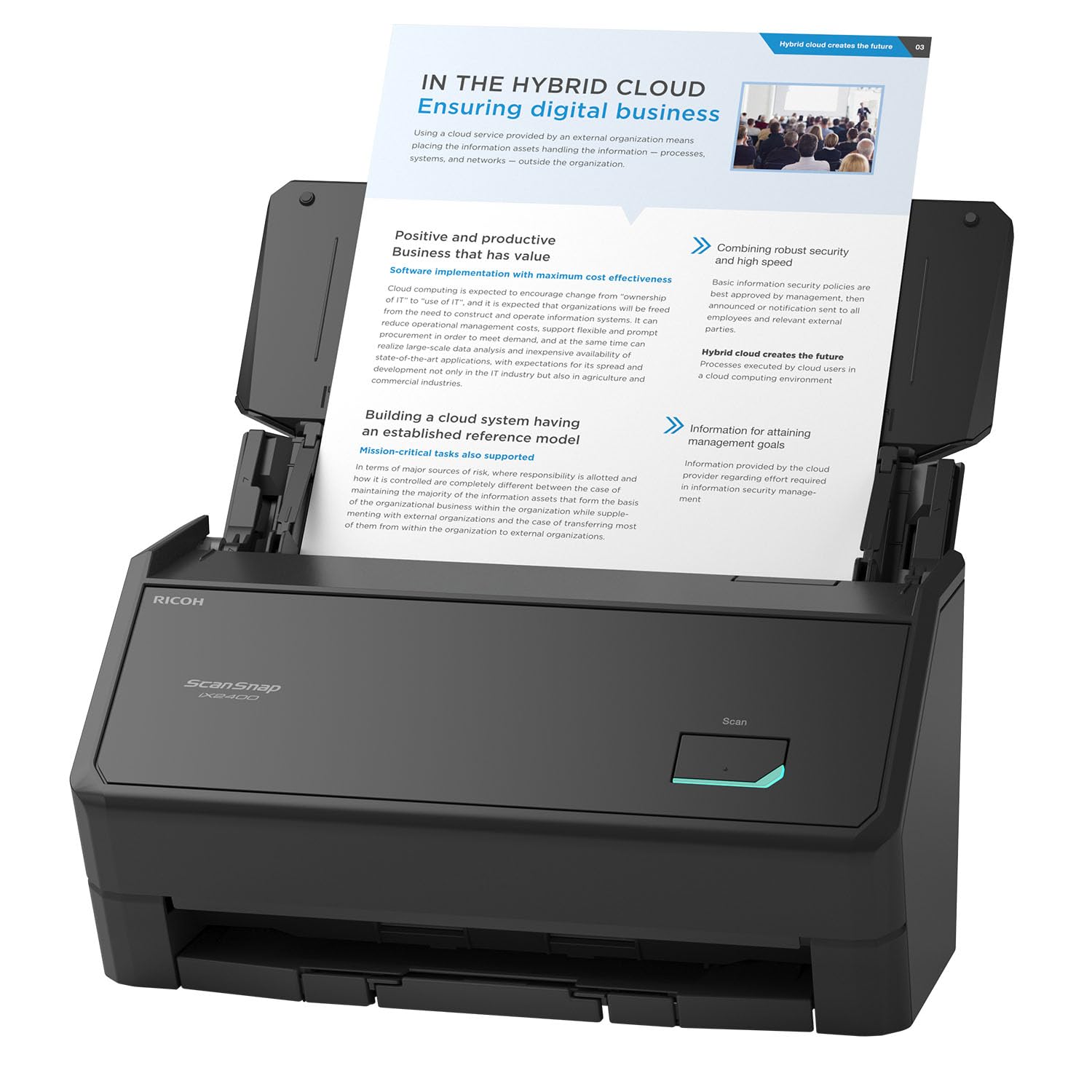
The ScanSnap iX2400 is the high-speed sibling designed for users who process large volumes daily. With a 100-sheet ADF and a blistering 45 pages per minute duplex speed, it can devour a full filing cabinet in an afternoon. The one-touch button and automatic cleanup features (deskew, streak removal, blank page deletion) keep the workflow moving without manual intervention.
Users upgrading from older ScanSnap models report that the iX2400 handles mixed paper sizes (from small receipts to legal documents) without jams, and the reliable USB connection ensures consistent performance without Wi-Fi dropouts. The ScanSnap Home software remains the gold standard for organizing scanned data into searchable PDFs.
However, this model lacks Wi-Fi and a TWAIN driver, which may be a limitation for users who need to scan directly into third-party applications. Despite the premium price, the sheer throughput speed and 100-sheet capacity make it the clear choice for high-volume paperless transitions.
Why it’s great
- Extremely fast 45 ppm duplex scanning for large batches
- 100-sheet ADF minimizes reload time
- Excellent automatic image correction and formatting
Good to know
- No Wi-Fi or TWAIN driver support
- Software interface could be more streamlined for advanced users
4. Epson Workforce ES-580W
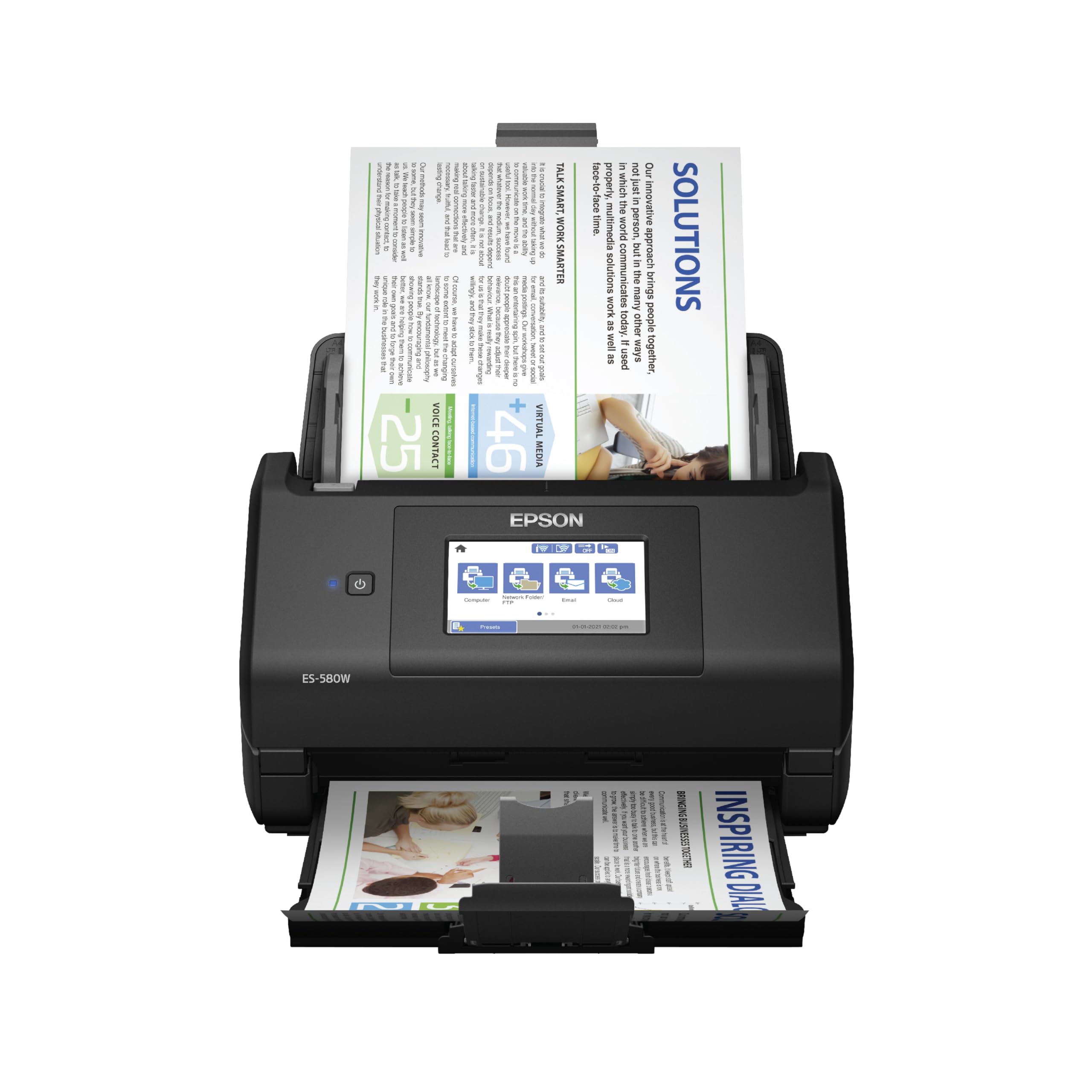
The Epson Workforce ES-580W stands out for its standalone operation. The large 4.3-inch color touchscreen lets you select scan destinations (email, cloud, folder) and adjust settings without a connected computer. Its 100-sheet ADF and 35 ppm duplex speed make it suitable for busy offices, and the CCD sensor captures crumpled documents with greater depth of field than typical CIS scanners.
Users running high-volume businesses (like notary services or medical offices) love the direct scan-to-USB and scan-to-cloud functionality, which completely bypasses a PC. The bundled Epson ScanSmart software includes data extraction features that can parse receipt line items for export to QuickBooks or Excel.
A common note from users is the lack of an Ethernet port (USB and Wi-Fi only), and the setup can be slightly more involved than a plug-and-play ScanSnap. However, for offices that need a dedicated scanning station serving multiple users, the ES-580W is a powerful and versatile workhorse.
Why it’s great
- Standalone scanning with intuitive touchscreen interface
- 100-sheet ADF with reliable 35 ppm duplex speed
- CCD sensor for better depth of field on damaged documents
Good to know
- No Ethernet port for wired networking
- Setup can be more complex than simpler USB-only models
5. Brother ADS-2200

The Brother ADS-2200 is a classic office workhorse built for multi-platform environments. It supports TWAIN, WIA, ICA, and SANE drivers, making it compatible with Windows, Mac, and Linux systems — a rarity in this category. Its 50-sheet ADF delivers 35 ppm duplex scanning with a true 1200 dpi optical resolution CCD sensor, providing the highest detail capture for fine print and graphics.
Users appreciate the adjustable DPI (up to 1200) for archiving photos, and the simultaneous duplex pass captures legal-size pages in roughly 5 seconds. The automatic background removal and blank page deletion features help clean up batches without manual editing.
Notable feedback includes that the maximum effective resolution for duplex scanning is 600×600 dpi despite the 1200 dpi rating, and some units have experienced power adapter or scanning line defects after the warranty period. For system administrators needing broad OS driver support, the ADS-2200 is a top contender.
Why it’s great
- Excellent multi-OS driver support (Windows, Mac, Linux)
- Fast 35 ppm duplex scanning with a CCD sensor for better depth
- Compact footprint with a folding output tray
Good to know
- Effective duplex resolution maxes out at 600 dpi
- Some users report reliability issues after extended use
6. Canon imageFORMULA DR-C225 II

The Canon imageFORMULA DR-C225 II occupies a sweet spot for small offices needing a reliable, space-saving duplex scanner without the bulk of a multi-function printer. Its upright design with top feed and top eject keeps the footprint small, while handling mixed media from receipts and business cards to embossed credit cards without issue.
Users report exceptional reliability with paper that has staples, Post-Its, or tape — the DR-C225 II has a reputation for feeding tricky documents that jam other scanners. The 30-sheet ADF and 25 ppm duplex speed are modest compared to high-volume models, but the TWAIN driver support ensures longevity and compatibility with professional scanning software.
One major user complaint is the lack of bundled software on the CD; drivers and software must be downloaded. The double-feed detection can be overly sensitive with sticky notes or envelopes, and there is no setting to disable it. For a sturdy, jam-resistant unit that handles mixed paper conditions, the DR-C225 II is a solid choice.
Why it’s great
- Superior paper handling with staples, tape, and Post-Its
- Compact upright design saves desk space
- TWAIN driver support for long-term compatibility
Good to know
- Drivers and software must be downloaded, not included
- Double-feed detection can be overly sensitive with some media
7. Doxie Pro

The Doxie Pro is designed for users who want a simple, reliable scanning experience without complex driver installations. It connects via USB (with both USB-C and USB-A cables included) and works with a straightforward software suite that automatically crops, straightens, and enhances scans before exporting to cloud services like Dropbox, Evernote, and OneNote.
Reviewers consistently note the sturdy plastic build and fast scanning at 300 dpi. The duplex scanning works well for typical documents, and the direct feed slot handles thick or delicate paper (like photos or folded maps) that would jam in a standard ADF. The software handles auto-rotation and contrast boost seamlessly.
The 20-page ADF is limiting for high-volume users, and the lack of an SD card slot or Chromebook app may be a drawback for some. A few users noted the price feels high compared to the relatively simple feature set. For a home office that needs a fuss-free solution, the Doxie Pro is a strong middle-ground choice.
Why it’s great
- Super easy setup with intuitive software
- Sturdy build with fast 300 dpi scans
- Direct feed slot for photos and thick media
Good to know
- 20-page ADF limits batch capacity
- No SD card slot or Chromebook support
8. Epson RapidReceipt RR-60

The Epson RapidReceipt RR-60 is the most portable option in this lineup, weighing under 10 ounces and running entirely on USB power. Its 60-sheet capacity is generous for a device this small, and the bundled ScanSmart AI software can extract and categorize data from scanned receipts for direct export to QuickBooks, TurboTax, and other financial software.
Users love the portability — it fits easily in a laptop bag and is perfect for digitizing receipts on the go. The single-sheet feed mechanism handles receipts smoothly, and the automatic file naming distinguishes receipts from invoices. The 10 ppm speed is adequate for occasional use but slow for large backlogs.
Several users reported reliability issues after a few months of use, with the scanner throwing “busy” errors or failing to connect via USB. The CSV export also requires manual cleanup. For mobile freelancers or small business owners scanning a handful of receipts per day, portability outweighs speed, but it is not a high-volume workhorse.
Why it’s great
- Extremely lightweight and portable at under 10 oz
- USB-powered — no external power brick required
- Integrates with financial software like QuickBooks and TurboTax
Good to know
- Prone to USB connectivity errors over time
- Slow 10 ppm speed for batch processing
9. Plustek PS186

The Plustek PS186 is a budget-friendly entry into the dedicated document scanner category, offering a 50-sheet ADF and single-touch preset buttons for up to 255 customizable scan profiles. It supports Windows 7 through 11 and includes OCR software for creating searchable PDFs, plus barcode recognition for automatic document separation.
Users who got a working unit praise its compact footprint (roughly the size of a loaf of bread) and reliable duplex scanning for black-and-white documents at 200 DPI. The auto-blank page removal and deskew features work well for standard office paper, making it a solid option for basic document archiving.
However, the PS186 has a notable split in user feedback: many experienced paper jams, loud screeching during operation, and color scanning quality that is poor with visible lines. Customer service responsiveness varies. For light to moderate use with mostly text documents, it offers good value, but it is not recommended for high-volume or color-critical workflows.
Why it’s great
- Large 50-sheet ADF for its compact size
- Customizable single-touch presets for quick scanning
- Barcode recognition for automatic file separation
Good to know
- Inconsistent build quality — some units prone to jams
- Poor color scan quality with visible lines
FAQ
What is the difference between a document scanner and a receipt scanner?
Can a document scanner scan crumpled or wrinkled receipts?
Final Thoughts: The Verdict
For most users, the best document receipt scanner winner is the ScanSnap iX1300 (White) because it combines a compact footprint, reliable 30 ppm duplex speed, flexible wireless connectivity, and excellent ScanSnap Home software that automates organization from day one. If you need high-volume batch processing, grab the ScanSnap iX2400 with its 100-sheet ADF and lightning-fast 45 ppm speed. And for true portability on the go, nothing beats the Epson RapidReceipt RR-60, which slips into any laptop bag and runs entirely on USB power.

Mo Maruf
I created WellFizz to bridge the gap between vague wellness advice and actionable solutions. My mission is simple: to decode the research and give you practical tools you can actually use.
Beyond the data, I am a passionate traveler. I believe that stepping away from the screen to explore new environments is essential for mental clarity and physical vitality.