Our readers keep the lights on and my smoothie glass nicely filled. As an Amazon Associate, I earn from qualifying purchases.
The difference between a day spent digging bottle caps and a day spent pocketing placer gold comes down to frequency and ground balance. Most consumer detectors roll at 8 kHz or less, a range that completely misses the tiny, low-conductivity flakes that signal a real gold strike. For serious prospecting, you need a machine that sees what standard units walk over.
I’m Mohammad Maruf — the founder and writer behind WellFizz. I’ve spent hundreds of hours cross-referencing manufacturer frequency sweeps, coil geometries, and real-user soil performance data to isolate the machines that actually deliver in mineralized ground.
Whether you are hunting remote dry washes or running a coil through a worked claim, the right tool determines whether you come home with a vial of fines or a pocket full of trash. This guide breaks down the detectors for gold that justify the investment by isolating tiny targets in hot ground.
How To Choose The Best Detectors For Gold
Gold prospecting detectors differ from standard coin or relic machines in three critical ways: operating frequency, ground balance circuitry, and coil design. Ignoring any of these three leads to a machine that chatters over hot rocks and misses the tiny flakes that make a claim profitable.
Frequency: The Gold Window
Gold is a low-conductivity target. Standard detectors running 6-8 kHz simply cannot energize a small gold flake enough to produce a reliable signal. A true gold machine starts at 18 kHz and goes up to 71 kHz. Higher frequency creates a stronger eddy current response in small, non-ferrous targets. If your budget allows, 45 kHz or above dramatically improves sensitivity to sub-gram nuggets.
Ground Balance: Hot Rock Rejection
Mineralized soil generates a strong background signal that masks gold. Manual ground balance lets you tune out the ground’s specific mineralization. Automatic ground tracking adjusts continuously as soil conditions change. A machine without ground balance becomes nearly unusable in black sand or ironstone gravel.
Coil Shape and Size
Double-D (DD) coils are standard for gold because they produce a blade-shaped magnetic field that slices through mineralized ground and gives better target separation. Concentric coils are more susceptible to ground noise. Larger coils (10-13 inches) cover more ground but sacrifice sensitivity on the tiniest targets. A secondary small coil (5-6 inches) is essential for sniffing out tiny nuggets in trashy areas.
Discrimination and Iron Audio
Gold detectors with ferrous/non-ferrous discrimination can reject iron trash, but gold is often found alongside hot rocks that mimic iron. Some premium units include an Iron Audio feature that lets you hear the iron tone so you can decide whether to dig. Pure all-metal mode is the deepest and most sensitive setting for gold — do not run discrimination so high that you eliminate small gold targets.
Quick Comparison
On smaller screens, swipe sideways to see the full table.
| Model | Category | Best For | Key Spec | Amazon |
|---|---|---|---|---|
| XP Deus II RC | Premium Multi-Freq | All-terrain multi-purpose gold hunting | 4-45 kHz simultaneous FMF | Amazon |
| Minelab Gold Monster 1000 | Premium VLF Gold | Nugget hunting in mineralized soil | 45 kHz VLF / 24-bit processor | Amazon |
| Fisher Gold Bug 2 | Specialist Gold VLF | Maximum tiny-flake sensitivity | 71 kHz operating frequency | Amazon |
| Garrett AT Gold | Premium All-Terrain | Fully waterproof gold detection | 18 kHz / IP54 rated | Amazon |
| Fisher Gold Bug Pro | Mid-Range VLF Gold | Balanced price/sensitivity for beginners | 19 kHz / 2.5 lbs weight | Amazon |
| Garrett ACE 300 | Entry-Level Multi-Purpose | Beginner coin, relic, and gold hunting | Digital Target ID 0-99 scale | Amazon |
| Hazlewolke TX-850 PRO | Budget Gold Detector | Entry-level gold prospecting on a budget | 19.23 kHz / 13″ DD coil | Amazon |
| Walfront Long Range | Specialty Long-Range | Broad area gold and silver searching | 6 kHz / rechargeable battery | Amazon |
| Minelab Gold Monster 1000 (Kit) | Premium VLF Kit | Ready-to-go with two search coils | 45 kHz / dual coil kit included | Amazon |
In‑Depth Reviews
1. XP Deus II RC Metal Detector

The XP Deus II RC is the first fully wireless Fast Multi-Frequency detector that delivers simultaneous transmission across a 4-45 kHz range. The patented radio protocol is ten times faster than Bluetooth, allowing instant coil-to-remote communication with zero detectable lag. The 9-inch FMF coil resolves tiny gold targets alongside high-conductivity coins in the same sweep, something single-frequency machines cannot match.
With 12 factory multi-frequency programs and 49 selectable single frequencies, this unit adapts to any terrain from mineralized desert to wet salt beach. The IP68 rating means the remote control and coil can go 66 feet underwater — a capability no other fully wireless gold detector currently offers. Bone conduction headphones (optional) provide audio without blocking ambient sounds, a real safety edge when hunting remote creeks.
The 4-band equalizer and extensive sound library let you tune each target’s audio signature precisely. Experienced users report digging targets at over 12 inches in mild soil, and the unit identifies small lead fragments and gold flakes at impressive depths. The only complaint among long-term owners is the stock remote mount, which some replace with a reinforced third-party bracket for longevity.
Why it’s great
- FMF technology detects across entire frequency range simultaneously
- Fully wireless, fully waterproof to 66 feet
- 49 selectable single frequencies for custom tuning
Good to know
- Premium-tier investment beyond most dedicated gold machines
- Stock remote mount may need replacement over time
2. Minelab Gold Monster 1000

The Minelab Gold Monster 1000 operates at 45 kHz and pairs that high frequency with a 24-bit digital signal processor that filters ground noise without losing sensitivity to sub-gram gold. This combination lets it detect tiny flakes that 18 kHz units walk over, while the automatic ground balance, noise canceling, and sensitivity adjust eliminate the need for constant manual tweaking.
The touchpad interface includes a gold chance indicator and two primary modes: gold-specific (iron reject) and deep all-metal. The telescoping shaft adjusts from 45 inches to nearly 138 centimeters, accommodating hunters of all heights. The waterproof coil is rated to 3 feet, allowing shallow creek work without worry. Battery life reaches 30 hours on the included lithium-ion pack, with a backup AA holder included in the box.
Experienced prospectors report that this unit hammers on tiny gold samples that require tweezers to pick up, and its automatic operation makes it the easiest premium gold detector to hand to a beginner. The main tradeoff is depth on larger targets — the 45 kHz frequency delivers peak sensitivity on small gold but does not push as deep as lower-frequency machines on coins or large nuggets.
Why it’s great
- Exceptional sensitivity to gold flakes under one gram
- Fully automatic ground balance and noise canceling
- Lightweight at 2.94 pounds with long battery life
Good to know
- Limited depth penetration compared to PI machines
- Headphones not included in base package
3. Fisher Gold Bug 2

The Fisher Gold Bug 2 runs at 71 kHz, the highest operating frequency of any dedicated gold detector in this class. That extreme frequency creates an eddy current response in gold flakes so small they are invisible to standard units. The included 6-inch elliptical coil provides pinpoint accuracy in tight bedrock crevices, while the 10-inch elliptical covers broader ground on open claims.
The manual 16-turn ground balance control and three-position mineralization switch give the operator direct control over how the machine responds to black sand and hot rocks. The iron discrimination mode filters ferrous signals without sacrificing the non-ferrous gold response. An audio boost mode selectively amplifies faint deep signals without increasing background noise, making faint whispers audible.
Weighing 2.9 pounds with a hip-mountable control housing, the Gold Bug 2 reduces fatigue during all-day hunts. The double-locking fiberglass-reinforced lower stem adds durability on rugged terrain. Users consistently describe it as the most sensitive off-the-shelf detector for the smallest gold, though the 71 kHz frequency means it can be chatty in extreme mineralization unless you dial in the ground balance carefully.
Why it’s great
- Highest gold-sensitivity frequency at 71 kHz
- Includes both 6-inch and 10-inch elliptical coils
- Manual ground balance for extreme soil conditions
Good to know
- Steep learning curve for ground balance tuning
- Can become noisy in heavily mineralized ground
4. Garrett AT Gold

The Garrett AT Gold operates at 18 kHz, a frequency optimized for small gold yet broad enough for coin and relic hunting. Its standout feature is the Iron Audio function, which forces an audible iron tone on rejected targets. Instead of guessing whether a silent signal is a hot rock or a nail, you hear the iron grunt and make an informed decision — saving hours of wasted digging.
The Ground Balance Window allows both manual and automatic balancing while displaying a visual ground phase window that shows how the soil changes as you sweep. The all-metal mode delivers maximum depth and sensitivity, and the search mode switch between all-metal, discrimination, and pinpoint is intuitive. The included Pro-Pointer AT adds a waterproof pinpointer rated to 20 feet, speeding recovery once the target is in the hole.
Built in the USA, the AT Gold is fully submersible to 10 feet, making it one of the few gold detectors that works equally well in a dry wash and a creek. The 8.5×11-inch DD coil provides solid depth and coverage, and owners consistently report recovering gold rings and jewelry at 8-10 inches in moderate soil. The tradeoff is that 18 kHz is less sensitive to sub-gram flakes than the 45 kHz or 71 kHz specialists.
Why it’s great
- Waterproof to 10 feet with detachable pinpointer included
- Iron Audio audibly identifies rejected iron targets
- All-metal mode provides best depth for gold
Good to know
- 18 kHz frequency misses very small gold flakes
- Headphones not always included in package
5. Fisher Gold Bug Pro

The Fisher Gold Bug Pro runs at 19 kHz and uses the industry-first V-Break tone discrimination system, which lets you set an audible breakpoint between ferrous and non-ferrous targets. This variable breakpoint is adjustable, so you can tune it to reject iron at a specific conductivity level while still hearing gold. The computerized Ground Grab auto-balances with a single button press, and a continuous ground condition readout shows mineralization levels in real time.
Independent threshold and gain controls give you fine-grained control over how the machine responds. In highly mineralized black sand, you can reduce gain without killing sensitivity. At 2.5 pounds, it is one of the lightest gold detectors available, reducing arm fatigue significantly on long walks. The simple interface makes it accessible to beginners while the manual controls satisfy experienced users who want to tweak.
The Gold Bug Pro shares coil compatibility with the Fisher F75 and Teknetics G2, giving users a wide aftermarket upgrade path. Owners consistently report that in moderate soil it detects gold flakes at the same depth as machines costing twice as much. The downsides are the lack of a built-in display (no visual target ID) and the omission of an armrest strap in some shipments.
Why it’s great
- Adjustable V-Break discrimination cuts iron trash efficiently
- Lightweight 2.5-pound build for all-day hunts
- Coil compatible with F75 and G2 aftermarket coils
Good to know
- No visual target ID display
- Armrest strap may not be included
6. Garrett ACE 300
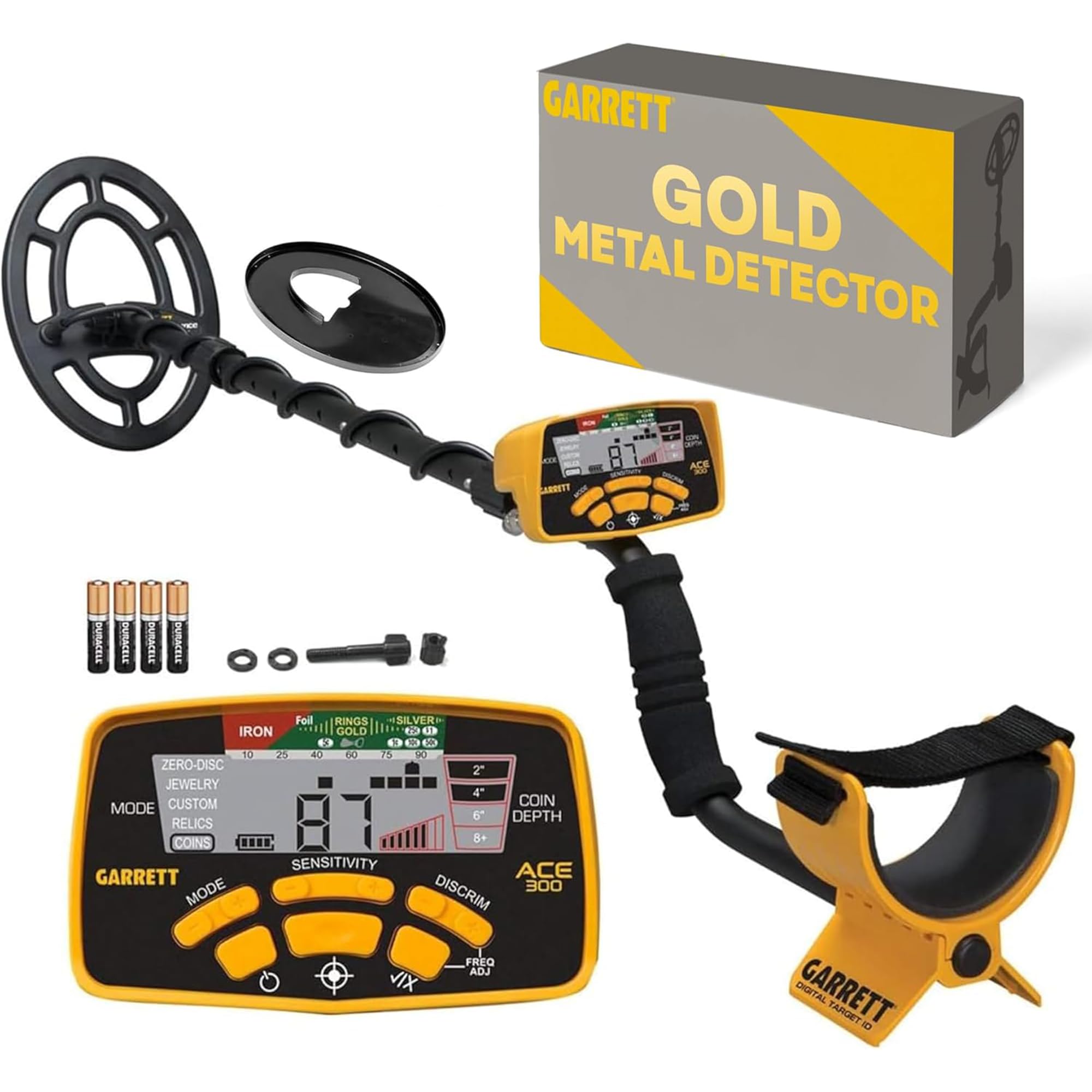
The Garrett ACE 300 is a mid-frequency entry-level detector that operates with a digital target ID scale (0-99) to help beginners understand what conductivity their coil is passing over. While it is not a dedicated gold prospecting detector, the ACE 300 includes iron resolution technology that separates ferrous trash from non-ferrous targets like small gold jewelry. The electronic pinpointing mode locates the exact center of a target for precise digging.
The adjustable frequency feature lets you shift the operating channel to avoid interference from power lines or other nearby detectors. The 7×10-inch waterproof search coil comes with a protective cover, and the unit runs on four AA batteries with a 25-hour typical life. The telescoping shaft extends to 51 inches, suitable for most adult heights.
Real-world users report recovering gold rings and silver coins at depths up to 8 inches in moderate soil. The ACE 300 is made in the USA and has one of the gentlest learning curves in the entry-level segment. The limitation is that the operating frequency is not published as a gold-optimized kHz value, so it cannot match the sensitivity of dedicated high-frequency gold machines for tiny flakes.
Why it’s great
- Digital Target ID simplifies learning for beginners
- Adjustable frequency reduces electromagnetic interference
- Built-in pinpoint mode for precise target location
Good to know
- Not optimized for sub-gram gold flakes
- Wrist ergonomics may require aftermarket adjustment for shorter users
7. Hazlewolke TX-850 PRO

The Hazlewolke TX-850 PRO operates at 19.23 kHz, a frequency tuned for small low-conductivity metals including gold nuggets. The 13-inch waterproof DD coil provides broad coverage and solid depth, while the manual and auto ground balance allows you to filter false signals from mineralized soil. The aluminum shaft collapses to 18.5 inches, making this one of the most portable gold-capable detectors in its price tier.
Three detection modes — all-metal, discrimination, and pinpoint — cover the essential search scenarios. The LCD display shows target depth and signal strength, and the knob-based controls are intuitive enough for a beginner to start hunting immediately. The unit weighs 3.5 pounds, which is moderate for a 13-inch coil configuration, and the adjustable armrest helps distribute weight during use.
Customer feedback highlights the TX-850 PRO surprising users who compare it against machines costing three times as much. In moderate soil, the 19.23 kHz frequency picks up small gold jewelry and coins at competitive depths. The main drawbacks are the mixed build quality reports — some units arrive with defects — and the fact that 19 kHz still falls short of the 45+ kHz range for detecting tiny gold flakes.
Why it’s great
- 19.23 kHz frequency suitable for small gold targets
- Large 13-inch DD coil for ground coverage
- Collapsible shaft for easy travel storage
Good to know
- Inconsistent quality control across production units
- 19 kHz sensitivity is below dedicated gold specialist frequency
8. Walfront Long Range Metal Detector

The Walfront Long Range detector uses a 6 kHz operating frequency and claims up to 1500 meters of detection range through a receiver-based search system. Unlike traditional sweep-and-scan VLF detectors, this unit is designed to scan large areas by tuning the frequency regulator to a specific metal type — gold, silver, or copper. It aims at broad area reconnaissance rather than precise pinpointing of individual targets.
The micro electronic processor handles chip unit calibration with a self-test system, and both the detector and receiver include rechargeable NiCr batteries for extended field use. The digital LCD display provides feedback on target type and signal strength, and the unit is lightweight enough for carrying over long survey lines.
User reviews are sharply divided. Some report accurate location of buried gold and silver, while others find the manual too sparse for proper operation and question the build quality compared to conventional VLF detectors. The 6 kHz frequency is far below the gold-optimized range, so this is better suited for locating large caches or silver deposits rather than small native gold.
Why it’s great
- Long-range detection capability for broad area searching
- Rechargeable batteries in both transmitter and receiver
- Frequency tuning for specific metal type selection
Good to know
- 6 kHz frequency has poor sensitivity to small gold
- Mixed user reports on build quality and instruction clarity
9. Minelab Gold Monster 1000 (Kit with 2 Coils)

This kit version of the Minelab Gold Monster 1000 includes both the 10×6-inch DD search coil and the 5-inch DD search coil, giving you wide coverage for open ground and a compact coil for trashy or rocky areas right out of the box. The 45 kHz VLF engine with 24-bit signal processing delivers the same tiny-flake sensitivity as the single-coil version, but the dual-coil bundle saves you aftermarket purchase costs.
The improved discrimination circuit handles conductive (salty) soils better than higher-frequency detectors, making this a viable option for coastal gold hunting where salt interferes with other VLF machines. The kit also includes headphones, a lithium-ion battery, spare AA battery holder, and a lens cleaning cloth. The automatic ground balance and noise canceling remain fully functional, keeping the learning barrier low.
Owners report that the 5-inch coil is especially useful for sniffing out gold in tight bedrock cracks where the larger coil cannot fit, and that the kit pays for itself compared to buying coils separately. The only downside is that the kit adds packaging weight (7.2 pounds total) and the included headphones are basic. For anyone committing to gold prospecting this season, the dual-coil kit is the smarter buy.
Why it’s great
- Two waterproof DD coils included for versatile hunting
- 45 kHz frequency with automatic operation
- Handles salty soil better than most high-frequency detectors
Good to know
- Heavier package weight due to dual coils and accessories
- Included headphones are basic quality
FAQ
Why is 19 kHz considered the minimum for a dedicated gold detector?
Can I use a gold detector on the beach for jewelry?
Do I need a waterproof coil for gold prospecting?
What is the advantage of a DD coil over a concentric coil for gold?
Final Thoughts: The Verdict
For most users, the detectors for gold winner is the Minelab Gold Monster 1000 because it offers the best blend of high sensitivity (45 kHz), fully automatic operation, and lightweight ergonomics for long days in the field. If you want maximum sensitivity to tiny flakes, grab the Fisher Gold Bug 2 with its industry-leading 71 kHz operating frequency and dual-coil package. And for all-terrain versatility including underwater hunting, nothing beats the XP Deus II RC with its fully wireless Fast Multi-Frequency technology.

Mo Maruf
I created WellFizz to bridge the gap between vague wellness advice and actionable solutions. My mission is simple: to decode the research and give you practical tools you can actually use.
Beyond the data, I am a passionate traveler. I believe that stepping away from the screen to explore new environments is essential for mental clarity and physical vitality.