Our readers keep the lights on and my smoothie glass nicely filled. As an Amazon Associate, I earn from qualifying purchases.
Overwatering is the number one cause of houseplant death, yet most gardeners water on a schedule instead of checking what is actually happening below the surface. A digital soil tester removes the guesswork by delivering precise readings for moisture, pH, fertility, and light intensity directly from the root zone, so you know exactly when to water and what your soil needs to thrive.
I’m Mohammad Maruf — the founder and writer behind WellFizz. I analyze hardware specifications, probe materials, and sensor logic across dozens of gardening tools to isolate the models that deliver consistently accurate data without the gimmicks.
Whether you are nursing finicky orchids or managing a vegetable patch, the right best digital soil tester gives you hard numbers instead of vague guesses, saving your plants from overwatering and nutrient imbalances before visible damage occurs.
How To Choose The Best Digital Soil Tester
Not all soil testers are built the same. The cheapest analog meters use a simple galvanic reaction that drifts quickly, while higher-end units pair dual displays with replaceable probes for sustained accuracy. Focus on three core factors before buying.
Sensor Type and Display Clarity
Analog dial meters are inexpensive but force you to squint at tiny scale markings. Dual-screen digital models show moisture, pH, fertility, and temperature on an LCD panel so you can read the numbers at a glance. Units with a backlit display and a rotating head (0° to 90°) let you take readings without bending or shading the screen.
Probe Quality and Replaceability
Probes made from alloy or stainless steel resist corrosion and conduct electrical signals more consistently than generic metal. Replaceable probes are a major advantage — when the tip wears down or bends, you swap only the probe instead of discarding the entire unit. Single-probe designs also disturb less soil and cause less root damage than multi-prong designs.
Measurement Range and Use Case
If you grow a variety of plants, a 6-in-1 or 7-in-1 tester that covers moisture, pH, fertility, sunlight, soil temperature, and air humidity gives you a full picture of your growing environment. For hydroponic or precision growers, a dedicated digital pH meter with Bluetooth logging offers continuous 24-hour monitoring and data storage.
Quick Comparison
On smaller screens, swipe sideways to see the full table.
| Model | Category | Best For | Key Spec | Amazon |
|---|---|---|---|---|
| SPECILITE 6-in-1 | Premium | Root‑zone accuracy | Alloy, replaceable probe | Amazon |
| YINMIK Digital pH Tester | Premium | Bluetooth logging | Stainless-steel dibber | Amazon |
| HSLGOVE 7-in-1 | Mid-Range | Comprehensive monitoring | 1.6” chip board | Amazon |
| Auduto 7-in-1 | Mid-Range | Beginner gardeners | Corrosion‑resistant metal | Amazon |
| Vlantro 6-in-1 | Budget | Budget starter kit | 3 replaceable probes | Amazon |
In‑Depth Reviews
1. SPECILITE 6-in-1 Soil Tester
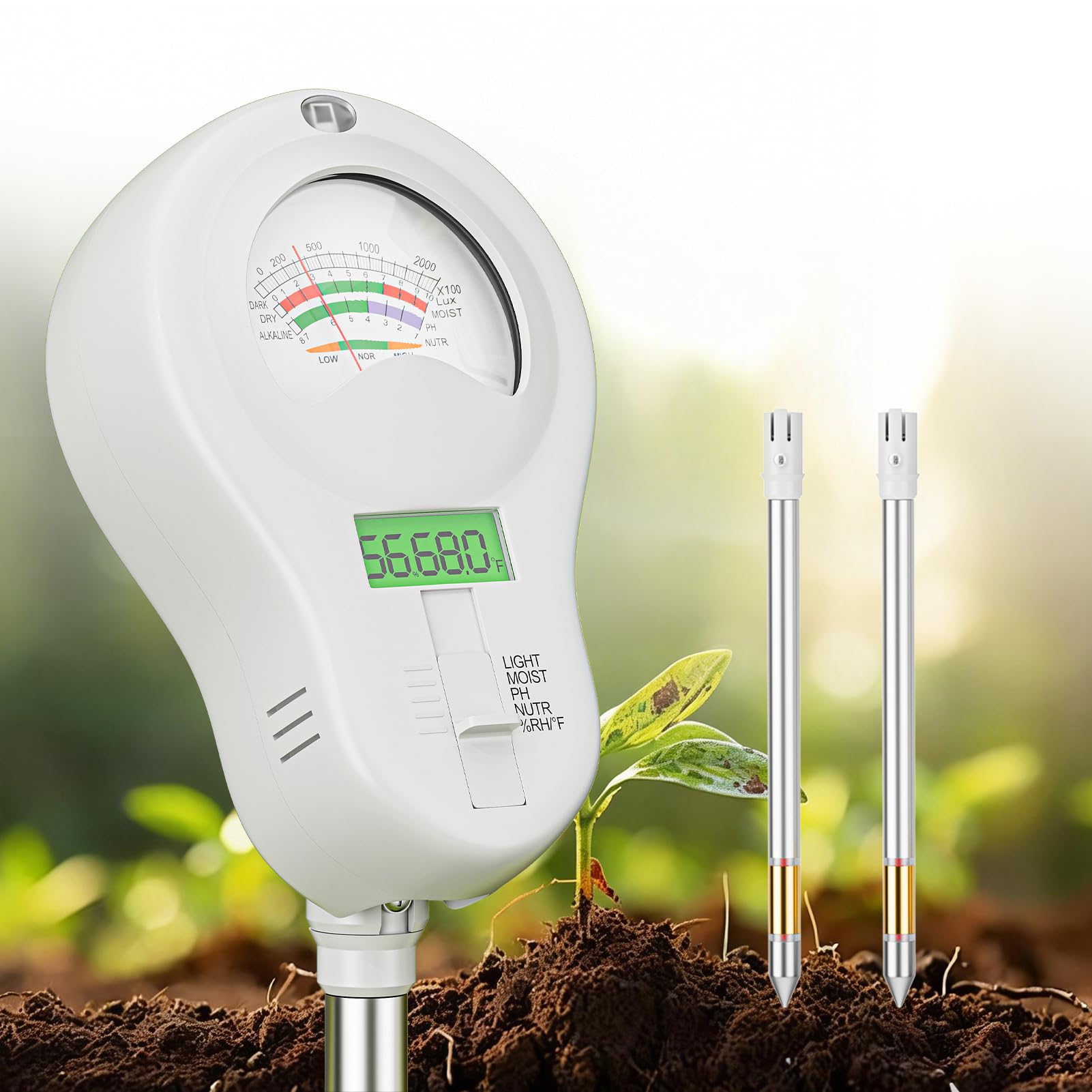
What sets the SPECILITE 6-in-1 apart is the alloy probe that offers high conductivity and sensitivity for immediate, accurate readings. The single-probe design minimizes root disturbance and avoids pulling excess soil out of the pot, while the detachable probe can be replaced cheaply when it wears out — a practical advantage over sealed units.
The dual-display combines an analog dial with a backlit LCD screen that rotates 0° to 90° for easy viewing in bright sunlight or cramped indoor corners. It measures moisture, pH, fertility, sunlight, air temperature, and humidity, covering all the essentials for houseplant and garden care without needing multiple gadgets.
A few users noted the probe attachment requires a firm twist to remove, and the smaller dial markings for pH and fertility demand good eyesight. Overall, this is a well-built mid-range unit that balances replaceability with a wide feature set for the price.
Why it’s great
- Replaceable alloy probe extends lifespan
- Backlit rotating LCD for glare-free reading
- Single-probe design reduces root damage
Good to know
- Probe removal requires noticeable force
- Dial markings are small for pH and fertility
2. YINMIK Digital pH Tester for Soil

YINMIK takes a different approach by focusing exclusively on pH accuracy rather than bundling every possible reading into one device. The tapered stainless-steel dibber protects the glass pH electrode while penetrating compacted or rocky soil, and the electrode itself can be removed to test water for hydroponic or liquid fertilizer applications.
The standout feature is the YINMIK App that connects via Bluetooth for 24-hour continuous monitoring. You can set automatic data storage and check soil pH trends on your phone without visiting each plant — especially useful for greenhouses or larger gardens. Calibration buffer powders are included, and the LR44 batteries ship with the unit.
Some users reported Bluetooth connectivity failures after several months, and the narrow focus on pH means you will need separate tools for moisture and light readings. But for serious growers who prioritize pH precision and want logged data, this is the most advanced option here.
Why it’s great
- Bluetooth app logs pH data continuously
- Stainless-steel dibber protects electrode in hard soil
- Works for both soil and water testing
Good to know
- Bluetooth pairing sometimes fails after months
- Only measures pH, not moisture or light
3. HSLGOVE 7-in-One Soil Test Kit
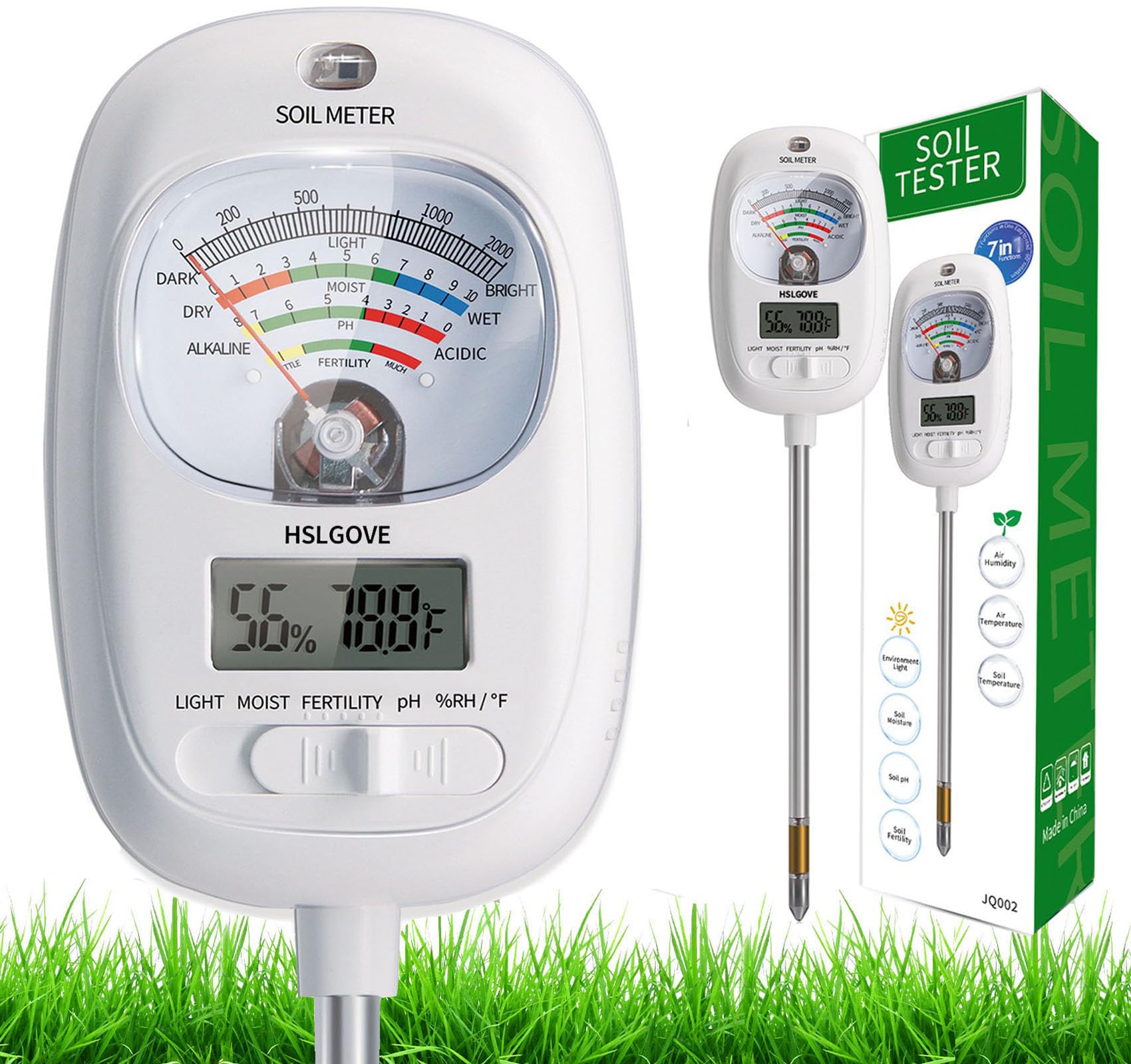
The HSLGOVE 7-in-1 packs an analog dial for moisture, pH, fertility, and light alongside an LCD screen that shows soil temperature, air temperature, and humidity. The dual-display layout lets you see real-time numbers without toggling modes repeatedly, and the built-in 1.6-inch chip board processes sensor data quickly for readings in three to five minutes.
Three metal probe materials (copper, zinc, and aluminum) give solid conductivity for moisture and pH analysis, and the single-probe design keeps soil disturbance low. The unit operates on three replaceable AAA batteries, and the function switch cycles through all seven metrics with one button.
Some professional agronomist reviewers flagged the light sensor as unreliable and noted that pH readings tended to skew acidic compared to laboratory results. For general home gardening and monitoring trends rather than exact lab values, this tester delivers broad utility at a reasonable cost.
Why it’s great
- Dual-screen shows analog and digital data simultaneously
- Measures seven parameters including air humidity
- Single-probe reduces root disturbance
Good to know
- Light sensor accuracy is inconsistent
- pH readings may skew more acidic than lab results
4. Auduto 7-in-One Soil Test Kit
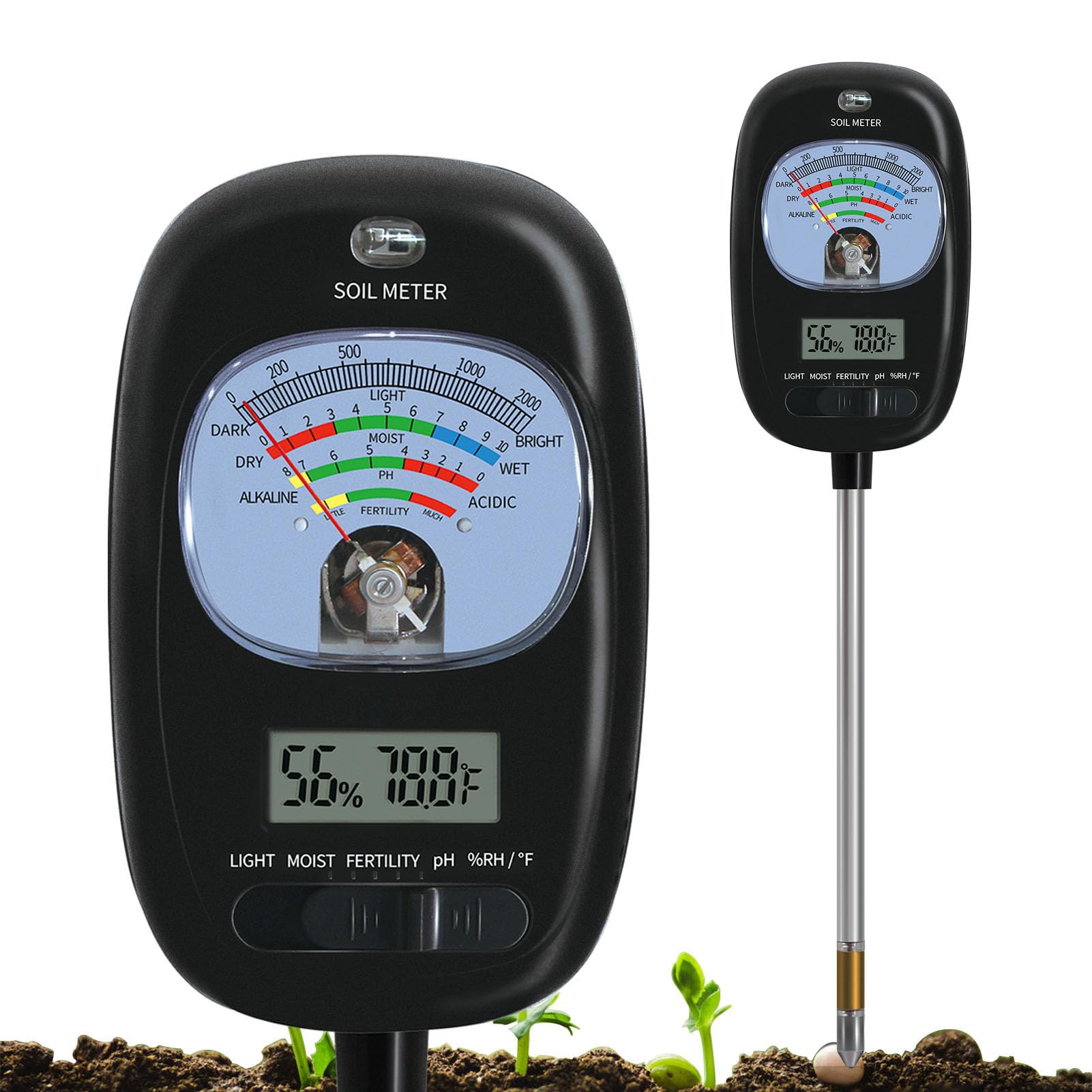
Auduto’s patented US design pairs a traditional analog meter with an LCD display that shows soil and air temperature along with humidity. The metal probes are coated for corrosion resistance and conductivity, aiming for faster pH and moisture detection. Like the HSLGOVE, it reads seven factors, making it a direct competitor in the same price neighborhood.
The unit is lightweight at 5.6 ounces and has a probe length suitable for medium to large pots. Users appreciate the clear analog scale for moisture (1–10) and pH (3.5–8), which helps beginners quickly understand whether their soil is too dry or too alkaline. Several gardeners reported the moisture readings trend higher than basic probe meters, likely due to dissolved minerals in tap water.
A small but vocal number of buyers found the mode selector labels hard to read and reported identical readings across healthy and unhealthy plants, which suggests unit-to-unit consistency varies. For casual gardeners who cross-check with visual plant cues, this tester is a functional entry point, but professionals should calibrate against a lab test.
Why it’s great
- Patented dual-dial and LCD hybrid design
- Lightweight and easy to handle in pots
- Clear analog moisture scale for beginners
Good to know
- Moisture can read high due to hard water minerals
- Unit-to-unit consistency varies
5. Vlantro 6-in-1 Soil Moisture Meter
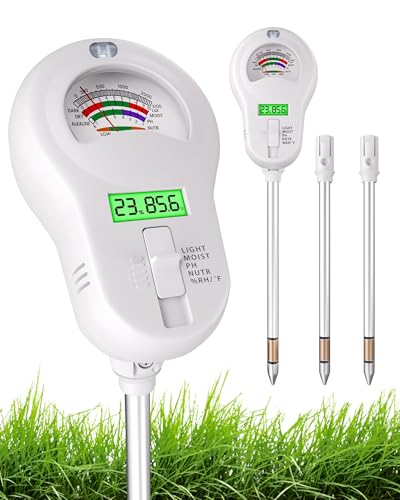
Vlantro’s 6-in-1 is the most budget-friendly option and runs without batteries, relying on a galvanic reaction between the three metal probes to drive the analog needle. The set includes two replacement probes, so when corrosion or bending dulls the readings, you can swap the tips instead of buying a whole new unit — a genuinely useful feature at this price tier.
The rotating head tilts from 0° to 90° for easier reading, and the slide switch cycles through moisture, pH, fertility, and sunlight. It also measures air temperature and humidity via the digital screen. The probes must be inserted about two-thirds into moist soil to make proper electrical contact, and the manual warns against rocky or sandy soils that can damage the tips.
Several users reported the pH needle barely moved during testing, and the lack of a digital readout means you have to interpret needle positions on a small printed scale. For a casual gardener who wants a cheap backup meter or an introduction to soil testing, this unit works, but do not expect laboratory precision.
Why it’s great
- No batteries required for basic functions
- Comes with two replacement probes
- Rotating head for easier viewing
Good to know
- pH needle barely moves in some units
- Not recommended for sandy or rocky soils
FAQ
Can I leave a digital soil tester in the ground permanently?
Why does my soil tester give different readings in the same pot?
What is the difference between analog and dual‑screen digital testers?
Final Thoughts: The Verdict
For most users, the best digital soil tester winner is the SPECILITE 6-in-1 because its replaceable alloy probe, backlit rotating LCD, and single-probe design offer the best blend of accuracy, durability, and root-friendly testing. If you want Bluetooth logging and pH-specific precision for hydroponics or data tracking, grab the YINMIK Digital pH Tester. And for a budget-friendly entry point with replacement probes included, nothing beats the Vlantro 6-in-1.

Mo Maruf
I created WellFizz to bridge the gap between vague wellness advice and actionable solutions. My mission is simple: to decode the research and give you practical tools you can actually use.
Beyond the data, I am a passionate traveler. I believe that stepping away from the screen to explore new environments is essential for mental clarity and physical vitality.