Our readers keep the lights on and my smoothie glass nicely filled. As an Amazon Associate, I earn from qualifying purchases.
Old negatives and slides are ticking time bombs, and a digital film scanner is the only tool that can pull every detail off that fading acetate before it’s gone. A flatbed copier can’t touch the optical resolution required to grab the grain and color depth of 35mm film, so a dedicated scanner is the real solution for preserving aging archives.
I’m Mohammad Maruf — the founder and writer behind WellFizz. I have spent countless hours analyzing the optical sensors, dynamic range, and bundled software ecosystems of dedicated film scanners to separate the machines that genuinely resolve grain from those that just interpolate cheap JPEGs.
Whether you are unboxing a batch of 35mm slides from the attic or tackling a collection of 110 negatives, you need a digital film scanner that pairs adequate sensor resolution with robust dust removal to deliver archival-quality files without a trip to a professional lab.
How To Choose The Best Digital Film Scanner
Dedicated film scanners vary widely in sensor technology, resolution, and software inclusion, so the choice comes down to the volume of your archive, the film formats you own, and how much manual cleanup you are willing to do after scanning. These are the three decisive factors for a buyer.
Optical Sensor Type and True Resolution
A CCD sensor with a true optical resolution of 7200 dpi will pull grain-level detail from 35mm frames, while CMOS-based units in the budget tier typically top out at interpolated 22MP ratings that look softer on a large monitor. If you plan to print enlargements or crop into frames, a CCD scanner with a spec like 7200 dpi is the difference between a sharp digital negative and a pixelated mess.
Infrared Dust and Scratch Removal
Dust on negatives is unavoidable, and manually cloning out hundreds of dust spots in Photoshop is miserable. A scanner with an infrared channel (marketed as iSRD, Digital ICE, or SRDx) automatically detects dust and scratches on the surface of the film and removes them without softening the actual image grain. This feature alone can cut your post-processing time by 80 percent, making it the single most valuable spec for anyone scanning a large collection.
Software and Workflow Integration
Standalone scanners with a built-in LCD screen and SD card slot let you digitize without a computer, which is convenient for casual batch work. However, serious archivists need software like SilverFast SE Plus or VueScan to control color profiling, set multi-exposure modes, and output 48-bit TIFF files. The scanner is only as good as the software that translates the raw sensor data into a usable file.
Quick Comparison
On smaller screens, swipe sideways to see the full table.
| Model | Category | Best For | Key Spec | Amazon |
|---|---|---|---|---|
| Plustek OpticFilm 8200i SE | Premium | Archival 35mm scanning | 7200 dpi / 48-bit / iSRD infrared | Amazon |
| Epson Perfection V800 | Premium | Medium-format & flatbed hybrid | 6400 dpi / 4.0 Dmax / Dual Lens | Amazon |
| Epson Perfection V600 | Mid-Range | Versatile photo & film scanning | 6400 dpi / Digital ICE / 48-bit | Amazon |
| KODAK SLIDE N SCAN | Mid-Range | Quick home slide digitization | 22MP interpolated / 5″ LCD | Amazon |
| HP Touch Screen Film Scanner | Mid-Range | Touchscreen standalone operation | 13MP CMOS / 22MP interpolated | Amazon |
| ClearClick QuickConvert 2.0 | Mid-Range | Scanning photos inside albums | 14MP optical / 5″ LCD / battery | Amazon |
| KODAK REELS 8mm Digitizer | Premium | 8mm and Super 8 movie film | 8MP sensor / 1080p output | Amazon |
| Magnasonic FS70 | Budget | Entry-level 35mm & slide scanning | 25MP interpolated / 5″ LCD | Amazon |
| KEDOK 4-in-1 Scanner | Budget | Multi-media scanning (photos & cards) | 22MP interpolated / 8GB SD included | Amazon |
In‑Depth Reviews
1. Plustek OpticFilm 8200i SE

The Plustek OpticFilm 8200i SE is the gold standard for dedicated 35mm film scanning at a realistic enthusiast price. Its CCD sensor delivers a true optical resolution of 7200 dpi, which resolves individual grain clusters on Kodachrome slides and allows for massive enlargements without interpolation artifacts. The 48-bit color depth captures a wide tonal range that preserves shadow detail even on underexposed negatives.
The infrared dust and scratch removal (iSRD) is the defining feature here — it automatically detects surface defects during scanning and removes them without affecting the actual image texture. This single function saves hours of manual cleanup in Photoshop. The bundled SilverFast SE Plus software offers multi-exposure and HDRi modes, giving you professional-grade control over color balance and dynamic range.
Scan speed is slower than a standalone LCD unit, averaging about three minutes per frame with iSRD enabled, but the quality justifies the wait. The USB 2.0 connection works on both Windows and Mac, though users with USB-C-only computers will need an adapter. For anyone serious about building a high-fidelity digital archive of 35mm film, this is the machine to beat.
Why it’s great
- True 7200 dpi CCD sensor captures real film grain
- Infrared dust removal drastically reduces post-processing
- Bundled SilverFast SE Plus offers multi-exposure and HDRi modes
Good to know
- Slow per-frame scan speed with iSRD enabled
- Limited to 35mm film only
- Requires USB adapter for USB-C computers
2. Epson Perfection V800 Photo

The Epson Perfection V800 Photo is a premium flatbed scanner that doubles as a serious film digitizer, making it ideal for users who shoot both 35mm and medium format film. Its exclusive Dual Lens System automatically selects between two optical paths to optimize the scan for the specific film type, delivering up to 6400 dpi optical resolution. The 4.0 Dmax rating ensures smooth tonal gradations and exceptional shadow detail, which is critical for pulling information out of dense negative areas.
The built-in transparency unit scans up to twelve 35mm mounted slides at once or a strip of medium format film up to 6×22 cm. The included Epson Scan software is intuitive and fast, avoiding the steep learning curve of third-party alternatives. Digital ICE technology handles infrared dust removal on film, though it must be disabled for Kodachrome slides to avoid artifacts.
This scanner also handles reflective prints up to 8.5 x 11.7 inches, so it serves as a general-purpose archive tool. The LED light source requires no warm-up time and reduces power consumption. The 18-frame 35mm film holder is a time-saver for batch scanning, but the medium format holder only accepts two 6×7 frames per pass, which can slow down large 120 film projects.
Why it’s great
- Dual Lens System optimizes for different film formats
- 4.0 Dmax delivers smooth tonal gradations and deep shadow detail
- Scans both film and reflective prints up to 8.5 x 11.7 inches
Good to know
- High price point limits to serious archivists
- Medium format holder only fits two 6×7 frames per pass
- Dust under platen can accumulate over time
3. Epson Perfection V600 Photo

The Epson Perfection V600 Photo balances versatility and image quality for users who need to scan a mix of prints, slides, and negatives without stepping up to the V800 price tier. Its CCD sensor provides a true optical resolution of 6400 x 9600 dpi, allowing for print enlargements up to 17 x 22 inches. The built-in transparency unit scans four 35mm mounted slides simultaneously or a strip of twelve negatives, which accelerates batch work.
Digital ICE technology on the V600 automatically detects dust and scratches on film and removes them during the scan, and the Color Restoration feature helps correct the magenta shift common on faded slides from the 1970s. The included ArcSoft PhotoStudio and Easy Photo Fix software provide basic editing and restoration tools, though many users prefer to edit in Photoshop for finer control.
Scan times are moderate — a 4800 dpi scan with Digital ICE enabled takes roughly ten minutes per set of four slides. The software interface feels dated compared to modern offerings, and the brightness setting resets between scans, requiring you to save a preset. For a medium-volume archivist who wants a single device for prints and film, the V600 delivers reliable results without a second mortgage.
Why it’s great
- True 6400 dpi optical resolution with 48-bit color depth
- Digital ICE removes dust and scratches automatically
- Scans prints, slides, and negatives in one device
Good to know
- Scan times are slow with Digital ICE enabled
- Software outdated and brightness setting resets on restart
- Not ideal for very high-volume batch scanning
4. KODAK SLIDE N SCAN

The KODAK SLIDE N SCAN is a purpose-built standalone digitizer designed for casual users who want to convert a box of slides and negatives without learning complex software. The large 5-inch LCD screen lets you preview each frame before saving, and the gallery mode doubles as a digital picture frame. It supports 135, 126, and 110 film formats, covering the three most common consumer film types from the 1960s through the 1990s.
This unit uses a CMOS sensor with a 22MP interpolated output, which produces files suitable for sharing on social media, printing at 8×10 inches, or viewing on a television via the included HDMI cable. The quick-load tray system allows continuous feeding, so you can scan several hundred slides in a single session. The scan speed is roughly two seconds per frame, making it much faster than a flatbed for high-volume work.
The image quality is adequate for archival purposes, but the CMOS sensor cannot match the optical resolution of a CCD-based unit like the Plustek. Dust on the film can leave marks on the final JPEG, and the included cleaning brush is essential. The unit requires an SD card (up to 32GB, not included) and powers via USB. The plastic build feels light, but the reliability is solid for home use.
Why it’s great
- Fast scan speed of about two seconds per frame
- 5-inch LCD preview with gallery mode
- Supports 135, 126, and 110 film formats
Good to know
- 22MP output is interpolated, not true optical resolution
- Dust on film can create visible marks in scans
- SD card not included
5. HP Touch Screen Film Scanner (HPFS500)
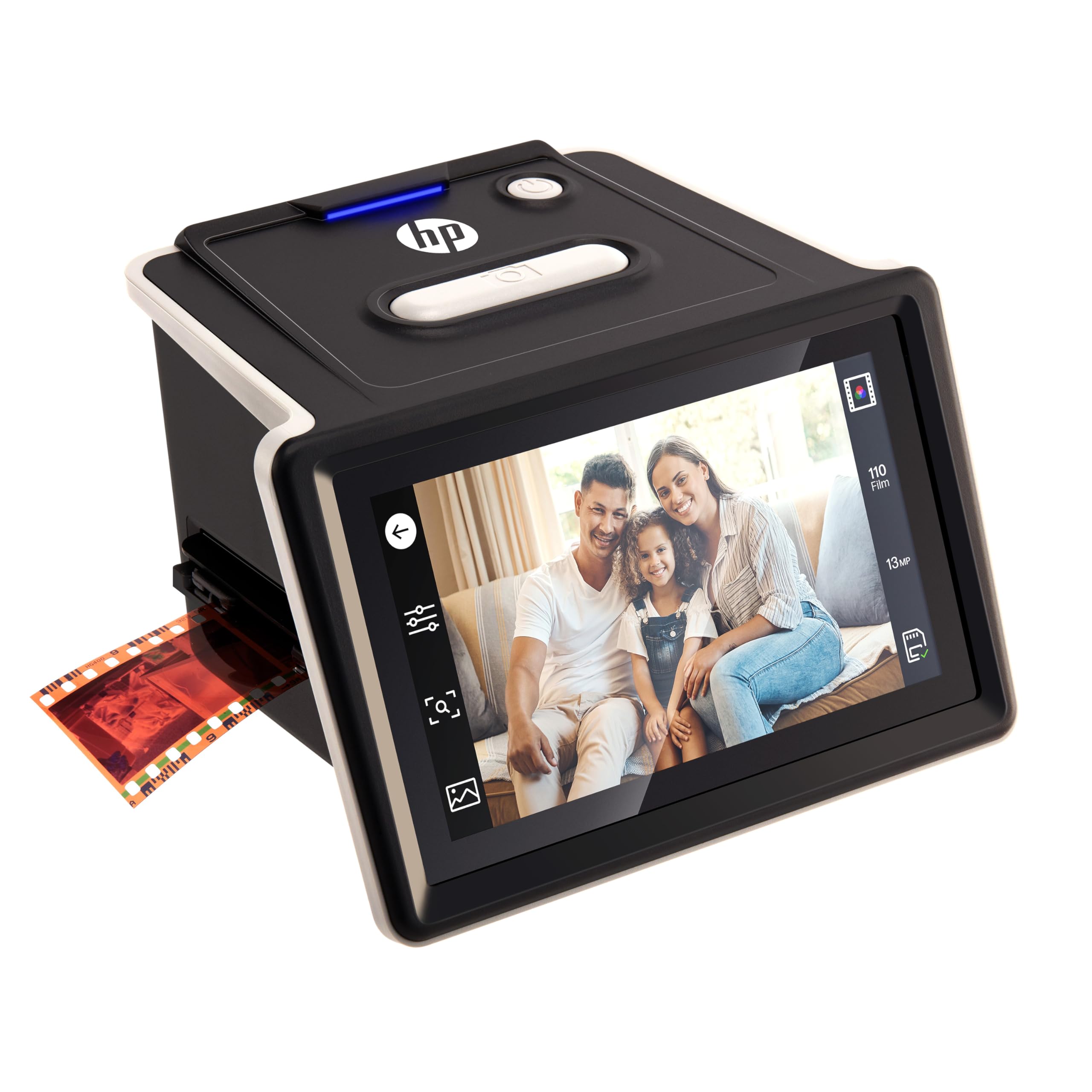
The HP Touch Screen Film Scanner brings a modern, consumer-friendly interface to the dedicated scanner category with its full-angle 5-inch LCD touchscreen. The all-angle display allows you to tilt the screen for comfortable viewing while feeding film, and the touch controls replace the clunky button menus found on other standalone units. It accepts 135, 126, and 110 formats through a quick-load tray that reduces insertion time.
Inside, a 13MP CMOS sensor captures the image, and the unit interpolates up to 22MP for the final JPEG file. The resulting image quality is solid for family photos and online sharing, producing clean color and reasonable sharpness on well-exposed slides. The USB Type-C power connector is a welcome upgrade over older micro-USB ports, and the scanner can run from a laptop USB port or an external 5V adapter.
User reports note that the red saturation can run high with certain slide types, but the built-in brightness and color controls let you adjust on the fly. The unit requires an SD card for storage and does not include one in the box. Over 2,000 slides have been processed through this unit in some cases without mechanical failure, indicating solid manufacturing quality for the price tier.
Why it’s great
- Touchscreen interface is intuitive and easy to navigate
- USB-C power simplifies cable management
- Good build quality for high-volume casual scanning
Good to know
- 13MP CMOS sensor limits fine detail compared to CCD units
- Red saturation can be too high on some slides
- SD card not included
6. ClearClick QuickConvert 2.0

The ClearClick QuickConvert 2.0 is built for a very specific pain point: scanning photographs that are already mounted in fragile albums. The removable base plate lets you scan photos without prying them out of their plastic sleeves, preventing damage to both the album and the print. It accepts 4×6 photos and smaller, plus 35mm, 110, and 126 negatives and slides.
The 14MP optical sensor (interpolated to 22MP) produces JPEG files at roughly 3824 x 2512 pixels, which is sufficient for online sharing and standard prints. Each scan takes only one to two seconds, making the throughput very high for large collections. The built-in rechargeable battery allows cord-free operation, so you can sit on the couch and scan without a power cord running across the room.
Color balance can be inconsistent — brightness adjustments sometimes introduce a bluish tint, and some users report a yellow-green cast on certain photos. The included 32GB SD card holds fewer images than expected (around 200 at the highest resolution), so you may need to offload files frequently. The scanner does not support 5×7 photos, which limits its usefulness for larger prints.
Why it’s great
- Scans photos directly inside album sleeves without removing them
- Built-in battery enables true cord-free operation
- Fast scan speed of one to two seconds per image
Good to know
- Color balance can introduce a bluish or yellow-green tint
- Limited to 4×6 photos and smaller
- SD card fills quickly at highest resolution setting
7. KODAK REELS 8mm & Super 8 Digitizer

The KODAK REELS Digitizer solves the unique problem of converting 8mm and Super 8 motion picture film into digital MP4 files without a professional telecine service. It accepts reels from 3 inches up to 9 inches in diameter and uses an 8.08-megapixel sensor to capture each frame individually, outputting 1080p video at approximately 20 frames per second. The fully automated process feeds the film frame by frame across the sensor, and the 5-inch LCD interface lets you adjust exposure, sharpness, and tint in real time.
The value proposition is clear: a professional transfer of a few hundred feet of 8mm film can cost hundreds of dollars, while this machine lets you do it yourself at home for the price of the hardware. The trade-off is time — a 400-foot reel takes roughly four and a half hours to digitize, and the machine requires manual supervision because old film is prone to broken sprocket holes and stuck splices. The output quality is a direct reflection of the source material; grainy, soft home movies from the 1960s look exactly as they did on the projector, which is authentic but not sharp.
Some users report a default low bitrate that causes blocky artifacts, which can be improved by modifying the internal firmware settings (an advanced procedure not supported by the manufacturer). The unit records at 20fps, but most 8mm film runs at 16-18fps, so playback appears slightly sped up unless you adjust the frame rate in external editing software like HandBrake.
Why it’s great
- Converts 8mm and Super 8 reels to digital 1080p at home
- 5-inch LCD interface with adjustable exposure and tint controls
- Cost-effective alternative to professional transfer services
Good to know
- Extremely slow digitization process requires constant monitoring
- Default bitrate can produce blocky compression artifacts
- Playback speed mismatch requires external editing software
8. Magnasonic All-in-One FS70

The Magnasonic FS70 is an entry-level standalone scanner designed for families who want to digitize a moderate collection of 35mm, 110, 126 slides, and Super 8 film stills without a computer. Its 25MP interpolated output and CCD sensor produce images that are noticeably better than the cheapest CMOS-based units, though still a step below true optical 7200 dpi scanners. The large 5-inch TFT LCD screen provides a clear preview, and the HDMI output lets you display scans on a TV in real time, which turns the scanning session into a shared family activity.
The FS70 includes dedicated trays for 35mm, 110, 126, and Super 8 formats, and the fast-loading mechanism keeps the workflow moving at roughly five seconds per scan. The built-in 64MB of internal memory is too small for practical use — you will need an SD card (up to 128GB) to store a full session. Onboard controls for brightness, RGB color correction, flipping, and mirroring allow simple edits directly on the device without connecting to a computer.
The 25MP resolution is interpolated, and some users report that switching between 13MP and 25MP settings produces no visible difference in sharpness. The scan quality compares to a disposable camera — fine for 4×6 prints and web use, but lacking the fine detail required for large enlargements. The build quality is lightweight, and the one-year direct warranty provides basic peace of mind for this price tier.
Why it’s great
- CCD sensor delivers better quality than CMOS competitors at this price
- Supports Super 8 stills and multiple slide formats
- HDMI output allows real-time viewing on a TV
Good to know
- 25MP resolution is interpolated, not true optical
- 64MB internal memory is insufficient for practical use
- Scan quality limited to 4×6 prints and web sharing
9. KEDOK 4-in-1 Photo, Slide & Negative Scanner

The KEDOK 4-in-1 Scanner is the most versatile entry-level option in this lineup, adding business card and photo scanning to the standard 35mm and 110 film support. It includes dedicated holders for 135 negatives, 135 slides, 110 film, and 3R/4R/5R photos, making it a true all-in-one device for digitizing a mixed-media memory box. The 5-inch LCD screen provides preview and basic editing, and the unit includes an 8GB SD card in the box, so you can start scanning immediately without buying extra accessories.
The 22MP interpolated output from the CMOS sensor produces decent results for web sharing and small prints, but the image quality is soft compared to CCD-based units. The scanner glass can scratch easily, so careful cleaning is necessary to avoid permanent marks on your scans. The simple touch-based interface lets you choose film type, adjust color and brightness, and assign a date and time stamp without connecting to a computer.
Some units arrive with power issues due to a loose micro USB-C connection, and customer support responsiveness varies. The three-year warranty is longer than most in this price tier, which adds some confidence, but the plastic build feels cheap in hand. For a user who wants to scan a mixed collection of photos, business cards, and slides on a strict budget, the KEDOK delivers functional results despite its limitations.
Why it’s great
- Includes 8GB SD card for out-of-box operation
- Scans photos, business cards, slides, and negatives
- Three-year warranty is longer than most budget options
Good to know
- CMOS sensor produces soft images compared to CCD alternatives
- Scanner glass scratches easily, affecting future scans
- Build quality feels cheap and power connection can be loose
FAQ
Can a flatbed scanner replace a dedicated film scanner for 35mm negatives?
What is the difference between CCD and CMOS sensors in film scanners?
Do I need SilverFast or VueScan for professional results?
Why does my scanner create images that look soft or pixelated?
How do I prevent dust spots from appearing on my scanned negatives?
Final Thoughts: The Verdict
For most users, the digital film scanner winner is the Plustek OpticFilm 8200i SE because its true 7200 dpi optical resolution and infrared iSRD dust removal deliver archival-quality 35mm scans that compete with professional lab output. If you want to scan medium format film alongside 35mm prints and negatives in a single device, grab the Epson Perfection V800. And for a casual family project digitizing hundreds of slides quickly without a computer, nothing beats the speed and simplicity of the KODAK SLIDE N SCAN.

Mo Maruf
I created WellFizz to bridge the gap between vague wellness advice and actionable solutions. My mission is simple: to decode the research and give you practical tools you can actually use.
Beyond the data, I am a passionate traveler. I believe that stepping away from the screen to explore new environments is essential for mental clarity and physical vitality.