Our readers keep the lights on and my smoothie glass nicely filled. As an Amazon Associate, I earn from qualifying purchases.
The difference between a great travel photo and a missed moment often comes down to a camera that keeps pace with your itinerary. A bulky, slow body or a lens that can’t handle a sudden downpour will turn a sunrise summit into a frustrating exercise in gear management. This guide is built for the photographer who wants the creative control of a DSLR without sacrificing the mobility that travel demands.
I’m Mohammad Maruf — the founder and writer behind WellFizz. I’ve spent hundreds of hours analyzing sensor specs, autofocus systems, weather sealing ratings, lens ecosystems, and build quality benchmarks to find which cameras actually hold up to the rigors of life on the road.
Whether you are upgrading from a smartphone or your first kit lens, this roundup of the best digital dslr for travel will help you match your shooting style to a body that won’t weigh you down.
How To Choose The Best Digital DSLR For Travel
Selecting a travel DSLR isn’t just about megapixels. You need a body that balances image quality with durability and size. Here are the critical factors to weigh before you buy.
Sensor Size and Resolution
A full-frame sensor (35mm) offers better dynamic range and low-light performance, ideal for evening street photography or indoor museums. APS-C sensors are smaller, lighter, and often cheaper, with a crop factor (1.5x or 1.6x) that actually gives you extra reach with telephoto lenses — a real advantage for wildlife or distant landmarks.
Autofocus Performance for Action
Travel often involves moving subjects: kids running in a plaza, a street performer, or a bird taking flight. Look for phase-detection autofocus points covering a wide area. A system with face and eye detection for both humans and animals will keep your shots sharp without constant manual adjustment.
Weather Sealing and Build Quality
Not all weather sealing is equal. A camera with an IP53 rating or extensive dust and moisture sealing (often advertised as “weather-resistant” or “splashproof”) can handle light rain, blowing sand, or high humidity. A non-sealed body paired with a sealed lens still leaves the vulnerable sensor area exposed — look for matched sealed gear.
Lens Ecosystem and Versatility
A travel camera is only as good as the glass you can mount. A deep lens library (native and third-party) gives you options from ultra-wide zooms for architecture to fast primes for low light. The kit lens should cover a useful range (24-70mm equivalent is standard) with image stabilization — but the ability to upgrade later is what future-proofs your setup.
Quick Comparison
On smaller screens, swipe sideways to see the full table.
| Model | Category | Best For | Key Spec | Amazon |
|---|---|---|---|---|
| OM-3 + 12-45mm F4 PRO | Premium | All-weather adventure | 20 MP Stacked BSI + IP53 | Amazon |
| Sony a7 III + 28-70mm | Premium | Full-frame all-rounder | 24.2 MP BSI + 693 AF points | Amazon |
| Nikon Z 6II | Premium | Stills/video hybrid | 24.5 MP BSI + 14 FPS | Amazon |
| FUJIFILM X100VI | Premium | Street photography | 40.2 MP + 6-stop IBIS | Amazon |
| Pentax K-1 Mark II + 28-105 WR | Premium | Landscape & Astro | 36.4 MP + Astrotracer | Amazon |
| Sony RX100 VII | Premium | Pocketable zoom | 20.1 MP Stacked + 24-200mm | Amazon |
| Canon EOS RP + 24-105mm STM | Mid-Range | Compact full-frame entry | 26.2 MP + 5-stop IS | Amazon |
| Nikon D7500 + 18-140mm VR | Mid-Range | Traditional DSLR reach | 20.9 MP + 51-point AF | Amazon |
| Panasonic LUMIX G85 + 12-60mm | Mid-Range | IBIS on a budget | 16 MP MFT + 5-Axis IBIS | Amazon |
| Canon EOS R100 + 18-45mm | Mid-Range | Compact entry-level | 24.1 MP APS-C + 6.5 FPS | Amazon |
| Panasonic LUMIX ZS99 | Mid-Range | Ultra-zoom compact | 30x optical zoom + USB-C | Amazon |
In‑Depth Reviews
1. OM SYSTEM Olympus OM-3 + 12-45mm F4 PRO

The OM-3 pairs a vintage metal body with modern engineering that matters on the road. Its IP53 dustproof, splashproof, and freezeproof rating means you can shoot confidently in a downpour or dusty trail — no rain cover needed. The 20 MP Stacked BSI Live MOS sensor delivers fast readout and excellent dynamic range, while the TruePic X processor enables computational features like Live ND and high-res shot modes that save you from carrying filters.
Paired with the M.Zuiko 12-45mm F4 PRO lens (24-90mm equivalent), the kit covers wide landscape to portrait lengths in a weather-sealed package that fits in a small sling bag. The 5-axis in-body image stabilization is among the best in any system, letting you shoot handheld at shutter speeds that would require a tripod on most cameras. The creative dial for JPEG color profiles also encourages you to edit less and share more — a real asset when traveling.
The 2.36m-dot OLED viewfinder is crisp, and the rear flip screen is useful for waist-level or overhead compositions. The autofocus is fast and reliable with subject detection for people, animals, and vehicles. Battery life is strong for mirrorless, easily lasting a full day of moderate shooting. The only real compromise is the Micro Four Thirds sensor’s smaller surface area compared to full-frame, though the system’s compactness and stabilization often erase that gap in practice.
Why it’s great
- IP53 weather sealing is industry-leading
- Excellent 5-axis IBIS for handheld shots
- Compact and light for a weather-sealed kit
Good to know
- MFT sensor has smaller surface area than full-frame
- Premium price point for a mirrorless body
2. Sony a7 III + 28-70mm Lens

The a7 III is the standard-bearer for full-frame travel performance. The 24.2 MP back-illuminated sensor offers 15 stops of dynamic range and usable sensitivity up to ISO 204,800, making it a beast in low-light environments like museums or night markets. The 693 phase-detection AF points cover 93% of the frame, and Real-time Eye AF for humans and animals locks onto moving subjects with zero hesitation.
The 28-70mm f3.5-5.6 kit lens is versatile for general travel: wide enough for streets, long enough for portraits. The 5-axis in-body stabilization works with any lens you mount, including vintage glass via adapters — a massive plus for creative travel photographers. Battery life is exceptional at roughly 710 shots per charge, meaning you can leave the spare in your bag most days.
The body is compact by full-frame standards but still offers a deep grip for comfortable all-day carry. 4K video with full pixel readout and S-Log profiles makes this a serious hybrid camera for travel vloggers. The menu system is deep but learnable, and the front/rear dials give quick access to exposure settings. The lack of a fully articulating screen and limited weather sealing are minor trade-offs for the price.
Why it’s great
- Excellent low-light and dynamic range performance
- Fast and reliable AF with Real-time Eye tracking
- Long battery life for full-day shooting
Good to know
- Menu system can be overwhelming for beginners
- Kit lens aperture is slow for low-light
3. Nikon Z 6II

The Z 6II refines the formula of the original Z6 with dual card slots (CFexpress/XQD + UHS-II SD) and improved AF performance that reduces hunting in low contrast scenes. The 24.5 MP BSI sensor produces sharp, true-to-life colors with excellent dynamic range — a hallmark of Nikon sensors. The 273-point phase-detection AF system includes eye detection for people and animals, though it trails Sony’s speed in complex tracking scenarios.
In-body stabilization rated at 5 stops makes non-stabilized F-mount lenses via the FTZ adapter fully usable for handheld video and stills. The body is weather-sealed and feels robust without being heavy, and the grip is comfortable for longer sessions. 4K 60p video with full pixel readout is clean and detailed, making this a strong option for serious travel vloggers who also shoot stills.
The Z 6II is compatible with the growing Z-mount lens lineup (including compact f/1.8 primes) and over 300 F-mount lenses with the adapter. The electronic viewfinder is bright and high resolution, and the rear screen tilts for high and low angles — though it doesn’t flip forward for self-recording. Battery life is solid but not class-leading, so carrying a spare is wise for longer excursions.
Why it’s great
- Dual card slots for backup and redundancy
- Excellent build quality and weather sealing
- Strong video specs for hybrid shooters
Good to know
- AF tracking lags behind Sony and Canon
- Screen does not flip forward for selfies
4. FUJIFILM X100VI

The X100VI is the definitive street and travel camera for those who value portability and character. The 40.2 MP X-Trans CMOS 5 HR sensor delivers incredible resolution for cropping, while the built-in 23mm f/2 lens provides a classic 35mm equivalent field of view — wide enough for environmental portraits and landscapes, with enough background separation at f/2 for pleasing bokeh. The new 6-stop in-body image stabilization is a massive upgrade over the X100V, allowing sharp handheld shots in low light.
Film simulation modes (20 total, including REALA ACE) produce straight-out-of-camera JPEGs that rival edited files. This is a huge advantage for travel: shoot JPEG and share directly to social media or print small without processing. The hybrid optical/electronic viewfinder is unique, letting you see the scene optically without lag or switch to EVF for full exposure preview. The camera is silent in electronic shutter mode and small enough to slip into a jacket pocket.
The fixed focal length is a creative constraint that forces you to “zoom with your feet” — freeing for some, limiting for others. The 1.4x and 2x digital teleconverter modes crop in-camera to approximate 50mm and 70mm, though with reduced resolution. Battery life is average, so a spare battery is recommended for full-day shoots. The lens is not weather-sealed without an optional adapter, and the premium price reflects the cult status of the X100 series.
Why it’s great
- Stunning SOOC JPEGs with film simulations
- Compact, pocketable body with 6-stop IBIS
- Unique hybrid OVF/EVF for composition
Good to know
- Fixed 23mm lens limits creative framing
- High price for a non-interchangeable lens camera
5. Pentax K-1 Mark II + 28-105 WR

The K-1 Mark II is a specialized tool for landscape and astrophotography travelers who demand maximum resolution and weather resilience. The 36.4 MP full-frame sensor captures staggering detail, and the Pixel Shift Resolution System II composites four exposures into a single high-res file with true color reproduction — ideal for static landscapes and studio-like product shots on location. The 5-axis SR II shake reduction provides 5 stops of stabilization, usable with any mounted lens.
The 28-105mm WR kit lens is weather-sealed, matching the body’s 87 seals for protection against dust and moisture. The flexible tilt-type LCD monitor articulates along the optical axis, useful for waist-level or overhead compositions without parallax issues. The GPS module powers the Astrotracer feature, which shifts the sensor to track stars — no expensive equatorial mount required, making this unique for night-sky travel photography.
The body is large and heavy by modern standards — it’s a true DSLR, not a compact mirrorless. The contrast-detection AF system is slower than phase-detection rivals, and the lens library is niche compared to Canon or Nikon. But for the dedicated landscape shooter who values resolution, dynamic range, and weather sealing at the premium-tier price, the K-1 II delivers results that rival medium format systems.
Why it’s great
- Exceptional 36.4 MP resolution and dynamic range
- Built-in Astrotracer for astrophotography
- Rugged weather sealing with 87 seals
Good to know
- Large and heavy for extended carry
- Slow contrast-detection autofocus
6. Sony RX100 VII
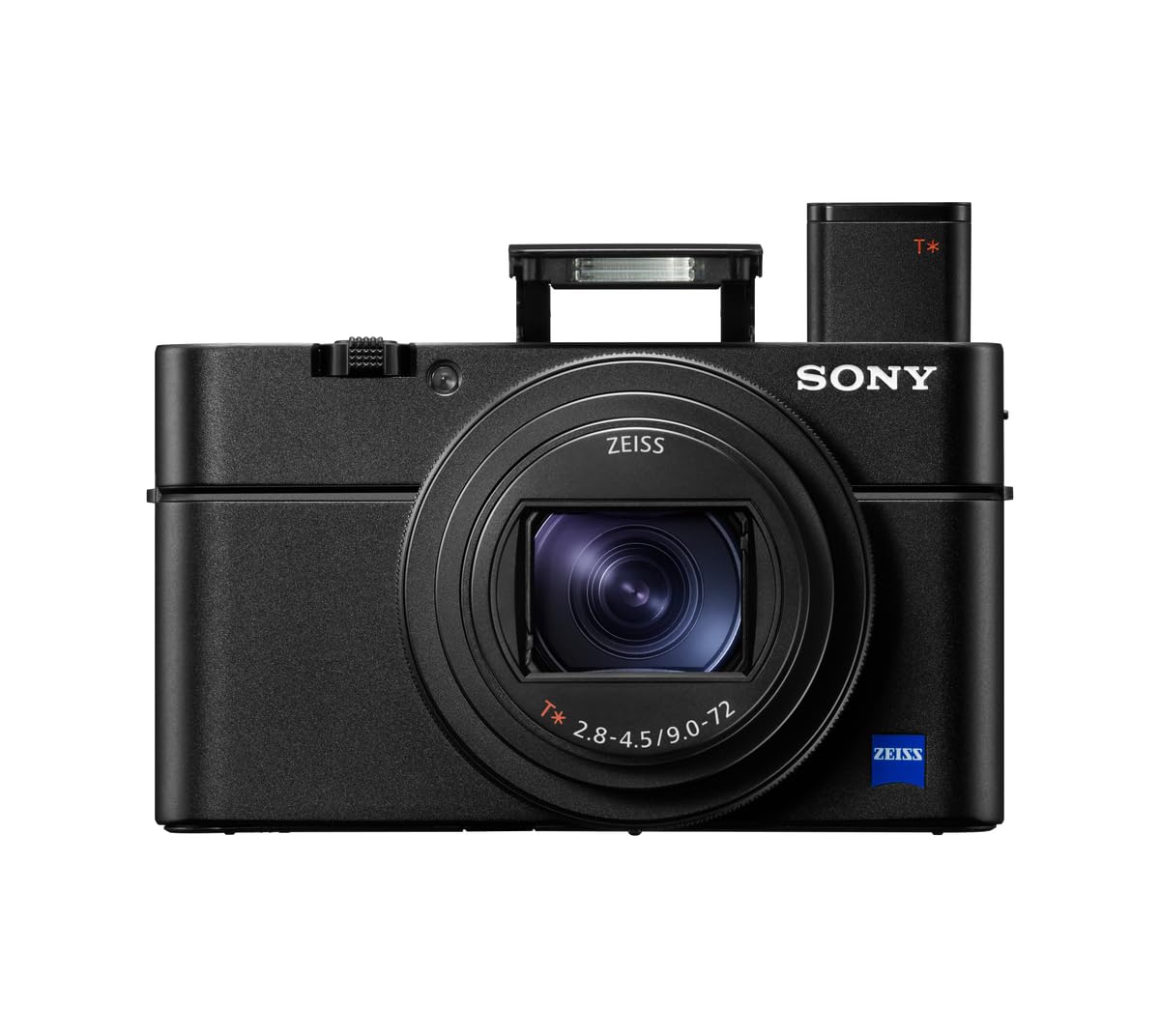
The RX100 VII packs a 1-inch stacked CMOS sensor and a Zeiss 24-200mm f2.8-4.5 zoom lens into a body that fits in a pocket. The 20.1 MP sensor delivers very good image quality in good light, with enough resolution for large prints or heavy crops. The 0.02-second autofocus speed and 357 phase-detection points provide DSLR-like focus performance in a compact package, and Real-time Eye AF works for both humans and animals.
The 24-200mm zoom range covers true wide-angle to serious telephoto, making it a do-it-all travel lens for everything from landscapes to distant wildlife. 4K video with active stabilization, S-Log3, and a microphone jack make it viable for vlogging. The pop-up electronic viewfinder is useful in bright daylight, and the tiltable touchscreen works for self-recording and low-angle shots. The camera shoots up to 20 fps with no blackout, ideal for fast action.
The biggest limitation is the small sensor: low-light noise is noticeable above ISO 1600, and the lens aperture narrows to f4.5 at telephoto, pushing ISO even higher. The body is slippery without an add-on grip. Battery life is average, and the premium price is significant for a fixed-lens compact. For those who prioritize pocketability and reach above all else, this is the ultimate travel camera.
Why it’s great
- 24-200mm zoom in a truly pocketable body
- Fast and reliable autofocus system
- 4K video with mic jack and stabilization
Good to know
- Small sensor struggles in low light
- Slippery body without optional grip
7. Canon EOS RP + 24-105mm STM

The EOS RP is Canon’s most affordable full-frame mirrorless body, and paired with the RF 24-105mm F4-7.1 IS STM lens, it becomes a lightweight travel setup that captures the depth and detail only a full-frame sensor can provide. The 26.2 MP sensor delivers excellent image quality with pleasing Canon color science, and the 5 stops of lens-based stabilization help keep handheld shots sharp in moderate light.
The body is strikingly compact for full-frame: it’s smaller and lighter than many APS-C DSLRs. The vari-angle touchscreen is useful for vlogging and unusual angles, and the user interface is beginner-friendly with guided menus. Dual Pixel CMOS AF provides fast and reliable face/eye tracking for both photos and video, making it easy to capture moving subjects during family trips or city walks.
4K video is present but with a significant crop factor and limited frame rate options (24 fps), so it’s not the best choice for serious video work. The continuous shooting speed at 5 fps is modest, and the kit lens’s variable aperture (f4-7.1) limits low-light performance without boosting ISO. Battery life is average for mirrorless. Still, as an entry into full-frame travel photography, the RP offers genuine image quality at a mid-range price.
Why it’s great
- Lightest full-frame mirrorless body on the market
- Canon Dual Pixel AF is fast and reliable
- Easy-to-use interface for beginners
Good to know
- 4K video has a crop and limited options
- Kit lens has a slow variable aperture
8. Nikon D7500 + 18-140mm VR

The D7500 is a traditional DSLR that proves the optical viewfinder experience still has value for travel. The 20.9 MP DX sensor delivers image quality that rivals the professional D500, with excellent dynamic range and color. The 51-point phase-detection AF system with 15 cross-type sensors provides fast and accurate focus, and continuous shooting at 8 fps captures fast action without the lag of many mirrorless competitors.
The AF-S DX 18-140mm VR lens (27-210mm equivalent) is the perfect travel companion: wide enough for landscapes, long enough for compressed portraits or zoo animals. The VR system works effectively for handheld shots at slower shutter speeds. The 3.2-inch tilting touchscreen is useful for low-angle compositions, and the optical viewfinder is bright and lag-free — a real advantage in bright sunlight where electronic viewfinders can struggle.
The body is larger and heavier than mirrorless alternatives, and the 4K video is capped at 30 fps without phase-detect AF during recording (contrast-detect only). The lack of in-body stabilization means you rely entirely on lens VR, and the 2017-era design lacks modern connectivity like USB-C. For travelers who prefer the ergonomics and battery life of a traditional DSLR, the D7500 remains a strong, mid-range contender.
Why it’s great
- Excellent image quality with D500-derived sensor
- Fast 51-point AF and 8 FPS burst
- Great battery life for all-day shooting
Good to know
- Heavier and bulkier than mirrorless options
- 4K video lacks phase-detect AF
9. Panasonic LUMIX G85 + 12-60mm

The G85 is a Micro Four Thirds camera that packs class-leading dual image stabilization (5-axis in-body + lens OIS) into a weather-sealed, magnesium-alloy body. The result is the ability to shoot handheld video that rivals gimbal-like smoothness, making it a top pick for travel vloggers and those who shoot in low light without a tripod. The 16 MP sensor (with no low-pass filter) produces sharp, detailed images, and the 12-60mm Power OIS lens offers a versatile 24-120mm equivalent range.
The kit lens is sharp throughout its zoom range, with reliable autofocus for both stills and 4K video (up to 30 fps). The 4K Photo mode lets you extract 8 MP stills from video at 30 fps — perfect for capturing fast moments like jumping shots or street scenes. The eye-level OLED viewfinder has 2360K dots and good magnification, and the rear tilt-touch LCD is responsive. The G85 is also fully compatible with the extensive Micro Four Thirds lens library, including compact primes and long telephotos.
The main downsides: the MFT sensor delivers less dynamic range and higher noise at high ISO than APS-C rivals, and the 16 MP resolution is lower than many competitors. Battery life is average, and the Wi-Fi can be finicky. The body is also heavier than the G7 it replaced, negating some of the weight advantage of the system. For its mid-range price, the G85 offers exceptional stabilization value for hybrid travel shooters.
Why it’s great
- Exceptional dual-IS for handheld video and stills
- Weather-sealed body for outdoor use
- Versatile kit lens and large lens library
Good to know
- Smaller MFT sensor limits low-light performance
- 16 MP resolution is lower than many rivals
10. Canon EOS R100 + 18-45mm

The EOS R100 is the lightest and smallest body in the EOS R series, making it an excellent entry point for travelers who want mirrorless quality without the weight. The 24.1 MP APS-C sensor paired with the DIGIC 8 processor delivers sharp, detailed images with Canon’s pleasing color science. The RF-S 18-45mm kit lens (29-72mm equivalent) is compact and collapsible, keeping the overall package small enough for a daypack or large purse.
The Dual Pixel CMOS AF covers 143 zones with human face and eye detection, and the system even supports animal and vehicle detection. Continuous shooting at 6.5 fps in One-Shot AF is enough for most travel scenarios — street scenes, casual portraits, and moving family members. 4K video at 24 fps is present but limited, with a significant crop factor. The camera is easy to use for beginners, with a guided interface and “quick menu” customization.
The biggest compromises are the lack of in-body image stabilization (relying on lens-side stabilization) and the plastic build that doesn’t feel as premium as higher-tier models. The 18-45mm kit lens has a slow variable aperture (f4.5-6.3), limiting low-light use. Battery life is adequate for a half-day of shooting. For the price-conscious traveler stepping up from a smartphone, the R100 delivers solid image quality in a compact, entry-level package.
Why it’s great
- Lightest EOS R body for easy packing
- Dual Pixel AF is reliable and beginner-friendly
- Good image quality at an entry-level price
Good to know
- No in-body stabilization
- Kit lens is slow in low light
11. Panasonic LUMIX ZS99

The ZS99 is a true pocket superzoom with a 24-720mm LEICA DC lens that covers wide-angle landscapes to extreme telephoto reach for distant subjects. The 20.3 MP 1/2.3-inch sensor is small, but the lens’s 30x optical zoom (plus 60x iZoom) makes it the only option in this list for concert-goers, safari travelers, or wildlife watchers who cannot physically get closer. The body is genuinely pocket-sized, slipping into a jeans pocket or small purse without effort.
4K video and 4K Photo mode (30 fps burst) provide solid video and still extraction options. The 1,840k-dot tiltable touchscreen is sharp and responsive, and the built-in Bluetooth v5.0 sends images directly to your phone. USB-C charging means you can share cables with your phone or laptop — a major convenience for international travel. The “Send Image” button simplifies sharing.
The image quality is limited by the small sensor: noise is visible above ISO 800, and low-light photos are often unusable without flash. The autofocus can be slow to lock in dim conditions, and the menu system is deep and unintuitive. The LCD screen can also be hard to read in bright daylight. For those who prioritize zoom reach above all else in a pocketable body, the ZS99 is unmatched, but image quality falls well short of larger-sensor cameras.
Why it’s great
- 30x optical zoom from 24-720mm
- Pocketable size for easy carry
- USB-C charging for travel convenience
Good to know
- Small sensor limits image quality in low light
- Autofocus can struggle in dim conditions
FAQ
Is a full-frame sensor worth the extra weight for travel?
How many autofocus points do I really need for travel?
What does a 5-axis IBIS mean for handheld travel shots?
Can I use lenses from my old DSLR on a new mirrorless body?
Final Thoughts: The Verdict
For most users, the best digital dslr for travel winner is the OM SYSTEM OM-3 because it combines professional-grade weather sealing, excellent stabilization, and a compact weather-sealed kit lens in a single package that handles rain, dust, and cold without compromise. If you want full-frame image quality and fast autofocus for action shots, grab the Sony a7 III. And for pocketable reach that covers wide landscapes to distant wildlife, nothing beats the Sony RX100 VII.

Mo Maruf
I created WellFizz to bridge the gap between vague wellness advice and actionable solutions. My mission is simple: to decode the research and give you practical tools you can actually use.
Beyond the data, I am a passionate traveler. I believe that stepping away from the screen to explore new environments is essential for mental clarity and physical vitality.