Our readers keep the lights on and my smoothie glass nicely filled. As an Amazon Associate, I earn from qualifying purchases.
A digital barometer does more than show a number — it reveals the invisible force of air pressure pressing down on your home, telling you whether a storm is brewing or clear skies are ahead before a single cloud appears. For anyone who tracks weather patterns, manages a greenhouse, or simply wants to understand why their joints ache before it rains, a precise barometric reading is the only reliable early warning system.
I’m Mohammad Maruf — the founder and writer behind WellFizz. I’ve spent hundreds of hours cross-referencing barometric sensor accuracy, transmission reliability, and display readability across dozens of home weather stations to find which digital barometers actually deliver useful, real-time pressure data you can trust.
After comparing sensor precision, transmission range, and barometric trend graphing across seven competing models, this guide will help you choose the right digital barometer for your home, workshop, or weather hobbyist setup.
How To Choose The Best Digital Barometer
Not every digital barometer delivers the same quality of pressure data. Some measure absolute pressure without compensating for altitude, while others calculate relative pressure adjusted to sea level — the number that actually correlates with incoming weather. Understanding the difference between a raw sensor reading and a weather-adjusted pressure value is the first step toward a purchase you won’t regret.
Barometric Trend vs. Single Reading
A barometer that shows only current pressure forces you to remember yesterday’s value to know if pressure is falling or rising. The most useful digital barometers include a trend indicator — an arrow pointing up or down — or better yet, a 12- or 24-hour barometric pressure graph. A falling pressure trend signals an approaching low-pressure system and potential precipitation, while a rising trend indicates clearing conditions. Without trend data, the absolute pressure number is nearly useless for forecasting.
Sensor Accuracy and Transmission Range
The barometer sensor itself lives inside the indoor console, but accurate weather prediction often requires outdoor temperature and humidity data to contextualize the pressure readings. The outdoor sensor’s transmission range — measured in feet in open air — determines whether the station can reliably pull data from a backyard, greenhouse, or detached garage. Look for 433 MHz or 868 MHz transmission frequencies, which offer the best balance of range and wall penetration for home use.
Display Readability and Power Source
Barometric pressure graphs and weather icons are useless if you have to squint to read them from across the room. Prioritize large-digit displays with adjustable backlight brightness. Many stations require AC power to keep the backlight continuously on; battery-only mode often dims or turns off the display after a few seconds. If you plan to mount the unit in a bedroom, check whether the backlight can be dimmed to avoid light pollution at night.
Quick Comparison
On smaller screens, swipe sideways to see the full table.
| Model | Category | Best For | Key Spec | Amazon |
|---|---|---|---|---|
| SensorPush HTP.xw | Smart Sensor | Bluetooth data logging | ±0.1°F temp accuracy | Amazon |
| La Crosse S77925-INT | Color Station | 24hr barometric graph | 433 MHz transmission | Amazon |
| BALDR B0C8NSZ5C2 | Color Station | 12hr pressure histogram | 326ft sensor range | Amazon |
| BALDR B0GFMXK5T3 | Vertical Display | 12-hour forecast engine | Vertical color LCD | Amazon |
| U UNNI UN0512 | All-in-One | Tide and moon phase | 330ft transmission radius | Amazon |
| La Crosse 512-85937-INT | Wall Clock | Atomic time accuracy | 11-inch wide display | Amazon |
| Ambient Weather BA212 | Analog Liquid | Traditional cherry decor | Liquid-filled storm glass | Amazon |
In‑Depth Reviews
1. SensorPush HTP.xw Smart Temperature & Humidity Sensor

SensorPush takes a fundamentally different approach from the rest of this list — it’s a compact Bluetooth sensor with no built-in screen, designed to log temperature, humidity, barometric pressure, dew point, VPD, and heat index directly to your smartphone. The barometric pressure reading is accessible through the app along with 30 days of onboard data logging and unlimited in-app storage, making it the only option here that gives you exportable CSV pressure trend data for serious analysis.
The temperature accuracy of ±0.1°F rivals laboratory-grade instruments, and users report the battery lasting over three years under typical conditions. Bluetooth range reaches 330 feet line-of-sight and 30 feet through brick walls, though remote access requires the separate G1 WiFi Gateway. This sensor is splash-resistant and suitable for freezers, greenhouses, wine cellars, and reptile enclosures where a wall-mounted console would be impractical.
The trade-off is clear — there is no display, no weather icons, no atomic clock. If you want to glance at a pressure number without pulling out your phone, this isn’t the solution. But if you need precise, logged, graphable barometric data for environmental monitoring, the SensorPush HTP.xw is in a class of its own.
Why it’s great
- Industry-leading ±0.1°F temperature accuracy
- Unlimited in-app data storage with CSV export
- Over 3-year battery life in typical conditions
Good to know
- No built-in display — requires smartphone app
- Remote monitoring needs separate G1 Gateway purchase
2. La Crosse Technology S77925-INT Wireless Color Weather Station

The La Crosse S77925-INT delivers the most complete barometric picture of any console-style station on this list thanks to its 24-hour historical barometric pressure graph displayed directly on the color LCD. Unlike stations that show only a current pressure number or a simple trend arrow, this one plots actual pressure fluctuations over the past full day, letting you see not just the direction but the magnitude and slope of pressure changes — critical data for predicting storm intensity and duration.
The station is AC powered with a constant backlight adjustable to three brightness levels, so the barometric graph and forecast icons remain visible around the clock. It supports up to three remote sensors for multi-zone temperature and humidity monitoring, with custom high/low alerts for both temperature and humidity that trigger audible warnings. The atomic self-set clock automatically syncs to WWVB for drift-free timekeeping, and the crescendo alarm with 10-minute snooze adds practical bedside functionality.
One limitation: the LCD display washes out when viewed from above eye level, so wall mounting at or below sightline is recommended for optimal readability. The station requires the 5V AC adapter to maintain constant backlight — battery backup preserves settings but dims the screen. For the price, the combination of a 24-hour pressure graph, atomic time, and expandable sensor support is unmatched.
Why it’s great
- Full 24-hour barometric pressure trend graph on display
- Expandable to 3 remote sensors with custom alerts
- Atomic time sync with automatic DST adjustment
Good to know
- Display readability drops when viewed from above
- Constant backlight only with AC adapter plugged in
3. BALDR Wireless Indoor Outdoor Weather Station (B0C8NSZ5C2)

The BALDR 359WH5-YB puts a 12-hour barometric pressure histogram front and center on its 5.9-inch color LCD, offering a clear visual of pressure trends over the past half-day. This is the same caliber of historical trend data found on stations costing significantly more, and it’s paired with a weather forecast engine that uses hourly calculations of indoor and outdoor temperature, humidity, and barometric data to predict conditions 12 hours ahead at 70-75% accuracy. The weather icons respond to actual local sensor data rather than pulling generic forecasts from the internet.
The station supports up to three wireless sensors (one included), with a transmission range up to 326 feet in open air. Users consistently report the display is readable from 10-12 feet away and at sharp viewing angles — a notable advantage over some competing models where readability narrows off-axis. The entire unit is powered by either the included AC adapter or a 5V USB connection, with a CR2032 backup battery to preserve settings during power loss.
Several users note that barometric pressure reads about 1 inch of mercury low when not calibrated to local elevation, and the offset is not user-adjustable. This means the absolute pressure number may differ from local weather station reports, but the trend direction and relative changes remain accurate. If you care more about seeing pressure rise or fall than matching the airport reading exactly, this is a minor quibble.
Why it’s great
- 12-hour barometric pressure histogram displayed on screen
- Excellent off-axis display readability
- USB-C or AC powered with battery backup
Good to know
- Barometric offset not user-adjustable for elevation
- Atomic time sync can be weak in signal-blocked areas
4. BALDR Vertical Color Display Weather Station (B0GFMXK5T3)
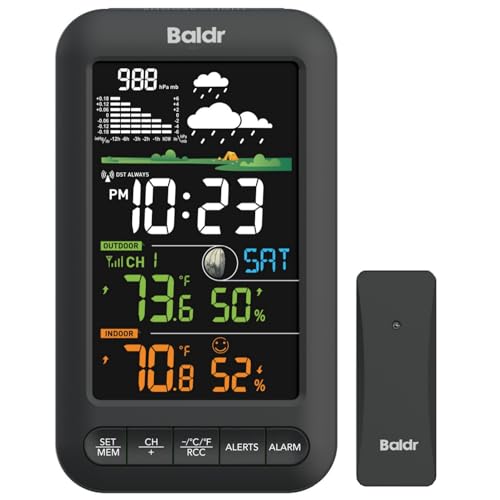
The BALDR FZ-WS571-BK breaks from the typical horizontal weather station layout with a vertical 7.1-inch color display that organizes temperature, humidity, barometric pressure, forecast icons, and time in a column format. The layout naturally fits narrower wall spaces and countertops, and the front-facing controls mean you never have to reach around the back to change settings. The 12-hour weather forecast uses local pressure trends rather than internet data, generating predictions based on your actual microclimate.
This station supports up to three remote sensors, with automatic rotation of temperature and humidity readings across all connected zones. Users praise the HD color screen for its wide viewing angles and crisp readability. The optional atomic clock syncs to WWVB for automatic time setting, though manual setting is recommended in areas with weak signal reception. A built-in crescendo alarm with 5-minute snooze adds bedside utility.
The remote sensor is not waterproof — multiple users report humidity spikes to 99% after rain exposure, requiring a sheltered mounting location or an aftermarket rain shield. The backlight behaves differently on battery power versus AC: plugged in, it offers three adjustable brightness levels; on batteries, it turns off after 10 seconds to conserve power. Overall, the vertical layout is a genuine space-saving innovation that doesn’t compromise barometric data visibility.
Why it’s great
- Space-saving vertical color display with wide viewing angle
- 12-hour forecast based on local pressure trends
- Automatic sensor reading rotation for multi-zone monitoring
Good to know
- Outdoor sensor is not weather-resistant — needs shelter
- Backlight dims and auto-off when running on battery only
5. U UNNI Weather Station with Atomic Clock (B0DG2689J4)
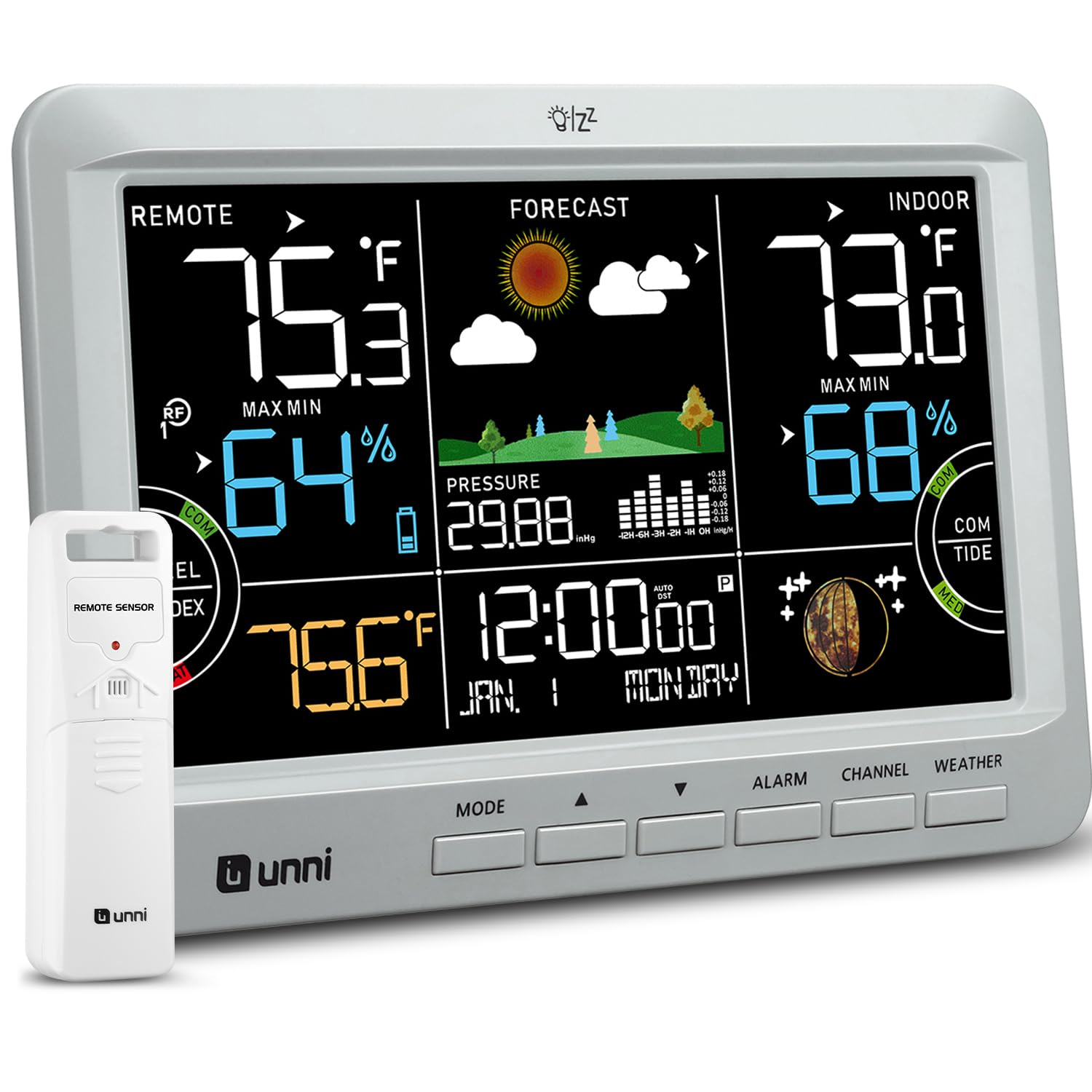
U UNNI’s UN0512 packs an unusually broad feature set into one console, including barometric pressure display, dew point, heat index, comfort level, tide phase, moon phase, and a weather forecast — all on a 7.5-inch LCD with bold temperature digits readable from across the room. The patented wireless technology transmits data from the outdoor sensor up to 330 feet every 30 seconds, making it one of the fastest-updating stations in this comparison.
The atomic clock syncs daily with WWVB for automatic time and date accuracy, including daylight saving time adjustment. Setup is guided through an on-screen menu system, and users report being fully operational within five minutes. The AC adapter provides constant backlight, while five AA batteries (not included) serve as data backup. A touch-sensitive area on the display controls backlight brightness without fumbling for hidden buttons.
The barometric data is presented as an air pressure reading within the forecast system rather than as a dedicated trend graph, so historical pressure visualization is less prominent than on the La Crosse or BALDR models. Some users wish the time digits were larger relative to the temperature display. For its price tier, though, the sheer density of features — tide, moon, dew point, heat index, comfort, and mold risk — makes this the most information-rich console in the mid-range.
Why it’s great
- Fast 30-second sensor updates at 330ft range
- Includes tide and moon phase alongside barometer
- Large temperature digits with touch backlight control
Good to know
- No dedicated barometric trend graph — pressure in forecast only
- Time display could be larger relative to temperature
6. La Crosse Technology Atomic Digital Wall Clock 512-85937-INT

The La Crosse 512-85937-INT is primarily an atomic wall clock with temperature and weather forecast functionality, but its barometric-based 12-hour forecast and indoor/outdoor temperature tracking make it a solid entry point for users who want weather awareness without a full station console. The 11-inch wide display is one of the largest in this roundup, with bold black digits on a gray/silver background that remains readable from across a room or even a small office.
Atomic time syncs automatically to WWVB across seven US time zones, with an on/off option for daylight saving time adjustment. The outdoor sensor is rated down to -40°F, making it suitable for cold climates where other sensors fail. Temperature trend arrows show whether readings are rising, falling, or steady, and the crescendo alarm with 10-minute snooze adds practical bedside functionality. The clock can sit on a table or hang on a wall using the integrated keyhole mount.
The forecast icons are the weakest link — some users report they are difficult to read from an angle and not always accurate compared to local conditions. The barometric data is used internally for the forecast algorithm but is not displayed as a numeric pressure reading, so users who want to see actual millibar or inHg values will need to look elsewhere. For those who prioritize atomic time accuracy and a clean, legible display with basic weather awareness, this clock delivers.
Why it’s great
- 11-inch display with exceptionally readable digits
- Atomic time sync with 7 US time zone support
- Outdoor sensor works down to -40°F
Good to know
- No numeric barometric pressure readout shown
- Forecast icons can be hard to read off-angle
7. Ambient Weather BA212 Wall Mounted Weather Station

The Ambient Weather BA212 is the only analog device in this roundup, using a liquid-filled storm glass barometer housed in a cherry wood frame. When atmospheric pressure drops, the liquid level in the spout rises above the body; when pressure rises, it falls. This physical, mechanical reaction to pressure change has a tangible, almost hypnotic quality that no digital LCD can replicate — and it makes for an excellent conversation piece in a study, library, or living room.
The unit also includes a comfortmeter that combines a thermometer and hygrometer with a comfort zone indicator, giving you temperature and humidity readings alongside the barometric storm glass. The cherry finish and antique styling make it feel like a heirloom instrument rather than a plastic gadget, and users consistently report receiving compliments on its appearance. Setup requires filling the glass body with water according to the included instructions, followed by calibration using your local barometric pressure.
This is not a precision scientific instrument — the storm glass indicates pressure trends directionally rather than numerically, and the included thermometer and hygrometer are decorative-grade rather than laboratory-accurate. The mounting hardware included with some units has been reported as undersized, requiring a trip to the hardware store for proper screws. If you need precise digital millibar readings and historical trend graphs, choose a digital station. If you want a beautiful, functional barometer that feels anchored in weather history, the BA212 delivers.
Why it’s great
- Handcrafted cherry wood frame with antique aesthetics
- Fascinating liquid barometer mechanism — great conversation piece
- Includes comfortmeter with temperature and humidity dials
Good to know
- No digital readout — trend indication only, not precise numbers
- Requires manual filling and calibration using online pressure data
FAQ
What is the difference between absolute and relative barometric pressure?
How long does it take for a digital barometer to calibrate after setup?
Can I use a digital barometer indoors for accurate readings?
Why does my barometer show different pressure than the local airport?
Final Thoughts: The Verdict
For most users, the digital barometer winner is the La Crosse Technology S77925-INT because its 24-hour barometric pressure graph combined with atomic timekeeping and multi-sensor expandability provides the best balance of data depth and everyday usability. If you want app-based data logging with exportable CSV pressure records, grab the SensorPush HTP.xw. And for a beautiful analog conversation piece with genuine barometric function, nothing beats the Ambient Weather BA212.

Mo Maruf
I created WellFizz to bridge the gap between vague wellness advice and actionable solutions. My mission is simple: to decode the research and give you practical tools you can actually use.
Beyond the data, I am a passionate traveler. I believe that stepping away from the screen to explore new environments is essential for mental clarity and physical vitality.