Our readers keep the lights on and my smoothie glass nicely filled. As an Amazon Associate, I earn from qualifying purchases.
A dedicated DIY welder puts fusion-level fabrication in your garage on a standard household outlet, turning scrap metal into functional repairs without the middleman.
I’m Mohammad Maruf — the founder and writer behind WellFizz. I’ve spent hundreds of hours analyzing inverter specs, duty cycles, and multi-process capabilities so you know exactly which machine delivers real penetration without the premium price tag.
Whether you need to patch a gate or build a fire pit from scratch, this guide to the best diy welder breaks down every critical spec so you invest once and weld with confidence for years.
How To Choose The Best DIY Welder
Picking your first wire-feed machine comes down to understanding the three variables that actually matter for home fabrication: power source compatibility, welding process flexibility, and heat management. Skip the marketing hype about max amperage alone—volt-amp curves tell the real story of penetration on 1/4-inch steel versus thin guage sheet metal.
Power Source and Voltage Flexibility
The most common DIY bottleneck is a standard 120V household circuit. True dual-voltage machines—units that run on both 120V and 240V without a transformer—let you start on a garage outlet and upgrade to a dryer outlet for thicker metal later. Check that the unit auto-detects the input voltage so you don’t have to manually flip an internal switch every time you move between power sources.
Welding Process: Flux-Core vs. Gas MIG vs. Multi-Process
Flux-core wire eliminates the need for bottled shielding gas, making it ideal for outdoor or windy conditions where gas would be blown away. Gas MIG produces cleaner welds with less spatter, but requires a dedicated regulator and C25 gas mix. Multi-process machines add Stick (MMA) and Lift TIG functionality—Stick is useful for thicker, rusty metal you don’t want to clean perfectly, while Lift TIG lets you weld thin stainless or aluminum without buying a separate TIG rig.
Duty Cycle and Heat Management
Expressed as a percentage at a given amperage, duty cycle tells you how many minutes out of a ten-minute period you can weld continuously before the machine needs to cool down. A 60% duty cycle at 90 amps means six minutes of welding followed by four minutes of cooling. For garage repairs on 1/8-inch to 3/16-inch steel, a 20-30% duty cycle at max output is sufficient. Premium inverter units manage heat more efficiently, running cooler and extending component life.
Quick Comparison
On smaller screens, swipe sideways to see the full table.
| Model | Category | Best For | Key Spec | Amazon |
|---|---|---|---|---|
| ARCCAPTAIN MIG200 | Multi-Process | Heavy DIY & Aluminum Prep | 200A, 6-in-1, Spot Weld | Amazon |
| PrimeWeld MIG180 | MIG + Spool Gun | Aluminum & Steel Fabrication | 180A, Spool Gun Included | Amazon |
| Weldpro 200A AC/DC TIG | TIG Focus | Thin Sheet & Exhaust Work | 200A, Pulse TIG w/ Pedal | Amazon |
| AHP AlphaTIG 203Xi | AC/DC TIG | Aluminum TIG & Stick Combo | 200A, Pulse, 3yr Warranty | Amazon |
| Forney 271 140 MP | Multi-Process | Farm & 120V Repairs | 140A, 3-in-1, All-Metal Case | Amazon |
| YESWELDER YWM-160 | Multi-Process | First-Time Buyers | 160A, Dual Voltage, Sync | Amazon |
| AZZUNO MIG200F | Multi-Process | Thick Steel Plate Hobby | 200A, Synergic, 5/16in Cap | Amazon |
| Bestarc MIG145 | Entry MIG | Light DIY & RV Mods | 145A, 4-in-1, 13.7 lbs | Amazon |
| Lincoln 90i FC Weld-PAK | Flux-Only | Portable Sheet Metal Repair | 90A, Shoebox Size, 15 lbs | Amazon |
In‑Depth Reviews
1. ARCCAPTAIN 200A 6-in-1 MIG Welder (MIG200)
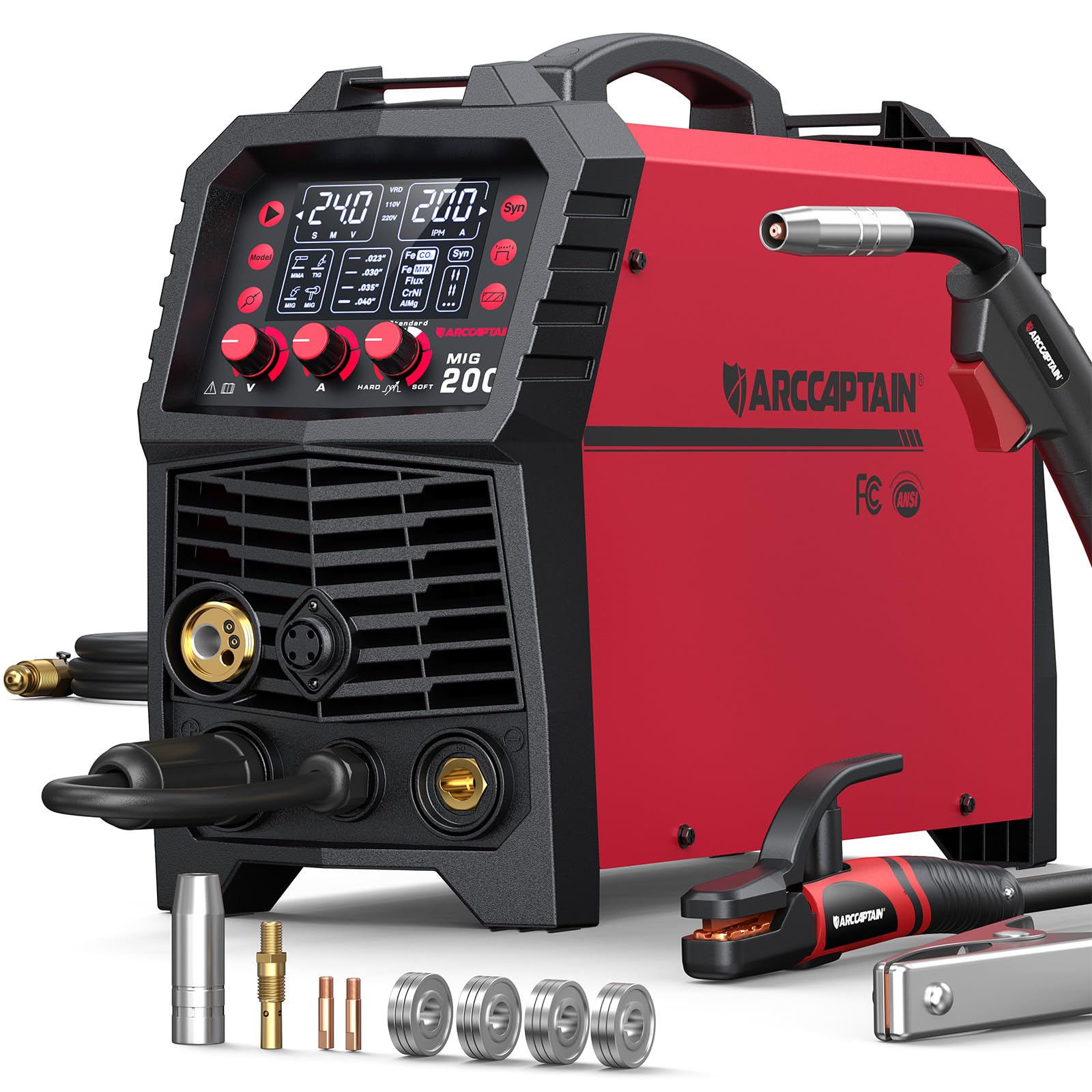
The ARCCAPTAIN MIG200 is the most feature-dense multi-process welder in the mid-range pool, offering 200 amps of output across Gas MIG, Flux-Core MIG, Stick, Lift TIG, Spot welding, and a spool gun connector for aluminum. The synergic control automatically matches wire feed speed and voltage when you select wire diameter and gas type, reducing guesswork significantly. Its large LED display is readable even under a welding helmet, and the 2T/4T trigger mode lets you run continuous beads without holding the trigger.
Built-in adaptive crater fill and burn-back adjustment prevent wire sticking at the end of a weld, a common frustration for beginners. The machine stores up to 10 preset parameter groups per process, so you can recall settings for repeat jobs instantly. Reviewers consistently note its build quality rivals brands costing twice as much, and the VRD (Voltage Reduction Device) adds a layer of safety for shop use.
On the downside, the included 110V-to-220V adapter cable feels undersized, and some units ship without the 0.035-inch drive roll installed. The manual leaves out key setup details like the 1-amp-per-0.001-inch thickness rule. Overall, this machine delivers premium power at a mid-tier price point.
Why it’s great
- Impressive 200A output with stable arc on both 110V and 220V
- Synergic control and 10 memory presets streamline repeat jobs
- Spot welding and crater fill features rarely seen in this price range
Good to know
- Adapter power cable is thin and heats up quickly on sustained use
- Missing 0.035-inch drive rolls and limited manual instructions
- Unit is fairly large and heavy for compact workshop storage
2. PrimeWeld MIG180 180A MIG Welder

The PrimeWeld MIG180 differentiates itself by including a dedicated spool gun for aluminum welding right in the box—a value that most competitors treat as a separate purchase. Running on dual 120V/240V input, it delivers 180 amps of wire-feed power and supports MIG (gas), flux-core, and Stick processes. The unit accepts standard Tweco consumables, making replacement parts easy to find at any welding supply store.
Its duty cycle is generous enough for DIY fabricators, and the included gas regulator and hose let you start gas MIG welding without extra trips to the supply house. Reviewers frequently mention that the MIG180 outperforms their expectations when compared to Miller or Lincoln units in the same amperage class. The spool gun feeds aluminum wire reliably without the bird-nesting issues common with long standard gun liners.
The primary drawback is its price point, which sits above budget-entry models. At 55 pounds, it’s not a machine you throw over your shoulder for quick mobile repairs. The stick welding functionality is present but basic, lacking the hot-start and arc-force features of dedicated Stick machines. For hobbyists who plan to weld aluminum regularly, this is the most complete package under the premium tier.
Why it’s great
- Spool gun, gas regulator, and consumables included for immediate aluminum welding
- Runs 10-pound wire spools without feed issues
- Uses standard Tweco consumables for easy replacement
Good to know
- Premium price compared to 140A-160A entry-level machines
- Stick welding lacks advanced arc force controls
- Heavy unit at 55 pounds, not ideal for mobile carry
3. Weldpro 200A AC/DC TIG Welder with Pulse
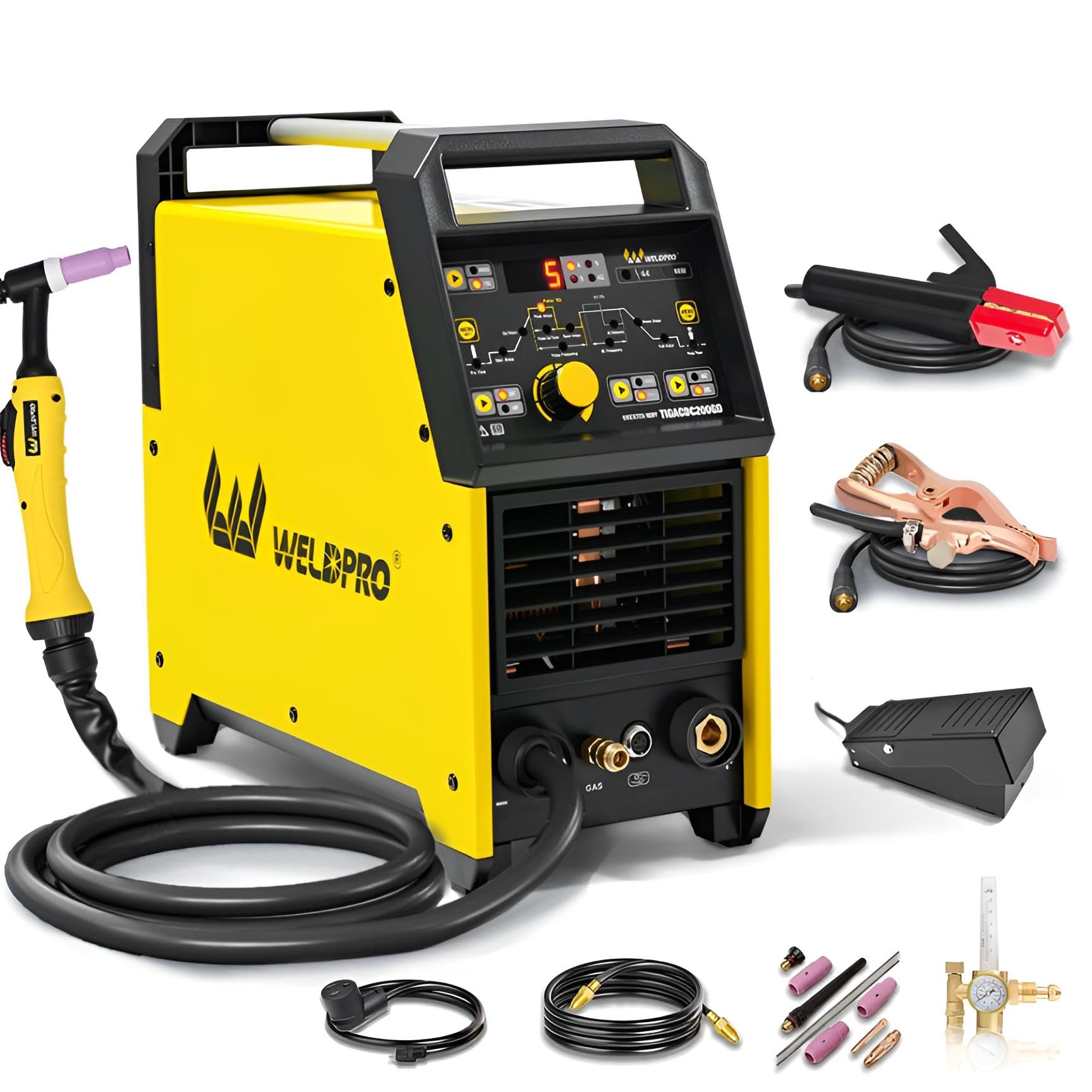
If your primary need is TIG welding—especially aluminum with AC balance and pulse control—the Weldpro 200A AC/DC is the most affordable way to get customizable waveform settings without stepping up to a + industrial unit. Its 5-in-1 capability covers AC TIG, DC TIG, AC Pulse, DC Pulse, and Stick, and the high-frequency start eliminates tungsten contamination from scratch starts. The included CK17 flex torch is a genuine premium component, offering better maneuverability in tight corners than budget torch alternatives.
The foot pedal provides seamless real-time amperage control, essential for variable-thickness joints where you need to taper heat input mid-weld. Pulse frequency adjustment between 0.5 and 200Hz lets you manage heat-affected zone width on thin sheet work, reducing distortion significantly on 16-gauge stainless. Reviewers with automotive exhaust and manifold repair experience praise its immediate arc stability.
Downsides include a ground clamp with a very stiff spring that barely opens one inch, making it difficult to secure on odd-shaped workpieces. The gas regulator is basic and may require replacement for precise flow metering. The duty cycle is 40% at full 200A output, which is adequate for DIY but will thermal-limit during continuous heavy aluminum runs.
Why it’s great
- True AC/DC pulse TIG with full adjustment at a fraction of industrial cost
- Includes top-tier CK17 flex torch and responsive rocker foot pedal
- High-frequency arc start for clean tungsten tip and consistent arc
Good to know
- Ground clamp spring is overly stiff, needs replacement or modification
- Gas regulator accuracy is questionable; verify with a secondary gauge
- 40% duty cycle at 200A may limit heavy production use
4. AHP AlphaTIG 203Xi AC/DC TIG/Stick Welder

AHP built its reputation on delivering industrial-grade TIG performance to serious hobbyists, and the 203Xi continues that legacy with a 100% duty cycle at 155 amps—meaning you can run that machine nonstop without thermal shutdown. That spec alone sets it apart from every other unit in this guide, making it viable for full-day fabrication sessions. It operates on 110V and 220V and includes a heavy-duty Nova Rotaflex TIG torch, a billet brass argon regulator, and a foot pedal with a 25-foot cord.
The 2024 revision adds HV Start (solid-state simulated high-frequency start) that eliminates the need for point-gap maintenance. Stick performance is outstanding, with a smooth arc that handles 6011, 6013, 7018, and 308L electrodes without sticking. AC balance and frequency control give clean aluminum welds with minimal tungsten balling, and the pulse function helps manage heat input on thin sections.
On the negative side, the stock ground clamp feels cheap and many users replace it immediately. The amperage knob and digital readout can mismatch at lower settings on 120V, requiring a calibration adjustment. AHP’s long-term support is an open question as the brand evolves, though current customer service response is fast. This is the pick for DIYers who know they will outgrow beginner machines within six months.
Why it’s great
- 100% duty cycle at 155A allows continuous non-stop welding
- Excellent Stick arc quality, runs 7018 and 6011 with ease
- Comes with premium Nova torch, foot pedal, and argon regulator
Good to know
- Ground clamp is cheap and should be upgraded immediately
- Amp knob and readout may need recalibration for low amp TIG
- Heavier and larger than typical 200A inverter units
5. Forney 271 140 MP Multi-Process Welder

Forney is a trusted American brand in the welding space, and the 271 140 MP is built around simplicity and toughness. Its 3-in-1 package covers MIG (gas and flux-core), DC TIG, and Stick on a standard 120V outlet, and the all-metal case can survive being tossed in a truck bed. The infinite voltage knob and wire speed adjustment allow fine-tuning instead of fixed-step selection, so you can dial in a smooth bead on thin sheet metal without burn-through.
The “simple start” feature helps beginners strike and maintain an arc without excessive spatter. Reviewers consistently note that this machine produces cleaner welds than comparably priced Harbor Freight units, and the metal drive mechanism feels substantially more durable than plastic-geared alternatives. At 25.8 pounds, it is manageable for one-person transport around a workshop or farm property.
Limitations include the lack of 240V support, which caps real-world penetration to 1/8-inch or 3/16-inch steel in a single pass. The stock MIG gun is functional but not premium—users upgrading to a better gun notice immediate improvement in feed consistency. The DC TIG function is basic without pulse or foot pedal, so this is not the machine for aluminum or precision stainless work.
Why it’s great
- All-metal build with proven Forney reliability and US-based support
- Infinite voltage/wire speed controls for precise bead tuning
- Generator-friendly inverter works well in remote farm locations
Good to know
- No 240V option limits single-pass thickness to 3/16-inch
- Included MIG gun feels flimsy; upgrade recommended for heavy use
- DC TIG is basic without pedal or pulse features
6. YESWELDER YWM-160 160A MIG Welder
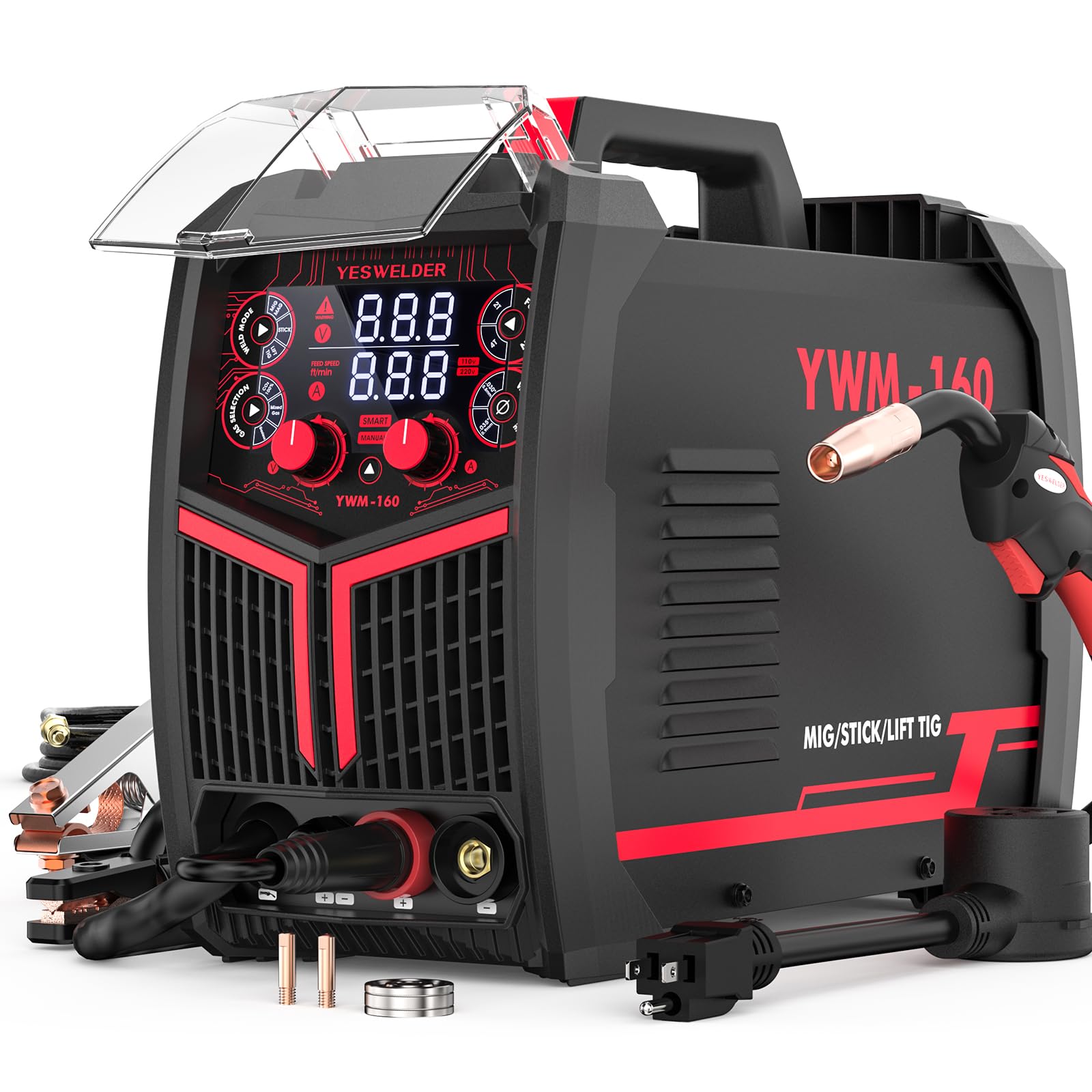
The YESWELDER YWM-160 packs synergic control into a budget-friendly package, automatically matching voltage and wire speed when you select material thickness. This is a genuine time-saver for first-time buyers who haven’t yet developed the intuition to dial in settings by ear. The 4-in-1 functionality covers flux-core MIG, gas MIG, Stick, and Lift TIG, and the 19.4-pound weight makes it genuinely portable for garage-to-driveway movement.
Users report strong performance on 120V with 0.030-inch flux-core wire on 1/8-inch steel, and stepping up to 220V unlocks cleaner beads on 1/4-inch material. The large LED digital display is crisp and readable even in direct sunlight. The included 220V-to-110V adapter adds flexibility without requiring a separate purchase. Experienced welders who have used Miller and Lincoln units note the arc quality is surprisingly smooth for the price bracket.
Downsides include a steep learning curve for the Stick mode—the arc can be difficult to initiate and maintain compared to dedicated Stick machines. The flux-core wire supplied in the box is basic, and upgrading to a quality brand like Hobart or Lincoln noticeably improves results. The Lift TIG mode is functional but limited to thin steel and stainless, not suitable for aluminum welding.
Why it’s great
- Synergic control makes first-time setup fast and intuitive
- Lightweight at 19.4 lbs with comfortable carrying handle
- Performs impressively on 120V for 1/8-inch steel projects
Good to know
- Stick mode arc-starting is finicky and requires practice
- Included flux-core wire is low quality; replace immediately
- Lift TIG won’t handle aluminum without AC capability
7. AZZUNO MIG200F 200A MIG Welder

AZZUNO’s MIG200F offers 200 amps of synergic welding power that can fuse material up to 5/16-inch thick, making it one of the few budget-tier welders that can handle structural repair on trailer frames and tractor implements. The 4-in-1 process selection (flux-core, gas MIG, Lift TIG, Stick) covers the vast majority of DIY scenarios, and the synergic presets automatically match wire speed to amperage when you select wire diameter.
User reviews consistently praise the build quality of the unit itself, with solid aluminum chassis components and high-quality cables that don’t feel brittle or undersized. The digital readouts are clear and intuitive, and 10-pound spools fit inside the compartment without modification. The Stick mode works well with E6013 electrodes, delivering stable arcs for general repair work without excessive spatter.
Weaknesses are concentrated in the documentation and support side. The included manual is borderline incomprehensible, especially for beginners, and the company lacks a dedicated website or phone support line—Amazon messaging is the only contact method. The gas inlet uses a hose barb rather than a standard CGA fitting, so you may need an adapter for your regulator. The machine weight is moderate, but there is no shoulder strap for true portability.
Why it’s great
- True 200A output with synergic control for thick steel up to 5/16-inch
- Solid aluminum chassis and quality cable construction
- Accepts 10-pound spools without modification
Good to know
- Manual is poorly translated and unhelpful for new welders
- Gas inlet uses non-standard barb fitting, needs adapter
- No phone or website support, only Amazon messaging
8. Bestarc 145A 4-in-1 MIG Welder (MIG145)
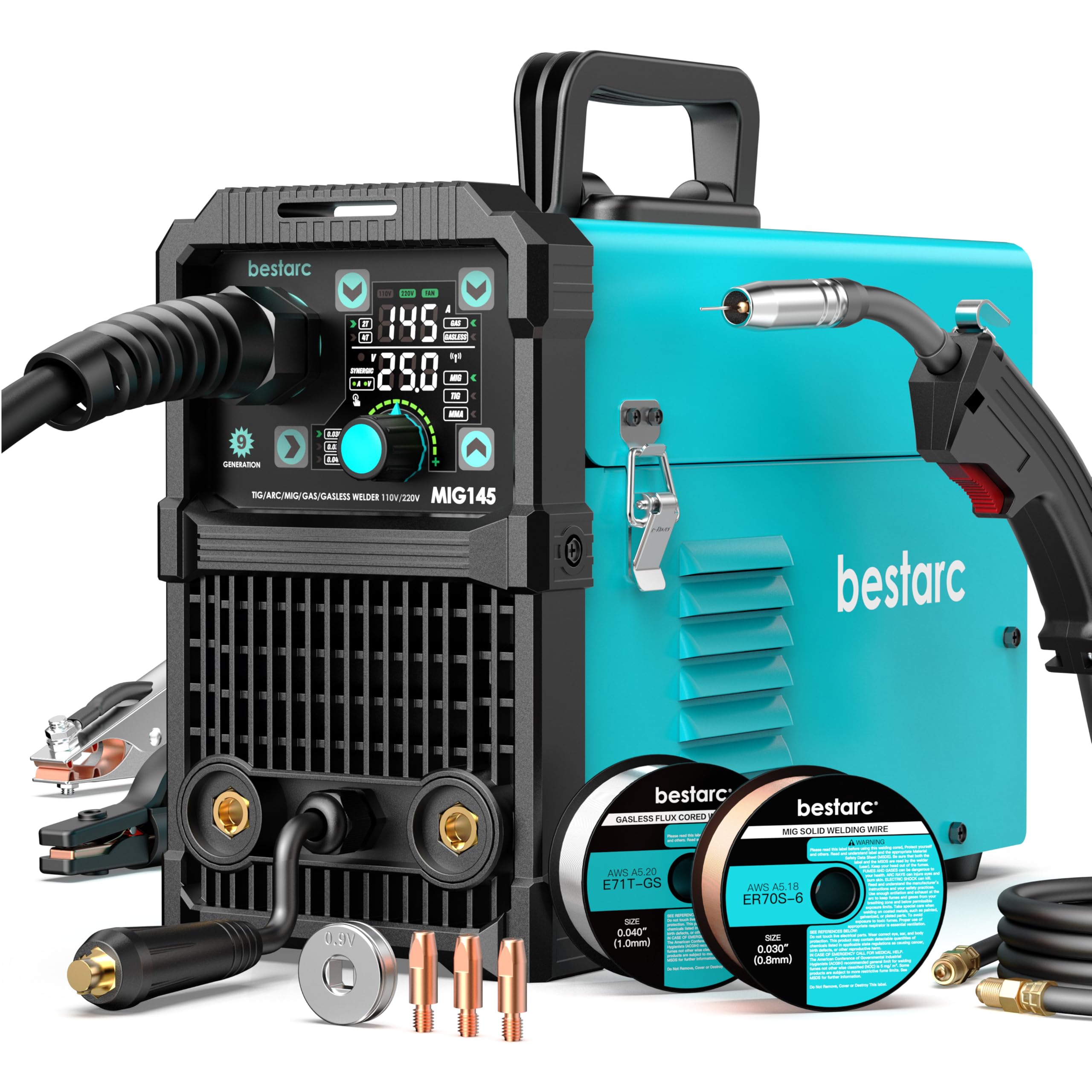
At just 13.7 pounds with a shoulder strap included, the Bestarc MIG145 is designed for the DIYer who needs to move the welder between jobs—tossing it in the back of a truck to fix a friend’s gate or hauling up a ladder for overhead railing work. Despite its small footprint, it offers 145 amps of synergic MIG welding across flux-core, solid wire MIG, Lift TIG, and Stick processes, all on dual 110V/220V input with automatic voltage detection.
The synergic control is a genuine help for beginners, automatically matching voltage to wire feed speed and allowing fine-tuning from -3V to +3V. Users report clean, strong welds on RV modifications, lawn equipment, and thin steel body panels. The safety protections—over-current, over-load, and over-heating shutdown—give peace of mind for first-time welders who might push the duty cycle too far. The large LED display shows wire speed and amps clearly.
Early units shipped with a short 5.5-foot gun lead and no knurled drive roll, but later revisions fixed both issues with a longer lead and a proper knurled roll for flux-core wire. The Stick mode is limited to about 130 amps, and the spring tension on the spool hub can cause bird-nesting if not loosened manually. The supplied flux-core wire is serviceable for practice but not project-quality.
Why it’s great
- Ultra-portable 13.7-pound design with comfortable shoulder strap
- Synergic control simplifies setup for first-time MIG users
- Automatic 110V/220V detection eliminates manual switching
Good to know
- Early units had short gun lead; verify you have the revised version
- Spool hub spring is too tight, requires adjustment
- Stick output capped around 130A, not for heavy electrode use
9. Lincoln Electric 90i FC Weld-PAK Flux-Core Welder

The Lincoln Electric 90i FC is a dedicated flux-core machine in a shoebox-sized chassis that weighs just 15 pounds, making it the ultimate portable option for sheet metal repair and light DIY projects. It runs on any 120V outlet and uses an inverter power source that delivers smoother weld characteristics than traditional transformer-based flux-core welders from the same brand. The infinite voltage dial (1-10) provides fine control that older two-position rocker switches simply cannot match.
Users consistently report that this machine produces welds with noticeably less spatter than other flux-core units in its class, and the cold feed switch allows easy wire changes without wasting material. It is particularly well-suited for automotive sheet metal work—car restoration enthusiasts praise its ability to weld 14-18 gauge steel without burning through. The included metal case offers real protection during transport, and the shoulder strap frees both hands for carrying other gear.
The flux-core-only limitation means it cannot run solid wire with gas shielding, so you are locked into flux-core wire for all applications. It only accepts 1-pound spools, which is fine for small jobs but requires frequent spool changes on larger projects. There is no handle on the machine itself—only the shoulder strap—which feels like an oversight from Lincoln’s engineers. For DIYers who primarily need a grab-and-go solution for thin metal repairs, this is the most hassle-free option available.
Why it’s great
- Shoebox-size design at 15 pounds is genuinely portable and easy to store
- Infinite voltage dial delivers low-spatter welds on thin sheet metal
- Trusted Lincoln Electric build quality with inverter efficiency
Good to know
- Flux-core only—no gas MIG, TIG, or Stick capability
- Accepts only 1-pound spools, not 10-pound bulk spools
- No built-in handle, only a shoulder strap for carrying
FAQ
Can a DIY welder run on a standard household 120V outlet?
What is the practical difference between flux-core and gas MIG for home use?
Do I really need a multi-process (MIG/Stick/TIG) machine as a beginner?
Final Thoughts: The Verdict
For most users, the best diy welder winner is the ARCCAPTAIN MIG200 because it combines a genuine 200-amp synergic multi-process performance with advanced features like spot welding and crater fill at a mid-range price. If you want dedicated aluminum fabrication capability straight out of the box, grab the PrimeWeld MIG180. And for lightweight portability and fuss-free sheet metal repair, nothing beats the Lincoln 90i FC Weld-PAK.

Mo Maruf
I created WellFizz to bridge the gap between vague wellness advice and actionable solutions. My mission is simple: to decode the research and give you practical tools you can actually use.
Beyond the data, I am a passionate traveler. I believe that stepping away from the screen to explore new environments is essential for mental clarity and physical vitality.