Our readers keep the lights on and my smoothie glass nicely filled. As an Amazon Associate, I earn from qualifying purchases.
A failing plant is often a silent alarm clock for a pH imbalance you cannot see. Whether you are tending a hydroponic reservoir, a raised garden bed, or a houseplant collection, the difference between a thriving green canopy and yellowing, stunted leaves often comes down to a single, invisible number. That is precisely where a precision electronic probe transforms guesswork into a data-driven decision.
I’m Mohammad Maruf — the founder and writer behind WellFizz. My approach to this guide was to cross-reference real-world feedback against factory calibration stability, electrode design, and multi-function capabilities, filtering out the noise from dozens of mid-range and premium composite meters to isolate the five that actually earn their spot in your toolkit.
After hours of comparing electrode response speeds, calibration routines, and build quality across these units, I have narrowed the field to the five most reliable contenders for any grower. This review covers everything you need to confidently select a digital soil ph tester that matches your specific setup and skill level.
How To Choose The Best Digital Soil pH Tester
A digital soil pH tester is not a single-purpose device anymore. Most models now bundle EC (electrical conductivity), TDS (total dissolved solids), and temperature sensing into one pen. To avoid buyer’s remorse, you need to weigh three core factors before clicking buy.
Probe Design and Electrode Quality
The electrode is the heart of any pH meter. Look for a unit with a replaceable glass bulb or a spear-tip probe if you test semi-solid samples like dough or soil slurries. A probe that ships with a storage cap containing a moist sponge (often soaked in KCL solution) will last significantly longer than one without. Flat-tip probes are easier to clean but less accurate in viscous media.
Calibration Simplicity and Buffer Support
No pH meter stays accurate forever. A good unit supports at least two-point calibration (pH 4.0 and 7.0), with three-point (adding pH 10.01) giving you a wider linear range. Bundled calibration powder packets or pre-mixed solutions reduce the hassle of buying separate chemicals. Factory-precalibrated meters save time but should always be verified against a known standard before first use.
Multi-Parameter Functionality vs. Dedicated Accuracy
A 4-in-1 tester (pH, EC, TDS, temperature) is a space-saver for hydroponic growers who already track nutrient strength. However, if your only concern is soil pH in a traditional garden, a dedicated pH-only pen with a robust probe may offer better long-term reliability, since multi-parameter electronics can introduce cross-sensor drift.
Quick Comparison
On smaller screens, swipe sideways to see the full table.
| Model | Category | Best For | Key Spec | Amazon |
|---|---|---|---|---|
| YINMIK YK-T4 Pro | Mid-Range | Hydroponic immersion monitoring | 4-in-1 with extended temperature steel electrode | Amazon |
| GIDIGI GX-4Pro | Premium | Color screen and broad home use | Color display with 4.0/7.0 & EC calibration kits | Amazon |
| GIDIGI GX-pST04B | Mid-Range | Simultaneous pH and PPM display | Dual pH & ppm on screen without switching | Amazon |
| UIUZMAR UMR-PH08 | Budget-Friendly | General hydroponic and spa testing | 4-in-1 with 3-point calibration and backlit LCD | Amazon |
| YINMIK YK-2S | Mid-Range | Food and semi-solid sample testing | Spear probe with 3-point auto-calibration | Amazon |
In‑Depth Reviews
1. YINMIK YK-T4 Pro

The YINMIK YK-T4 Pro is engineered specifically for growers who need continuous immersion monitoring. Its extended stainless steel temperature electrode is designed to stay submerged in a hydroponic reservoir or aeroponic tube without needing to be removed between readings, meaning you get real-time pH and EC values the moment you turn it on. The four-in-one display simultaneously shows pH and temperature, with EC and TDS accessible via a quick mode switch — a workflow advantage when you are adjusting nutrient doses mid-cycle.
Out of the box, the meter includes pH 4.00 and 7.00 calibration solutions plus 1413 µS/cm EC buffer, so you can verify accuracy before your first use. Users report that the probe stabilizes fast, often within a few seconds, and that the automatic temperature compensation keeps readings consistent even when the reservoir warms under grow lights. The build quality feels solid, with a rubberized grip that holds up to daily handling in a humid environment.
Where this unit really separates itself is its reliability at the price point. Multiple verified reviews note that it outperforms earlier meters from brands like Vivosun in both consistency and calibration retention. A few users mention a slight learning curve with the multi-mode interface, but once you understand the button logic, it becomes second nature. For anyone running a serious hydro setup, this is the most balanced pick.
Why it’s great
- Can be left immersed in reservoirs for continuous monitoring
- Stainless steel electrode responds quickly to temperature shifts
- Comes with full calibration kit ready out of the box
Good to know
- Mode switching between EC and TDS requires a button hold — not instant
- Backlight is absent, making dark tent readings harder
2. GIDIGI GX-4Pro
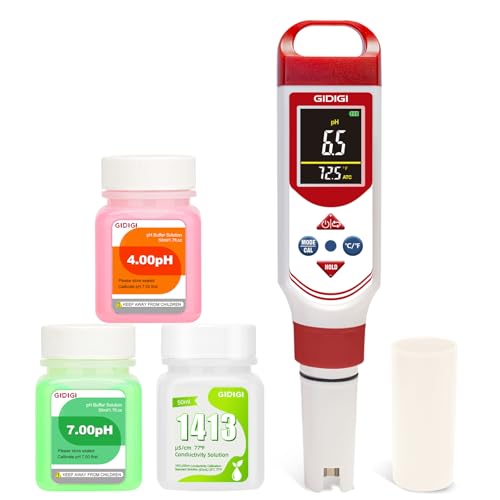
The GIDIGI GX-4Pro stands out immediately because of its large color screen. Instead of a monochrome LCD that washes out under sunlight, this display presents pH, TDS, EC, and temperature values in crisp, color-highlighted digits that are easy to read at a glance. That might sound cosmetic, but when you are mixing nutrients in a brightly lit garage or greenhouse, the readability difference is real.
Beyond the screen, the meter ships with a complete calibration kit — pH 4.00, pH 7.00, and 1413 µS/cm EC solution — and arrives pre-calibrated from the factory. Multiple users report that after initial calibration and a few subsequent checks, the readings locked in consistently for weeks. The sensitive probe has a 0.1 pH resolution and an ATC range of 0-60°C, which covers everything from chilled RO water to a warm fish tank.
Reviewers highlight its performance in aquariums and small hydroponic systems, calling it the best pH pen they have used at this level. The only trade-off is that the color screen consumes more power than a basic LCD, so the auto-off feature kicks in after a short idle period, which can be slightly annoying during longer testing sessions. For versatility and modern interface design, this is a top contender.
Why it’s great
- Color display is genuinely useful in bright or low light
- Includes both pH and EC calibration solutions for full verification
- Factory pre-calibrated with good stability over weeks
Good to know
- Auto-off timer cannot be disabled, interrupting prolonged sessions
- Probe cap lacks a moisture-retaining sponge for storage
3. GIDIGI GX-pST04B
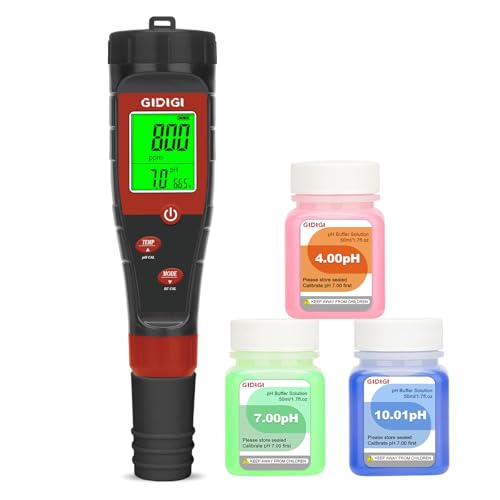
The GIDIGI GX-pST04B differentiates itself with a genuinely useful interface trick: it displays pH and PPM (parts per million) on the screen simultaneously without needing to toggle modes. For a hydroponic grower who constantly cross-references acidity against nutrient strength, this saves seconds every time you test — and those seconds add up fast during a full reservoir check.
In terms of specs, it covers the full pH range (0.1-14.0) and an EC range up to 9990 µS/cm, with an ATC that kicks in from 32°F to 140°F. The green backlight is a nice middle ground — bright enough for dark cabinet corners but not so power-hungry that the batteries die prematurely. The sponge cap keeps the electrode moist between uses, which extends probe life considerably compared to dry-stored units.
Verified buyers consistently praise its calibration stability, with one reviewer noting that after months of dry storage the meter still held accurate readings. Another mentioned it bridges the gap between cheap disposable pens and high-end lab meters. A small drawback is that the backlight cannot be locked on permanently, but this is a minor nitpick for a meter that otherwise performs well above its tier.
Why it’s great
- Shows pH and PPM together — no button pressing required
- Green backlight is clear without draining batteries fast
- Calibration remains stable even after periods of non-use
Good to know
- Backlight automatically turns off after a short interval
- EC range upper limit is moderate for very concentrated solutions
4. UIUZMAR UMR-PH08

The UIUZMAR UMR-PH08 proves that you do not need to spend heavily to get a reliable four-in-one meter. It supports three-point calibration (pH 4.0, 7.0, and 10.01) and includes two sets of calibration powders in the box — a welcome addition since many budget meters only offer two-point. The LCD backlight is triggered by any button press, making it usable in dim propagation tents or early-morning checks.
Reading stability is surprisingly solid for the price tier. Users report that after initial calibration, the meter holds its accuracy well for routine spa, pond, and hydroponic use. One reviewer noted it reads consistently about 0.2 pH high for their spa, but that is easily compensated for once you know the offset. Automatic temperature compensation covers 32-122°F, which covers most common growing conditions.
The main compromises are in probe longevity and build feel. The glass bulb is exposed without a robust guard, so rough handling or dropping could cause damage. The unit also uses 4 LR44 button cells, which are less common than AAA or CR2032 batteries. For a backup meter or for growers on a strict budget who need basic pH, EC, and TDS visibility, this is a strong entry point.
Why it’s great
- Full three-point calibration support at an entry-level price
- Includes two sets of calibration powder packets
- Backlit LCD works well in low-light environments
Good to know
- Glass bulb probe is fragile without a protective guard
- Uses 4 LR44 button cells — less convenient than common sizes
5. YINMIK YK-2S
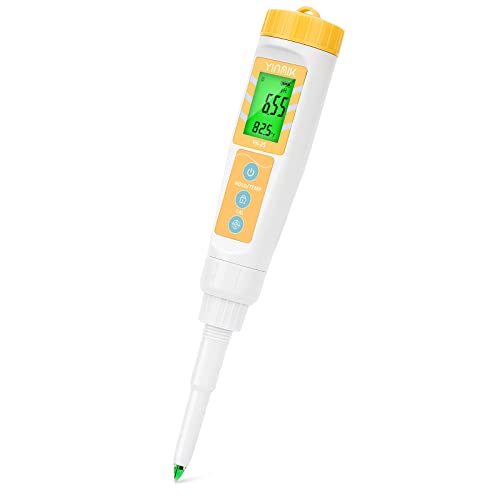
The YINMIK YK-2S is a dedicated food-grade pH meter built around a sharp spear-shaped probe that penetrates semi-solid samples without needing to create a slurry. That makes it uniquely suited for testing sourdough starter, fermenting sausage, salami, cheese curds, and even cosmetics or lotions. The spear tip is a genuine departure from the flat-bulb or conical tips found on standard hydroponic pens.
Accuracy is stated at ±0.1 pH across the full 0.00-14.00 range, with three-point auto-calibration (4.0, 7.0, 10.01) and ATC that keeps readings stable across hot fermentation chambers and cold storage environments. The protective cap contains a wet sponge soaked in KCL solution, which keeps the spear probe moist and extends the electrode’s usable life dramatically. The included six packets of buffer powder provide enough calibration solution for many months of regular use.
Some users note that after calibration with the three buffer solutions, the meter can still show small deviations — a modest price to pay for a sub- food-grade tool compared to professional lab meters costing five times as much. However, for home fermenters and small-batch producers who need a repeatable pH range rather than absolute lab precision, this meter is a fantastic value. Just remember to rinse the spear tip thoroughly after every use, especially after testing fermented foods.
Why it’s great
- Spear probe pierces solid and semi-solid samples directly
- KCL-moistened cap keeps probe hydrated during storage
- Three-point auto-calibration for broad pH range
Good to know
- Calibration may show small deviations immediately after setup
- Not ideal for continuous immersion in liquid reservoirs
FAQ
Can I use a hydroponic pH meter to test garden soil directly?
How often should I calibrate a digital pH tester?
Which calibration solution should I use for a three-point setup?
Final Thoughts: The Verdict
For most users, the digital soil ph tester winner is the YINMIK YK-T4 Pro because it combines immersion-rated durability, fast ATC, and a full calibration kit at a price that does not punish beginners. If you want a color screen that makes readings pop, grab the GIDIGI GX-4Pro. And for fermenters and food makers who need a spear probe, nothing beats the YINMIK YK-2S.

Mo Maruf
I created WellFizz to bridge the gap between vague wellness advice and actionable solutions. My mission is simple: to decode the research and give you practical tools you can actually use.
Beyond the data, I am a passionate traveler. I believe that stepping away from the screen to explore new environments is essential for mental clarity and physical vitality.