Our readers keep the lights on and my smoothie glass nicely filled. As an Amazon Associate, I earn from qualifying purchases.
Plunging into the deep, the first thing that vanishes is color, then definition, then your sense of direction. A weak dive light doesn’t just limit your view; it shrinks your safe zone, turning a vibrant reef into a narrow tunnel of grey. The difference between a good dive and a great one often comes down to the single beam in your hand.
I’m Mohammad Maruf — the founder and writer behind WellFizz. My work focuses on pulling apart every lumen, beam angle, and depth rating so you skip the marketing and land on the hardware that actually performs where pressure and darkness are the real test.
After analyzing over fifty hours of user reports and technical specs, this guide zeroes in on the best dive lights for clarity, runtime, and build integrity, covering everything from compact backups to powerful video-grade torches.
How To Choose The Best Dive Lights
Selecting a dive light means balancing brightness, beam focus, battery endurance, and depth integrity. A light that performs flawlessly at 5 meters may fail catastrophically at 40. Understanding the interplay of a few key specs separates a reliable tool from a flooded disappointment.
Beam Angle: Spot vs. Flood
A narrow beam (6 to 12 degrees) punches through murky water and reaches into crevices but creates a tunnel-vision effect. A wide beam (over 100 degrees) fills your field of view, making it ideal for video or navigating a wreck. Most divers carry one of each: a focused primary light for range and a floody backup for situational awareness.
Brightness and Color Rendering
Lumens matter, but underwater, a 3000-lumen light with a tight beam often looks brighter than a 5000-lumen flood because the light is concentrated. For photography and video, Color Rendering Index (CRI) becomes critical: 90 CRI or higher restores the natural colors of coral and marine life, while lower CRI lights wash everything in a cold blue or green tint.
Depth Rating and Construction
An IPX8 rating alone doesn’t guarantee performance at depth. Look for lights that specify depth in meters (100m, 150m) and are constructed from aerospace-grade aluminum with multiple O-ring seals. A light that passes a factory pressure test is far more trustworthy than one that only carries a generic waterproof claim.
Battery System and Runtime
Internal rechargeable batteries offer convenience, but swappable 18650 or 21700 cells let you run multiple dives without waiting for a charge cycle. Check runtime on the highest mode — many lights only sustain turbo output for a few minutes before thermal regulation drops them to a lower level. Reliable runtime information comes from actual user reports, not just manufacturer claims.
Quick Comparison
On smaller screens, swipe sideways to see the full table.
| Model | Category | Best For | Key Spec | Amazon |
|---|---|---|---|---|
| LetonPower L24 | Premium | Underwater video and wide-area lighting | 12000 lumens, 120° beam, 100m depth | Amazon |
| Wurkkos DL08 | Mid-Range | Versatile multi-mode (spot, flood, red, UV) | 3600 lumens, 133° flood, 90 CRI | Amazon |
| OrcaTorch D710 | Premium | Narrow-beam primary light for tech/wreck diving | 3000 lumens, 6° beam, 150m depth | Amazon |
| Wurkkos DL02 | Mid-Range | Long-throw spotting and general diving | 3000 lumens, 19° beam, 496m throw | Amazon |
| Odepro SD1500 | Budget | Compact backup or primary for recreational dives | 1500 lumens, 6.4° beam, 150m depth | Amazon |
| WindFire TS08 | Budget | Entry-level light for night dives and snorkeling | 5500K beam, 12° beam, IPX8 rated | Amazon |
In‑Depth Reviews
1. LetonPower L24 Sealion

The LetonPower L24 is a different beast entirely — a video-grade light that outputs 12,000 lumens from multiple LED sources, covering a 120-degree area with 6500K white light plus red and blue modes. It is designed for underwater videographers and serious night divers who need to illuminate an entire wreck or reef without harsh hotspots. The corrosion-resistant, conductivity-free shell is tested to 120 meters, and users report it surviving repeated saltwater exposure with no issues.
Runtime hits 70 minutes on full power, with a low mode that stretches to 8 hours. The L24 uses user-replaceable battery packs charged via USB-C, which addresses a common pain point for multi-dive days. Divers who have run this light on camera rigs for over two years praise its consistent output and build quality, often buying additional units for twin-light setups.
The main concern is charging logistics: the L24 requires charging four 18650 batteries separately unless you invest in a multi-bay charger, and some early units shipped without a charging cable. A few isolated reports of seal failure after deep dives exist, but the overall track record from heavy users — including technical wreck divers — remains overwhelmingly positive.
Why it’s great
- Massive 12,000 lumen output for wide-area illumination
- Excellent color rendering for underwater video
- User-replaceable batteries extend dive-day flexibility
Good to know
- Requires external battery charging (no built-in port)
- Size and weight are noticeable on camera rigs
- A few reports of seal integrity on deeper dives
2. Wurkkos DL08

The Wurkkos DL08 packs four lighting modes — spot, flood, red, and UV — into a single compact housing, making it one of the most versatile dive lights in the mid-range. The flood mode uses nine LEDs to deliver up to 3,600 lumens across a 133-degree beam with a 90 CRI rating, which means coral colors and fish patterns appear natural and vivid on camera. The rotary magnetic switch cycles through modes cleanly, and the infinite brightness adjustment lets you dial in exactly the output you need without cycling through fixed steps.
Users who have taken the DL08 on multiple saltwater dives to depths of 130 feet report that the wide-angle flood is excellent for night diving without blinding your buddy, and the UV mode reveals fluorescing coral and marine life. The built-in 5000mAh battery supports long runtimes, and the hard-anodized aluminum construction resists corrosion from saltwater exposure.
The UV function is notably weak compared to dedicated UV lights — several users describe it as underwhelming for serious fluorescence photography. Additionally, the spot beam shows some ring artifacts rather than a clean, even circle. A small number of units have been reported as defective out of the box, though Wurkkos generally honors its warranty.
Why it’s great
- Four modes (spot, flood, red, UV) cover every diving scenario
- High CRI flood mode restores natural underwater colors
- Rotary switch with infinite brightness adjustment is intuitive
Good to know
- UV mode is weaker than dedicated UV lights
- Spot beam shows ring artifacts
- Occasional reports of quality control issues
3. OrcaTorch D710

The OrcaTorch D710 is built for divers who prioritize reach over area coverage. Its 6-degree ultra-narrow beam delivers 3,000 lumens in a tight, focused hotspot that cuts through low-visibility water and reaches into deep crevices and wreck interiors. The four brightness levels — including a temporary turbo mode at 3,000 lumens — allow precise control, and the side switch features a lock function to prevent accidental activation in your gear bag.
Users consistently praise the D710 for its build quality, noting the triple O-ring seals and 5mm tempered glass that have survived hundreds of dives without leaking. The included hard case with foam cutouts and two swappable batteries makes it an ideal travel companion, and the battery indicator on the switch gives clear real-time feedback. Many divers report using it as a primary light for Florida lobster hunting and technical wreck diving with complete confidence.
The narrow beam is explicitly not designed for video or wide-angle work — it creates a sharp hotspot that causes bloom on camera. Some users find the temporary turbo mode, activated by holding the button, less intuitive than a fixed high mode. The light also requires external charging for its 18650 batteries, though the kit includes a charger.
Why it’s great
- Extremely tight 6° beam penetrates murky water
- Rock-solid build quality with triple O-ring seals
- Travel case with two batteries for multi-dive trips
Good to know
- Narrow beam is not suitable for video
- Temporary turbo mode requires holding the button
- Batteries require external charging
4. Wurkkos DL02
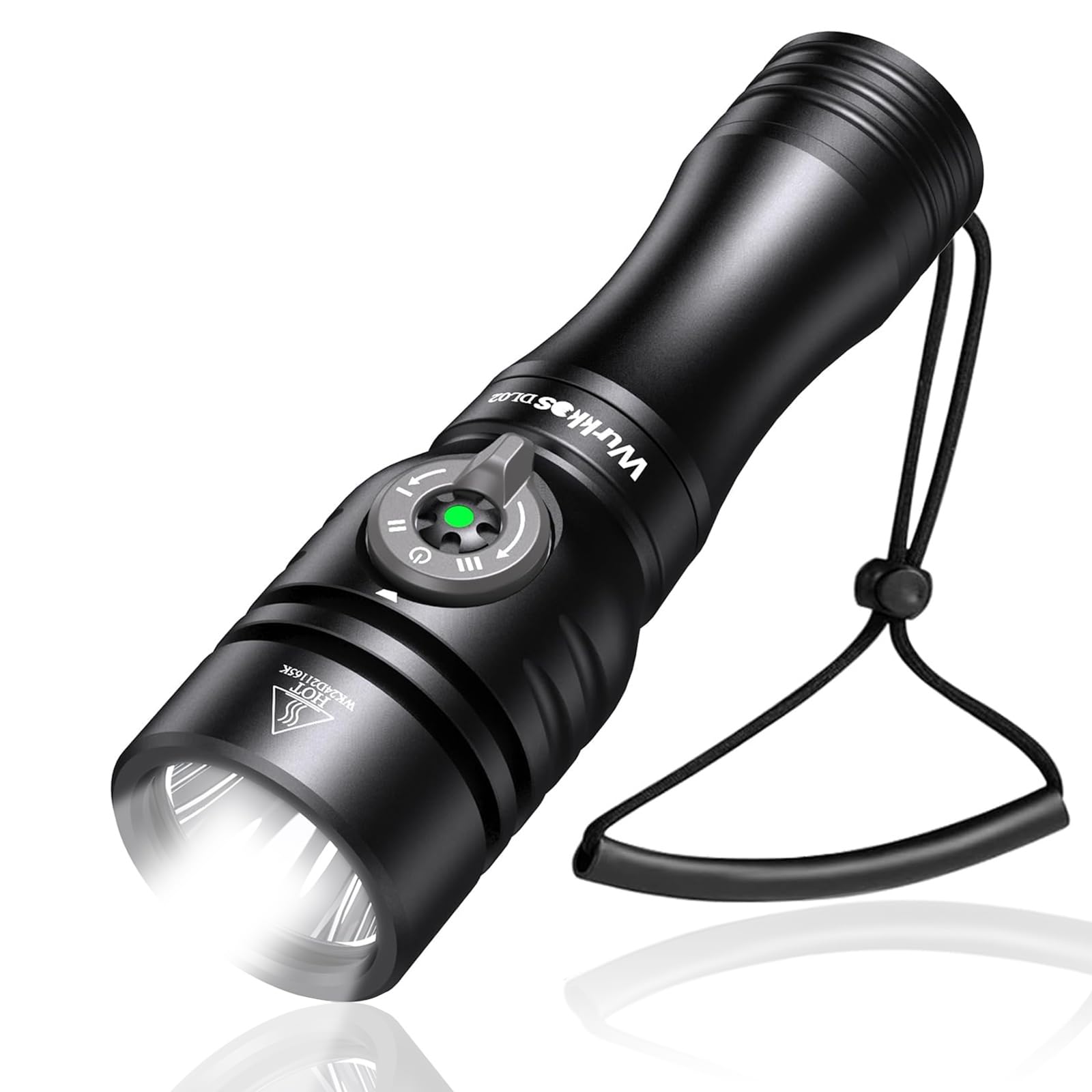
The Wurkkos DL02 is a dedicated long-throw light that pushes 3,000 lumens through a 19-degree beam for a rated throw of 496 meters. That kind of reach makes it exceptional for cave diving, wreck penetration, and spotting distant features in low-visibility conditions. The rotary magnetic switch allows one-handed mode changes between three brightness levels plus a convenient instant-access high mode, and the power indicator provides clear battery status feedback.
Users who have logged over 20 dives with the DL02 report that the hot spot and spill balance well underwater, avoiding the tunnel-vision problem of ultra-narrow beams while still offering impressive range. The aluminum build with double O-rings has proven reliable at depth, and the included battery and external charger mean you can swap cells between dives. Many reviewers note that the light competes with units costing twice as much.
The DL02 lacks onboard charging, which is a deliberate design choice to maintain waterproof integrity, but it means you need to carry an external charger and spare batteries for extended trips. The 19-degree beam, while versatile, doesn’t match the pure flood of video lights nor the razor focus of the OrcaTorch D710 — it sits in a middle ground that some find compromises both extremes.
Why it’s great
- Impressive 496-meter throw for long-range visibility
- Rotary magnetic switch is glove-friendly and reliable
- Outstanding value compared to similar-performance lights
Good to know
- No onboard charging required external charger
- 19° beam is a compromise between spot and flood
- Not ideal for wide-area video illumination
5. Odepro SD1500

The Odepro SD1500 packs 1,500 lumens into a compact, cylindrical body with a 6.4-degree narrow beam, making it an excellent backup or primary light for recreational divers. The three modes — high, low, and strobe — are controlled via a side button that is easy to operate with gloves, and the real-time battery indicator shows green, red, or flashing red status. The IP68 rating to 150 meters is backed by rigorous factory testing, and the aerospace-grade aluminum body resists saltwater corrosion.
User reviews consistently highlight the focused beam that cuts through poor visibility — several divers describe using it in conditions under 5 feet of visibility and still being able to signal effectively. The USB-C rechargeable 3400mAh battery provides over 2 hours on high, and the included kit includes spare O-rings and a lanyard. Many users compare it favorably to lights at twice the price, noting it is reliable enough for night diving and deep wrecks.
The single BCD attachment point may not suit all mounting preferences, and the focused beam — while excellent for penetration — creates a very narrow field that isn’t suitable for video or wide-area scanning. Some users find the need to cycle through modes each time they turn the light on slightly inconvenient, though this is common in this price range.
Why it’s great
- Tight 6.4° beam cuts through low-visibility water
- USB-C rechargeable with clear battery indicator
- Tested to 150m with solid corrosion resistance
Good to know
- Narrow beam not for video or wide lighting
- Must cycle through modes each activation
- Single BCD attachment point limits mounting options
6. WindFire TS08

The WindFire TS08 is a budget-friendly entry point that still delivers a legitimate dive-light experience. Its 12-degree focused beam reaches 150 meters and cuts through dark water effectively, with a 5500K color temperature that restores natural underwater tones. Three lighting modes — high, low, and SOS — give basic flexibility, while the color-coded power indicator provides real-time battery awareness. The aerospace-grade aluminum body and IPX8 rating make it suitable for recreational depths.
After 40-plus dives, users report that the TS08 remains leak-free to depths beyond 100 feet when O-rings are properly lubricated with silicone grease. The lithium polymer battery runs up to 4 hours on low mode, and the compact size makes it a popular choice as a backup or helmet-mounted light. The included storage box and adjustable lanyard add convenience for travel. Many reviewers note it outperforms expectations for its price tier, especially in brightness and build.
The 12-degree beam is wider than the ultra-narrow lights but still too focused for video or wide-area illumination. The need to cycle through modes each time you turn it on is a minor annoyance. Some users advise applying silicone grease to the O-rings before the first dive, as dry O-rings can compromise the seal. The strap is long and may need trimming for a helmet mount.
Why it’s great
- Legitimate IPX8 performance at a very accessible price
- Color-coded power indicator gives battery confidence
- Compact and lightweight for travel or helmet mounting
Good to know
- Must cycle through modes each time you turn it on
- 12° beam not suitable for video work
- O-rings need silicone grease before first use
FAQ
Can I use a regular flashlight for scuba diving?
How many lumens do I need for a night dive?
What does IPX8 mean for a dive light?
How do I maintain the O-rings on my dive light?
Final Thoughts: The Verdict
For most users, the best dive lights winner is the Wurkkos DL08 because it combines multiple modes, a high-CRI flood, and a solid build at a price that doesn’t require a second mortgage. If you need extreme throw and a no-nonsense rugged build for technical dives, grab the OrcaTorch D710. And for underwater video work where color accuracy and wide coverage matter most, nothing beats the LetonPower L24 — its 12,000-lumen output and 90 CRI rating make it the go-to choice for serious content creators.

Mo Maruf
I created WellFizz to bridge the gap between vague wellness advice and actionable solutions. My mission is simple: to decode the research and give you practical tools you can actually use.
Beyond the data, I am a passionate traveler. I believe that stepping away from the screen to explore new environments is essential for mental clarity and physical vitality.