Our readers keep the lights on and my smoothie glass nicely filled. As an Amazon Associate, I earn from qualifying purchases.
Cutting the cord on your ISP’s monthly equipment fee is the first smart move. But swapping out that rented black box for a DOCSIS 3.1 modem requires more than just a compatible chipset—it demands understanding the specific OFDM channel counts and multi-gig port standards that separate a stable connection from a streaming nightmare.
I’m Mohammad Maruf — the founder and writer behind WellFizz. Over many hours of research, I’ve analyzed the hardware specs, customer reports, and ISP compatibility matrices to isolate the modems that actually deliver on their promised bandwidth without overheating or dropping sync.
Your goal is to own a device that unlocks the full potential of your cable plan without introducing new lag or stability issues. This guide reviews the best docsis 3.1 modem options available, broken down by performance tier and real-world use case.
How To Choose The Best DOCSIS 3.1 Modem
A DOCSIS 3.1 modem is a long-term investment in your home network’s backbone. The wrong choice can bottleneck a gigabit plan, while the right one future-proofs your connection for years. Focus on three critical factors before you click buy.
Ethernet Port Speed vs. Your Internet Plan
Most DOCSIS 3.1 modems ship with a single 1 Gbps Ethernet port, which caps your wired speed at roughly 940 Mbps due to overhead. If your plan is 1 Gbps or lower, this is fine. For plans over 1 Gbps—like Xfinity’s 1.2 Gbps or 2 Gbps tiers—you need a modem with a 2.5 Gbps Multi-Gig port. A 1 Gbps port on a 1.2 Gbps plan literally leaves 200 Mbps of paid bandwidth on the floor.
OFDM Channel Count and Mid/High-Split Support
DOCSIS 3.1 uses Orthogonal Frequency Division Multiplexing (OFDM) channels. More OFDM channels mean better capacity and lower latency under load. Look for modems with at least 2 downstream and 2 upstream OFDM channels. Additionally, the “mid-split” or “high-split” specification determines upload speed potential. On networks like Xfinity that support mid-split, a modem lacking this capability will lock you below 100 Mbps upload, even if your plan promises 200 Mbps up.
Modem-Only vs. Gateway (Modem + Router Combo)
A modem-only unit (no built-in WiFi) gives you lower heat, better reliability, and the freedom to pair it with your own router. Gateways often run hot in a single chassis, which can degrade performance over time. If you already own a router or mesh system, always choose a modem-only device. Only consider a gateway if you need integrated voice lines (telephone ports) and cannot manage a separate router.
Quick Comparison
On smaller screens, swipe sideways to see the full table.
| Model | Category | Best For | Key Spec | Amazon |
|---|---|---|---|---|
| NETGEAR CM3000 | Premium | Future-proof multi-gig speeds | 2.5 Gbps port / Mid-split | Amazon |
| ARRIS SURFboard SB8200 | Premium | Rock-solid reliability | 2 x 1 Gbps ports | Amazon |
| Hitron CODA56 | Mid-Range | 2.5 Gbps at a value price | 2.5 Gbps port / Low profile | Amazon |
| NETGEAR CM2500 | Mid-Range | Mid-split upload speeds | 2 x 1 Gbps + link aggregation | Amazon |
| Hitron CODA | Entry-Level | Budget 1 Gbps plan | 1 Gbps port / Compact | Amazon |
| Arris S33-RB | Mid-Range | Multi-gig on a budget | 2.5 Gbps port | Amazon |
| Motorola MT8733 | Premium | All-in-one with phone lines | 2.5 Gbps port / WiFi 6 / 2 phone | Amazon |
In‑Depth Reviews
1. NETGEAR Nighthawk CM3000

The NETGEAR Nighthawk CM3000 is the definitive choice for users on Xfinity, Spectrum, or Cox who want to unlock the highest possible upload speeds from their plan. It supports mid/high-split DOCSIS 3.1, enabling up to 2.5 Gbps down and 1 Gbps up when paired with a compatible ISP tier. The single 2.5 Gigabit Ethernet port directly connects to a WiFi 7 router for full bandwidth without bottleneck.
Thermal performance is excellent; the vertical design pulls cool air through the bottom and exhausts heat from the top, keeping internal components stable even under sustained load. Setup is straightforward via the ISP app once the MAC address is registered. Multiple reviewers on Xfinity report consistent 2 Gbps down and 200 Mbps up speeds after activation.
The only downside is its premium price relative to entry-level DOCSIS 3.1 modems. However, for households with multi-gig plans or heavy upload requirements (streaming, NAS access, security cameras), the CM3000 eliminates the need for link aggregation and delivers full bandwidth out of a single port.
Why it’s great
- Full mid/high-split support for faster uploads
- 2.5 Gbps port with no bottleneck
- Excellent thermal design for long life
Good to know
- Higher upfront cost than mid-range modems
- No built-in WiFi (modem only)
- Requires a router with 2.5 Gbps WAN port for full speed
2. ARRIS SURFboard SB8200
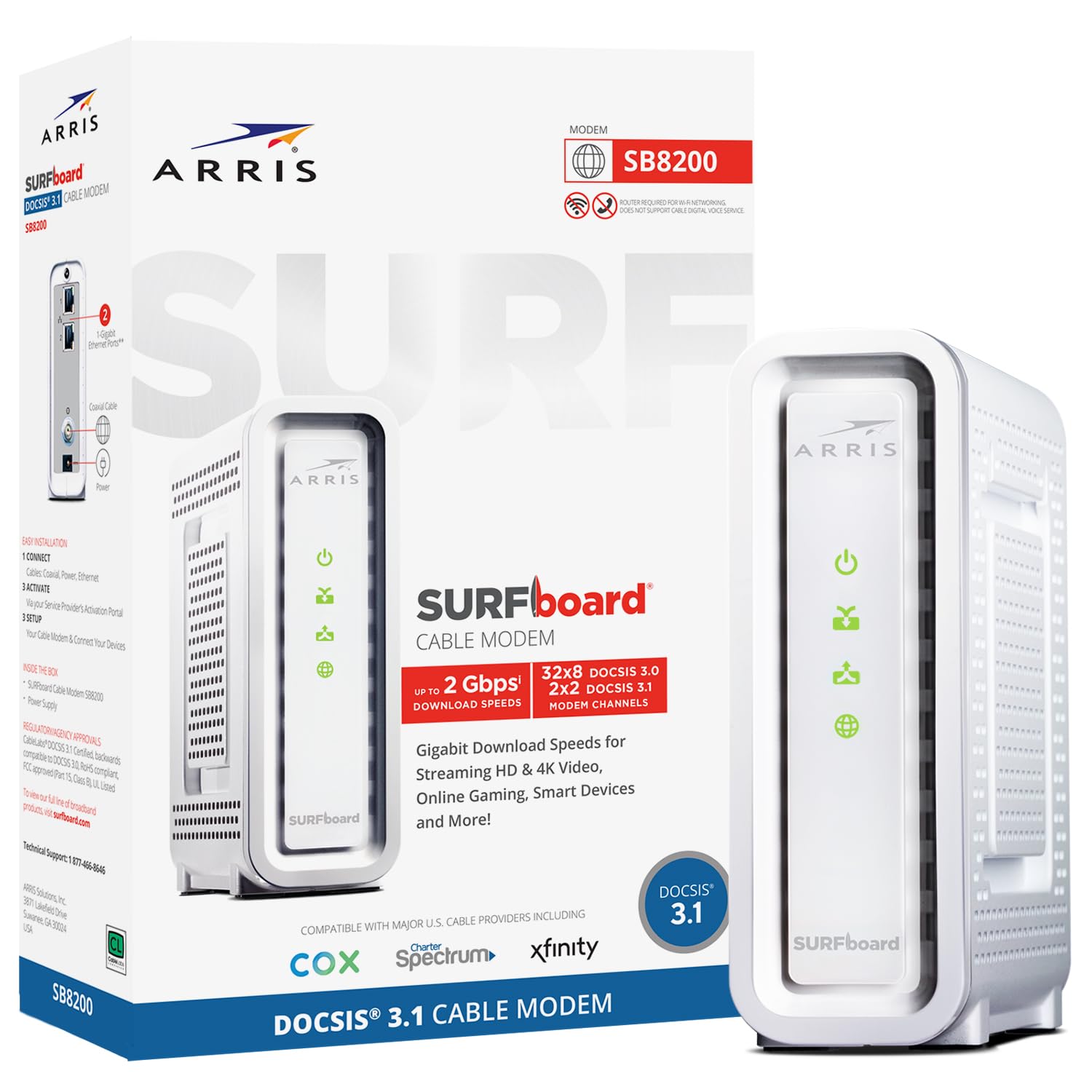
The ARRIS SURFboard SB8200 has been a perennial favorite for those who value rock-solid stability over raw multi-gig performance. It houses a Broadcom chipset with 32×8 channel bonding plus two downstream OFDM channels, making it well-suited for 1 Gbps cable plans. The dual 1 Gigabit Ethernet ports can be used for link aggregation if your router supports it, pushing total wired throughput close to 2 Gbps.
Its compact footprint (5.13 x 1.75 x 5.25 inches) and low power draw make it ideal for cramped entertainment centers. Setup is painless via the SURFboard Central app, and the modem runs cool to the touch. As a modem-only device, it pairs perfectly with any third-party router. Customer reviews highlight years of trouble-free service on Xfinity and Spectrum, with only rare line-quality issues causing reboots.
The main limitation is the lack of a native 2.5 Gbps port. If you plan to subscribe to a 1.2 Gbps or 2 Gbps plan in the future, you would need link aggregation or a modem upgrade. For current 1 Gbps subscribers, the SB8200 remains a near-perfect balance of price and reliability.
Why it’s great
- Proven Broadcom chipset for stable connections
- Quiet, compact, and cool-running
- Dual Gigabit ports for link aggregation
Good to know
- No 2.5 Gbps port for single-cable multi-gig
- No mid/high-split support
- Limited to 1 Gbps without aggregation
3. Hitron CODA56

The Hitron CODA56 brings a 2.5 Gbps Ethernet port to the mid-range tier without sacrificing compatibility. It is certified with Xfinity, Spectrum, and Cox, and supports internet plans up to 2.5 Gbps. The DOCSIS 3.1 implementation includes two downstream OFDM channels, reducing latency for gaming and video calls. Its slim profile (7 x 1.77 x 8.13 inches) fits neatly on a desk without dominating the space.
Setup takes about 10 minutes—plug in the coax and power, connect Ethernet to your router, and activate via the ISP app. Customers on Xfinity report consistent speeds matching their 1.2 Gbps plan, with some pushing 930 Mbps over the 2.5 Gbps port to a compatible router. The modem runs warm but not hot, and the white chassis hides dust well.
The trade-off is a bare-bones user interface. The web UI offers no advanced diagnostics or signal-to-noise ratio graphs, limiting troubleshooting for power users. If you need deep monitoring tools, this modem’s simplicity might frustrate you. But for plug-and-play multi-gig performance at a reasonable price, the CODA56 is hard to beat.
Why it’s great
- 2.5 Gbps port at a mid-range price
- Low latency DOCSIS 3.1 OFDM channels
- Compact and easy to position
Good to know
- Basic web UI with no advanced diagnostics
- Runs slightly warm in continuous use
- Requires a router with 2.5 Gbps WAN for full speeds
4. NETGEAR Nighthawk CM2500

The NETGEAR Nighthawk CM2500 is purpose-built for cable subscribers whose ISPs have deployed mid/high-split technology. It supports up to 2 Gbps down and 1 Gbps up, making it one of the few modems that can actually deliver 200 Mbps upload speeds on Xfinity. The two Gigabit Ethernet ports support link aggregation (802.3ad) when paired with a compatible router, combining throughput up to 2 Gbps without needing a single 2.5 Gbps port.
Owners report a straightforward activation process with Xfinity and Spectrum. The modem’s black, wedge-shaped design stands vertically or horizontally and includes front-facing LED indicators for power, upstream, downstream, and internet connectivity. Thermal performance is solid, with the modem staying cool even during multi-hour gaming sessions.
The trade-off is that full multi-gig speeds require a router that supports link aggregation. Without it, you are limited to 1 Gbps per port. Additionally, the CM2500 is a modem-only unit, so you must supply your own WiFi router. For users on ISPs that support mid-split, it is the most affordable path to high upload speeds.
Why it’s great
- Mid/high-split enabled for upload speed gains
- Link aggregation for up to 2 Gbps throughput
- Stable and runs cool
Good to know
- Requires aggregation-capable router for multi-gig
- No built-in WiFi
- Black finish shows fingerprints
5. Hitron CODA (Renewed)

The Hitron CODA is the entry-level DOCSIS 3.1 modem that strips away all frills while keeping core performance intact. It supports internet plans up to 1 Gbps with a single Gigabit Ethernet port and is certified with Xfinity, Spectrum, Cox, and several regional providers. The renewed (refurbished) version comes at a budget-friendly price, making it the cheapest way to eliminate rental fees on a gigabit plan.
Setup is as simple as it gets: connect the coaxial cable, plug in power, and activate via the ISP app. Customers consistently report that the modem delivers their full paid speed—often 940 Mbps down on a gigabit line. The white plastic chassis is lightweight (1.8 pounds) and small enough to hide behind a TV stand. It runs cool and silent with no fan noise.
The limitation is that there is no path to multi-gig speeds. If your plan ever exceeds 1 Gbps, the CODA will bottleneck. Also, renewed units occasionally arrive DOA, so ensure you purchase from a seller with a solid return policy. For budget-conscious buyers who will stay on a 1 Gbps plan, this modem is an incredible value.
Why it’s great
- Most affordable way to stop modem rental fees
- Delivers full speed on 1 Gbps plans
- Compact and silent operation
Good to know
- No 2.5 Gbps port for multi-gig plans
- Renewed units may have higher defect rate
- Basic UI with limited diagnostics
6. Arris S33-RB (Renewed)

The Arris SURFboard S33 is a direct competitor to the Hitron CODA56, offering the same 2.5 Gbps Ethernet port and DOCSIS 3.1 certification. The renewed (S33-RB) version drops the price considerably, bringing multi-gig capability to a broader audience. It supports plans up to 2.5 Gbps and is approved for Cox, Spectrum, and Xfinity. The modem features four OFDM channels (two downstream, two upstream) for better latency management.
Setup requires the SURFboard Central app or manual activation via ISP. Customers report that the renewed units arrive in like-new condition with protective film intact. Performance on Xfinity gigabit plans hits around 977 Mbps down over the Gigabit LAN port, while the 2.5 Gbps port allows full multi-gig throughput when paired with a compatible router. The modem runs warm, and some owners have relocated it to improve airflow.
The main drawback is the limited configurability: the web UI and app are read-only, providing no DHCP or security controls. Some users experienced DHCP lease failures after firmware updates, requiring a power cycle. For the price, however, the S33-RB is one of the cheapest ways to bring a 2.5 Gbps port into your home network.
Why it’s great
- 2.5 Gbps port at a renewed discount
- Four OFDM channels for lower latency
- Compact and easy to place
Good to know
- Read-only web UI (no DHCP settings)
- Runs warm under load
- Occasional DHCP lease issues after firmware updates
7. Motorola MT8733

The Motorola MT8733 is the only modem in this guide that combines DOCSIS 3.1, WiFi 6 (AX6000), and two telephone ports into a single gateway. It is certified specifically for Xfinity Internet and Voice service, making it the ideal solution for households that need landline support without an extra rental box. The 2.5 Gigabit Ethernet port ensures wired clients can reach multi-gig speeds when paired with a separate switch or device.
The built-in AX6000 WiFi 6 radio supports simultaneous dual-band transmission with strong coverage in medium-sized homes. The motosync app simplifies initial setup, guiding users through activation with Xfinity. Customers upgrading from older DOCSIS 3.0 gateways see dramatic speed increases—jumping from 150 Mbps to 800 Mbps on a gigabit plan. The unit pays for itself by eliminating both the modem and router rental fees.
Reliability is a concern: a subset of reviewers report daily WiFi dropouts and packet loss that require hard reboots. Support from Motorola is limited, and the motosync app has been criticized for connectivity issues. If you need integrated voice lines and are willing to troubleshoot occasional instability, the MT8733 is a space-saving choice. For pure modem performance, a modem-only unit is safer.
Why it’s great
- Includes phone ports for Xfinity Voice
- WiFi 6 eliminates separate router
- 2.5 Gbps wired port
Good to know
- Reports of WiFi drops and packet loss
- Limited customer support options
- Not compatible with non-Xfinity voice services
FAQ
Will a DOCSIS 3.1 modem work with my current 3.0 cable plan?
Why does my modem need a 2.5 Gbps port if my plan is only 1 Gbps?
How do I know if my ISP supports mid-split for faster uploads?
Final Thoughts: The Verdict
For most users, the docsis 3.1 modem winner is the NETGEAR Nighthawk CM3000 because it combines full mid/high-split support with a 2.5 Gbps port, ensuring compatibility with today’s fastest cable plans and tomorrow’s upgrades. If you want the best balance of price and multi-gig performance, grab the Hitron CODA56. And for those who need integrated phone lines and WiFi in one box, nothing beats the Motorola MT8733.

Mo Maruf
I created WellFizz to bridge the gap between vague wellness advice and actionable solutions. My mission is simple: to decode the research and give you practical tools you can actually use.
Beyond the data, I am a passionate traveler. I believe that stepping away from the screen to explore new environments is essential for mental clarity and physical vitality.