Our readers keep the lights on and my smoothie glass nicely filled. As an Amazon Associate, I earn from qualifying purchases.
Choosing the wrong speedlight means harsh shadows, slow recycling that kills your rhythm, and compatibility headaches that turn a creative session into a chore. A good digital camera flash does more than fire light—it shapes your subject with controlled output, syncs reliably, and keeps pace with fast-moving shoots like weddings or events.
I’m Mohammad Maruf — the founder and writer behind WellFizz. I’ve spent countless hours dissecting spec sheets, comparing TTL accuracy, recycling times, and build quality across dozens of speedlights to separate the flashes that deliver from those that only promise.
This guide walks through seven carefully selected models so you can find the right best digital camera flash for your kit without second-guessing compatibility or performance.
How To Choose The Best Digital Camera Flash
Photographers often fixate on power alone, but the real usability of a flash depends on how it integrates with your camera system and how fast it recycles between shots. Three factors dominate the decision: light output control, triggering flexibility, and build reliability under regular use.
TTL vs. Manual Flash Control
Through-the-lens (TTL) metering lets the camera and flash communicate to automatically set the right exposure. This is invaluable for fast-paced events where you cannot dial in manual power between frames. Manual mode gives you full control over output from 1/1 to 1/128 power, ideal for off-camera setups where consistency matters more than speed.
Wireless Triggering and System Compatibility
A flash with built-in 2.4GHz radio eliminates the need for line-of-sight optical triggering and works reliably across rooms or outdoors. Check that the flash uses a wireless system that either matches your existing triggers or offers broad compatibility with brands like Godox, Neewer, or the camera maker’s own radio system.
Guide Number and Recycle Time
Guide number (GN) measured in meters at ISO 100 tells you the flash’s reach at full power. A GN of 60 covers most event and portrait needs. Recycle time—how long the flash takes to recharge between shots—is equally critical. Faster recycle times under two seconds keep you from missing decisive moments during continuous shooting.
Quick Comparison
On smaller screens, swipe sideways to see the full table.
| Model | Category | Best For | Key Spec | Amazon |
|---|---|---|---|---|
| Nikon SB-910 | Premium CLS | Nikon system integration | GN 34m (ISO 100) | Amazon |
| Canon 600EX II-RT | Pro Radio | Canon wireless workflow | GN 197′ (ISO 100) | Amazon |
| Neewer Z2-C | Mid-Range Round | Versatile TTL + HSS | 76Ws / 3000mAh batt. | Amazon |
| Neewer Z1-C | Value Round | Budget round-head flash | 76Ws / 2600mAh batt. | Amazon |
| Godox TT600 + X2T-N | Manual Power | High GN off-camera work | GN 60m (ISO 100) | Amazon |
| Godox iT32 + X5N | Compact TTL | Travel/event portability | Magnetic hotshoe 2-in-1 | Amazon |
| Godox TT520II | Budget Manual | Low-cost off-camera slave | GN 33 / 433MHz | Amazon |
In‑Depth Reviews
1. Nikon SB-910 Speedlight Flash

The Nikon SB-910 represents the pinnacle of Nikon’s Creative Lighting System, offering seamless i-TTL communication with Nikon bodies and a robust set of wireless commander and remote features. Its auto zoom covers 17–200mm, giving you flexible coverage from wide-angle group shots to tight telephoto portraits without swapping modifiers.
Recycle time is snappy with four AA Eneloop cells, and the thermal cut-out protection prevents overheating during extended burst sequences—critical at weddings where you’re firing frame after frame. The included hard-type color filters (fluorescent and incandescent) snap into place and the flash automatically detects them for correct white balance.
Build quality is typical Nikon pro: solid, weather-sealed construction that survives heavy use. The interface is intuitive for Nikon shooters, though the price sits well above third-party alternatives. For photographers who demand absolute system compatibility and one-touch TTL reliability, the SB-910 remains a benchmark.
Why it’s great
- Flawless i-TTL communication with Nikon bodies
- Auto-detect hard color filters for correct WB
- Fast recycle time and thermal cut-out protection
Good to know
- Premium price compared to third-party speedlights
- No built-in radio trigger — uses optical CLS only
- Large head feels bulky on smaller mirrorless bodies
2. Canon Speedlite 600EX II-RT

The Canon 600EX II-RT is the flagship speedlight for Canon EOS shooters, combining dual wireless transmission (radio and optical) with a powerful guide number of 197 feet at ISO 100 and 200mm zoom. The radio system supports up to five groups, giving you advanced off-camera control without needing line-of-sight.
Continuous flash performance improved roughly 1.1 to 1.5 times over the previous 600EX-RT, and with the optional CP-E4N battery pack you can push that further for high-volume event work. The flash head tilts and swivel widely, and the built-in wide panel and bounce card add quick options for softening light on the go.
Build quality includes dust and moisture resistance, matching the weather sealing on Canon’s pro bodies. E-TTL II metering is accurate and consistent, making exposures reliable even in rapidly changing conditions. The price is high, but for Canon professionals who rely on first-party integration and radio stability, this speedlight is the complete package.
Why it’s great
- Built-in 2.4GHz radio for reliable multi-flash control
- Excellent E-TTL II accuracy with Canon cameras
- Weather-resistant construction for outdoor shooting
Good to know
- Premium price point — the most expensive in this guide
- Requires separate Canon trigger for off-camera radio use
- Heavier than many third-party alternatives
3. Neewer Z2-C TTL Round Head Flash
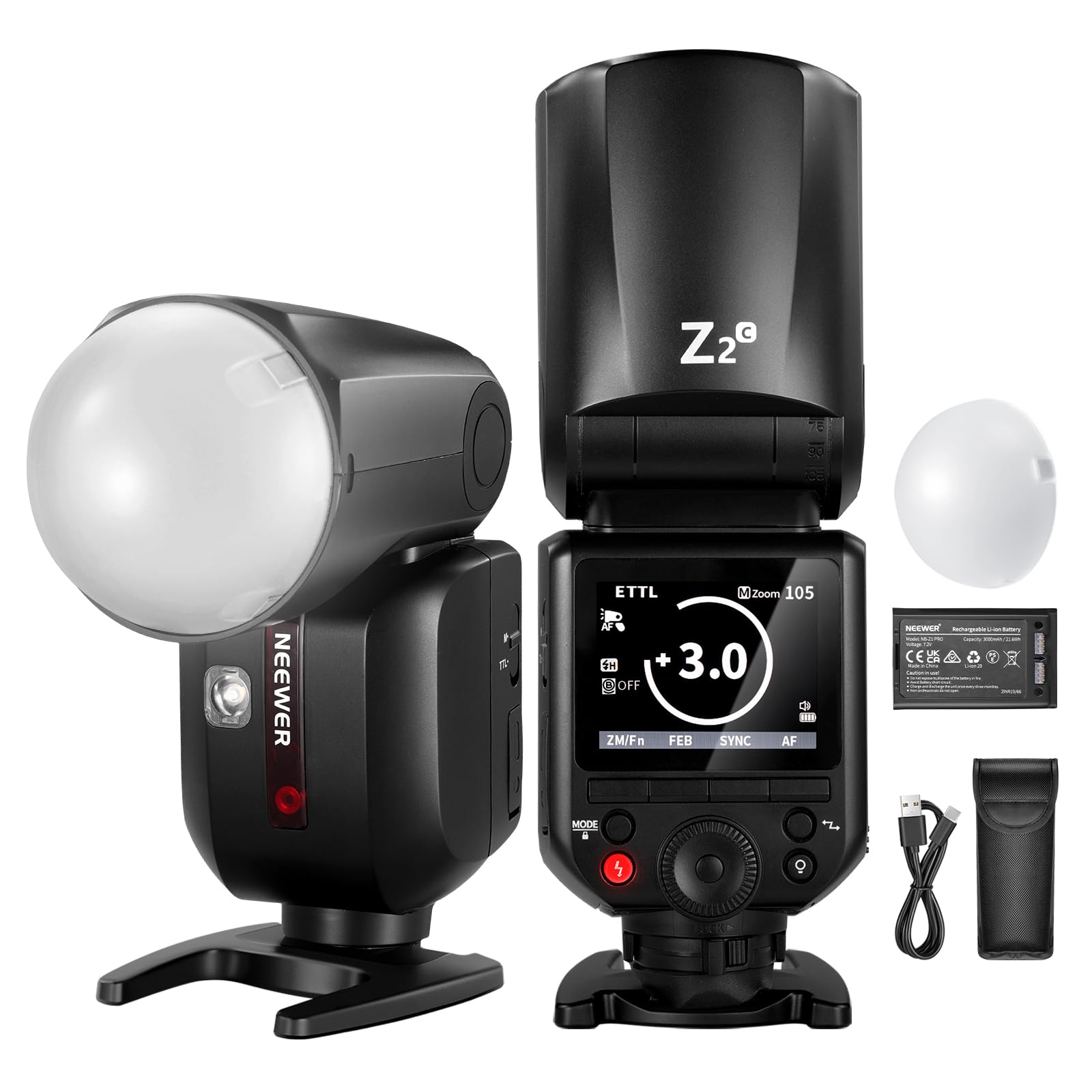
The Neewer Z2-C brings a round-head design to the mid-range category, delivering natural, even light fall-off that mimics studio strobes. With 76Ws of output and a guide number equivalent to 481 feet, it covers portrait and event scenarios easily. The upgraded UI includes a dedicated TCM key that switches from TTL to manual mode instantly, so you can lock in your exposure after auto-metering.
Two 2W LED modeling lamps (one below the flash head and one on the front) provide 10 brightness levels for previewing shadow placement. The 2.4GHz wireless system works with Neewer QPRO-C transmitters and is compatible with Godox X system triggers in RX mode, giving you cross-brand versatility. The 3000mAh lithium battery delivers 600 full-power flashes with a 1.5-second recycle time.
Build quality is solid for the price, though the menu system can feel cluttered during initial setup. The magnetic dome diffuser attaches securely and softens output nicely. For photographers wanting round-head light quality without jumping to premium price brackets, the Z2-C is a compelling choice.
Why it’s great
- Round fresnel head for natural, even light distribution
- Instant TTL-to-manual toggle with TCM key
- Compatibile with Godox X system triggers
Good to know
- Menu navigation can be unintuitive at first
- Plastic housing feels less robust than pro alternatives
- Battery is proprietary — carry a spare for long shoots
4. Neewer Z1-C TTL Round Head Flash

The Neewer Z1-C shares the same 76Ws round-head design as the Z2-C but at a more accessible price point. It delivers the same even light fall-off that makes round flashes popular for portrait work, with a stable 5600K color temperature across the power range. The built-in 2W LED modeling lamp offers 10 brightness levels for previewing light direction.
TTL and HSS sync up to 1/8000s work reliably on compatible Canon bodies, and the 2.4GHz wireless Q system allows remote control across four groups and 32 channels. The 2600mAh lithium battery provides 480 full-power shots and a fast 1.5-second recycle time, which keeps pace with most event work without noticeable lag.
The included magnetic dome diffuser attaches easily and softens output effectively. The bounce head swivels 330° horizontally and tilts from -7° to 120°, offering plenty of flexibility for ceiling or wall bounce. Build quality is plastic but adequate for regular use. For the price, the Z1-C delivers round-head light quality that previously required a bigger budget.
Why it’s great
- Round fresnel head for soft, even light at a low price
- Fast 1.5s recycle time with lithium battery
- Included magnetic dome diffuser works well
Good to know
- Plastic body feels less premium than metal alternatives
- Menu system is clunky compared to Neewer Z2-C
- Battery life at full power is lower than Z2-C (480 vs 600 shots)
5. Godox TT600 + X2T-N Trigger
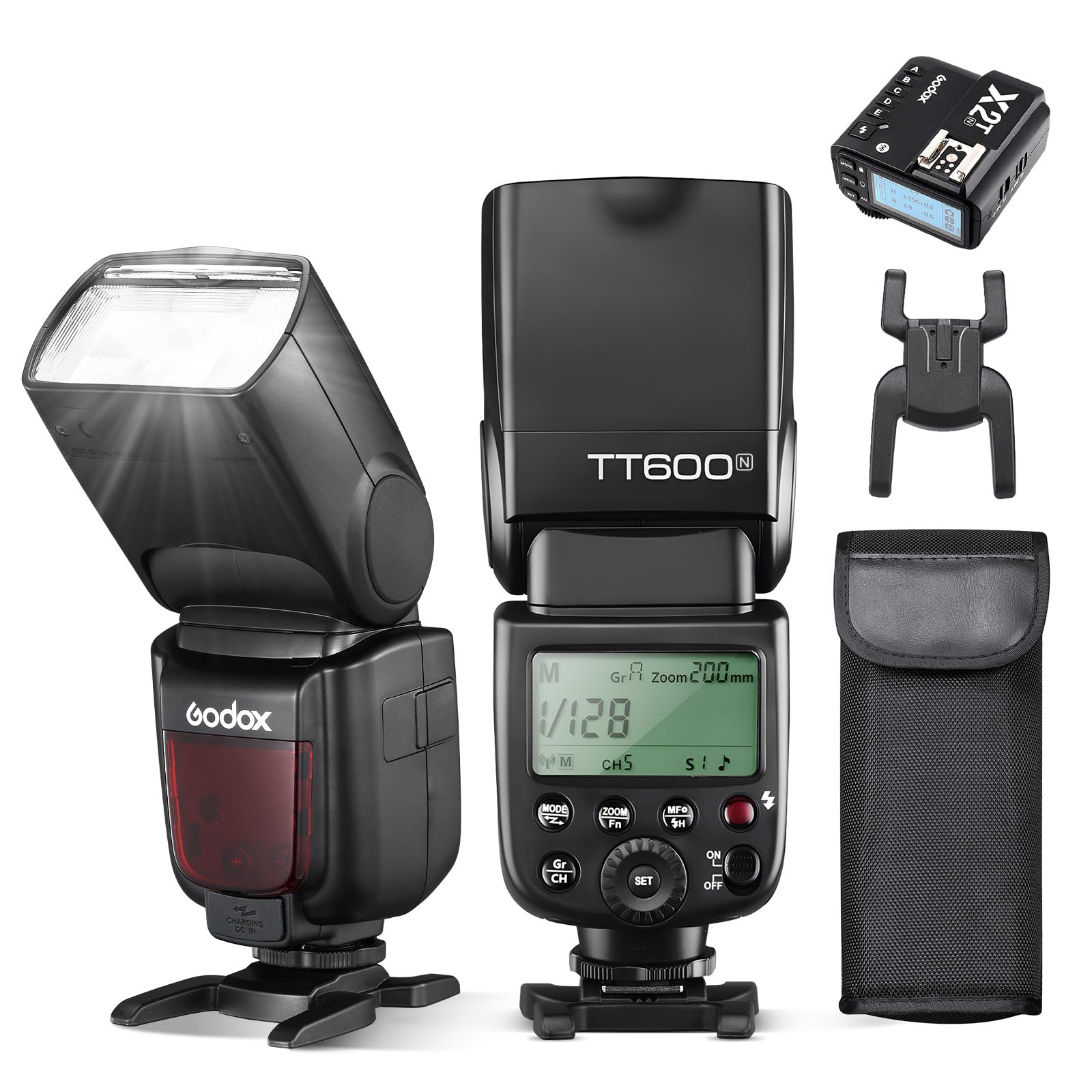
The Godox TT600 is a manual-only speedlight with a high guide number of 60 meters at ISO 100, giving it excellent reach for off-camera work. The bundle with the X2T-N trigger turns it into a complete radio-controlled flash system. The built-in 2.4GHz X system provides 100-meter range and 16 channels, freeing you from optical line-of-sight limitations.
Recycle time at full power runs 0.1 to 2.6 seconds using Ni-MH batteries, and the flash duration spans 1/300s to 1/20000s for freezing motion. High-speed sync up to 1/8000s is available when using the X2T trigger, making it useful for daylight fill-flash where you need to overpower ambient light with a wide aperture.
There is no TTL, so every shot requires manual power adjustment. That makes it ideal for studio-like setups where you dial in your exposure once and shoot consistently. The interface is straightforward with a clear LCD screen. For cost-conscious shooters building a multi-light kit, the TT600 offers remarkable value per watt-second.
Why it’s great
- GN 60 provides strong output for off-camera use
- Reliable 2.4GHz radio with 100m range
- Excellent low-cost option for multi-flash setups
Good to know
- Manual-only — no TTL for automatic exposure
- Recycle time is slower at full power
- X2T-N trigger only compatible with Nikon in this bundle
6. Godox iT32 + X5N Trigger
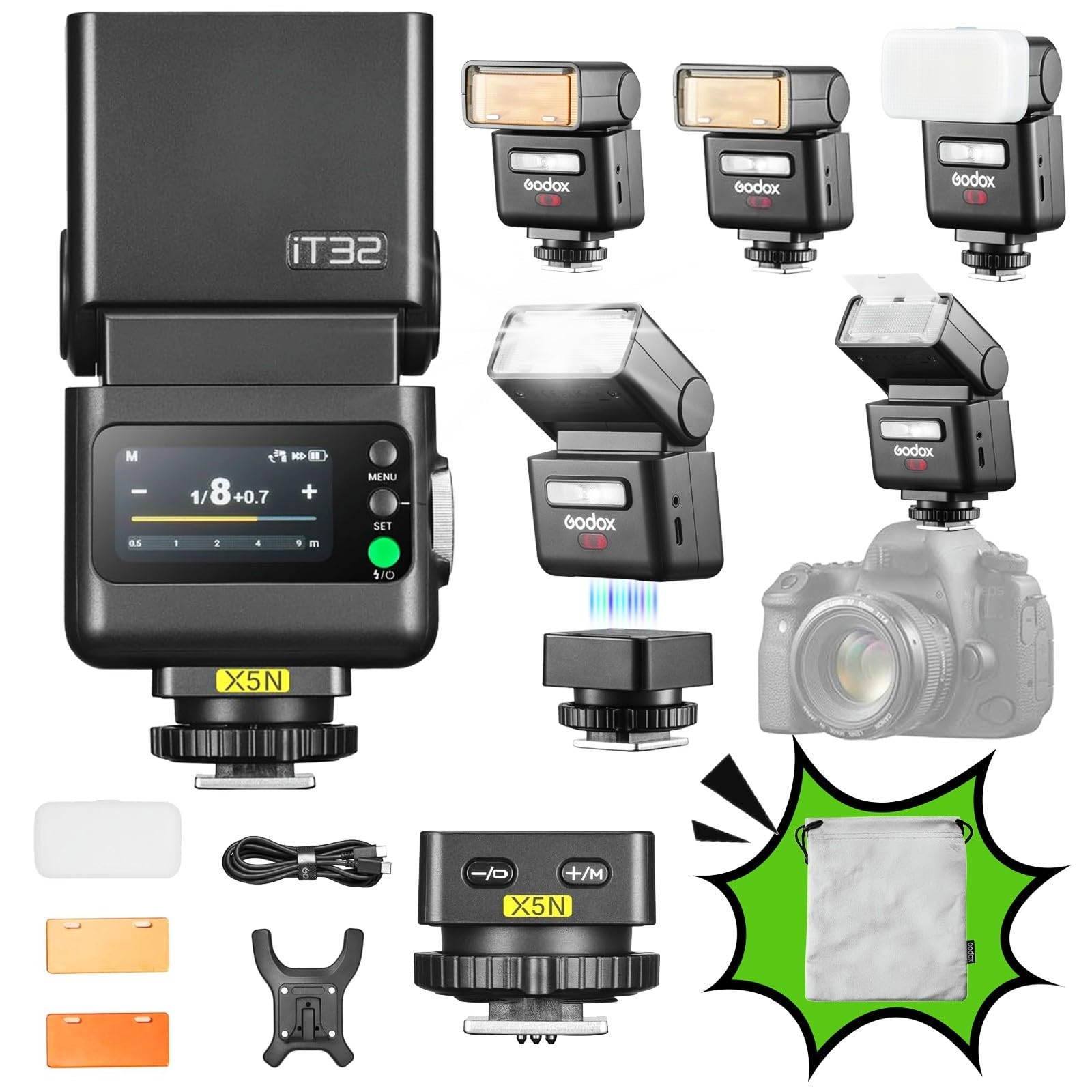
The Godox iT32 is a compact TTL speedlight designed for portability without sacrificing essential features. Its magnetic hotshoe system lets you snap the X5N trigger onto the flash for on-camera use or detach it to act as a wireless transmitter for off-camera control. This 2-in-1 design eliminates the need for separate trigger purchases and streamlines your travel kit.
TTL and HSS support up to 1/8000s sync speed, and the built-in 2.4GHz receiver pairs instantly with the X5N sender without manual pairing. The intelligent recognition system displays the X5 model type, battery level, and charging status on the flash’s screen, reducing operational errors. The flash head rotates for bounce lighting, and the built-in reflector and diffuser add versatility.
Battery life is strong thanks to USB-C charging, and the compact footprint makes it ideal for mirrorless bodies. Power output is lower than full-sized speedlights, so it is best suited for close-range event work and travel photography where weight matters more than raw output. For photographers who value speed and simplicity, the iT32 system is a smart pick.
Why it’s great
- Magnetic hotshoe for instant on/off-camera switching
- Compact and lightweight for travel or mirrorless kits
- No manual pairing needed between flash and trigger
Good to know
- Lower power output than full-size speedlights
- Limited to Nikon compatibility with this specific X5N trigger
- Battery is proprietary — not AA compatible
7. Godox TT520II Speedlite

The Godox TT520II is a manual-only flash that strips away automation to deliver reliable power at a very low cost. With a guide number of 33 meters at ISO 100, it is best suited for close-to-medium range work. The included RT remote transmitter operates on 433MHz with 16 channels, giving you basic wireless control without breaking the bank.
It supports three flash modes—M, S1, and S2—so it can act as an optical slave triggered by another flash’s pre-flash or main burst. The variable power output adjusts from 1/128 to full in eight steps, and the built-in wide panel diffuser and color filter set included in the bundle add creative options out of the box.
Recycle time runs 3 to 5 seconds at full power, which is slower than modern lithium-powered units but acceptable for deliberate shooting. The trigger battery is non-replaceable, but the flash itself runs on four AA batteries that last for over 200 shots. For beginners or photographers building a multi-light setup on a tight budget, the TT520II offers a functional entry point.
Why it’s great
- Extremely affordable entry into wireless flash
- Includes remote trigger, diffuser, and color filters
- Simple manual controls with optical slave modes
Good to know
- No TTL — manual adjustment only
- Recycle time is slow at full power
- Trigger battery is non-replaceable
FAQ
Do I need TTL or can I shoot with manual flash only?
What does high-speed sync (HSS) do for outdoor portraits?
Can I use a Canon flash on a Nikon camera or vice versa?
How many flashes do I need to start a basic off-camera setup?
Final Thoughts: The Verdict
For most users, the best digital camera flash winner is the Neewer Z2-C because it combines round-head light quality, TTL and HSS reliability, and long battery life at a price that undercuts premium OEM options while delivering cross-brand wireless compatibility. If you need flawless system integration for Nikon, grab the Nikon SB-910. And for budget-conscious shooters building a multi-light kit, nothing beats the value of the Godox TT600.

Mo Maruf
I created WellFizz to bridge the gap between vague wellness advice and actionable solutions. My mission is simple: to decode the research and give you practical tools you can actually use.
Beyond the data, I am a passionate traveler. I believe that stepping away from the screen to explore new environments is essential for mental clarity and physical vitality.