Our readers keep the lights on and my smoothie glass nicely filled. As an Amazon Associate, I earn from qualifying purchases.
Dozens of parts move in perfect sync every time you inhale at depth, yet only a handful of engineers truly obsess over how that air feels. A diving regulator is the single most life-critical piece of scuba gear you own—it transforms 3,000 PSI of tank pressure into a breath that matches your exact demand, whether you’re hovering at 15 feet or pushing the recreational limit. Choose wrong, and you fight your gear for air. Choose right, and breathing underwater becomes as effortless as it is on the surface.
I’m Mohammad Maruf — the founder and writer behind WellFizz. I’ve spent hundreds of hours dissecting regulator schematics, analyzing customer dive logs, and cross-referencing first-stage piston designs with real-world performance feedback to separate hype from genuine breathing comfort.
This guide covers nine systems spanning piston and diaphragm first stages, balanced and unbalanced designs, and integrated octopus setups so you can find the best diving regulator for your diving style, depth preferences, and maintenance expectations.
How To Choose The Best Diving Regulator
A regulator is your underwater respiratory lifeline. It must deliver air on demand with minimal inhalation effort, resist free-flow, and hold up to the salt, sand, and pressure cycles of regular diving. The three most important factors are first-stage type, second-stage balance, and port configuration.
First-Stage Design: Piston vs Diaphragm
Piston first stages (like the Cressi AC2 or the Scubapro MK25 EVO) are mechanically simpler, with fewer moving parts, and deliver high volumes of air quickly. They thrive in warm, clean water environments. Diaphragm first stages isolate internal components from the water, making them more resistant to freezing in cold-water conditions and more tolerant of particulate contamination from the tank. If you dive exclusively above 60°F water, a sealed diaphragm model or a balanced piston with thermal insulation (like the MK25 EVO’s ice-dry kit) is the safer bet.
Balanced vs Unbalanced Second Stages
An unbalanced second stage requires progressively more inhalation effort as tank pressure drops below 1,000 PSI. A balanced second stage (found on the Aqualung Leg3nd Octopus and Scubapro S620 Ti) keeps inhalation resistance constant regardless of tank pressure, meaning your last breath at 500 PSI feels identical to your first. For deep dives or long bottom times, a balanced second stage eliminates the “sucking on a milkshake” sensation near the end of the dive.
Port Configuration and Swivel Turrets
Low-pressure ports should face downward or outward to route hoses cleanly away from your chin. High-pressure ports opposite each other allow you to mount the first stage facing up (hoses over your shoulder) or down (hoses under your arm). Swivel turrets (present on the Scubapro MK25 EVO) let you rotate hose positions without moving the first-stage yoke or DIN connection, reducing snag risk and improving streamlined hose routing. Count at least four LP ports if you plan to run a BC inflator, drysuit inflator, and octopus from the same first stage.
Quick Comparison
On smaller screens, swipe sideways to see the full table.
| Model | Category | Best For | Key Spec | Amazon |
|---|---|---|---|---|
| SCUBAPRO MK25 EVO/S620 Ti | Premium | Cold-water & deep recreational dives | Balanced piston, titanium barrel, 7 ports | Amazon |
| Cressi Travelight Package | Premium | Travel divers needing a complete kit | Balanced diaphragm 1st stage, 6lb BCD | Amazon |
| Cressi Essential R1 Package | Mid-Range | New divers wanting a full gear-up set | AC2 piston, Donatello C2 computer | Amazon |
| Cressi Start-er Pro Pack | Mid-Range | Beginners in warm/temperate water | Cordura BCD, AC2/Compact reg, console | Amazon |
| Cressi Novice Complete Package | Mid-Range | Entry-level divers on a tight budget | Solid BCD + AC2 reg + Mini SPG | Amazon |
| Cressi AC2/Compact + Octopus | Mid-Range | Divers who want a dedicated octopus | AC2 piston + XS Compact octopus | Amazon |
| Cressi AC2/Compact (Solo) | Mid-Range | Travelers and beginner single-reg setups | Piston 1st stage, 923g total weight | Amazon |
| Aqualung Leg3nd Octopus | Mid-Range | Upgrading an octopus to balanced performance | Balanced 2nd stage, 210g weight | Amazon |
| Aqualung Airsource 3 | Budget | Octo-integrated air source alternative | Pneumatically balanced 2nd stage, integrated | Amazon |
In‑Depth Reviews
1. SCUBAPRO MK25 EVO/S620 Ti Diving Regulator System

The MK25 EVO first stage uses an air-balanced flow-through piston design with thermal insulation that delays ice formation in cold water—a crucial advantage for divers hitting temperatures below 50°F. Chrome-plated brass body, a stainless steel frame, and seven ports (two HP, five LP on a swivel turret) give you every mounting option imaginable. The S620 Ti second stage is all titanium barrel construction, making it exceptionally corrosion-resistant while keeping weight to a minimum.
Real-world feedback confirms effortless breathing at depths down to 140 feet with zero difference in inhalation effort between a full tank and near-empty. The diver-adjustable Venturi-Initiated Vacuum Assist (VIVA) lever prevents free-flow on the surface, and the ergonomic Hi-Flow mouthpiece sits comfortably in the jaw without pinching. The intermediate pressure adjustment screw allows technicians to fine-tune cracking pressure externally.
One consistent observation: the dive/pre-dive switch is largely redundant because the regulator breathes cleanly in either position. Owners who upgraded from standard unbalanced regs report a noticeable reduction in jaw fatigue over multi-day liveaboard trips. The only trade-off is the premium investment, but the build quality and breathing consistency justify it for serious divers.
Why it’s great
- Balanced piston delivers identical inhalation effort from 3,000 PSI to 500 PSI
- Thermal insulation protects against ice formation in cold water
- Swivel turret allows optimal hose routing without moving the yoke
- Lightweight titanium second stage reduces jaw fatigue
Good to know
- Premium tier pricing requires a larger upfront investment
- Dive/pre-dive venturi switch is essentially redundant in practice
- Requires professional annual servicing for warranty compliance
2. Cressi Travelight 15 LBS Scuba Diving Package

The Travelight BCD weighs only 6 pounds and folds compactly into a carry-on-friendly footprint, but the regulatory heart of this package is the MC9 balanced diaphragm first stage. A balanced diaphragm regulator isolates the internal mechanism from water contact, which makes it more reliable in silted or cold conditions compared to a basic unbalanced piston. The MC9 is paired with a Compact second stage and Compact Octo that all fit into the included GupG Regulator bag.
Customers consistently highlight the Cressi Donatello C2 dive computer console—four dive modes (Air, Nitrox, Gauge, Free), a crisp backlit display, and the mini pressure gauge that sits neatly without dangling. The Lock Aid weight system on the Travelight BCD holds up to 20 pounds, and eight D-rings give you ample clip points for accessories. The Cressi-certified Lancaster Scuba team assembles and tests every unit before shipping, so the system arrives ready to dive.
The main criticism relates to the included carry bag: it fits the BCD, regulator set, mask, snorkel, and small accessories but won’t hold fins unless they are ultra-compact. The tank safety strap on the BCD is also non-adjustable and longer than ideal for smaller tanks. For divers who prioritize airline portability and want a balanced-diaphragm first stage without piecing together separate components, this package delivers.
Why it’s great
- Ultra-light 6lb BCD folds small for carry-on luggage
- Balanced diaphragm first stage resists cold and silt
- Fully assembled and tested by certified technicians
- Donatello C2 computer with Nitrox capability included
Good to know
- Carry bag is too small for full-size fins
- BCD tank strap is non-adjustable and slightly overlong
- Premium price reflects the complete system, not just the regulator
3. Cressi Essential Scuba Diving Gear Package (R1 BCD + AC2 + Donatello C2)
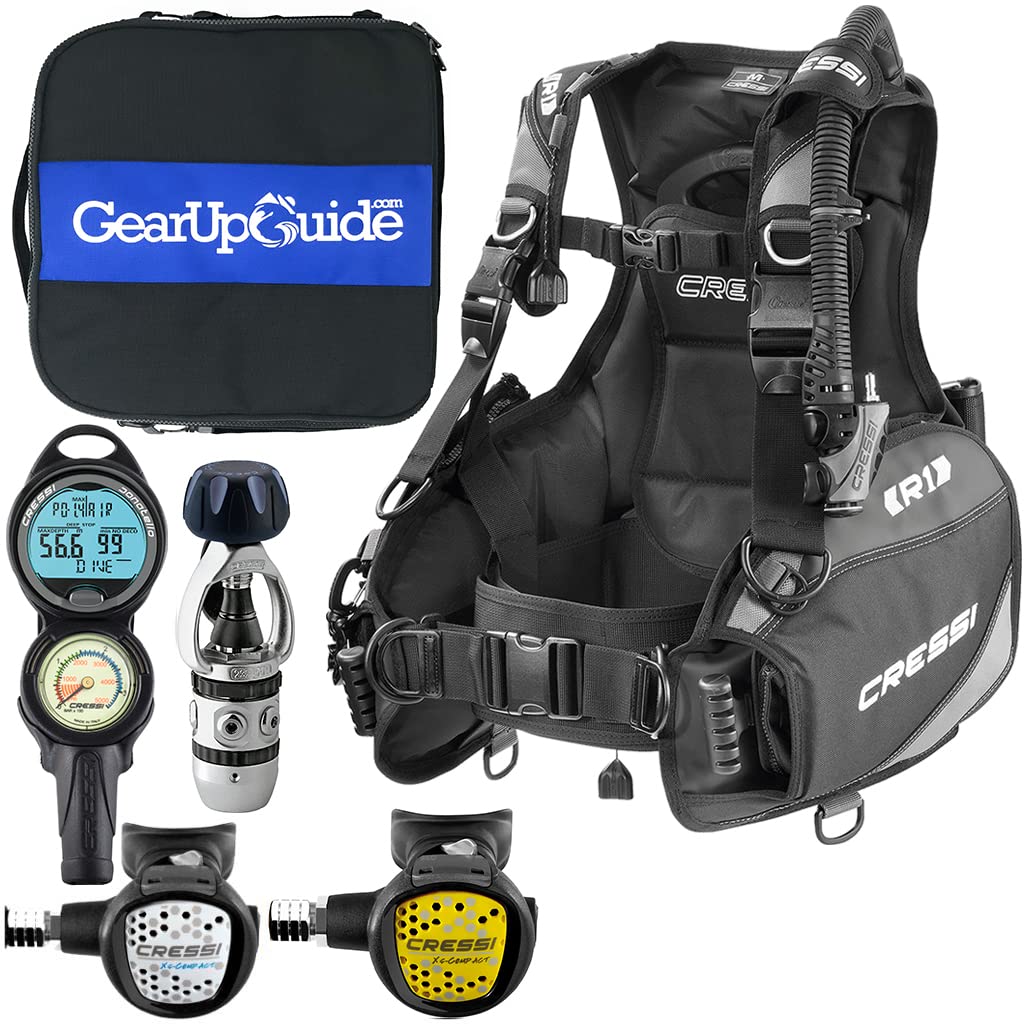
The R1 BCD features a durable 500-denier Cordura shell with the Lock Aid weight system supporting up to 20 pounds, three exhaust valves, and large zippered pockets. Paired with the venerable AC2 piston first stage and Compact second stage, this package delivers a functional and travel-friendly regulator set. The Donatello C2 dive computer console rounds out the package with a two-gauge display (depth and pressure) plus full computer functions.
Buyers appreciate that the entire system is fully assembled and wet-tested by Lancaster Scuba before shipping, so there is no guesswork about compatibility or leaks. The AC2 is a non-balanced flow-through piston—simple, robust, and easy to service anywhere in the world. Its four LP ports handle the BC inflator and octopus without needing a splitter. The Compact second stage uses a single-hull ABS body that keeps weight to 7.4 ounces per second stage.
Some users note that the primary regulator is unbalanced, meaning inhalation effort increases slightly below 700 PSI tank pressure. For recreational diving above 100 feet, this is rarely a problem, but deeper divers may notice the difference. The factory octopus holder is basic, and a few buyers replaced it with a sturdier clip. Overall this is a strong mid-range package for divers who want a computer, BCD, and reg set in one box.
Why it’s great
- Fully assembled and tested, dive-ready out of the box
- Includes BCD, computer, regulator, and octopus in one package
- 500-denier Cordura BCD is durable for travel and local diving
- Donatello C2 computer offers Air/Nitrox/Gauge/Free modes
Good to know
- AC2 is an unbalanced piston—harder breathing below 700 PSI
- Factory octopus holder is flimsy
- Computer uses imperial units only (PSI, feet)
4. Cressi Start-er Pro Pack (Start Pro 2.0 BCD + AC2/Compact Regulator)

The Start Pro 2.0 BCD uses 1000 and 500 denier Cordura fabric—the same material found on much more expensive wings—to resist abrasion from tank straps and rocky shore entries. The AC2/Compact regulator delivers the proven non-balanced piston first stage with a compact single-hull second stage that fits comfortably in smaller mouths. The MiniConsole 2 houses both an analog pressure gauge and analog depth gauge in a polycarbonate/Desmopan boot that protects against shock.
Divers using this package in warm water report that the AC2 piston provides abundant airflow even during rapid ascents, and the compact second stage weighs little enough that jaw fatigue is minimal. The double air filtration system in the BCD inflator—filters under the hose connection and around the valve—adds an extra layer of protection against moisture ingress. The sternal whistle buckle is a thoughtful safety addition.
The primary limitation is that the regulator is unbalanced, so performance degrades slightly as tank pressure drops. The gauges are only marked in imperial units, which may be inconvenient for metric-accustomed divers. The BCD lacks dedicated trim weight pockets, though D-rings allow attachment of accessory pouches. For recreational warm-water diving, this package offers exceptional value for money.
Why it’s great
- Heavy-duty Cordura fabric on the BCD resists cuts and tears
- Integrated double air filtration on the inflator
- Compact second stage reduces jaw strain on long dives
- Analog gauges are easy to read without batteries
Good to know
- Unbalanced piston first stage—noticeable effort below 1000 PSI
- Gauges are imperial only (PSI/feet)
- No trim weight pockets on the BCD
5. Cressi Novice Complete Scuba Diving Package (Solid BCD + AC2/Compact + Octopus + Mini SPG)

This package strips away extras to focus on the essential three: a Solid BCD, the AC2/Compact regulator with octopus, and a Mini SPG console. The Solid BCD features a colored reinforcement band at the neck collar that protects the jacket from the abrasive action of the first stage and improves visibility. The AC2 piston first stage has one HP port and four LP ports, enough for a straightforward single-tank setup.
Customers report over 150 dives on the AC2/Compact with zero performance degradation. The Compact octopus uses the same casing as the XS Compact model, so breathing characteristics are nearly identical to the primary—important for stress-free buddy sharing. The Mini SPG is very compact, eliminating console drag and keeping the hose tidy. The BCD fits comfortably for both male and female divers up to about 200 pounds.
Packaging quality has been inconsistent—some units arrived with visible wear suggesting a returned item. Cressi USA customer service response times have frustrated some owners, particularly when seeking service locations. The non-balanced AC2 piston requires slightly more inhalation effort as tank pressure drops, but at this price point, that trade-off is acceptable for most entry-level divers.
Why it’s great
- Complete set includes everything except the tank and mask
- Octopus breathes nearly as well as the primary second stage
- BCD neck reinforcement resists first-stage abrasion
- Compact SPG console eliminates bulky gauge drag
Good to know
- Packaging and product condition may vary on arrival
- Cressi USA service network has been difficult to reach
- Unbalanced piston demands more effort at low tank pressure
6. Cressi Scuba Diving Regulator Kit (AC2/Compact + Octopus Compact)
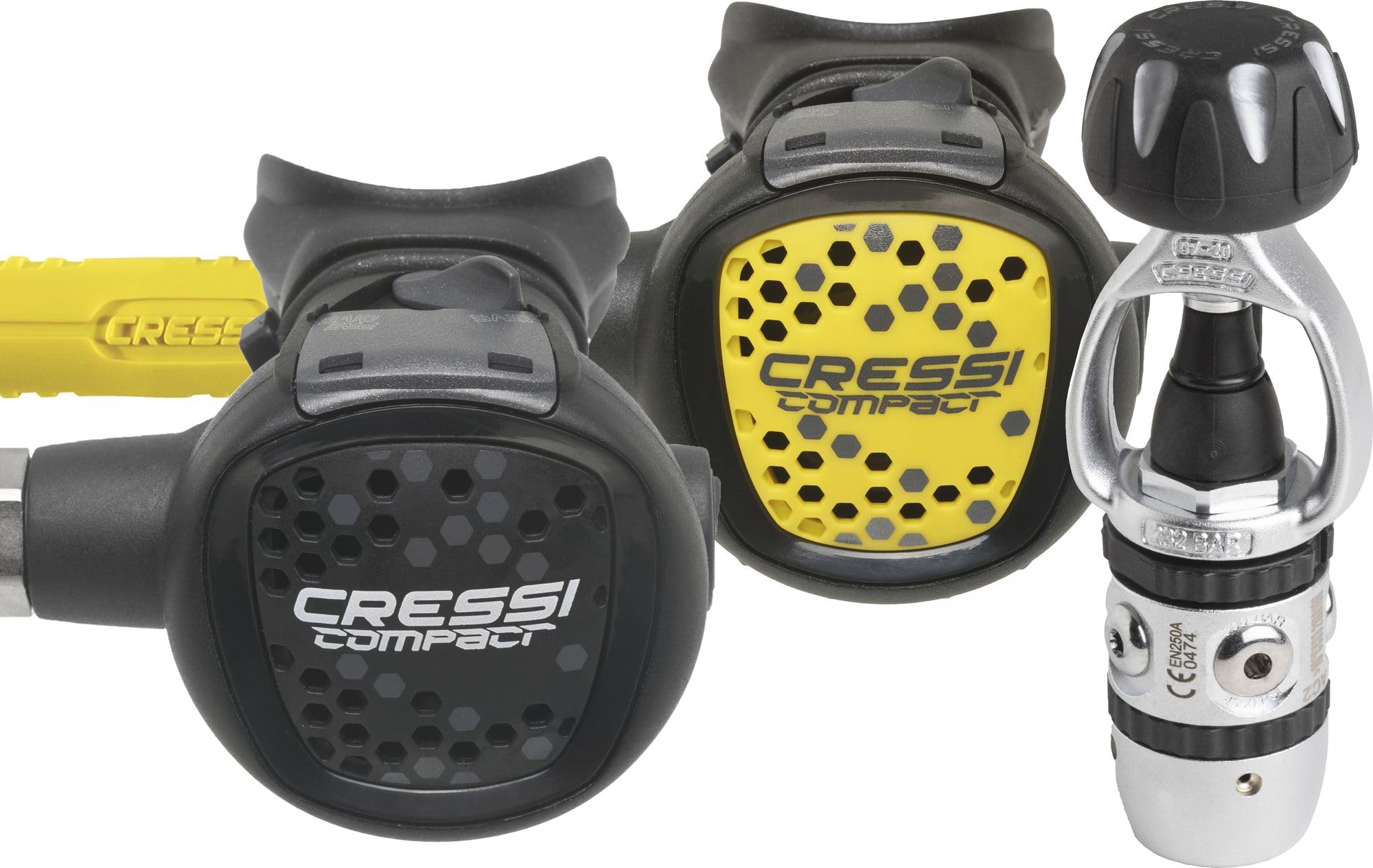
The AC2 piston first stage is paired here with both a Compact second stage and a matching Compact Octopus. Using the same second-stage design for primary and octopus means the backup breathes, purges, and feels identical to the primary—a real advantage during an out-of-air drill. The AC2 is 60% plastic and 40% stainless steel, making it one of the lighter piston first stages on the market at just under 35 ounces for the full setup.
Owners with over 150 logged dives report that this regulator set performs identically to day one with proper annual servicing. The asymmetrical drilling on the Compact front cover channels water flow to push the diaphragm into optimal position for smooth lever movement, regardless of the diver’s orientation. The octopus comes with a yellow hose for visibility and a silicone mouthpiece with ergonomic bite wings.
The non-balanced AC2 piston shows breathing resistance below 1,000 PSI, as expected. Some buyers noted the hoses are factory-standard length, which may be too short for tall divers using a long-hose primary configuration. The plastic-heavy construction, while lightweight, may not inspire the same confidence as a fully chrome-plated brass regulator for cold-water wreck divers.
Why it’s great
- Identical second-stage design for primary and octopus simplifies buddy drills
- Lightweight construction—entire set weighs under 35 oz
- Proven AC2 piston design with thousands of dives in the field
- Ergonomic bite wings on both mouthpieces reduce jaw fatigue
Good to know
- Unbalanced first stage—harder breathing below 1000 PSI
- Standard hose lengths may not suit tall divers
- More plastic components than premium all-metal regs
7. Cressi AC2/Compact Scuba Diving Regulator

The AC2/Compact is the standalone regulator that forms the foundation of several Cressi packages. The heavy-duty piston first stage is simple, reliable, and robust—dive centers and rental fleets choose it for its surprising level of performance at a fraction of the cost of premium regs. The conical filter with large filtering capacity prevents particles from the tank from reaching the internal mechanism.
At just 32.6 ounces total, this is one of the lightest piston regulator sets available. The external LP regulation with a common hex key makes adjustments and maintenance straightforward without specialized tools. The asymmetrical front cover drilling pushes water flow anti-clockwise to retract the diaphragm into a flat position for consistent lever action regardless of water flow conditions. The specific calibration rewards an abundant flow without relying on the Venturi effect.
Some users report occasional free-flow when the regulator enters the water face-up—turning it upside down resolves the issue. There is a slight inhalation drag when the diver is completely inverted (looking up under a reef ledge), but this is an edge case. The compact second stage is small enough to fit in a BCD pocket, making it an excellent travel reg for minimalist packers.
Why it’s great
- Extremely lightweight at 32.6 oz for the complete set
- Simple piston design is easy to service anywhere
- Conical filter provides excellent particle protection
- Compact profile fits easily into travel bags
Good to know
- Occasional free-flow on surface entry can happen
- Slight inhalation drag when completely inverted
- Unbalanced piston—noticeable breathing effort below 1000 PSI
8. Aqualung Leg3end Octopus
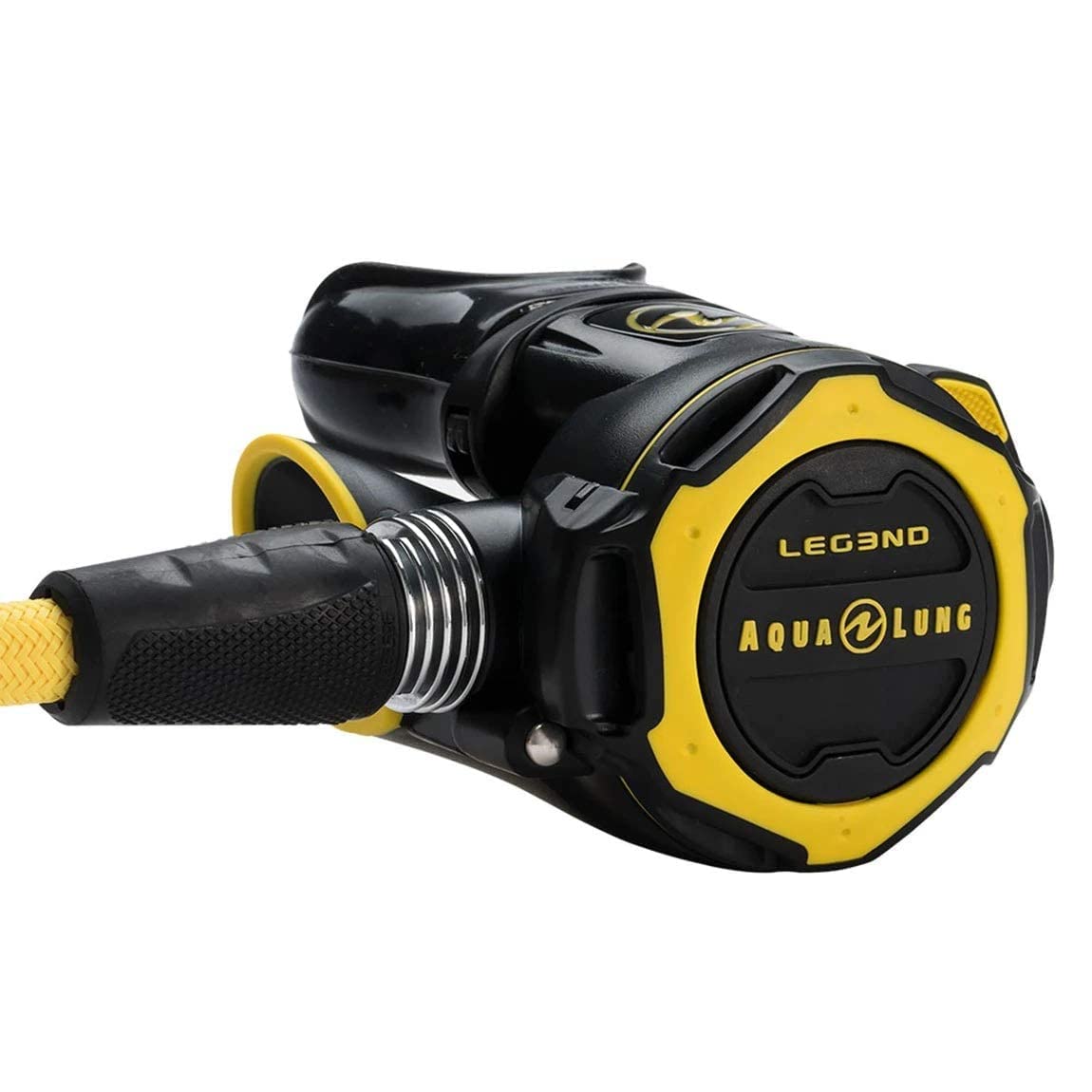
The Leg3end Octopus is a pneumatically balanced second stage that brings the same breathing performance as the full Leg3end regulator in a dedicated octopus package. Balanced second stages maintain consistent inhalation effort regardless of tank pressure, making this octopus one of the few backups that breathes better than many primary regulators on the market. The techno-polymer case keeps weight to just 7.4 ounces.
Divers who own the Aqualung Leg3end primary regulator report that this octopus breathes almost identically—a rare trait that eliminates the “sucking through a straw” sensation when sharing air. The Dive/Pre-Dive Venturi switch prevents free-flow at the surface, and the ergonomic exhaust tee channels bubbles out of the field of vision. The yellow high-visibility color ensures your buddy can locate it instantly in low light or stirred-up silt.
One unit was reported with a hose failure after 20 minutes of use, which suggests a quality-control gap on a small number of units. Generally, the build quality is excellent, with a manufacturer limited lifetime warranty backing the product. At this price point, it sits at the upper end of octopus pricing, but the balanced breathing performance justifies the cost for divers who prioritize safety and breathing consistency in their backup system.
Why it’s great
- Balanced second stage breathes consistently at any tank pressure
- Ultra-light at 7.4 oz reduces jaw fatigue
- Bubble-diverting exhaust tee keeps vision clear
- High-vis yellow improves safety in low-light conditions
Good to know
- Rare but reported hose failure on initial use
- Priced higher than most standard octopus units
- Requires compatible Aqualung first stage for optimal performance
9. Aqualung Airsource 3 Integrated Octopus
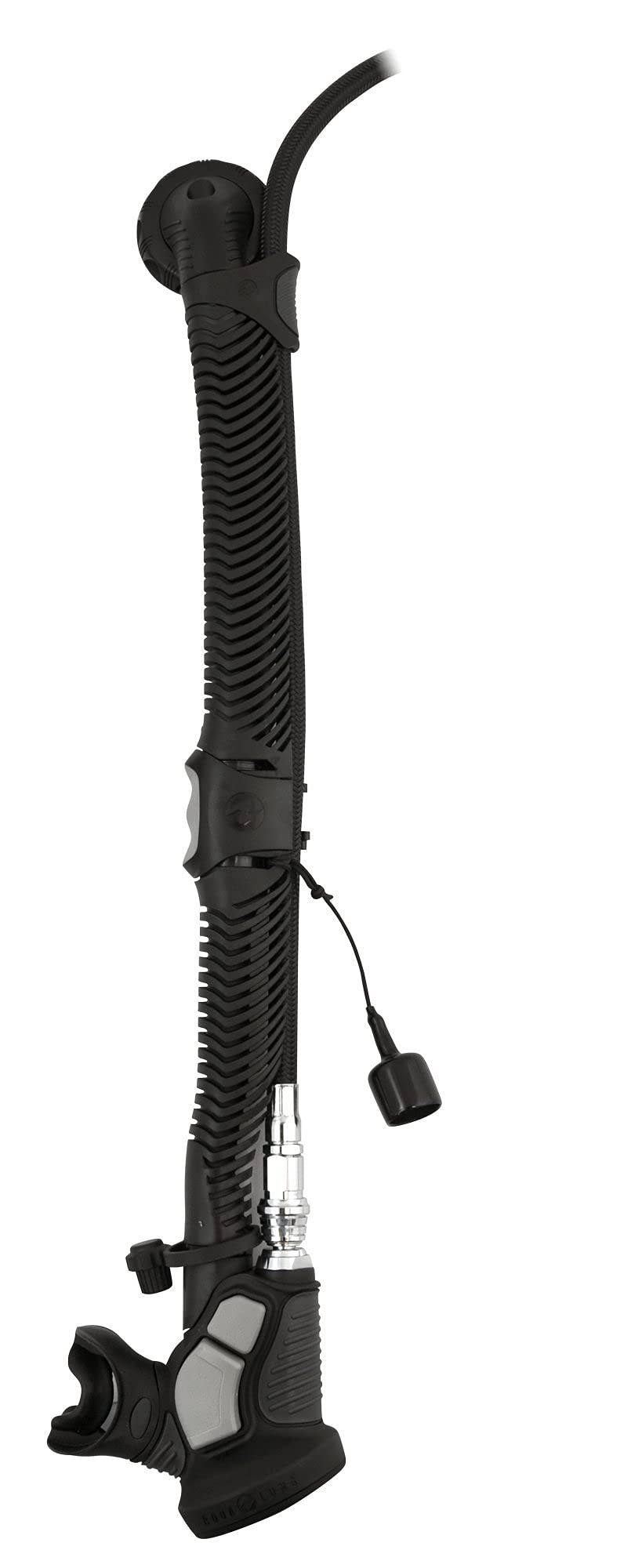
The Airsource 3 replaces a traditional octopus with an integrated second stage that clips directly into the BC inflator assembly, removing one hose and one dangling second stage. The second stage is pneumatically balanced, delivering consistent performance across the entire tank pressure range. The redesigned Trim Grip in the middle of the corrugated hose allows the diver to hold the hose for better control during ascent.
Customers who use this as their backup air source appreciate the streamlined profile—one less hose to manage, one less second stage to clip to your harness. The balanced valve ensures that if your buddy needs air, they get the same breathing experience regardless of whether the tank is full or nearly empty. It is designed to work optimally with over-balanced first stages (like Aqualung’s own), where the intermediate pressure rises slightly with depth.
The integrated design limits placement—it must attach to the BC’s corrugated hose, which means it cannot serve as a standalone octopus on a separate LP port. Some users noted that the plastic body feels less robust than dedicated octopus models. For divers who value hose management and a clean profile and already use an Aqualung first stage, this is a practical budget-friendly solution, but it is not a universal octopus replacement.
Why it’s great
- Integrated design eliminates an extra hose and second stage
- Pneumatically balanced valve delivers consistent backup breathing
- Trim Grip provides a positive hold point on the corrugated hose
- Works intuitively with over-balanced first stages
Good to know
- Integrated design limits placement to BC corrugated hose only
- Plastic construction feels less durable than all-metal octopus
- Not a universal solution—best with Aqualung first stages
FAQ
Should I choose a piston or diaphragm first stage for cold water diving?
How often does a scuba regulator need to be serviced?
Can I use a Cressi regulator with a Scubapro first stage?
What does the Venturi switch on a second stage actually do?
Final Thoughts: The Verdict
For most divers, the best diving regulator winner is the Scubapro MK25 EVO/S620 Ti because its balanced piston first stage and titanium second stage deliver effortless breathing across all depths, cold-water compatibility, and premium build quality that holds up for decades. If you want a complete travel-ready system with a balanced diaphragm first stage and dive computer included, grab the Cressi Travelight Package. And for the best entry-level value, the Cressi Novice Complete Package gets you in the water with reliable Italian engineering at a fraction of the cost of premium setups.

Mo Maruf
I created WellFizz to bridge the gap between vague wellness advice and actionable solutions. My mission is simple: to decode the research and give you practical tools you can actually use.
Beyond the data, I am a passionate traveler. I believe that stepping away from the screen to explore new environments is essential for mental clarity and physical vitality.