Our readers keep the lights on and my smoothie glass nicely filled. As an Amazon Associate, I earn from qualifying purchases.
A directional TV antenna is the critical upgrade for cord-cutters who live where broadcast towers cluster in one direction or where foliage and buildings eat signals alive. Unlike multi-directional designs that compromise gain for 360° coverage, a directional antenna focuses its reception energy in a single, narrow beam—pulling in distant, weak stations that a standard antenna would miss entirely.
I’m Mohammad Maruf — the founder and writer behind WellFizz. My buying guides are built on hundreds of hours comparing raw specs like impedance, frequency bands, amplifier gain, and element geometry to find the unit that actually delivers clean signal in challenging environments.
Whether you are mounting to a roof 40 miles from the nearest transmitter or fighting signal drift from passing weather, the right directional tv antenna locks onto your local towers and holds the picture steady through game day.
How To Choose The Best Directional TV Antenna
A directional antenna is about precision, not luck. You are buying the ability to reject off-axis noise while pulling every decibel of signal from a specific compass heading. Misunderstand the specs and you end up with an antenna that works worse than a bent paper clip.
Element Design and Frequency Focus
The physical length and number of elements—those horizontal rods on a Yagi-style antenna—determine how much signal the antenna can gather. Longer elements capture VHF (channels 2-13), while shorter, more numerous elements handle UHF (channels 14-36). A true directional antenna will have a mix of both. If you only need UHF stations, a smaller UHF-only Yagi works; if you need both bands, ensure the VHF dipole is present and long enough to resonate at 174–216 MHz.
Gain vs. Mile Ratings
Mile ratings are marketing fiction. What matters is gain, measured in decibels (dB). A directional antenna with 12–15 dB of forward gain will pull stations 50–70 miles away reliably. Any claim above 200 miles is physically impossible due to the Earth’s curvature. Instead, look for the advertised gain figure and compare it against your distance to the farthest broadcast tower. Use the FCC’s DTV Reception Maps to find real distances and headings.
Rotator or Fixed Mount
If all your local towers sit within a 30-degree arc, a fixed mount is fine. If you need stations from opposite directions—say a CBS tower to the north and a Fox tower to the southwest—a motorized rotator is essential. A rotator adds mechanical complexity and a potential failure point, but for multi-directional coverage, it transforms one directional antenna into the functional equivalent of a multi-directional unit without sacrificing gain.
Quick Comparison
On smaller screens, swipe sideways to see the full table.
| Model | Category | Best For | Key Spec | Amazon |
|---|---|---|---|---|
| Five Star Outdoor Amplified HDTV Antenna | Premium | Multi-TV homes with rotator | 360° motorized rotator, 5-TV support | Amazon |
| Five Star Yagi UHF VHF Antenna | Premium | Single-direction fixed mount | Yagi design, ATSC 3.0, 200-mile range | Amazon |
| PBD Amplified Outdoor TV Antenna | Mid-Range | Motorized rotation on a budget | 360° motorized, 150-mile range, dual TV output | Amazon |
| PIBIDI Outdoor TV Antenna | Mid-Range | Pure directional gain, no rotator | Extended elements, 200-mile range | Amazon |
| Five Star Outdoor HDTV Antenna 200 Mile | Mid-Range | Attic or roof fixed mount | 46″L x 28″W elements, 200-mile range | Amazon |
| Merpersom 5000+ Miles Digital TV Antenna | Budget | Compact indoor placement | 38-ft coax, 5000+ mile rating | Amazon |
| Susbrothe 6000+ Miles TV Antenna | Budget | Small space indoor/outdoor | 52-ft coax, 6000+ mile rating | Amazon |
In‑Depth Reviews
1. Five Star Outdoor Digital Amplified HDTV Antenna
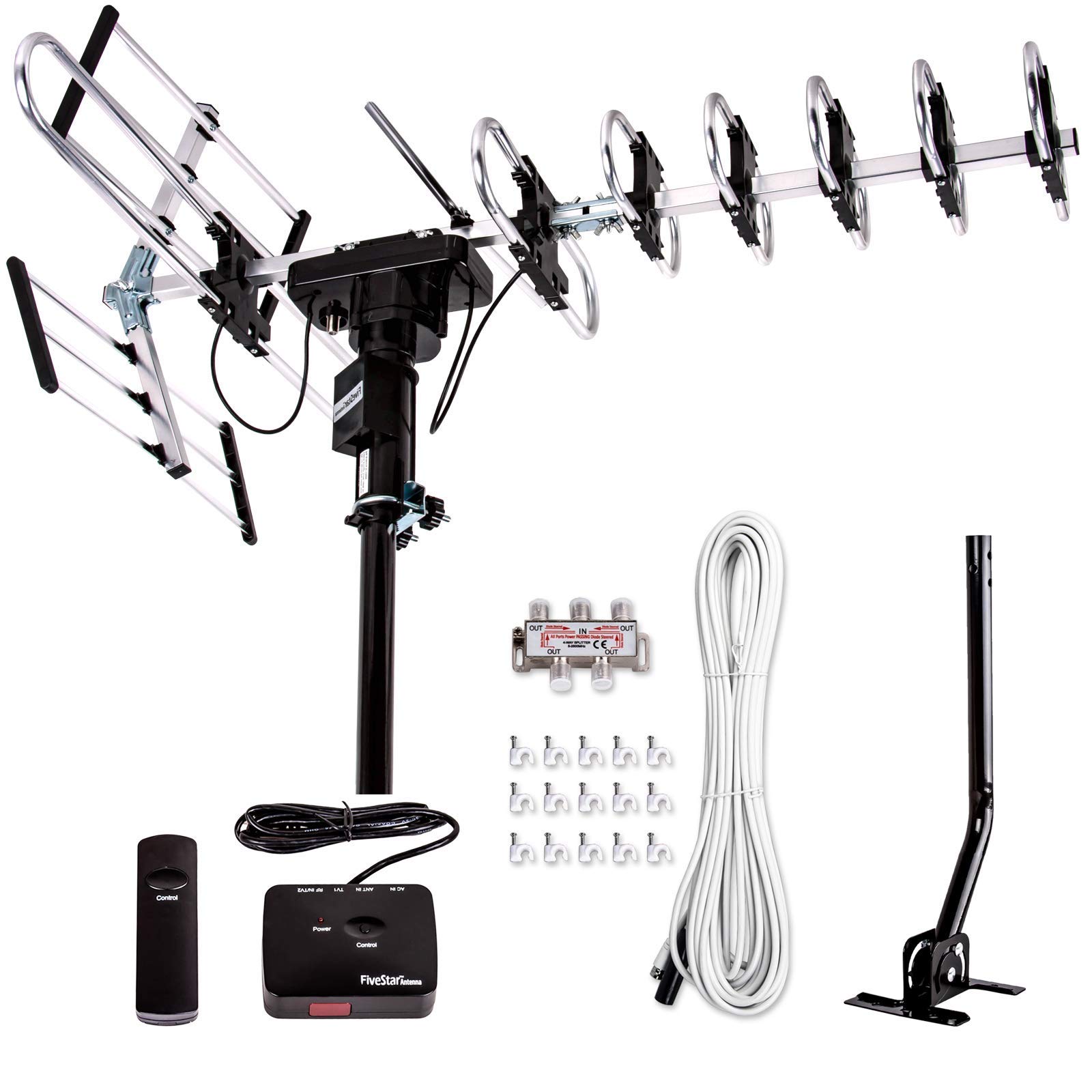
The Five Star Outdoor Digital Amplified Antenna is the most complete package for anyone who needs a motorized rotator and multi-room distribution out of the box. The 360° rotation lets you point the directional beam at towers in opposite directions without climbing a ladder, and the included 4-way splitter and 40 ft of RG6 coax mean you can feed five TVs immediately. The built-in auto gain control chip adjusts amplification between 15–35 dB to prevent overloading when towers are close and boost when they are distant.
The Yagi-style reflector array uses six UHF elements and a dedicated V-band dipole, which reviewers report improves VHF channel 7–13 reception by roughly 50% compared to four-element designs. In practice, users 25 miles from transmitters with a 65° separation between tower clusters consistently pull in ABC, CBS, NBC, and FOX without pixelation. The rotator itself draws power through the coax, so no extra control box wiring is needed—though some units arrive with a jerky motor, and the lack of a direction indicator means you rotate by trial and error.
The trade-off is build quality: the aluminum elements feel light and the rotator mechanism can fail early, as evidenced by reports of the motor dying within weeks. One reviewer resorted to rotating the antenna manually with a broom handle. For households where towers are within a 30–40° arc, a fixed-direction antenna would be more reliable. But for the price, the combination of a rotator, distribution kit, and 15–35 dB gain makes this a compelling all-in-one for cord-cutters serving multiple rooms.
Why it’s great
- Built-in 360° motorized rotator for multi-directional coverage
- Full installation kit includes splitter, 40-ft coax, and J-pole
- Auto gain control adjusts from 15 to 35 dB for varying tower distances
Good to know
- Rotator motor can be unreliable; no direction indicator
- Aluminum construction feels flimsy compared to solid Yagi antennas
- Some users report the coax length reduces power to the rotator motor
2. Five Star Outdoor TV Antenna 200 Miles Yagi UHF VHF

The Five Star Yagi is a no-nonsense directional antenna for fixed-mount installations where all target towers lie in one general direction. Its classic Yagi arrangement—a single driven element, a reflector behind it, and multiple directors in front—provides focused forward gain without the mechanical complexity of a rotator. The click-and-lock assembly requires no tools and folds flat for easy transport or storage, making it practical for seasonal use or RV setups.
The antenna supports both high-band VHF (170–230 MHz) and UHF (470–790 MHz), so channels 7 through 36 are covered. Reviewers 45 miles from transmitters report pulling 22 channels with zero pixelation, even in areas the FCC labels as having weak or poor expected reception. The 75-ohm impedance matches standard RG6 coax without needing a matching transformer. The included J-pole mounting hardware is rated for roof or attic installs, though the plastic connection between the front base and the elements may flex in high wind.
Mile claims on the listing hit 200, but buyers should calibrate expectations: Earth curvature and terrain block anything beyond about 70 miles even with perfect line of sight. One reviewer found the antenna underperformed a 1980s-era antenna at 22 miles in a tree-heavy area, suggesting the plastic connectors can degrade signal path integrity. For users in open terrain with a clear heading to towers, this Yagi delivers clean HD without the rotator failure risk.
Why it’s great
- True Yagi design for maximum directional gain
- Tool-free click-and-lock assembly; folds for storage
- ATSC 3.0 and 4K broadcast ready for future upgrades
Good to know
- Plastic element joints may weaken in heavy wind or tree cover
- 200-mile claim is physically unrealistic; expect 50–70 miles real-world
- No rotator included; requires manual adjustment if towers shift heading
3. PBD Amplified Outdoor TV Antenna with 360° Motorized Rotation

The PBD Amplified Outdoor Antenna strikes the best balance between features, performance, and cost. The 360° motorized rotation is controlled via a wireless remote, allowing you to scan for channels from the couch without climbing onto the roof. It includes a 40-ft RG6 cable, mounting pole, and hardware out of the box, plus dual TV outputs that let you connect two televisions without buying a splitter.
The built-in high-gain low-noise amplifier provides enough boost for ranges up to 150 miles under ideal conditions, though real-world users 35 miles from Philadelphia report it outperformed a Mohu Sky 60, pulling channels that previously pixelated. The ATSC 3.0 compatibility future-proofs the unit for NextGen TV broadcasts once stations in your area upgrade. One reviewer mounted the unit in a challenging attic location only 7 ft high with obstructions and still matched the channel count of a well-placed first unit.
The main drawbacks are assembly and coax termination. The included lag bolts can snap during install if over-torqued, and one reviewer reported the 40-ft coax was missing from the box. The remote control for the rotator is functional but basic—no memory presets for preferred headings. Still, the reliability of the motorized rotation combined with dual-TV output at this price makes it the pick for most households.
Why it’s great
- Wireless remote-controlled 360° rotation for easy aiming
- Dual TV outputs eliminate need for external splitter
- ATSC 3.0 ready for future NextGen TV broadcasts
Good to know
- Included hardware can snap during install if over-tightened
- Remote lacks heading memory presets
- Missing coax cable reported by some users
4. PIBIDI Outdoor TV Antenna UHD-8903

The PIBIDI UHD-8903 is a fixed-direction outdoor antenna designed for users who need raw element length to pull weak signals. Its extended UHF and VHF receiving elements are longer than many competing antennas, which translates to better capture of marginal signals in rural areas. Reviewers in upstate South Carolina and Eugene, Oregon, report receiving 64 to 86 channels, with some stations 40–100 miles away coming in crystal clear—outperforming older, more expensive antennas.
Assembly is straightforward: most of the antenna comes pre-assembled, and only a few elements need to be snapped or screwed into place. No tools are required, which simplifies roof or attic installs. The weather-resistant housing includes lightning protection and grounding provisions, so you can safely mount it on a mast without worrying about surges. It does not include a rotator, so you must fix it permanently in one direction.
The 200-mile range claim is overstated, as one reviewer noted from personal testing near Hicksville. However, at 40–100 miles—the realistic sweet spot for a well-placed directional antenna—the PIBIDI delivers excellent gain. The lack of a built-in amplifier means you may need an inline preamp if your coax run exceeds 50 ft. For fixed-mount installations where the towers are clustered in one azimuth, this is a strong value.
Why it’s great
- Extra-long VHF/UHF elements improve capture on fringe signals
- Pre-assembled for tool-free installation in under 30 minutes
- Weather-resistant with lightning protection and grounding
Good to know
- No built-in amplifier; long coax runs may require external preamp
- 200-mile real-world range is not achievable; expect 40–100 miles
- No motorized rotator; fixed-mount only
5. Five Star Outdoor HDTV Antenna 200 Mile

The Five Star Outdoor HDTV Antenna (model FSA-6828) is a multi-directional design that works well for attic or roof mounting when towers lie within a broad 60–90° angle. Its 46-by-28-inch element array is larger than many comparably priced antennas, giving it a physical aperture that captures both UHF and VHF signals without needing precise aiming. The included J-pole and mounting bracket support roof, chimney, and eave installations.
Users report reliable reception on all major networks—ABC, CBS, NBC, FOX, PBS, and more—for stations 25–40 miles away. One reviewer mounted the antenna on a satellite dish post and picked up roughly 70 local channels plus 300+ free streaming channels. The design is not strictly directional in the Yagi sense; it uses a multi-element panel that offers moderate forward gain while still picking up off-axis signals to a degree. This makes it forgiving for attic installs where you cannot achieve perfect line of sight.
The primary limitation is VHF interference in some environments. One reviewer noted that CFL lamps caused noise on channels 7, 9, and 11 when the antenna was mounted in the attic. Another found that attic foil insulation reduced VHF signal by 3–4 dB, requiring a preamplifier to compensate. Build quality is solid—assembly takes about 15 minutes with clear instructions—but the mounting pole is better suited for sheltered indoor use than exposed roof tops in high-wind areas.
Why it’s great
- Large element array provides strong off-axis signal capture
- Includes mounting bracket and J-pole for easy install
- Works on roof, chimney, eave, or attic mount
Good to know
- VHF reception can pick up interference from nearby electronics
- Mounting pole is not weather-rated for exposed roof use
- Foil attic barriers may degrade VHF signal by 3–4 dB
6. Merpersom 5000+ Miles Digital TV Antenna
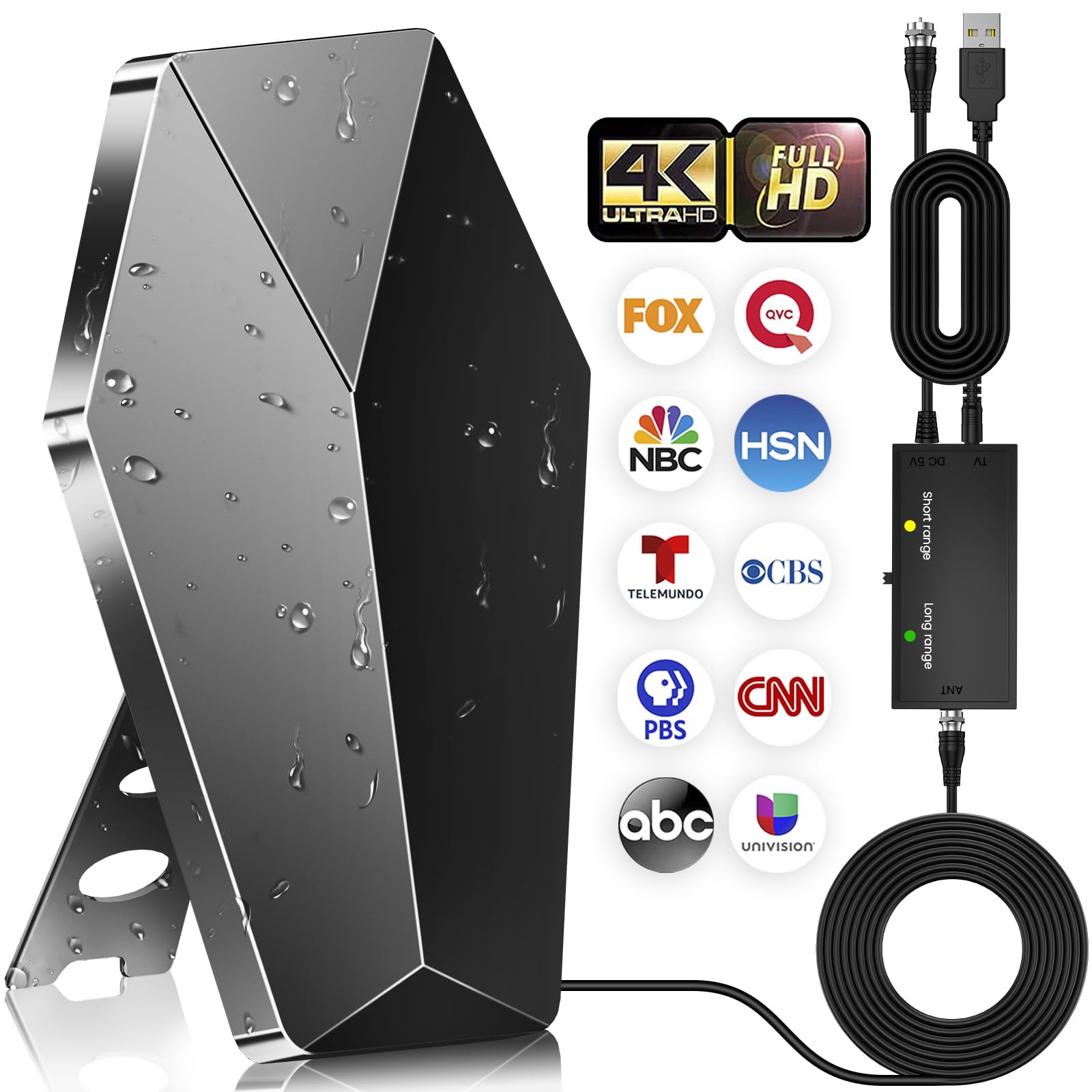
The Merpersom antenna is an entry-level amplified option that works best for indoor placement near a window or in a small house within 35 miles of broadcast towers. Its compact black housing measures roughly 10 by 3 by 20 inches and includes a 38-ft RG6 coaxial cable, giving you flexibility to position it high on a wall or shelf. The built-in Smart IC chip filters out 95% of cellular and FM interference, which helps reduce pixelation in urban environments dense with RF noise.
Setup takes under five minutes: stick the antenna to a wall or window using the included adhesive pads, connect the coax to your TV’s antenna port, and run a channel scan. Users report reliable reception of ABC, CBS, NBC, Fox, PBS, and Univision with clear 1080p and some 4K signals. The 5000+ mile range claim is pure marketing fiction—expect 30–50 miles under ideal line-of-sight conditions—but the antenna performs well within that realistic envelope.
The construction is lightweight and plastic, which makes it durable for indoor use but questionable for outdoor exposure. The amplifier is USB-powered, and the coaxial cable is permanently attached, so you cannot swap it for a different length. For apartments, RVs, or small houses where the nearest tower is within 35 miles, this antenna provides a completely cable-free TV experience at a minimal cost. It is not a directional antenna in the classic sense, but its multi-directional panel design can be aimed by rotating the entire unit.
Why it’s great
- Ultra-compact design mounts nearly anywhere indoors
- Smart IC chip filters out 95% of cellular and FM interference
- Five-minute setup with USB-powered amplifier
Good to know
- 5000+ mile range claim is false; expect 30–50 miles
- Coax cable is permanently attached; cannot be replaced or upgraded
- Plastic housing not durable for long-term outdoor use
7. Susbrothe 6000+ Miles TV Antenna
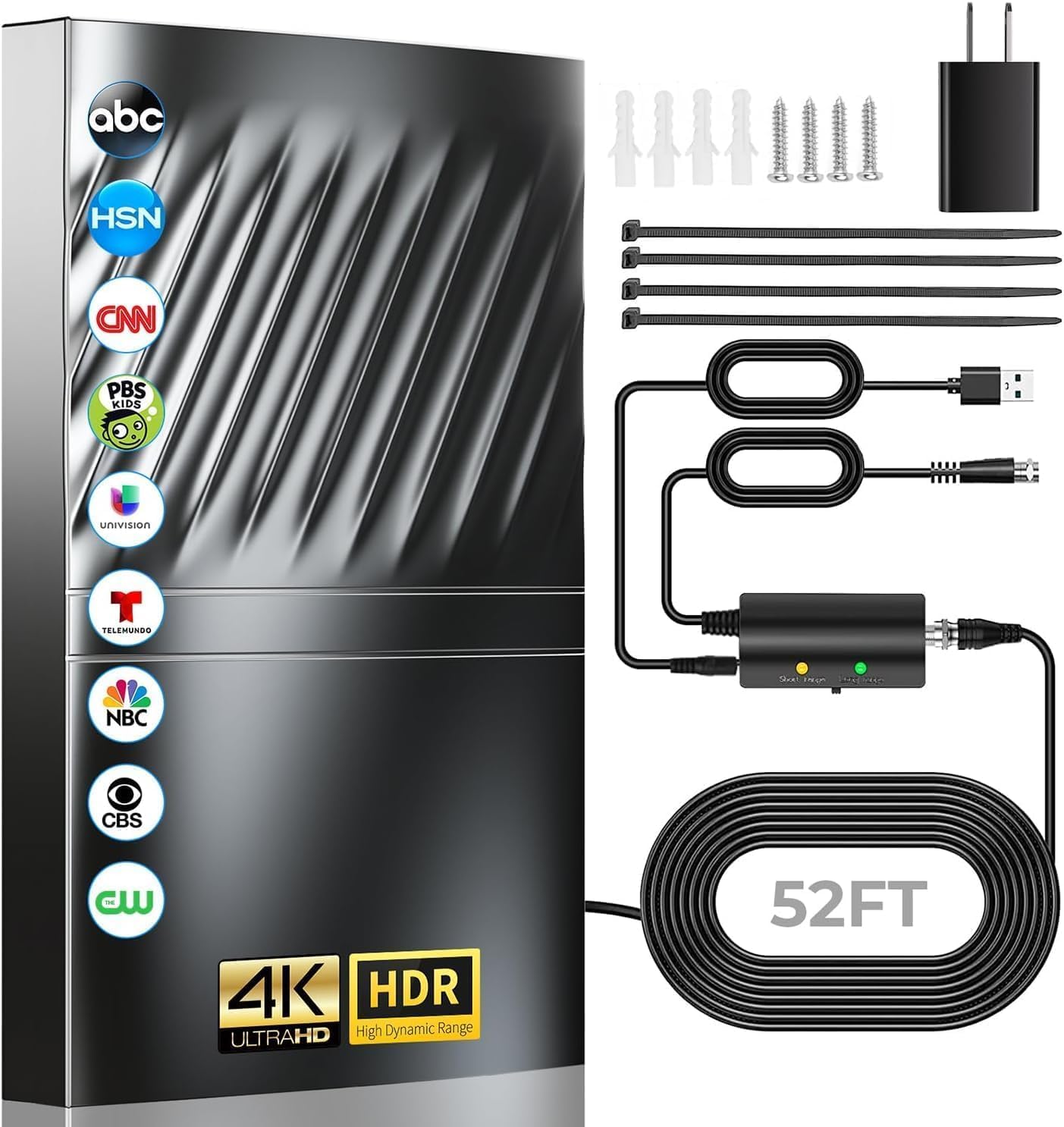
The Susbrothe antenna is another budget-tier option that differentiates itself with a 52-ft coaxial cable and a Smart Switch amplifier that toggles between short-range (under 35 miles) and long-range modes. This dual-mode amplifier prevents signal overload when towers are close and boosts gain when they are distant. The ultra-slim design—10.4 by 3 by 20 inches—allows it to fit behind a TV or on a window frame, and the included adhesive stickers and expansion screws support both indoor and outdoor mounts.
Real-world performance from reviewers is surprisingly solid for the price. Users in rural areas report picking up 46 channels indoors and over 50 outdoors, including all major networks. One reviewer across state lines received 100+ channels including out-of-market stations, though mileage will vary based on terrain. The amplifier is powered via USB, and the package includes an AC adapter for TVs without a USB port, ensuring the antenna stays active even when the TV is off if you run the scan separately.
The 6000+ mile rating is pure hype, but the physical antenna does benefit from the 52-ft coax, which lets you place it in an attic or high window far from the TV. The weatherproof housing is rated for outdoor use, but the adhesive stickers are indoor-only; outdoor installation requires the included screws. The signal amplifier has a physical switch, so you must access the unit itself to toggle modes—no remote control. For a low-cost entry into free OTA TV, this antenna delivers more usable reach than its marketing implies.
Why it’s great
- 52-ft coaxial cable offers long reach for optimal antenna placement
- Smart Switch amplifier prevents overload on nearby towers
- Includes AC power adapter for non-USB TVs
Good to know
- 6000+ mile claim is unsupported; realistic range is 30–60 miles
- Mode switch is on the unit itself, not remote-controllable
- Adhesive mount is indoor-only; screws required for outdoor install
FAQ
Can I use a directional indoor antenna for attic mounting?
Will a motorized rotator work with a Yagi antenna?
Why do I need a preamplifier if my antenna already has an amplifier?
Final Thoughts: The Verdict
For most users, the directional tv antenna winner is the PBD Amplified Outdoor TV Antenna because it combines a reliable motorized rotator, dual TV output, and ATSC 3.0 readiness at a price that beats premium competitors. If you want a fixed-mount Yagi with zero mechanical failure points, grab the Five Star Yagi Outdoor Antenna. And for a complete multi-TV distribution package with motorized rotation, nothing beats the Five Star Outdoor Digital Amplified HDTV Antenna.

Mo Maruf
I created WellFizz to bridge the gap between vague wellness advice and actionable solutions. My mission is simple: to decode the research and give you practical tools you can actually use.
Beyond the data, I am a passionate traveler. I believe that stepping away from the screen to explore new environments is essential for mental clarity and physical vitality.