Our readers keep the lights on and my smoothie glass nicely filled. As an Amazon Associate, I earn from qualifying purchases.
The core challenge with many at-home monitors is cuff fit and measurement technique, not the device’s electronics. Getting reliable data starts with choosing a monitor built to handle your specific arm size and measurement environment.
I’m Mohammad Maruf — the founder and writer behind WellFizz. My research for this guide involved cross-referencing clinical accuracy standards, analyzing over a thousand verified user reviews, and comparing the real-world performance of the top-selling upper arm monitors on the market.
This guide breaks down the five top-rated options and explains exactly how to match a monitor to your needs, helping you find a truly reliable device for blood pressure tracking at home.
How To Choose The Best Device For Blood Pressure
Choosing a home blood pressure monitor comes down to three variables: cuff range, data management, and display clarity. Most errors in home monitoring stem from a cuff that is too small or too large for the user’s arm, not from the device’s internal sensor. Prioritize a model that includes at least one cuff size that matches your measured upper arm circumference, or better yet, one that offers two cuff sizes for a perfect fit.
Cuff Size and Fit
A cuff that is too tight will artificially raise your systolic reading, while a cuff that is too loose will produce an unpredictably low number. Look for monitors that list the arm circumference range clearly in inches or centimeters. Models offering both a standard M/L cuff (roughly 9–17 inches) and an XL cuff (13–21 inches) cover the widest range of adult arm sizes and prevent the most common source of measurement error.
Memory and Multi-User Support
If you are tracking trends over weeks or sharing the monitor with a partner, the number of stored readings per user matters. Entry-level monitors often store 30–90 total readings, while mid-range and premium units can store 500–1000 per user. Separate user modes prevent your readings from mixing with a family member’s, making the data useful for your doctor.
Display and Feedback Features
A large, backlit LCD screen with color-coded WHO classification bars (green for normal, orange for elevated, red for high) lets you interpret your results instantly without cross-referencing a chart. This feature is especially helpful for older adults who may have limited vision or prefer a quick visual snapshot of their status.
Quick Comparison
On smaller screens, swipe sideways to see the full table.
| Model | Category | Best For | Key Spec | Amazon |
|---|---|---|---|---|
| AQESO Blood Pressure Machine | Premium Mid-Range | Family tracking with high memory | 1,000 total readings (500 per user) | Amazon |
| iHealth Track Smart Monitor | Premium | Smartphone app integration | Bluetooth 4.0 with iOS/Android app | Amazon |
| SDUNW Automatic Upper Arm Monitor | Mid-Range | Big arms and corded electric use | Dual cuffs: 9-17in & 13-21in | Amazon |
| COCACIS Blood Pressure Monitor | Mid-Range | Travel and seniors | Dual cuffs + 6-inch backlit display | Amazon |
| Medline Digital Blood Pressure Monitor | Budget | Simple single-user operation | Single cuff: 8.6-11.8in | Amazon |
In‑Depth Reviews
1. AQESO Blood Pressure Machine

The AQESO monitor uses oscillometric technology to deliver fast, consistent readings, and it is the only model in this group that stores up to 500 readings per user across two users. That 1,000-reading total memory makes it the strongest option for a couple or two family members who want to track trends over several months without ever clearing the device.
It includes both an M/L cuff (9–17 inches) and an XL cuff (13–21 inches), covering essentially all adult arm sizes. The large backlit LCD displays a clear WHO classification bar, so you instantly know where your reading lands. The one-touch automatic inflation keeps operation simple for elderly users, and the dual power supply (4 AAA batteries or USB Type-C) gives you flexibility at home or on the road.
Users consistently praise its accuracy when compared against a manual reading, and the included carry case makes it easy to take to doctor’s appointments. The only minor trade-off is that the monitor is not rechargeable—it requires a continuous USB connection when not using batteries. For a family-focused machine with massive storage, this is the top pick.
Why it’s great
- 1,000 total reading memory split between two users
- Two cuff sizes cover 9–21 inch arms
- Large backlit LCD with WHO color bar
Good to know
- USB connection requires constant power source; not rechargeable
- Some users report the XL cuff feels snug on very large arms
2. iHealth Track Smart Upper Arm Monitor
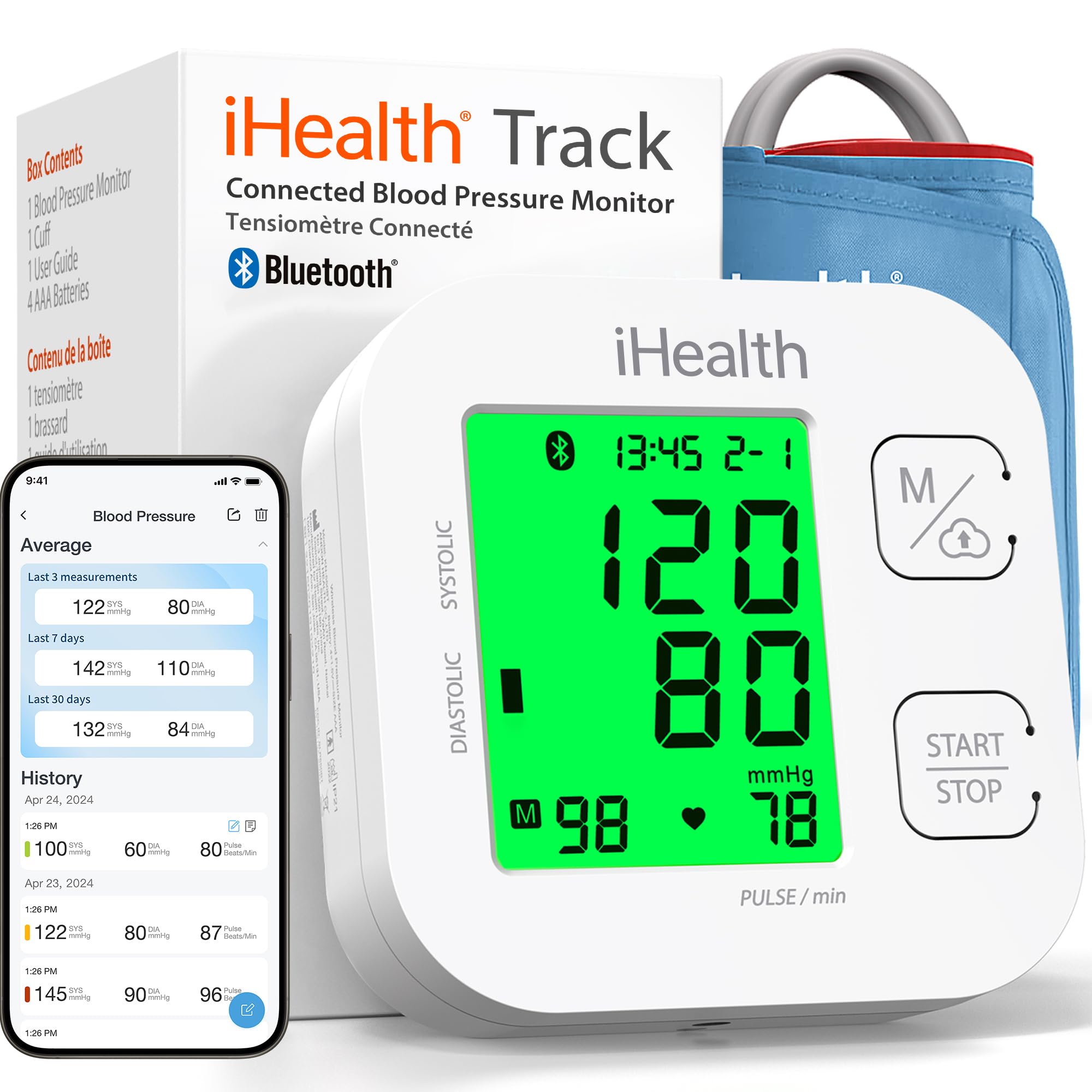
The iHealth Track is the only monitor here that fully integrates with a smartphone app, syncing readings via Bluetooth 4.0 to both iOS and Android devices. The iHealth app manages unlimited readings and can export data to Apple Health, making it the strongest choice for anyone who wants to share longitudinal trends with their physician without manual logging.
It meets ESH 2010 performance standards and automatically alerts you to heart rhythm disturbances, displaying a warning symbol after measurement if an irregularity is detected. The large multi-color backlit display uses a green/yellow/red coded system for instant interpretation, and the oversized numbers are exceptionally easy to read at a distance. The wide-range cuff fits arms from 8.7 to 16.5 inches, covering standard and large adult arms.
Many users report readings that match closely with their doctor’s office equipment, and the simple two-button operation requires no calibration. The main limitation is that the app contains ads, which some users find annoying enough to skip app logging entirely and rely on the on-board 99-reading memory. If Bluetooth tracking matters to you, this is the unit to get.
Why it’s great
- Bluetooth sync with iOS/Android and Apple Health
- ESH 2010 clinical accuracy certification
- Heart rhythm disturbance detection
Good to know
- Free app includes persistent ads
- No travel case included; uses AAA batteries only
3. SDUNW Automatic Upper Arm Monitor
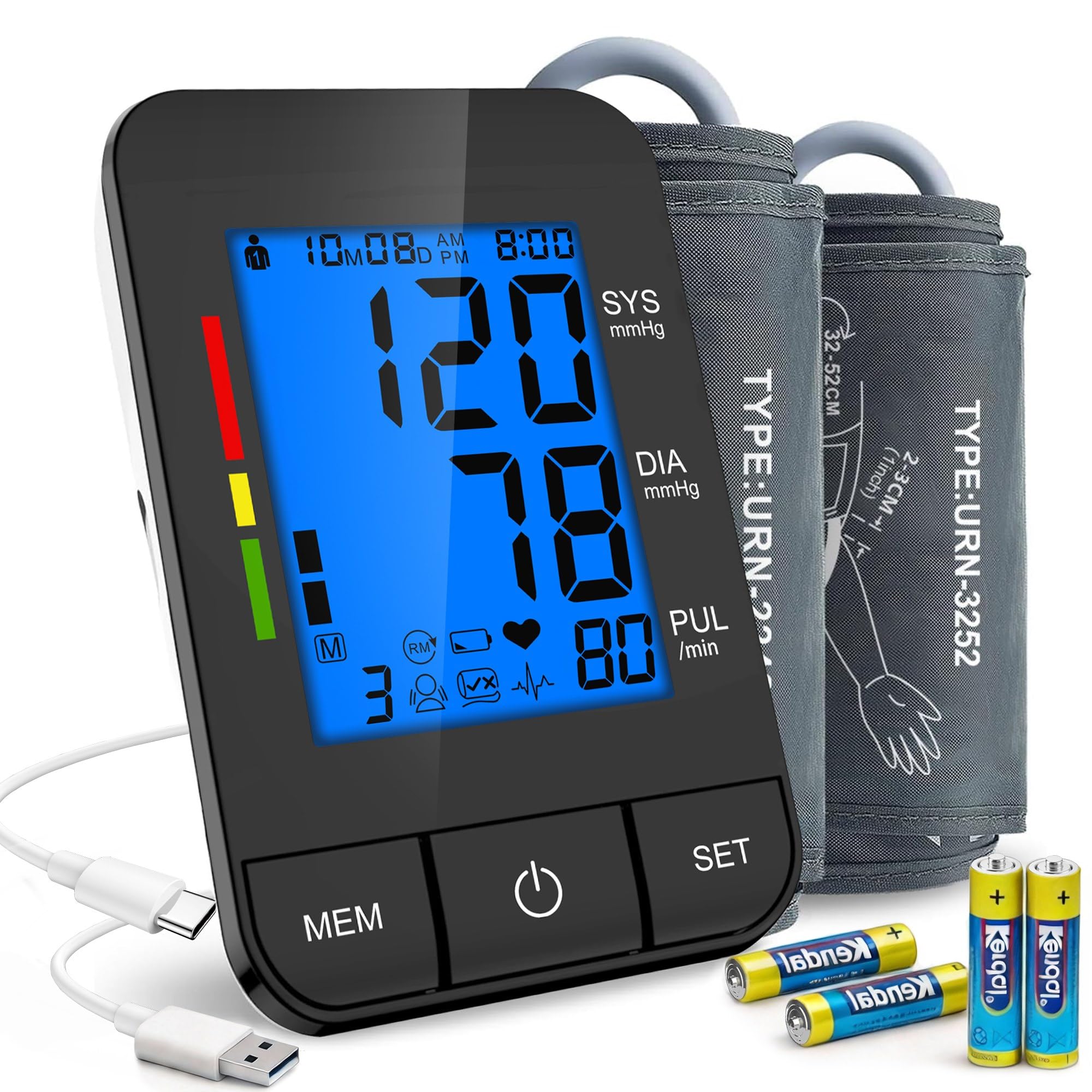
The SDUNW monitor focuses on solving two specific problems: big arms and measurement errors caused by user mistakes. It comes with an XL cuff that fits 13–21 inches and a standard M/L cuff for 9–17 inches, ensuring that users with larger biceps get a proper seal without pinching. The 2.95mm thick air tube is 80% thicker than the industry average, which prevents air leaks mid-measurement and helps maintain consistent inflation pressure across repeated readings.
Its 5-in-1 smart alert system catches common errors like incorrect cuff wear, movement during measurement, and low battery. The one-touch quiet inflation takes about 30 seconds, and the monitor stores 90 readings per user for two users. The WHO color-coded classification appears on the display, and you can power it via 4 AAA batteries (rated for 499+ readings) or a Type-C cable for corded use.
Customer reviews highlight that the unit feels durable and the cuffs are odor-free and comfortable for daily use. The kit includes both cuffs, batteries, a USB cable, and a manual. The only downside is that the backlit display, while clear, is not as large as the 6-inch screen found on some competing models. For heavy-built users or anyone who wants robust error prevention, this is a strong mid-range option.
Why it’s great
- Dual cuffs with genuine XL range up to 21 inches
- Heavy-duty 2.95mm air tube prevents leaks
- 5-in-1 smart alerts for user error
Good to know
- Display is functional but smaller than some competitors
- Requires very still posture for best accuracy
4. COCACIS Blood Pressure Monitor
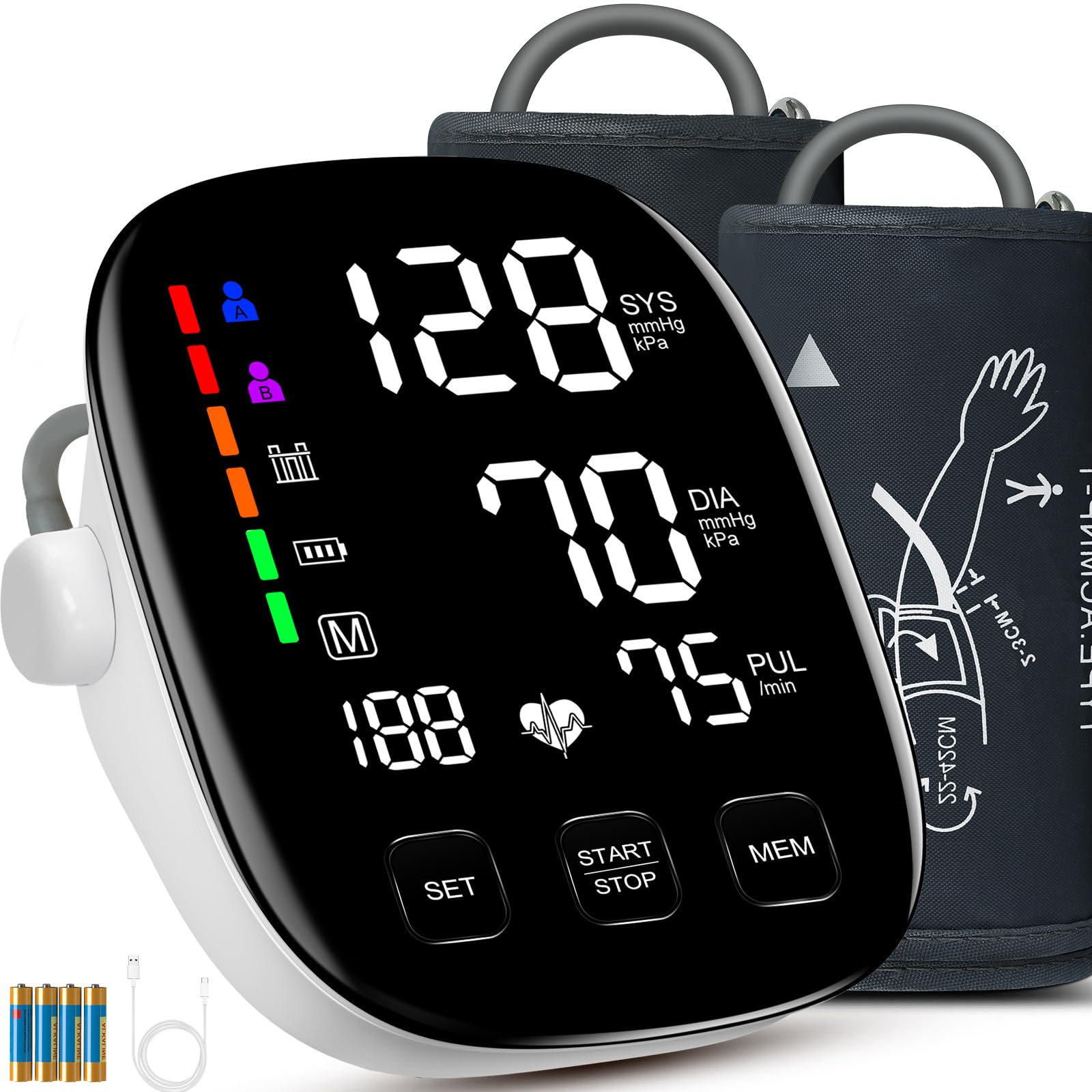
The COCACIS monitor stands out for its 6-inch HD backlit color display, which is the largest screen among the monitors reviewed here. The oversized numbers and large operation buttons make it the best choice for older adults or anyone with vision concerns. The color-coded WHO indicator sits prominently in the upper right corner of the screen, giving an immediate green (normal), orange (mild), or red (high) status.
It includes two adjustable cuffs: a standard M/L cuff (9–17 inches) and an XL cuff (13–21 inches), plus a nylon carry bag for storage and travel. The dual power model works with 4 AAA batteries or the included Type-C charging cable, so you can measure at home or on the go without worrying about battery life mid-trip. It stores 199 readings per user across two users, which is sufficient for a month of twice-daily tracking.
Users report that readings match closely with manual measurements when the cuff is applied correctly, and the lifetime customer support adds peace of mind. One reviewer initially got error codes but found that proper cuff placement resolved the issue. The battery life is adequate, though some users wish it lasted longer with frequent use. For a bright, senior-friendly screen and a complete travel kit, this monitor delivers excellent value.
Why it’s great
- 6-inch backlit screen with oversized fonts
- Includes both M/L and XL cuffs plus carry bag
- Dual power: batteries and USB Type-C
Good to know
- Battery life is average; may need replacement every few months
- Cuff position is critical to avoid error codes
5. Medline Digital Blood Pressure Monitor

Medline is a well-known name in medical-grade supplies, and this monitor reflects that reputation with consistent, clinically reliable readings. It uses a single adult cuff that fits arms from 8.6 to 11.8 inches (22–30 cm), which is suitable for average-sized adults but will not accommodate larger upper arms. The digital LCD display shows systolic, diastolic, and pulse readings clearly, with a colored scale beside the screen for interpretation.
The push-button inflation provides customized inflation levels per reading, and advanced error detection helps ensure you get reliable results. It stores up to 90 measurements per user for two users, which is enough for about a month of twice-daily tracking. The unit comes with 4 AA batteries and a one-year warranty, and the battery life is among the best in this group—many users report months of use without a change.
Customer reviews frequently note that readings match closely with doctor’s office equipment, and the simple interface makes it very easy to operate. The single cuff size is a clear limitation for people with arm circumferences over 12 inches, and the display is not backlit, making it harder to read in low light. For a straightforward, no-frills monitor trusted by healthcare facilities, this is a solid entry-level pick.
Why it’s great
- Medical-grade brand with proven accuracy
- Excellent battery life on 4 AA batteries
- Simple one-button operation with error detection
Good to know
- Single cuff fits only 8.6–11.8 inch arms
- No backlight on the display
FAQ
How do I know which arm cuff size I need?
Can I use a blood pressure monitor if I have an irregular heartbeat?
How often should I replace my home blood pressure monitor?
Final Thoughts: The Verdict
For most users, the device for blood pressure winner is the AQESO Blood Pressure Machine because it combines dual cuff sizes for universal fit, a massive 1,000-reading memory for family use, and a clear backlit display with WHO color coding. If you want Bluetooth smartphone integration and heart rhythm detection, grab the iHealth Track Smart Monitor. And for a budget-friendly option that’s simple and clinically trusted, nothing beats the Medline Digital Blood Pressure Monitor.

Mo Maruf
I created WellFizz to bridge the gap between vague wellness advice and actionable solutions. My mission is simple: to decode the research and give you practical tools you can actually use.
Beyond the data, I am a passionate traveler. I believe that stepping away from the screen to explore new environments is essential for mental clarity and physical vitality.