Our readers keep the lights on and my smoothie glass nicely filled. As an Amazon Associate, I earn from qualifying purchases.
Nothing kills a great descent faster than a warped rotor that turns your brake lever into a pulse generator. When the braking surface goes out of true, you lose modulation, accumulate heat spots, and start second-guessing every corner. For serious mountain bikers, the rotor is the unsung hero of the stopping system—it has to shed heat, stay perfectly flat, and pair seamlessly with your pads.
I’m Mohammad Maruf — the founder and writer behind WellFizz. I’ve spent hundreds of hours cross-referencing technical specs, analyzing customer reliability data, and comparing heat dissipation metrics across the most talked-about rotors on the market to bring you this guide.
This deep-dive comparison of the best mtb disc brake rotors breaks down material composition, thickness tolerance, and real-world durability so you can pick the perfect match for your riding style and brake setup.
How To Choose The Best MTB Disc Brake Rotors
Picking the wrong rotor is the fastest way to ruin a high-end brake system. A rotor that is too thin will warp under prolonged braking, while an incompatible mounting type locks you out of wheel swaps. Focus on four non-negotiable factors before you buy.
Mounting Standard: 6-Bolt vs. CenterLock
6-bolt rotors use six small bolts threaded into the hub flange. This system is universal—almost every hub on the market supports it, and loosening a warped rotor trailside is possible with a single multi-tool. CenterLock uses a splined interface and a lockring, making rotor swaps tool-free but hub-specific. If you swap wheelsets frequently or run a modern Shimano hub, CenterLock saves time. For maximal hub compatibility and field serviceability, 6-bolt wins.
Rotor Thickness and Material
Most mountain bike rotors measure between 1.8mm and 2.3mm thick. Thinner rotors weigh less but are more prone to heat-induced warping during long descents. Stainless steel is the standard for the braking surface because it resists corrosion and dissipates heat moderately well. Premium designs use a two-piece construction—an aluminum center spider to shed weight paired with a stainless steel braking track to maintain thermal stability and true running.
Diameter Selection and Heat Management
Common diameters are 160mm, 180mm, and 203mm. Larger rotors provide more leverage and better heat capacity, which reduces brake fade on steep, sustained descents. Smaller rotors suit cross-country and lighter riders. A 180mm front and 160mm rear is a versatile all-mountain setup. Aggressive enduro or heavy riders should consider 203mm front to prevent the rotor from becoming a glowing heat sink.
Pad Compatibility
Some rotors are explicitly designed for resin (organic) pads only. Resin pads offer quiet braking and good modulation but wear faster and overheat quicker. Sintered (metallic) pads generate more heat and require a rotor surface that can handle higher thermal loads without glazing. If you plan to run metallic pads for wet-weather power, choose a rotor rated for both pad types. Mixing pad types on unrated rotors can cause rapid wear or uneven braking feel.
Quick Comparison
On smaller screens, swipe sideways to see the full table.
| Model | Category | Best For | Key Spec | Amazon |
|---|---|---|---|---|
| Galfer MTB Disc Wave 180mm | Premium | Outstanding fade resistance & true running | 180mm stainless steel, 1.8mm thickness | Amazon |
| Shimano SM-RT56 6-Bolt 180mm | Mid-Range | Reliable Shimano quality for resin pads | 180mm, stainless steel, resin-pad only | Amazon |
| Sram Centerline Rounded 140mm | Premium | Consistent friction & quiet running | 140mm aluminum, CenterLine design | Amazon |
| Magura Storm HC 180mm | Mid-Range | Durable steel, works with various calipers | 180mm steel, 2.0mm thickness | Amazon |
| Shimano RT10 CenterLock 160mm | Entry-Level | Budget-friendly CenterLock replacement | 160mm stainless steel, CenterLock | Amazon |
| JKSPORTS MT200 Disc Brake Set | Budget | Complete pre-bled hydraulic system upgrade | Includes 2 rotors, calipers, levers, hoses | Amazon |
| RUJOI Bike Disc Brake Kit | Budget | Full mechanical brake system replacement | 160mm rotors, includes calipers & levers | Amazon |
In‑Depth Reviews
1. Galfer MTB Disc Wave 180mm
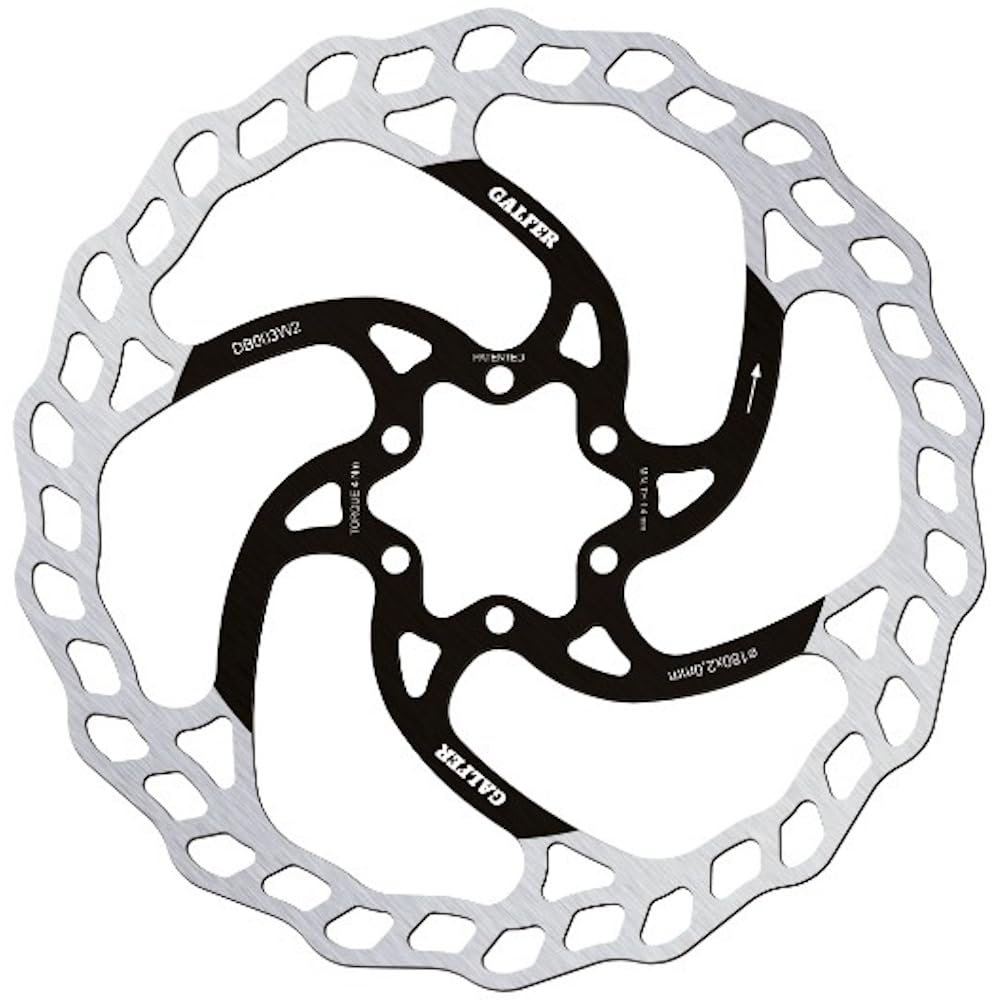
The Galfer Wave rotor uses a fully stainless steel braking surface paired with an aggressively waved outer edge design that sheds heat more efficiently than a plain round disc. At 180mm diameter and 1.8mm thickness, it strikes a strong balance between weight savings and thermal capacity for all-mountain and trail riding. Owners report zero warping even after a thousand-plus miles of aggressive riding, which speaks directly to the material stability and manufacturing tolerances.
The 6-bolt mounting pattern means it fits virtually any mountain bike hub, and Galfer includes six pre-Loctite Allen bolts so you do not need to chase threadlocker at installation. Customers coming from larger 203mm rotors noted minimal braking power loss when downsizing to this 180mm version, proving that rotor quality matters more than sheer diameter. The waved profile also reduces pad glazing by constantly wiping the pad surface.
Where the Galfer excels is fade resistance under sustained loads. Riders exceeding 250 pounds reported that the rotor practically eliminated brake fade on long descents, a claim backed by multiple verified reviews citing zero performance degradation during extended braking. The only caveat is that the wavy edge can create a slight pulsing feel if your pads are not fully bedded, but this disappears after a proper break-in procedure.
Why it’s great
- Exceptional warp resistance over long miles
- Includes pre-Loctite bolts for simple install
- Waved design aids heat dissipation and reduces glazing
Good to know
- Premium price compared to standard steel rotors
- Wavy edge requires thorough pad bedding to avoid initial pulsing
2. Shimano SM-RT56 6-Bolt 180mm

The Shimano SM-RT56 is the benchmark for resin-only rotors in the mid-range tier. It uses a stainless steel braking surface with a black anodized finish that resists cosmetic corrosion well. The rotor ships with an anti-loosen plate integrated into the bolts, a small but meaningful detail that prevents bolts backing out under vibration—a common failure point on cheaper rotors that use standard hardware.
At 180mm, this rotor pairs naturally with Shimano Deore and SLX-level brakes. The braking surface is smooth and free of burs, and owners report the rotor arrives true out of the box with zero lateral runout. After bedding, users noted silent operation with no squeak or vibration, even on a rigid 29er setup with mechanical calipers. The rotor thickness is consistent with Shimano’s 1.8mm standard, which keeps weight manageable without sacrificing stiffness.
The major limitation is pad compatibility. Shimano explicitly states this rotor is for resin pads only. Running sintered pads will accelerate wear and can cause the braking surface to glaze. If you ride in wet or muddy conditions where metallic pads give better bite, you will need to step up to a rotor rated for both pad types. For dry-weather trail riders who prioritize quiet, predictable stopping, this rotor delivers exactly that.
Why it’s great
- Arrives true and well-finished out of the box
- Anti-loosen bolts prevent hardware failures
- Silent, vibration-free braking after proper bedding
Good to know
- Resin pads only—no sintered pad compatibility
- Not the lightest rotor in its size class
3. Sram Centerline Rounded 140mm
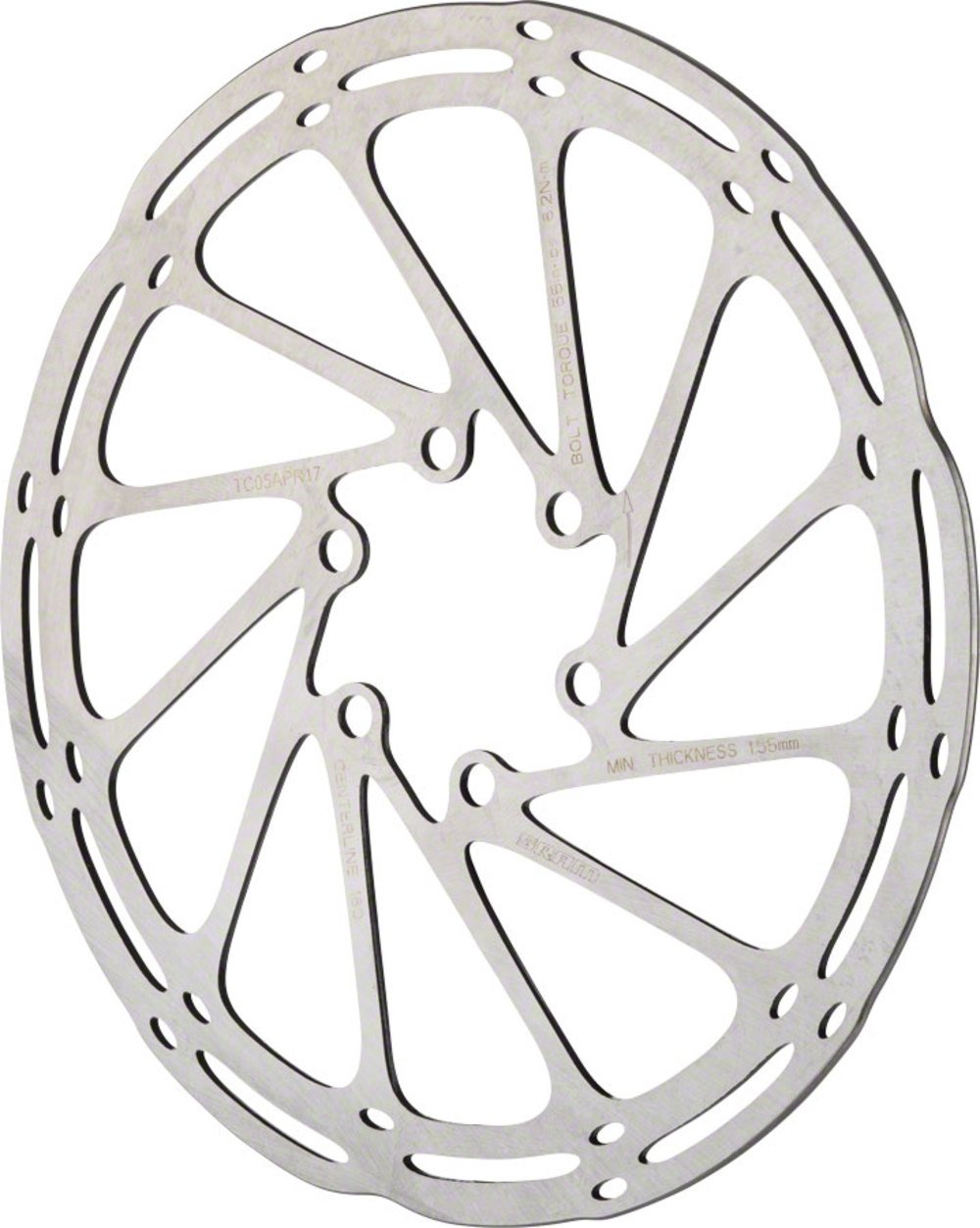
Sram’s Centerline rotor uses a two-piece construction with an aluminum spider and a stainless steel braking surface, saving noticeable weight compared to a full-steel rotor of the same size. The 140mm diameter is a niche choice—best suited for cross-country bikes, rear-only use on trail bikes, or lightweight builds where every gram counts. The rounded CenterLine pattern is designed to keep the center of friction consistent across the entire rotation, which minimizes vibration and keeps the braking feel predictable.
Verified buyers consistently report that these rotors run exceptionally true. Multiple reviews mention zero lateral runout out of the box, and the laser-etched branding confirms genuine Sram manufacturing. When paired with Sram Level or Avid BB7 calipers, the CenterLine rotor delivers a quiet braking experience with no squeal after bedding. The 140mm size is particularly useful for upgrading a rear wheel where braking torque demand is lower, shaving rotational mass without compromising modulation.
The main trade-off is that the 140mm diameter limits heat capacity. It is not suited for aggressive enduro or heavy riders on steep terrain, as the smaller surface area will heat up faster and can cause fade. Additionally, some users with Avid BB7 calipers reported a 2-3mm pad overhang past the rotor edge at low spoke count, which occasionally caused a minor pulsation at low speeds. For cross-country and light trail riders who want a smooth, consistent rotor, this is a top pick.
Why it’s great
- Lightweight aluminum spider reduces rotational mass
- CenterLine pattern provides quiet, vibration-free braking
- Arrives flat and true with genuine Sram packaging
Good to know
- 140mm size limits heat capacity for aggressive riding
- May cause pad overhang pulsation with certain calipers
4. Magura Storm HC 180mm

The Magura Storm HC rotor is a full-steel 6-bolt rotor that measures 2.0mm thick—0.2mm thicker than many standard rotors. That extra thickness translates directly into better heat absorption and resistance to warping under prolonged braking. The rotor is available in 160mm, 180mm, and 203mm diameters, giving you options across the entire mountain bike spectrum. At 180mm, the claimed weight is 148 grams, which is competitive for a steel rotor of this thickness.
Compatibility is broader than the Magura branding suggests. Owners have successfully paired this rotor with Shimano Deore and SLX brakes, as well as Hayes Dominion calipers. The 2.0mm thickness sits within the usable range for most brake pad retraction systems, so caliper clearance is rarely an issue. Users report that the rotor runs quiet and smooth, with zero noise even after hard trail miles. One customer who tacoed an older Hayes 203mm rotor found the Magura significantly sturdier in side-load tests.
The only downside reported is packaging. Several buyers received the rotor in a simple plastic bag with screws but no box, and one unit arrived with a very slight bend that was either incurred during shipping or present from the factory—though that same user noted the rotor was durable enough to likely straighten on a truing stand. For riders prioritizing durability and heat management over marginal weight savings, the Storm HC is a solid choice.
Why it’s great
- 2.0mm thickness offers excellent warp resistance
- Compatible with Shimano, Hayes, and other calipers
- Silent operation after proper bedding
Good to know
- Packaging can be inconsistent—sometimes shipped in a bag
- Heavier than two-piece aluminum-spider designs
5. Shimano RT10 CenterLock 160mm

The Shimano RT10 is the entry-level CenterLock rotor that ships on countless stock bikes. It is a simple one-piece stainless steel rotor with no floating hardware or complex heat treatments, but it does exactly what a budget rotor should—stop the bike reliably without creaking or vibrating. The 160mm diameter is standard for cross-country and recreational mountain biking, and the CenterLock interface means installation requires only a lockring tool.
Owners praise the rotor for arriving true and clean, with the necessary lockring included in the package. It is slightly heavier than premium CenterLock options, but at this price point the weight penalty is acceptable. Multiple customers used it successfully to diagnose caliper issues, noting that swapping to a known-good rotor pinpointed their sticky piston problem immediately. The stainless steel surface works fine with resin pads and, in a pinch, can handle light use with sintered pads—though Shimano recommends resin for this model.
The downside is that the RT10 is not built for thermal abuse. On long descents or with heavy riders, the 1.8mm thickness can heat up quickly, potentially leading to rotor warp over time. It also lacks any anti-corrosion coating beyond the natural stainless finish, so riders in salty or coastal climates may see surface rust spots develop. For a simple, cheap replacement that keeps a backup bike rolling, the RT10 gets the job done without fuss.
Why it’s great
- Affordable CenterLock option with genuine Shimano quality
- Arrives true and includes the lockring
- Works as a reliable diagnostic tool for brake issues
Good to know
- Heavier than premium CenterLock rotors
- Limited thermal capacity, prone to warp under hard use
6. JKSPORTS OEM BR MT200 Hydraulic Disc Brake Set

The JKSPORTS kit delivers genuine Shimano MT200 hydraulic brakes—calipers, levers, pre-bled hoses, and rotors—all in one box. The included rotors are standard 160mm stainless steel discs that pair with the BR-MT200 calipers out of the box. The pre-bled hoses measure 800mm for the front and 1450mm for the rear, which fits most full-suspension and hardtail mountain bikes without needing to shorten or re-bleed the lines.
Verified users consistently describe the install as straightforward, with the pre-bled system cutting down setup time significantly compared to buying individual components. The MT200 brakes deliver smooth, predictable modulation that rivals higher-end Shimano XT brakes in feel, though peak stopping power is slightly lower. Customers who replaced failing Sram or Avid hydraulic brakes found the JKSPORTS kit bolted directly on with minimal adjustment and have run it for months without issues.
The exact rotor specs in this kit are basic, but they are matched perfectly to the MT200 calipers. The main limitation is that the included 160mm rotors may feel undersized for aggressive riding or heavier riders. Additionally, the kit does not include extra barbs or olives, so if you need to shorten or re-route the hoses internally through your frame, you will need to purchase those fittings separately. For a drop-in replacement or budget bike upgrade, this kit offers exceptional value.
Why it’s great
- Complete pre-bled hydraulic system ready to install
- Shimano MT200 calipers offer smooth modulation
- Cost-effective alternative to rebuilding old brakes
Good to know
- Basic rotors may lack thermal capacity for aggressive descents
- No extra barbs or olives for hose shortening
7. RUJOI Bike Disc Brake Kit

The RUJOI kit is a complete mechanical disc brake system including front and rear calipers, levers, cables, and two 160mm stainless steel rotors. The standout feature is the tool-free pad adjuster—a twist dial on the caliper that brings the pads closer to the rotor without needing a hex wrench. This is a genuine convenience for riders who want quick on-trail adjustments without carrying extra tools.
Customer experiences vary. Some users successfully replaced hydraulic brakes on budget ebikes with this kit and found the stopping power adequate for casual riding. Others noted that while the rotors function, the calipers have a squishy lever feel compared to even entry-level hydraulic systems. The included cables are pre-cut and work for typical frame routing, though the instructions are minimal. Several buyers emphasized that installation is not truly tool-free—you still need a hex set for lever clamping and caliper alignment.
The main drawbacks are quality control on the hardware. Multiple reviews mention that the pad adjuster threads stripped almost immediately, though the adjuster is not strictly necessary once pads are set. The braking performance is rim-brake equivalent, not hydraulic-grade, making this kit best for town cruisers, kids’ bikes, or emergency replacements rather than serious trail bikes. For the price of a single premium rotor, you get a full brake system—acceptable for low-demand applications.
Why it’s great
- Complete mechanical system includes rotors, calipers, levers, cables
- Tool-free pad adjuster simplifies on-trail tweaks
- Affordable way to convert a rim-brake bike to disc
Good to know
- Braking feel is squishy, not as crisp as hydraulics
- Pad adjuster hardware can strip easily
- Poor stopping power in wet conditions or on steep trails
FAQ
What causes a rotor to warp and how can I prevent it?
Can I run a 180mm rotor on my 160mm brake caliper?
How do I properly bed in new rotors with existing pads?
Is it safe to use a slightly bent rotor if I can true it with a wrench?
Final Thoughts: The Verdict
For most riders, the best mtb disc brake rotors winner is the Galfer MTB Disc Wave 180mm because it combines warp resistance, excellent heat dissipation, and reliable true running over thousands of miles in a 6-bolt format that fits any hub. If you want a quiet, lightweight rotor for cross-country or recreational riding, grab the Sram Centerline Rounded. And for a complete hydraulic system upgrade that simplifies your build, nothing beats the JKSPORTS MT200 Disc Brake Set.

Mo Maruf
I created WellFizz to bridge the gap between vague wellness advice and actionable solutions. My mission is simple: to decode the research and give you practical tools you can actually use.
Beyond the data, I am a passionate traveler. I believe that stepping away from the screen to explore new environments is essential for mental clarity and physical vitality.