Our readers keep the lights on and my smoothie glass nicely filled. As an Amazon Associate, I earn from qualifying purchases.
DLP and MSLA printers are the standard for high-resolution 3D printing, turning digital models into solid objects layer by layer with a light source that cures liquid resin. Getting the best results means choosing a machine that balances XY resolution, build volume, and reliable mechanics to avoid wasted time and material.
I’m Mohammad Maruf — the founder and writer behind WellFizz. I’ve spent countless hours analyzing printer specs, reading through thousands of user experiences, and comparing the hardware details that separate a reliable tool from a frustrating one.
Whether you are casting jewelry patterns, printing dental models, or producing tabletop miniatures, you need a machine that delivers sharp edges every time. This guide walks through nine models to help you find the best dlp 3d printer for your specific workflow.
How To Choose The Best DLP 3D Printer
Selecting a resin printer requires looking beyond the headline resolution number. The build plate size, light source technology, and support ecosystem all determine whether your prints succeed consistently.
Resolution and Pixel Size
The XY resolution, measured in microns, defines how small a detail the printer can reproduce. A 22-micron pixel captures fine textures on miniatures, while a 43-micron pixel at a larger build plate is sufficient for bigger objects like dental models. The 14K and 16K screens offer extremely fine pixel grids, but only matter if your prints actually need that level of detail.
Build Volume and Footprint
Smaller printers like the 6-inch class save desk space but limit you to single miniatures. Mid-size options around 8.6 inches handle multiple models in one batch. Professional units with 12-inch plates are meant for production but require dedicated bench space and weigh over 50 pounds.
Light Source Uniformity
COB (Chip on Board) light sources paired with Fresnel lenses spread UV light evenly across the screen. A uniformity rating above 90 percent ensures that every part of the build plate receives the same exposure, preventing dimensional errors and failed corners. Printers with stray light control below 3 degrees produce cleaner edges.
Release Film and Print Speed
Standard FEP film works for most resins but creates suction that slows printing. ACF (All-Cutter Fluoropolymer) film reduces release force and enables speeds above 120 mm per hour. Faster printing reduces each layer cycle but requires dialing in exposure times to avoid failed models with thin supports.
Quick Comparison
On smaller screens, swipe sideways to see the full table.
| Model | Category | Best For | Key Spec | Amazon |
|---|---|---|---|---|
| Bambu Lab P1S | FDM | Fast multi-color | 500 mm/s speed | Amazon |
| Creality K2 Pro Combo | FDM | Large multi-color | 300 mm³ volume | Amazon |
| Phrozen Sonic Mega 8K S | MSLA | High-volume pro | 12.9 x 7.2 in plate | Amazon |
| Anycubic Photon Mono M7 Pro | MSLA | Heated resin vat | 14K resolution | Amazon |
| Creality Halot-X1 Combo | MSLA | Auto resin feed | 16K LCD 14×19 μm | Amazon |
| Elegoo Saturn 3 | MSLA | Large volume value | 12K 10-inch LCD | Amazon |
| Elegoo Mars 5 Ultra | MSLA | AI-assisted printing | 150 mm/h speed | Amazon |
| Anycubic Photon Mono 4 Ultra | MSLA | Affordable precision | 10K 7-inch screen | Amazon |
| Phrozen Sonic Mini 8K S | MSLA | Beginner reliability | 22 μm XY resolution | Amazon |
In‑Depth Reviews
1. Bambu Lab P1S 3D Printer

The P1S is a fully enclosed FDM printer, not a resin-based DLP machine. It reaches 500 mm per second with 20,000 mm/s² acceleration and supports up to 16 colors using the optional AMS system. The 260 mm³ build volume handles helmets and large prototypes without needing to split models.
Setup takes under 30 minutes, and the auto-leveling bed compensates before every print. Users report consistent adhesion and sharp layer lines from PLA, PETG, and ABS. The enclosed design stabilizes the chamber temperature for advanced materials like ASA, though TPU requires some trial and error with retraction settings.
Bambu Studio streamlines slicing on the desktop, and the integrated camera lets you monitor progress remotely. The machine is louder than the X1 Carbon but quieter than typical open-frame printers. If your work requires multi-color FDM output with minimal tweaking, the P1S delivers professional speed out of the box.
Why it’s great
- Exceptional speed and consistency for FDM
- Enclosed chamber supports engineering filaments
- Multi-color printing with AMS expands creative options
Good to know
- AMS sold separately adds cost
- Not a resin printer; cannot match DLP surface finish
2. Creality K2 Pro Combo (A) 3D Printer
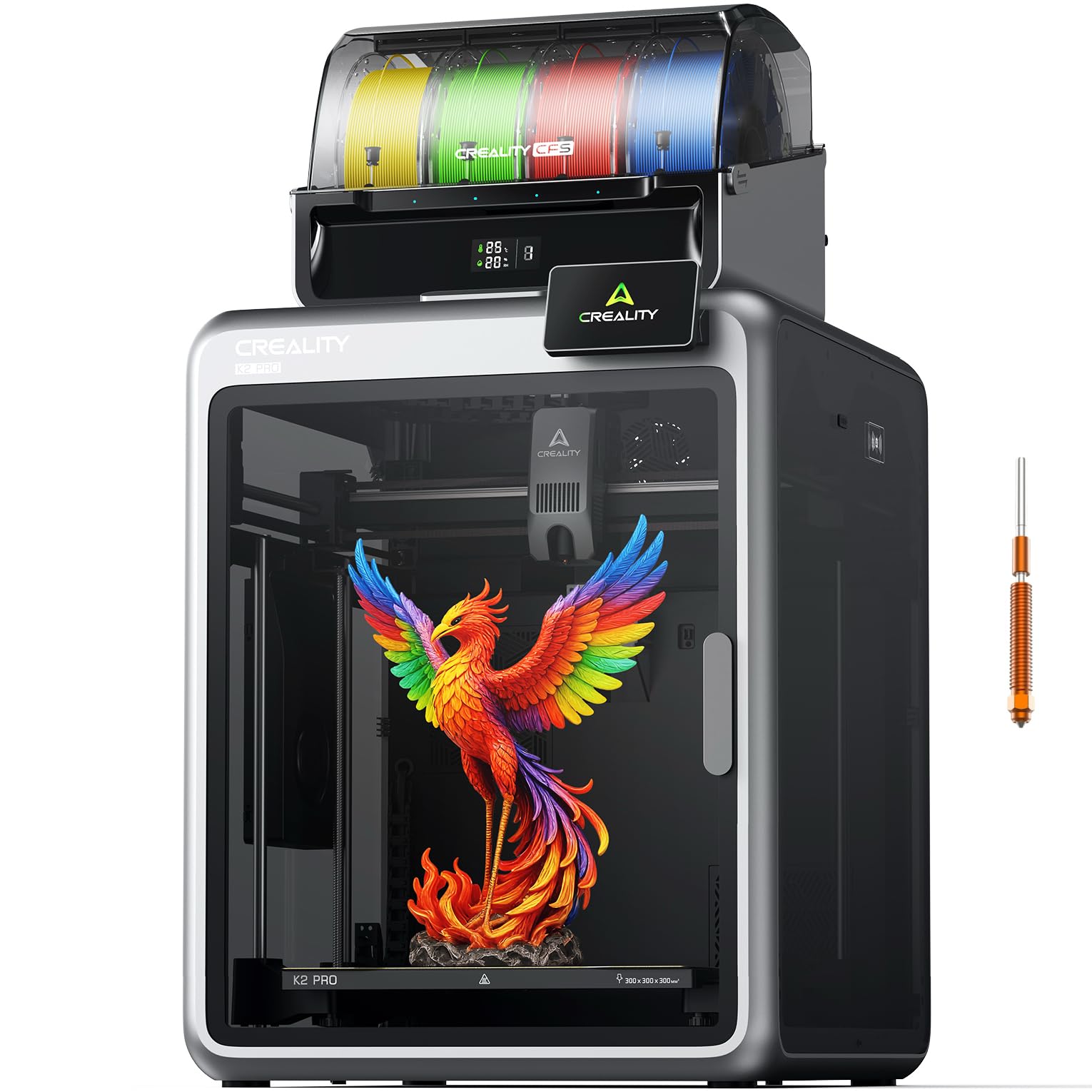
The K2 Pro Combo features a 300 mm cubed build volume, an exoskeleton frame made from aerospace-grade aluminum, and a high-flow hotend rated for 40 mm³ per second. It prints at up to 600 mm per second with 20,000 mm/s² acceleration, driven by FOC step-servo motors that keep noise levels low.
Dual AI cameras monitor the chamber and nozzle in real time, checking for extrusion errors, blockages, and bed readiness. The auto-leveling system probes only the target print area, reducing setup time significantly. Chamber heating up to 60 °C stabilizes ABS and PPA-CF for reduced warping across large prints.
The CFS unit provides auto-filament switching for up to four colors per unit, and the moisture-proof storage keeps spools dry. Users note that the included nozzle kit and hardened steel extruder handle abrasive filaments well. The machine is heavy at 85 pounds, so plan for a permanent workstation.
Why it’s great
- Massive build volume for single large prints or batches
- Dual AI cameras catch failures during long jobs
- Chamber heating enables reliable ABS and ASA output
Good to know
- Heavy footprint requires dedicated space
- Some reports of clogging after extended use
3. Phrozen Sonic Mega 8K S LCD/MSLA Resin 3D Printer

The Sonic Mega 8K S is built for production, with a 15-inch monochrome LCD that delivers 43-micron XY resolution across a 12.99 by 7.28 inch build plate. It prints 80 miniatures in a single batch under 90 minutes when paired with Phrozen TR300 high-speed resin and the ACF release film.
The lift-up lid design reduces overhead clearance, making it easier to place on shelving units. The built-in metal drip hanger allows excess resin to flow back into the vat after printing, minimizing waste. The auto-refill mechanism for the resin vat works well once calibrated, though the large build plate has holes that prevent adding a flex plate.
Users running dental studios and collectible workshops report consistent results after initial tuning. The 57-pound weight requires a sturdy table. Warranty support response is generally fast, but some users experienced LCD ribbon cable failures during transport; securing the screen before moving the machine is recommended.
Why it’s great
- Massive build plate for high-volume production
- ACF film and TR300 resin enable very fast print times
- Zero-waste drip system saves resin over months
Good to know
- Large plate prevents most flex plate upgrades
- Lift-up lid limits stacking other equipment on top
4. Anycubic Photon Mono M7 Pro 14K Resin 3D Printer

The M7 Pro uses a 10.1-inch 14K monochrome LCD with 13312 by 5120 resolution and 16.8 by 24.8 micron XY pixel size. The COB LighTurbo 3.0 system keeps light angle within 3 degrees and uniformity above 90 percent, producing clean edges on holes as small as 0.3 millimeters.
Its dynamic temperature-controlled vat heats the resin to maintain optimal viscosity during cold ambient conditions. The auto-fill and one-key recycling reduce manual handling. The printer includes six types of intelligent detection covering connection status, resin level, failed prints, and release film lifespan.
Users upgrading from the M3 series note the larger build volume and faster print times. Some experienced false vat blocked errors and found that increasing the light-off delay to six seconds resolved intermittent failures. The included USB stick has trouble reading folders, so using your own formatted drive improves reliability.
Why it’s great
- Heated vat keeps resin viscosity consistent in cold rooms
- Very fine 14K resolution handles small details
- Auto-fill and recycling reduce resin waste
Good to know
- Light-off delay adjustment needed for supports
- Dark top cover makes it hard to see failures early
5. Creality Halot-X1 Combo Resin 3D Printer
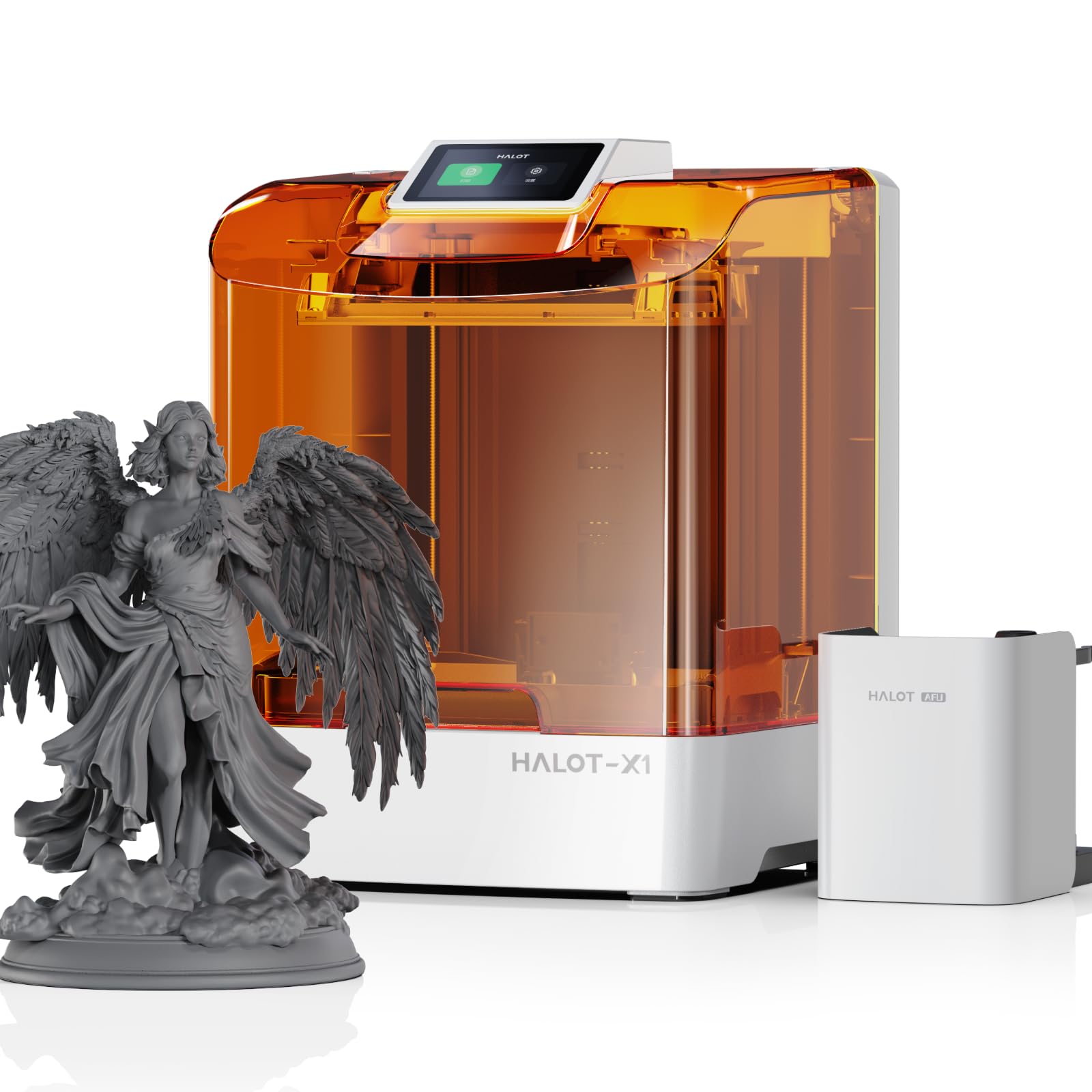
The Halot-X1 Combo features a 10.1-inch 16K monochrome LCD with 15120 by 6230 resolution and a 14 by 19 micron pixel size, making it one of the densest pixel grids available. The intelligent AFU resin management system heats the vat to between 30 and 45 degrees Celsius within three minutes, reducing resin viscosity for better flow.
RFID tags on Creality resin vats auto-load exposure parameters, while the laser detection system feeds and recycles leftover resin. Real-time weight monitoring ensures there is enough material for each print. The top-down movable optical system and fixed build plate improve Z-axis precision to 0.01 millimeters.
The twist-to-release build plate eliminates scraping for model removal. Some users report that the Halot Box slicing software crashes during large file processing, making third-party slicers like Lychee or Chitubox a better workflow choice. Once dialed in with non-Creality slicers, the print quality matches high-end resolution claims.
Why it’s great
- Extremely high 16K resolution for ultra-fine detail
- RFID resin auto loading reduces manual setup errors
- Fixed build plate design eliminates leveling
Good to know
- Bundled slicer software has stability issues
- Weight monitoring adds cost without a clear ROI for casual users
6. ELEGOO Saturn 3 MSLA 12K 3D Printer

The Saturn 3 uses a 10-inch 12K monochrome LCD at 11520 by 5120 resolution, with XY pixels of 19 by 24 microns. The Fresnel collimating light source and COB array produce light within 5 degrees and uniformity above 90 percent, which translates to consistent curing across the 8.62 by 4.84 inch build plate.
The laser-carved build plate provides excellent adhesion for the first layer. Three print modes are available: static, smooth dynamic, and high-speed dynamic. The built-in air filter helps with odor, though it is not a substitute for a dedicated ventilation system.
Users upgrading from smaller printers appreciate the generous build height of about 9.8 inches. The Voxeldance Tango slicer works fine for basic projects, but many switch to Chitubox or Lychee for more control. A separate screen protector is recommended to guard against resin spills between vat changes.
Why it’s great
- Large 10-inch build plate at a competitive price point
- Very uniform light source reduces print failures
- Laser-carved plate holds models firmly
Good to know
- Included USB stick is unreliable
- Some units require careful screen flatness inspection
7. ELEGOO Mars 5 Ultra 9K MSLA Resin 3D Printer

The Mars 5 Ultra reaches printing speeds up to 150 mm per hour with Tilt Release Innovation that separates the cured layer from the film more efficiently. The 7-inch 9K monochrome LCD (8520 by 4320 pixels) provides 18 by 18 micron XY resolution for detailed miniatures.
A built-in AI camera detects empty build plates and model warping during the print and supports time-lapse recording. The smart mechanical sensor performs one-click calibration and alerts to low resin or high light board temperature. WiFi cluster printing handles file transfer without USB and enables OTA firmware updates.
Users consistently praise the print quality for tabletop scale figures. Temperature management is critical; both the resin and build plate need to be warmed above about 68 degrees Fahrenheit to prevent layer separation. The Chitubox software has a learning curve, but once settings are dialed in, the printer runs reliably.
Why it’s great
- Very fast printing for a compact MSLA machine
- AI camera provides real-time failure detection
- WiFi printing without USB is convenient
Good to know
- Requires stable room temperature to avoid failed layers
- Small build plate limits batch printing
8. ANYCUBIC Photon Mono 4 Ultra 10K Resin 3D Printer

The Photon Mono 4 Ultra uses a 7-inch 10K screen with 9024 by 5120 resolution and 17 by 17 micron pixel size. The ACF release film combined with the Intelligent Release Algorithm supports a maximum print speed of 120 mm per hour while maintaining dimensional accuracy across each layer.
The COB light source channeled through Fresnel lenses keeps stray light within 3 degrees and achieves light uniformity above 90 percent. Five intelligent detection routines cover printer auto-inspection, residual and leftover resin monitoring, failed print detection, and release film lifespan management.
Users note that setup takes only minutes and that the 17-micron pixel delivers crisp details ideal for jewelry patterns. The included plastic spatula is too sharp for the ACF film, so replacing it with a softer scraper is recommended. A screen protector is tricky to install but worth applying to protect the LCD from leaks.
Why it’s great
- Excellent detail for sub-50 micron prints
- ACF film speeds up release and reduces wear
- Multiple automated checks reduce failed prints
Good to know
- Small build plate limits batch size
- Included plastic spatula can damage release film
9. Phrozen Sonic Mini 8K S LCD Resin 3D Printer

The Sonic Mini 8K S is a compact entry-level resin printer with a 7.1-inch 8K monochrome LCD that delivers 22-micron XY resolution. The build volume is 6.5 by 2.8 by 6.7 inches, large enough for a few miniatures or small functional parts but not suited for batch production.
Z-axis calibration is handled manually but stays accurate across prints once set. The printer supports open-source slicers including Lychee, Chitubox, and Tango. The 22-pound machine has a small footprint and fits easily on a desk without needing a dedicated stand.
Users new to resin printing find the straightforward workflow easy to learn. Customer support from Phrozen has been responsive, replacing LCD screens when needed. The main limitation is the USB-only file transfer — there is no WiFi. The 22-micron XY resolution captures facial details on 32-mm scale figures without visible pixel stepping.
Why it’s great
- Great entry price for 8K resolution
- Open-source slicer compatibility
- Compact footprint fits small workspaces
Good to know
- USB-only file transfer; no WiFi
- Small build volume limits batch printing
FAQ
What does the LCD screen resolution number like 8K or 12K actually mean for print quality?
Is a DLP printer always better than an FDM printer for miniatures?
How much does temperature affect print success on an MSLA printer?
Final Thoughts: The Verdict
For most users, the best dlp 3d printer winner is the ELEGOO Saturn 3 because it balances a large 10-inch 12K build plate, excellent light uniformity, and a price that undercuts many smaller printers. If you need very high resolution for tiny parts, grab the Creality Halot-X1 Combo. And for high-volume production where speed and large format matter, nothing beats the Phrozen Sonic Mega 8K S.

Mo Maruf
I created WellFizz to bridge the gap between vague wellness advice and actionable solutions. My mission is simple: to decode the research and give you practical tools you can actually use.
Beyond the data, I am a passionate traveler. I believe that stepping away from the screen to explore new environments is essential for mental clarity and physical vitality.