Our readers keep the lights on and my smoothie glass nicely filled. As an Amazon Associate, I earn from qualifying purchases.
Rural TV reception is a battle against physics—distant towers folded into rolling hills, dense tree canopies that swallow UHF signals, and the occasional interference pulse from a neighbor’s 5G tower. A flimsy indoor “150-mile” antenna sold at the big-box store will deliver maybe a dozen snowy channels on a clear day. The real solution requires a directional, high-gain outdoor antenna with intelligent filtering and a build quality that survives hailstorms and humidity.
I’m Mohammad Maruf — the founder and writer behind WellFizz. I’ve spent hundreds of hours cross-referencing customer reception reports from fringe zones, studying antenna radiation patterns and front-to-back ratios, and analyzing how each unit’s amplifier handles the one-two punch of distant weak signals and nearby interference.
After reviewing mounting requirements, real-world mileages, VHF/UHF performance splits, and filter effectiveness, this guide reveals the best digital tv antenna for rural areas that actually delivers consistent clear reception when you’re miles from the nearest broadcast tower.
How To Choose The Best Digital TV Antenna For Rural Areas
Rural buyers face a unique set of obstacles: your nearest broadcast tower is often 50 to 100 miles away, and the signal must pass through trees, hillsides, and sometimes even another ridge. The antenna you choose must be directional to reject noise coming from the sides and rear, it must have a high-gain amplifier with a low noise figure (under 2 dB is ideal), and it must include modern filtering to block FM radio and nearby cellular towers that would otherwise swamp the weaker TV signal.
Directional Design and Front-to-Back Ratio
A directional antenna with a high front-to-back ratio (12 dB or better) focuses its reception in a narrow beam toward the towers. This concentrates what little signal energy exists at 60 miles into a usable level, while rejecting multipath ghosting and interference from the sides. Omni-directional antennas are almost useless for true fringe reception—stick with yagi, stacked-boom, or triple-boom directional designs.
Amplifier Quality: Gain vs. Noise Figure
An amplifier that boosts signal by 30 dB sounds great, but if its noise figure sits at 3.5 dB, it will amplify static as much as the real signal, masking weak channels entirely. Look for amplifiers with a noise figure of 1 dB or lower, like the embedded units found in higher-end Televes and Winegard models. The best rural antennas ship with the amplifier already integrated into the antenna body, not as a separate indoor box.
Interference Filtering
Rural areas are increasingly dotted with 4G and 5G micro-towers and FM broadcast antennas. An antenna with built-in FM / LTE / 4G / 5G filtering (a spec you should see explicitly listed) will prevent these strong nearby signals from overloading the amplifier’s input stage. When the amplifier saturates, your distant TV signals simply vanish from the scan. Filtering is non-negotiable for long-range reliability.
Quick Comparison
On smaller screens, swipe sideways to see the full table.
| Model | Category | Best For | Key Spec | Amazon |
|---|---|---|---|---|
| Televes DAT BOSS Mix LR 149884 | Premium Long Range | Fringe zones 60-100 miles from towers | 46 dBi UHF gain / 38 dBi VHF gain | Amazon |
| Televes Ellipse Mix 148883 | Premium Compact | Rural attics & 40-75 mile reception | 40 dBi UHF gain / Built-in TForce preamp | Amazon |
| Winegard Elite 7550 | Mid-Range Directional | Suburban/rural 40-70 mile zones | 1 dB ultra-low noise amplifier | Amazon |
| CeKay Motorized Outdoor | Motorized Mid-Range | Viewers needing remote rotation | 150-mile max / 360° motorized rotation | Amazon |
| GE Outdoor Yagi 33685 | Budget-Friendly Yagi | Entry-level outdoor / 25-50 mile zones | 80-mile claim / ATSC 3.0 compatible | Amazon |
In‑Depth Reviews
1. Televes DAT BOSS Mix LR 149884
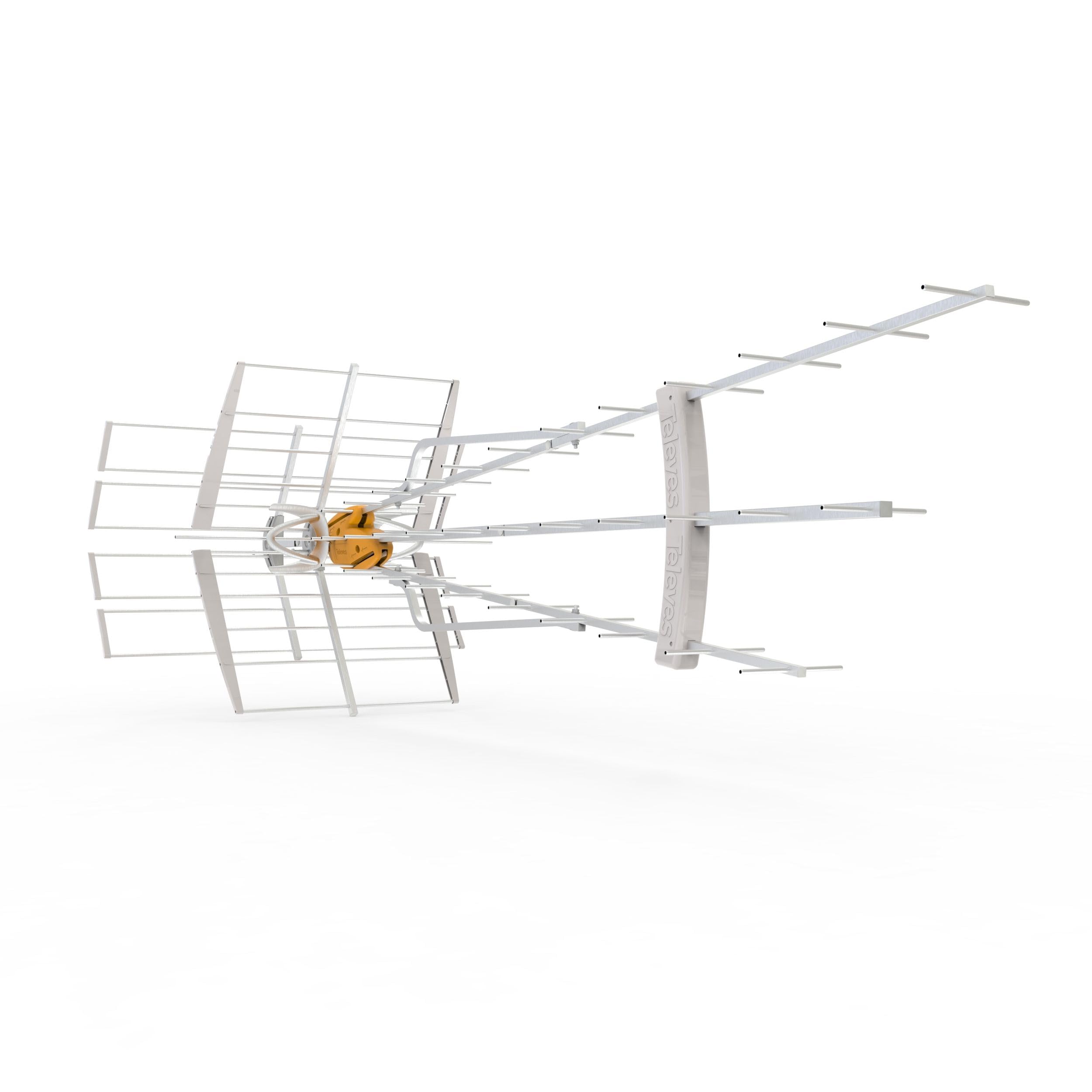
The Televes DAT BOSS Mix LR is the gold standard for extreme fringe reception. With a stacked triple-boom design that delivers 46 dBi of UHF gain and a 25 dB front-to-back ratio, it is built to lock onto signals 80 to 100 miles away while rejecting everything else. Real-world reports from rural Wisconsin and Nebraska confirm 37–65 usable channels at distances of 70 miles, with the built-in TForce preamp and BOSS-Tech automatic gain control preventing the signal overload that plagues lesser amplifiers when a strong station shares the band with a weak one.
Assembly is tool-free and takes under 60 seconds. The unit comes with integrated FM and LTE/4G/5G filtering, which is essential when a nearby cell tower sits on the same frequency band as a distant TV transmitter. The amplifier also operates in passive mode if power is interrupted, so you never fully lose reception. At 84 inches long, it is a large antenna—you need solid mast support and clearance for wind loads—but the reception reward is unmatched.
If you are 60-plus miles from the nearest towers, surrounded by trees, and have tried three other antennas that failed to hold pixel-free signals on UHF and VHF-Hi channels, this is the antenna that will finally work. The premium price reflects genuine engineering, not marketing.
Why it’s great
- Highest UHF gain (46 dBi) in its class for fringe reception
- BOSS-Tech auto gain control prevents amplifier overload from strong nearby stations
- Built-in filtering eliminates interference from 4G/5G towers and FM radio
- Tool-free assembly and dual-operation mode (amplified or passive)
Good to know
- Large footprint (84″ long) requires sturdy mast and wind load planning
- Premium tier pricing is significantly higher than mid-range options
2. Televes Ellipse Mix 148883
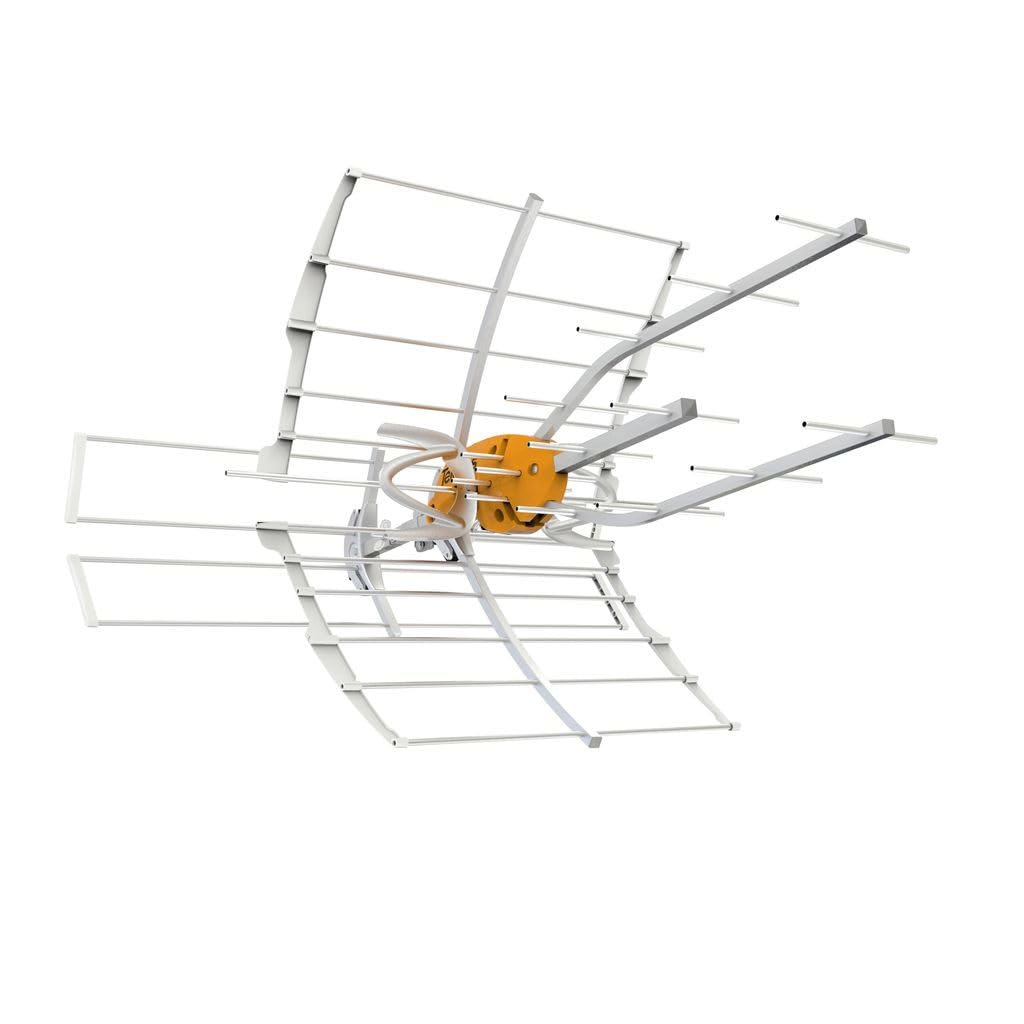
The Televes Ellipse Mix packs the same intelligent TForce preamp and BOSS-Tech automatic gain control found in the larger DAT BOSS, but into a more compact triple-boom body that measures just 39 inches across. This makes it the superior choice for attic installations where physical space is limited and wind loading isn’t a concern. Real user reports from Central Florida and the Chicago suburbs describe jumping from 85 to 113 detected channels after switching to the Ellipse, with dramatically improved stability on VHF-Hi stations (channels 7-13) that many amplified antennas struggle with.
Its 36.5 dBi (VHF) and 40 dBi (UHF) gain figures are roughly 6 dB lower than the DAT BOSS LR, which translates to roughly half the raw power for fringe pickup. In practice, the Ellipse reliably captures signals up to 75 miles away when mounted outdoors or in an attic with a clear line of sight. The built-in FM and LTE/4G/5G filtering handles typical rural cellular interference, and the tool-free assembly is genuinely completed in under 60 seconds.
For most rural buyers whose towers sit between 40 and 70 miles away, the Ellipse delivers 90% of the DAT BOSS’s performance in a package that is far easier to handle and mount. It is the sweet spot for the majority of viewers.
Why it’s great
- Compact footprint fits attic spaces where larger antennas cannot
- Intelligent gain control adapts to fluctuating signal conditions without manual tuning
- Tool-free assembly in under 60 seconds with corrosion-resistant aluminum construction
- Real-world reports show massive channel count increases over competing antennas
Good to know
- 6 dB less gain than the DAT BOSS LR, limiting fringe performance beyond 75 miles
- Single-year warranty is shorter than some competitor lifetime pledges
3. Winegard Elite 7550
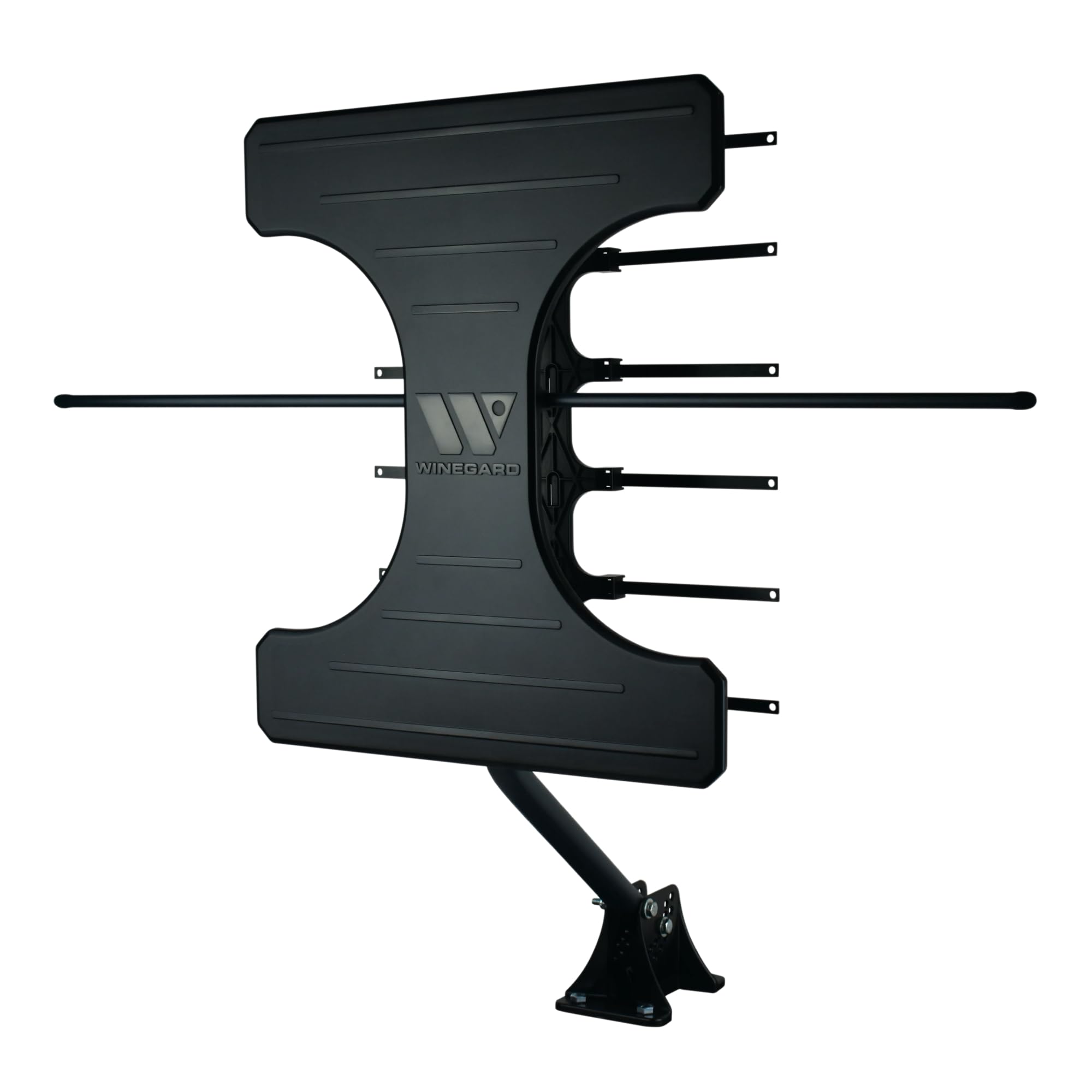
The Winegard Elite 7550 is a mid-range directional antenna that punches above its tier in one critical spec: its embedded amplifier has an ultra-low noise figure of just 1 dB. That matters because every decibel of amplifier noise masks distant signals before they even reach your tuner. Users in rural zones 45–60 miles from towers consistently report doubling their channel count after aiming the 7550 with a phone compass app, and the Clear Circuit Technology does a reasonable job filtering out FM interference.
The antenna’s 70-mile range claim is realistic for open terrain, but performance drops in heavy tree cover or when signals must travel through multiple hillsides. The included mounting bracket and J-mount hardware are adequate for roof or wall installation, though some users note that the plastic elements (the housing is 95% ABS) may become brittle after several seasons of direct sun and freezing temperatures. Assembly is straightforward but requires a screwdriver and patience—unlike the Televes tool-free designs.
For buyers on a budget who still need directional gain and a low-noise amplifier for medium-range rural reception (30–60 miles), the Elite 7550 is the most cost-effective option that will not leave you chasing ghost signals on channel rescan day.
Why it’s great
- Ultra-low 1 dB noise figure amplifier preserves distant weak signals
- Proven track record at 40–60 mile ranges from real users in fringe areas
- ATSC 3.0 compatible for future NextGen TV broadcasts
- Reinforced by a limited-lifetime replacement pledge
Good to know
- Plastic housing raises long-term durability concerns in harsh sun and wind
- No built-in LTE/5G filtering—may require a separate filter near cell towers
4. CeKay Motorized Outdoor HD TV Antenna
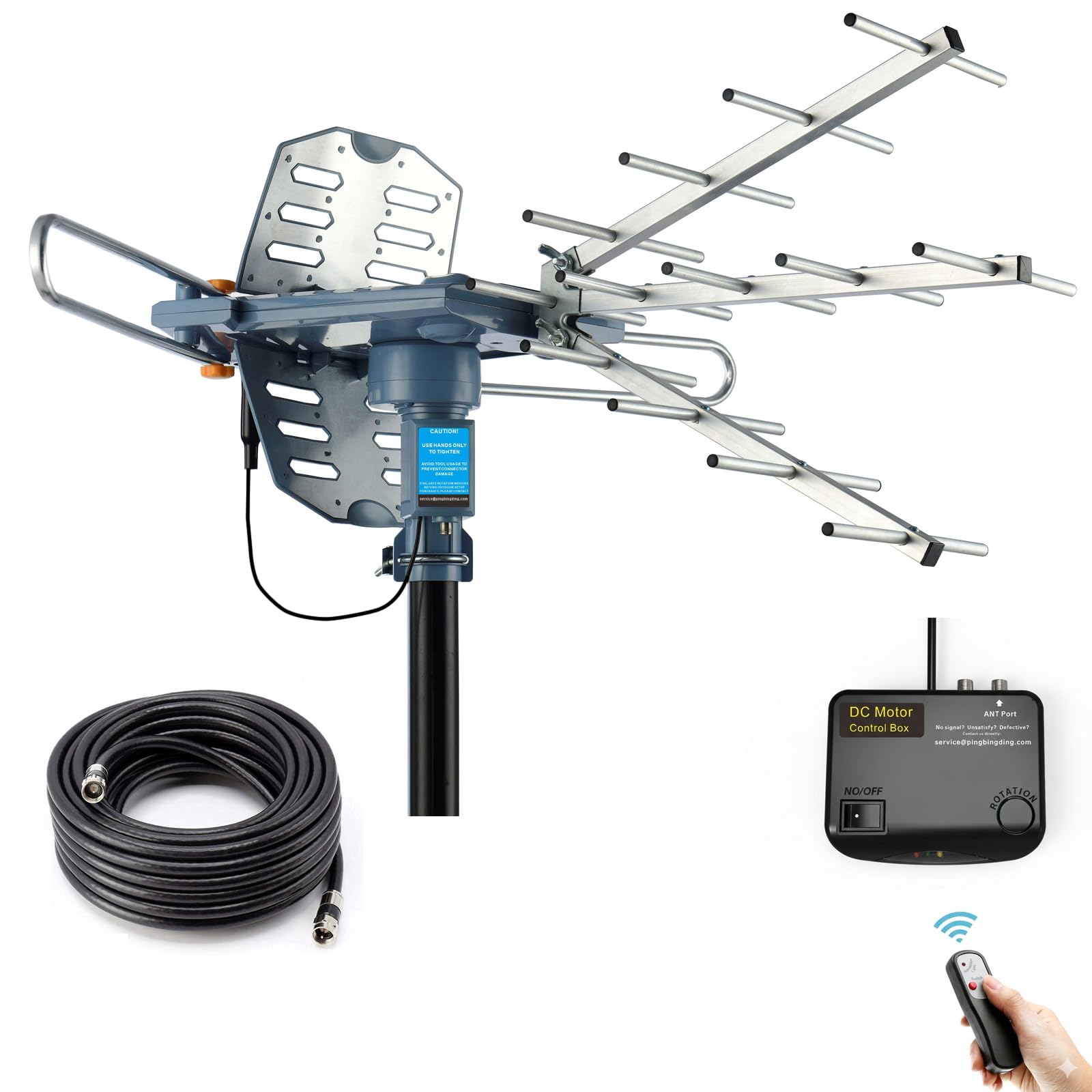
The CeKay Motorized antenna solves a common rural problem: broadcast towers rarely cluster in one direction. When you have stations at 30 degrees and others at 210 degrees, a fixed yagi forces you to choose one direction. CeKay’s motorized 360-degree rotation lets you aim remotely—no climbing onto a pitched roof to fine-tune. Real users 50 miles from towers report pulling in 70+ channels by rotating to the optimal bearing for each band, a flexibility no fixed antenna offers.
The 150-mile range claim should be taken with the same skepticism as all flat-rated maximums; real reception in tree-dense rural areas hovers around 50–70 miles. The built-in amplifier is adequate but its noise figure is higher than the Televes or Winegard units, so extremely weak signals at the fringes may still be lost in the noise. The 40-foot RG6 coax cable included is generous, and the weather-resistant housing holds up well in rain and moderate wind.
If you have towers located in multiple directions and the physical ability to install a rotating system, this is a unique solution. The motorized remote does not require a separate power injector for rotation—both power and signal travel through the same coax, making installation simpler than it sounds.
Why it’s great
- Motorized 360° remote rotation lets you optimize direction for stations in different bearings
- Cable-tangle-free design prevents winding during rotation (common in cheaper motorized units)
- Complete kit includes 40-ft RG6 coax and all mounting hardware
- Customers report 70+ channels at 50-mile distances
Good to know
- Amplifier noise figure is higher than premium competitors—loses some weak fringe signals
- Motorized parts add a mechanical failure point over many seasons
- Mounting pole must be sturdy enough to handle the motor unit’s weight and torque
5. GE Outdoor HD Digital TV Antenna 33685

The GE Yagi 33685 is the entry-level directional antenna that works best for viewers in the lighter rural zone—anywhere from 25 to 50 miles from towers. Its classic yagi-style design provides decent directivity and a front-to-back ratio that rejects signals from the rear, though the included amplifier is a separate unit (not embedded) and its noise figure is not published, which typically means it is higher than the premium competition. Users at 25–35 miles report 36–55 channels with clear reception, especially after upgrading the supplied mast to a higher mounting position.
Assembly is the weakest point: the instructions are sparse, and the many small screws and brackets make the process frustrating compared to the tool-free Televes units. The J-mount and mast clamp included are functional for roof or wall installation, but the antenna’s size (37 inches long) is manageable for most skill levels. The weather resistance is adequate for moderate climates, though the plastic mounting hardware can degrade in prolonged UV exposure.
For the budget-conscious buyer who needs a real directional antenna rather than a flat indoor foil, the GE 33685 is a legitimate starting point. It is ATSC 3.0 ready and backed by GE’s limited-lifetime replacement, but do not expect it to hold signals from 80 miles away through heavy tree cover—that is simply not the job this antenna was designed for.
Why it’s great
- True yagi directional design—better than flat antennas for consistent reception
- ATSC 3.0 (NextGen TV) compatibility at an entry-level price point
- GE’s limited-lifetime replacement pledge covers defects for the original owner
- Users at 25–35 mile ranges report reliable reception of 36–55 channels
Good to know
- Assembly is time-consuming with poor instructions and many small parts
- No built-in amplifier noise figure spec—likely higher noise floor than premium units
- Plastic mounting components may degrade faster in direct sun/humidity
- Real-world performance drops significantly beyond 50 miles in tree-heavy areas
FAQ
Do I really need a 100-mile antenna if my nearest tower is 60 miles away?
Should I mount the antenna in my attic or on the roof for the best rural reception?
Do I need to add a separate amplifier if my antenna already has one built in?
My antenna gets strong signals during the day but pixelates at night. What’s wrong?
How do I aim a directional antenna accurately without a professional signal meter?
Final Thoughts: The Verdict
For most users, the best digital tv antenna for rural areas winner is the Televes DAT BOSS Mix LR 149884 because its 46 dBi UHF gain, intelligent BOSS-Tech gain control, and built-in LTE/5G filtering deliver consistent pixel-free reception where other antennas fail at 70-plus miles. If you want compact size and attic-friendly mounting, grab the Televes Ellipse Mix 148883. And for a motorized setup that can aim at towers in multiple directions, nothing beats the CeKay Motorized Outdoor Antenna.

Mo Maruf
I created WellFizz to bridge the gap between vague wellness advice and actionable solutions. My mission is simple: to decode the research and give you practical tools you can actually use.
Beyond the data, I am a passionate traveler. I believe that stepping away from the screen to explore new environments is essential for mental clarity and physical vitality.