Our readers keep the lights on and my smoothie glass nicely filled. As an Amazon Associate, I earn from qualifying purchases.
An underwater camera that turns murky ocean blues into crisp, vibrant memories is the difference between a blurry vacation clip and a frame you’d print. The challenge is finding a model that delivers reliable color accuracy and sharp detail without demanding a massive investment.
I’m Mohammad Maruf — the founder and writer behind WellFizz. I spend hundreds of hours cross-referencing underwater test results, ISO performance data, and depth ratings to cut through the noise and identify the digital cameras that actually perform below the surface.
Whether you are snorkeling a reef, documenting a dive, or surveying marine infrastructure, having the right tool changes everything. This guide breaks down the specs that matter so you can confidently choose the best digital underwater camera for your specific water-based activities.
How To Choose The Best Digital Underwater Camera
Selecting an underwater camera involves more than just confirming it can get wet. You need to weigh optical performance, physical toughness, and the specific shooting scenarios you’ll face. The following factors are the most critical for a satisfying buying decision.
Depth Rating and Build Toughness
The depth rating tells you how many meters the camera can survive without a separate housing. Entry-level models often reach 10 to 15 meters, which is fine for snorkeling and shallow dives. For serious scuba work down to 40 meters or more, you may need a dedicated housing or a specialty model like the SeaLife SportDiver case rated to 130 feet. Shockproof, dustproof, and freezeproof ratings are equally important for rugged outdoor use.
Sensor Size and Low-Light Performance
A larger sensor (like the 1/1.3-inch sensor found in some premium action cameras) collects more light, reducing noise in darker underwater environments. This translates to cleaner video and sharper stills when the sun is low or the water is murky. Look for models with wide pixel sizes, such as 2.4 µm, for better signal-to-noise ratios in challenging conditions.
Underwater Color and White Balance Controls
Water absorbs red and orange wavelengths first, which is why many underwater shots look blue or green. Cameras with dedicated Underwater modes adjust white balance and contrast to restore natural colors. Some models, like the SeaLife SportDiver housing, include a physical red filter that attaches to the lens, while others rely on software processing. Dedicated macro modes with ring lights can also help bring back color in close-up shots.
Quick Comparison
On smaller screens, swipe sideways to see the full table.
| Model | Category | Best For | Key Spec | Amazon |
|---|---|---|---|---|
| DJI Osmo Action 5 Pro | Action Camera | All-Day Adventure | 1/1.3-inch sensor, 20m waterproof | Amazon |
| GoPro HERO13 Black | Action Camera | High-Res Video | 5.3K60, waterproof to 10m | Amazon |
| OM System TG-7 Red | Rugged Compact | Macro & Underwater Detail | F2.0 lens, 5 underwater modes | Amazon |
| Insta360 X5 | 360 Action Camera | Immersive 360 Video | 8K30, replaceable lenses | Amazon |
| Pentax WG-90 Black | Rugged Compact | Macro & Field Work | 6-LED ring light, 14m depth | Amazon |
| Ricoh WG-80 Orange | Rugged Compact | All-Weather Durability | 5x optical zoom, 14m depth | Amazon |
| SeaLife SportDiver Housing | Phone Housing | Smartphone Underwater Use | 130ft depth, leak alarm | Amazon |
| Pentax WG-1000 Gray | Rugged Compact | Casual Outdoor Use | 15m waterproof, 4x zoom | Amazon |
| Kodak PIXPRO WPZ2 | Rugged Compact | Budget Snorkeling | 16MP, 4x zoom, 15m depth | Amazon |
In‑Depth Reviews
1. DJI Osmo Action 5 Pro

The DJI Osmo Action 5 Pro brings a 1/1.3-inch sensor and 2.4 µm pixel architecture that captures far more light than typical action-camera sensors. This gives you 4K/120fps video with 13.5-stop dynamic range and genuinely usable low-light footage, even in dim water. The 20-meter waterproof rating means most snorkeling and recreational dives are covered without a housing, and the IP68 seal keeps dust and sand out during beach transitions.
Battery life hits up to 4 hours of recording, which is a standout in this class — most competitors tap out closer to 80 minutes. The dual OLED touchscreens (front and rear) make framing a selfie or vlog simple, and the 360° HorizonSteady stabilization removes all roll-axis shake so your footage stays level even in waves. Voice control works reliably with gloves, and the 4nm chip enables subject tracking for fast-moving marine life like turtles or rays.
The 47GB of built-in storage is a nice buffer, but filling it quickly at 4K means you’ll still rely on a fast micro SD card. Audio capture is clear in calm conditions, but wind noise can creep in during surfaced action shots without an external mic. Overall, this is the most versatile all-around performer for divers who also want a capable land-based action cam.
Why it’s great
- Large sensor provides excellent low-light performance underwater
- 4-hour battery life outlasts most dives
- Fully waterproof to 20m without extra housing
Good to know
- Built-in storage fills fast at high bitrates
- Built-in mics are susceptible to wind noise
- Higher price point but justified by sensor quality
2. GoPro HERO13 Black

The GoPro HERO13 Black is the gold standard for high-resolution underwater footage, delivering 5.3K60 video with 91% more resolution than 4K. The 27-megapixel stills are crisp enough to pull usable frames from video, which is a lifesaver when the action happens too fast to compose a shot. HyperSmooth stabilization rivals gimbal-level smoothness, keeping your reef swims and surf clips steady.
The HB-series lens system brings auto-detected mods for ultra-wide, macro, and anamorphic shooting — though these lenses require extra investment. The Enduro battery lasts about 79 minutes of continuous recording, which is short compared to the DJI Action 5 Pro, but still enough for a typical dive. The built-in water-repelling lens cover minimizes flare from surface light, a thoughtful touch for underwater users.
Waterproof rating is 33 feet (10m) without a housing, which covers snorkeling but not deeper scuba. You’ll need the optional dive housing for serious depth. The Quik app is polished for fast editing, but the lack of built-in storage means the HERO13 is totally reliant on micro SD cards. It remains the best choice for users who prioritize maximum video resolution over raw battery runtime.
Why it’s great
- 5.3K60 video offers best-in-class detail and cropping flexibility
- HB-series lens mods allow creative shooting (macro, anamorphic)
- HyperSmooth stabilization is excellent for rough water
Good to know
- Only 79 minutes battery life at high settings
- Deep water requires optional housing
- No built-in storage — SD card required
3. OM System TG-7 Red

The OM System (formerly Olympus) TG-7 is the reigning champion of the waterproof point-and-shoot category, delivering a bright F2.0 zoom lens that keeps more light coming in at depth. It’s waterproof to 15 meters (50 feet), shockproof from 2.1 meters, and freezeproof to -10°C, making it a tank of a camera for fieldwork, snorkeling, or casual scuba. The variable macro system captures subjects from 1 centimeter away, which is extraordinary for documenting tiny crustaceans or coral polyps.
Five dedicated underwater modes — including Underwater Microscope and Underwater HDR — automatically adjust color and contrast to counter the blue-green cast. The 4K video at 120 fps slow-motion is a bonus, and the option to shoot in raw gives advanced editors flexibility. Built-in flash and a tough chassis mean it’s always ready, but the 12-megapixel sensor is relatively modest by modern standards, producing some noise in low light.
Battery life is decent for a day of casual shooting, but the TG-7 drains quickly if you use raw and flash heavily. Some users note the video zoom mechanism is audible on the recording, but stills and overall image quality remain excellent. For anyone who wants a dedicated, pocketable camera that can go anywhere, the TG-7 is the logical upgrade from phone-based shooting.
Why it’s great
- F2.0 max aperture for brighter underwater photos
- Variable macro modes with 1cm focusing distance
- Rugged build: waterproof, shockproof, crushproof, freezeproof
Good to know
- Modest 12MP sensor shows noise in low light
- Battery dies without warning under heavy load
- Video zoom mechanism can be heard on recordings
4. Insta360 X5

The Insta360 X5 is a paradigm shift for underwater content, capturing everything in 8K 360° so you can choose your angle after the dive. Dual 1/1.28-inch sensors improve low-light performance significantly over the previous X4 generation, and the triple AI chip design processes noise reduction in real time. The Invisible Selfie Stick effect creates third-person perspectives that are impossible with fixed-lens cameras, ideal for showcasing a reef swim from every side.
FlowState Stabilization and 360° Horizon Lock remove all shakes, and the brand-new replaceable lenses are scratch-resistant and field-swappable in seconds — a huge advantage for divers who risk lens damage on rocks or boat hulls. The wind guard on the 4-mic array reduces wind interference for clearer surfaced audio. Battery life hits over 3 hours, which is impressive for a dual-sensor 360 cam.
The learning curve is real — 360 editing requires the Insta360 app or desktop software, and file sizes are massive at 8K. The camera is fully waterproof to 10m without a housing, but deeper dives need the optional dive case. It is the best choice for creative videographers who want to reframe shots after the fact and post to social media with zero compromise on immersion.
Why it’s great
- 8K 360° video captures every direction for post-dive reframing
- Replaceable lenses reduce risk of costly repairs
- Excellent stabilization and low-light processing
Good to know
- Steep learning curve for 360 editing
- Large file sizes require fast, high-capacity SD cards
- Needs optional dive housing for deeper than 10m
5. Pentax WG-90 Black
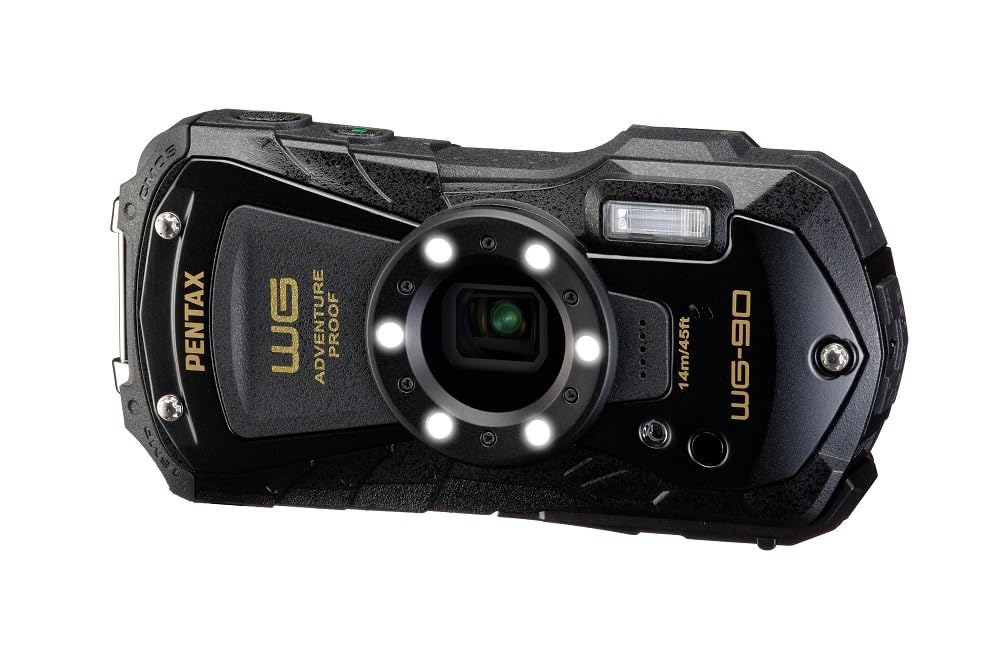
The Pentax WG-90 is built for macro work underwater, with six LED ring lights positioned around the lens barrel to flood tiny subjects with even illumination. This eliminates the harsh shadows that plague close-up reef shots and makes the Digital Microscope Mode genuinely useful for documenting microscopic marine life. The back-illuminated 16MP CMOS sensor and ISO 6400 ceiling give decent detail, though auto mode can be inconsistent — manual control is where the WG-90 shines.
Its 5x optical zoom (28-140mm equivalent) provides versatility for both wide landscape and close-up framing, and the 14-meter depth rating covers snorkeling and recreational scuba. The Macro Stand accessory helps maintain a 1cm focusing distance for extended macro observation. Triple anti-shake protection is a big help in choppy surface conditions, where smaller cameras often produce motion blur.
Battery life is excellent, with some users reporting charging only twice over a year of regular use. The instruction manual is minimal, but the camera is intuitive enough to set up in a few minutes. The WG-90 is the best dedicated macro shooter in this lineup, ideal for divers who prioritize tiny details over wide-angle panoramas.
Why it’s great
- Six-LED ring light for flawless macro illumination
- Digital Microscope Mode captures minute detail
- Excellent battery life for long dive days
Good to know
- Auto mode is weak — manual settings produce better results
- Instruction manual is sparse and unhelpful
- Some users reported water ingress at the battery seal
6. Ricoh WG-80 Orange

The Ricoh WG-80 (Pentax-engineered) shares the same rugged DNA as the WG-90 but at a slightly lower entry point. It is waterproof to 14 meters for up to two hours, shockproof from a fall of 1.6m, and freezeproof to -10°C. The back-illuminated 16MP CMOS sensor with ISO 6400 delivers good performance for a compact, and the 5x optical zoom (28-140mm equivalent) captures everything from landscapes to close-ups.
The six LED Macro Lights are identical to the WG-90’s, making the WG-80 a strong macro performer at a more accessible tier. Underwater and Underwater Movie modes auto-tune color balance to reduce the blue cast, and the bright orange color is easy to spot against dark rocks or sand. Autofocus points are limited to a single point, which is a downgrade from the WG-90’s 99-point hybrid system — this means slower focus in complex scenes.
Durability is the WG-80’s playground. It is built for construction sites, marine survey work, and rough family vacations where any other camera would break. The video quality is adequate at Full HD, but there is no 4K option. For users who need a bombproof camera that can handle mud, salt, and drops while delivering solid macro stills, the WG-80 is a reliable tank.
Why it’s great
- Six-LED macro lights for excellent close-up illumination
- Extremely durable: waterproof, shockproof, freezeproof
- Bright orange chassis is easy to locate underwater
Good to know
- Only single-point autofocus — slower than competitors
- No 4K video recording
- Battery orientation can be confusing on first use
7. SeaLife SportDiver Housing
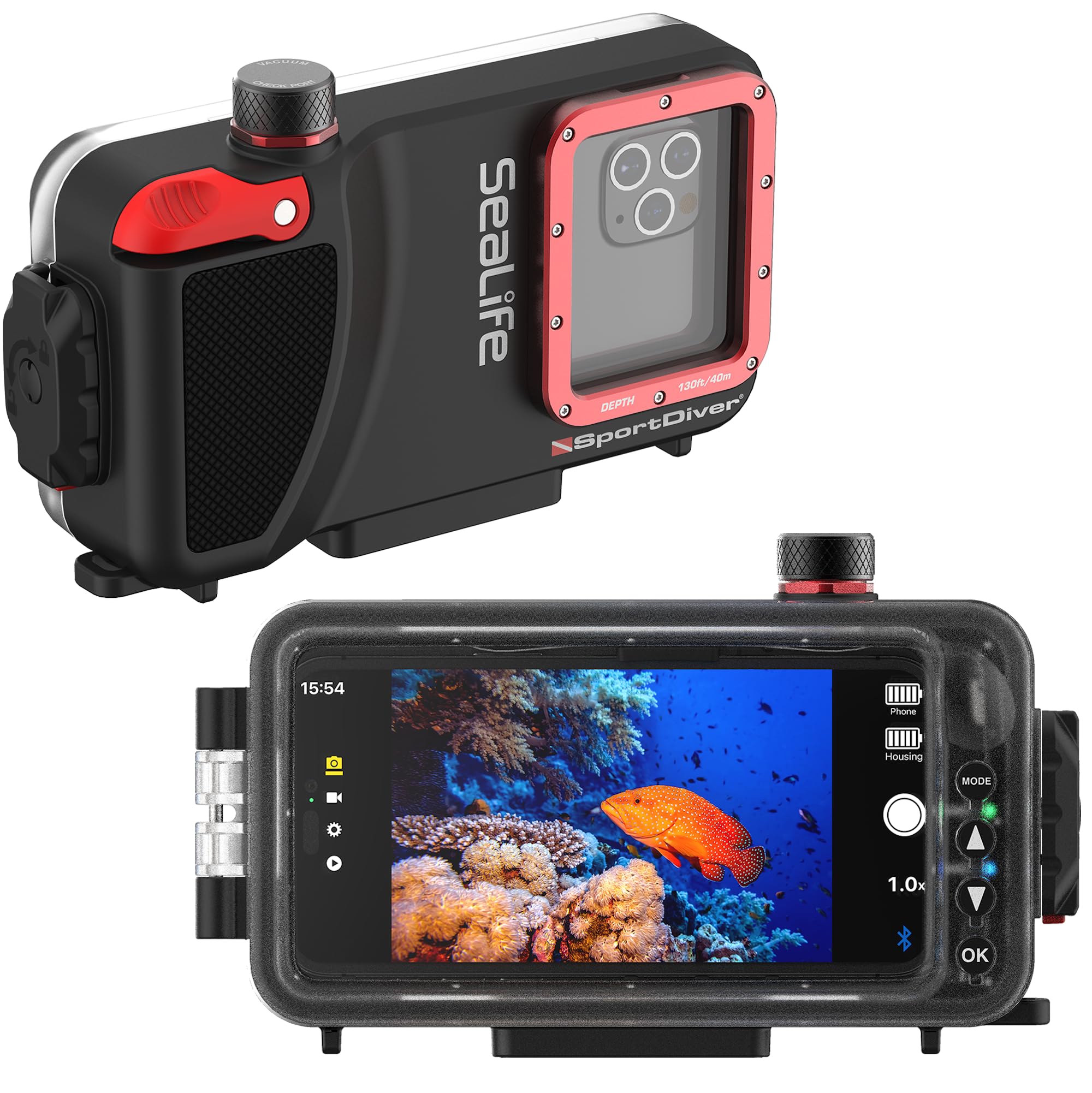
The SeaLife SportDiver housing turns your smartphone into a fully capable underwater camera rated to 130 feet. This is a radical departure from dedicated camera designs — you get the phone’s native camera app with all its controls (zoom, focus, white balance) plus the included red color-correction filter that restores natural hues at depth. The cam-lock sealing mechanism and audible/visual moisture alarms provide real-time protection against leaks.
The free SportDiver app (iOS/Android) connects via Bluetooth to show full-size photos and video thumbnails for quick review between dives. The vacuum pump leak test takes about 3 minutes per check, which is slightly time-consuming but gives peace of mind. Three 1/4-20 mounting points let you attach the housing to tripods or trays, and the large shutter lever works with gloved hands. Battery life is rated at 50 hours of continuous Bluetooth use on two AAA cells.
The main limitation is that your phone becomes the only camera, and if the housing fails, the phone is at risk. Some users experience false humidity alarms that can interrupt a dive. The housing is also fairly large (8.4 x 4.9 inches) and does not float. For anyone who already owns a flagship smartphone and wants zero extra editing or file transfer steps, this is the smartest way to go deep without buying a separate camera.
Why it’s great
- Uses your existing phone camera for zero extra editing workflow
- 130ft depth rating with leak alarm for safety
- Included red filter restores accurate color underwater
Good to know
- Vacuum leak test takes about 3 minutes each time
- Does not float — risk of sinking if dropped
- False humidity alarms can interrupt dives
8. Pentax WG-1000 Gray

The Pentax WG-1000 is the most accessible rugged point-and-shoot in this list, waterproof to 15 meters for up to one hour. It is also shockproof from a 2m drop and dustproof, making it a solid companion for hiking, kayaking, and shallow snorkeling. The 4x optical zoom (27mm wide-angle equivalent) and ISO 3200 sensitivity are modest but sufficient for daylight underwater use, and the 20 color modes (including Underwater mode) add creative flexibility.
A unique benefit is the sterilization-friendly body — it can be cleaned with ethanol or sodium hypochlorite solutions, making it usable in medical or food-service environments. The included O-CC180 Protector Jacket guards against scratches, and the carabiner strap is handy for clipping to a backpack. The rubberized coating provides a confident grip when wet.
Image quality is adequate in good light but struggles in murky conditions or at depth, where autofocus can hunt. Some users report internal fogging and battery corrosion after heavy use. It is best understood as a tough, entry-level camera for occasional water use, not a tool for serious underwater photography. If your main need is a rugged camera that can get wet occasionally without breaking the budget, the WG-1000 fits perfectly.
Why it’s great
- Sterilization-friendly body for medical/field environments
- Rubberized coating and carabiner strap for easy carry
- Dustproof, shockproof, and waterproof to 15m
Good to know
- Image quality degrades in low light or at depth
- Autofocus can hunt in murky water
- Some reports of internal fogging after extended wet use
9. Kodak PIXPRO WPZ2

The Kodak PIXPRO WPZ2 delivers an all-in-one bundle that includes the camera, case, lens pen, monopod, USB card reader, screen protector, cleaning cloth, and wrist strap, making it the most complete package for absolute beginners. It is waterproof to 15 meters (49 feet) and shockproof to 2 meters, with a dustproof seal that keeps sand and grit out. The 16MP sensor and 4x optical zoom (27-108mm equivalent) are sufficient for bright, shallow snorkeling conditions.
1080p Full HD video is the ceiling here — there is no 4K, but for casual clips shared on social media, the quality is crisp enough. The yellow color is highly visible in water, reducing the chance of losing it overboard. The bundle includes a floating strap, which is a practical safety net for nervous first-time users. Digital image stabilization helps reduce shake, but it is not as effective as the optical stabilization on higher-tier models.
The biggest drawback is that batteries are not included, so you’ll need to factor in that extra purchase. The autofocus uses contrast detection and can be slow in low-contrast underwater scenes. For families taking a camera on a vacation where the phone stays on the boat, the WPZ2 is an affordable and fun option that captures memories without the anxiety of damaging an expensive primary device.
Why it’s great
- Full bundle with floating strap, case, and accessories included
- Bright yellow color is easy to spot in the water
- Waterproof to 15m and shockproof to 2m
Good to know
- Batteries not included — must be purchased separately
- Contrast-detect autofocus can be slow underwater
- 1080p video only — no 4K option
FAQ
Can I use an action camera without a housing for scuba diving?
What is the most important spec for underwater macro photography?
Should I buy a dedicated underwater camera or a smartphone housing?
Why do my underwater photos look blue or green even with an Underwater mode?
Final Thoughts: The Verdict
For most users, the best digital underwater camera winner is the DJI Osmo Action 5 Pro because it balances a large 1/1.3-inch sensor, 20m waterproofing without a housing, 4-hour battery life, and stabilized 4K video — all in a compact package. If you want maximum macro detail for reef exploration, grab the OM System TG-7 Red. And for 360° creative freedom with post-dive angle selection, nothing beats the Insta360 X5.

Mo Maruf
I created WellFizz to bridge the gap between vague wellness advice and actionable solutions. My mission is simple: to decode the research and give you practical tools you can actually use.
Beyond the data, I am a passionate traveler. I believe that stepping away from the screen to explore new environments is essential for mental clarity and physical vitality.