Our readers keep the lights on and my smoothie glass nicely filled. As an Amazon Associate, I earn from qualifying purchases.
A compass that sticks on a critical bearing or fades in low light isn’t just frustrating—it’s a safety hazard. Whether you’re navigating a reef line, searching for a lost shot line, or running a square pattern in silty water, your instrument needs to be locked in before you even hit the surface. The wrong model sends you off course by meters on a simple out-and-back, turning a controlled drill into a guessing game.
I’m Mohammad Maruf — the founder and writer behind WellFizz. I’ve spent hundreds of hours analyzing dive compass designs, comparing bezel mechanisms, tilt tolerances, luminescence quality, and console compatibility so you don’t have to trial-and-error your way through a dozen bad units.
After stacking seven of the most popular models head-to-head against real-world conditions—low visibility, current, odd dive positions, and console integration—one thing is clear: the best dive compass balances a fast-settling needle with a responsive bezel you can actually operate in thick gloves.
How To Choose The Best Dive Compass
Buying a dive compass means filtering past generic hiking compasses that claim to be waterproof. You need an instrument that settles quickly when tilted, offers a bezel you can index with one hand, and stays readable across a 60-minute dive. Here are the three specs that separate a top pick from a novelty item.
Tilt Tolerance and Needle Damping
Most compass needles float on a pivot and rely on a liquid-filled capsule to stop oscillation. The fluid’s viscosity directly affects how fast the needle settles. A well-damped needle locks onto north within two seconds even after a sharp turn. Models with 25-degree or greater tilt compensation keep reading accurately when your wrist isn’t perfectly level—critical when you’re scooter-mounted, hovering over a wreck, or swimming sideways against current. Cheap, thin fluid leads to overshoot and a needle that dances for five seconds or more.
Bezel Action and Lubber Line Design
The bezel should click into position with distinct, crisp detents—not slip freely or feel gritty. A 360-degree ratcheting bezel lets you set and hold a heading without creeping, even in thick gloves. The lubber line (the fixed reference mark inside the capsule) must be high-contrast and preferably dual-sided or side-view-equipped so you don’t have to rotate your whole forearm to read your bearing. Some console modules skip the side window entirely, forcing you to look straight down—which is often impractical.
Mounting Format and Console Compatibility
Dive compasses come as wrist-mounted units, clip-on retractors, or drop-in console modules. A wrist compass keeps your bearing in your peripheral vision but can interfere with your computer if both sit on the same arm. A retractor model lets you stow the compass on your BCD shoulder d-ring and pull it up only when needed—ideal for mid-water navigation checks. Console modules fit into dual-gauge boots or save-a-dive kits, but you must verify the manufacturer and model number because no two console cutouts are identical.
Quick Comparison
On smaller screens, swipe sideways to see the full table.
| Model | Category | Best For | Key Spec | Amazon |
|---|---|---|---|---|
| Cressi Compass | Mid-Range | Tilt-tolerant wrist navigation | 25° tilt compensation | Amazon |
| Scubapro FS-2 | Premium | High-tilt/low-light precision | Side view window | Amazon |
| Sherwood Genesis NH | Mid-Range | Console module replacement | 360° ratchet bezel | Amazon |
| Aqualung Compass Module | Premium | Aqualung console integration | Side-view window | Amazon |
| Scuba Choice Retractable Clip | Mid-Range | BCD clip-on convenience | 31.5″ retractor cord | Amazon |
| Scuba Choice Deluxe Wrist | Budget-Friendly | Entry-level wrist compass | 2.3″ display | Amazon |
| Silva Ranger 2.0 | Specialty | Surface navigation / planning | Declination adjustment | Amazon |
In‑Depth Reviews
1. Cressi Underwater Compass

The Cressi Compass is the benchmark for mid-range wrist-mounted dive compasses because of how well it handles off-angle bearings. Its magnetic card moves freely even when the instrument is not perfectly level—a critical advantage when you’re swimming against current or hover-trimming over a reef. The side-reading gun-sight window lets you track your bearing without rotating your entire arm, and the rotating ratchet bezel features crisp 10-degree detents that lock in place audibly.
The face is luminous and divided into 10-degree intervals, making fine heading adjustments straightforward. Several instructors in the review pool reported using this model for PADI Advanced Open Water nav drills and completing square patterns without drift. The bezel holds its position even when accidentally bumped against a BCD hose or tank valve. At just over three ounces, it disappears on your wrist, and the wide anatomical band keeps it from spinning around your arm during descent.
The one weak point is luminescence duration—charge fades faster than premium models, requiring a flashlight recharge during night dives. A minority of users also mention that the navigation window is small for divers with bulky prescription masks. Still, for the price-to-tilt-tolerance ratio, few models match it.
Why it’s great
- Exceptional tilt compensation for off-level readings
- Gun-sight side window improves bearing tracking
- Two-year warranty from an Italian brand with decades of dive heritage
Good to know
- Luminescence fades quickly after initial charge
- Side window is small for some mask fits
2. Scubapro FS-2 Wrist Mount Compass

The Scubapro FS-2 is an oil-filled polycarbonate compass designed for divers who need visibility from multiple angles. Its side view window is wide and clear, allowing you to read the bearing without lifting your wrist to eye level—a feature that becomes essential during low-visibility silty bottom navigation. The case is scratch-resistant and has held up in heavy commercial use including marine archaeology surveys and scooter-to-anchor chain runs.
Dive masters who have used this compass for multiple seasons report that the needle settles quickly and stays steady even when the diver is moving at speed. The luminous dial charges from the bottom, which is slightly unusual but effective once you learn to hold it under a dive light for 30 seconds before descending. The FS-2 works in both the Northern and Southern hemispheres simply by flipping a small internal magnet—no calibration tool required.
On the downside, the included wrist strap is somewhat long and doesn’t adjust down well for narrower wrists. A few users have reported the compass card sticking intermittently, though this seems limited to isolated units rather than a design flaw. At the premium end of the market, this is the model you choose when console integration isn’t an option and you need a standalone wrist instrument that can handle any dive environment.
Why it’s great
- Wide side window for off-axis reading
- Scratch-resistant oil-filled capsule dampens needle quickly
- Dual-hemisphere usability with internal flip magnet
Good to know
- Strap is long for smaller wrists
- Occasional reports of card sticking in isolated units
3. Sherwood Scuba Genesis NH Compass Module
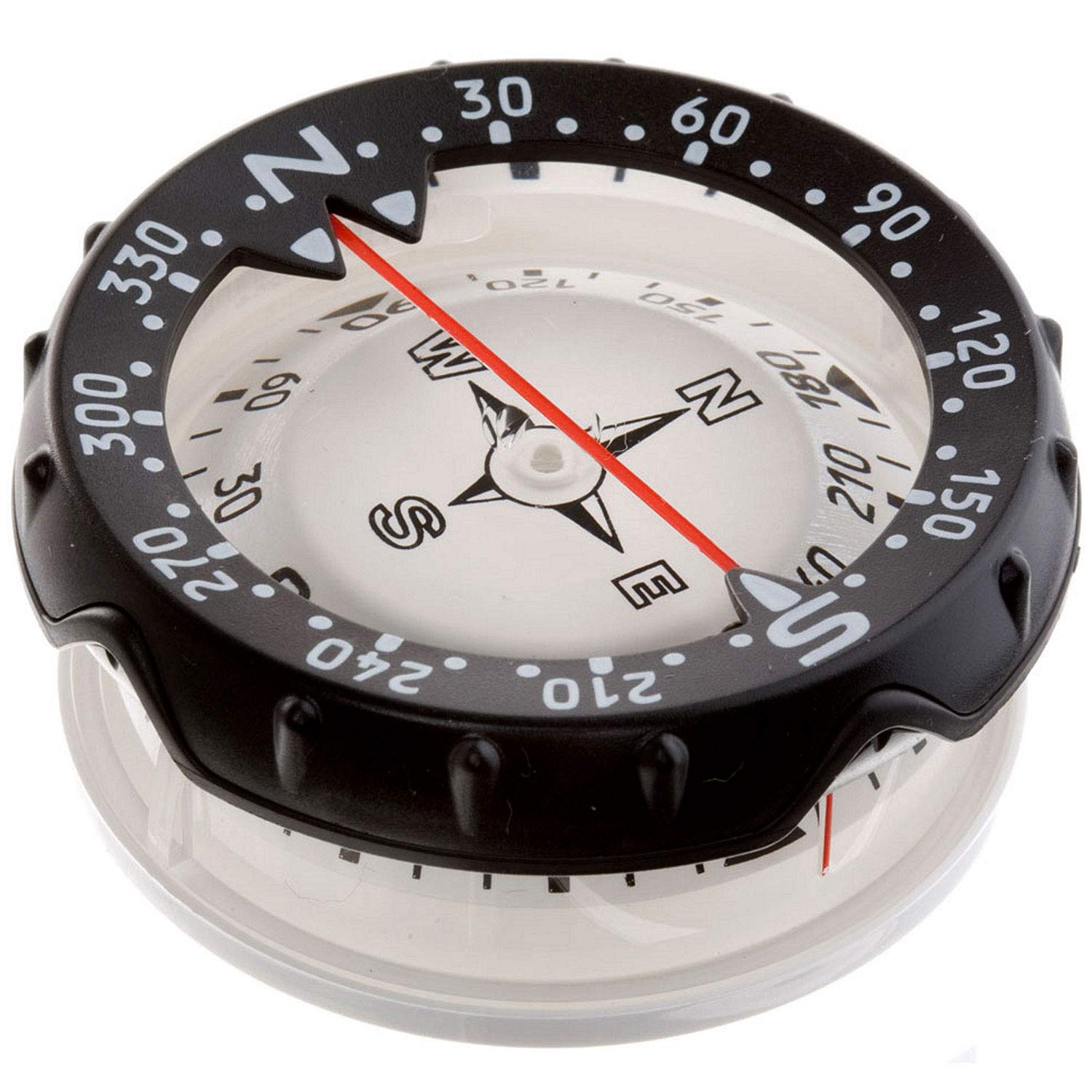
The Sherwood Genesis NH is a liquid-filled console module built for divers who want a clean, integrated setup. It features a 360-degree ratchet bezel with directional and reciprocal index points, plus twin heading indicators and a high-visibility lubber line. The open-side design means you can read the bearing from the dial plane without craning your neck, and the clear plastic case permits quick heading confirmation even when the console is mounted on a short hose.
Reviewers who used this module for divemaster training noted that it never failed during navigation circuits, even when student divers bumped the console against the boat ladder or tank heels. The strong magnets give a fast needle response, and the bezel clicks audibly at each detent so you can count clicks while wearing five-millimeter gloves.
One caution: this module is designed to fit Sherwood consoles specifically. While some users have successfully pressed it into Oceanic and generic boots, you should verify the cutout dimensions before buying. The thick plastic case survives short drops but can crack under hard impact. For a dedicated console module at this price point, the Genesis NH offers reliable navigation without the bulk of a wrist unit.
Why it’s great
- Quick needle settling with strong magnets
- Open-side design for easy viewing
- Audible detent clicks for glove-friendly use
Good to know
- Console-specific fit—not universal
- Plastic case can crack under hard impact
4. Aqualung Compass Module
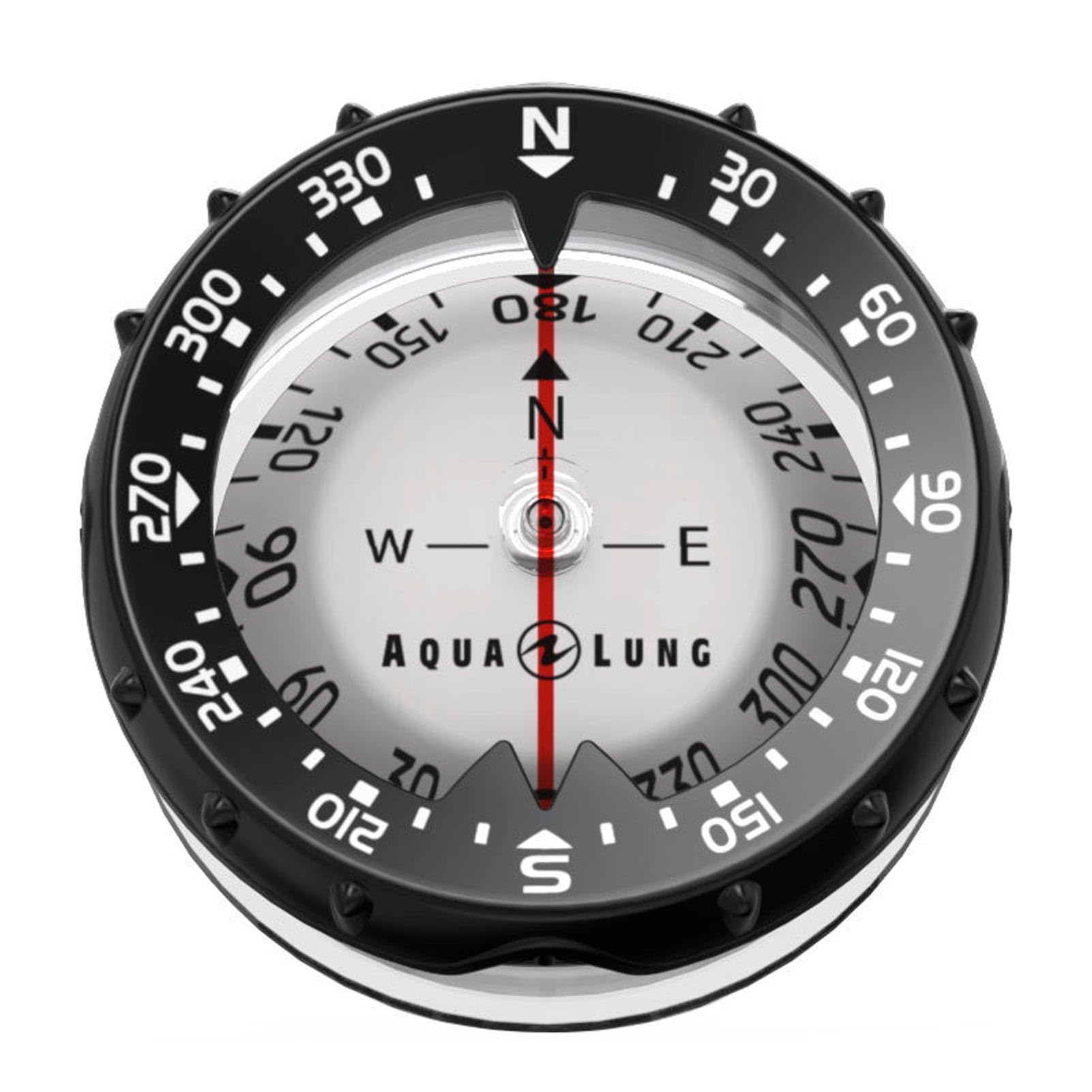
The Aqualung Compass Module is purpose-built for divers running Aqualung dual-gauge consoles or save-a-dive kits. Its stand-out feature is the large side-view window that offers a clear bearing read without twisting the console upright, and the luminous dial with fluorescent markings remains legible in low-light conditions. The 360-degree ratcheting bezel turns smoothly with distinct detents and zero play, so your heading stays locked even when the console is resting against your body.
Installation requires removing a white plastic filler plug inside the console boot. Several user reports emphasize lubricating the module with soapy water and pressing firmly on a hard surface—it takes significant force to seat fully, and the plastic filler piece will break during the process. Once installed, the module is not removable in one piece without damaging the console. This is a permanent integration, not a snap-in accessory.
The compass is designed for the Northern Hemisphere, so if you travel frequently to southern dive destinations, you’ll need to verify your console’s calibration compatibility. Bearings read within 30-degree increments, which is sufficient for recreational nav but may feel coarser than the 10-degree intervals found on premium wrist units.
Why it’s great
- Large side-window makes console navigation easy
- Luminescent dial holds charge for night dives
- Precision fit in Aqualung consoles
Good to know
- Permanent, irreversible installation
- 30-degree increments feel coarse for fine navigation work
- Northern Hemisphere only
5. Scuba Choice Retractable Clip Compass

The Scuba Choice Retractable Clip Compass solves the gear-clutter issue neatly: you clip the unit to your BCD shoulder d-ring and pull it up when you need a bearing, then let go and the retractor stows it back against your chest. The dial is 2.5 inches in diameter with glow-in-the-dark markings that charge quickly and stay visible through a full dive. This format is ideal for divers who don’t want a wrist unit competing for space with their dive computer.
The retractor extends to 31.5 inches and retracts to seven inches, so you can bring the compass to eye level without unclipping anything. The compass itself is compact and lightweight—under a quarter-pound—so it doesn’t tug at your BCD webbing. The clear, large dial allows quick navigation checks during square patterns or reciprocal headings, and the bezel offers standard 10-degree increments for basic nav.
Reliability is a mixed bag in the user feedback. Some divers report using the same unit for years with no issues, while others have received compasses that consistently point in random directions regardless of orientation. The retractor mechanism works smoothly on land but can collect sand and salt grit over time, potentially causing it to stick. Check the unit immediately after arrival for needle accuracy before taking it on a dive trip.
Why it’s great
- Retractor keeps compass off your wrist and out of the way
- Good glow-in-the-dark visibility for night and murky water
- Light enough to clip to any BCD without drag
Good to know
- Quality control issues with needle accuracy in some units
- Retractor mechanism can jam if exposed to sand
6. Scuba Choice Deluxe Wrist Compass

The Scuba Choice Deluxe Wrist Compass is an entry-level option that offers a large 2.3-inch dial and 25-degree tilt technology at a budget-friendly price point. It’s depth-rated to 80 meters, making it suitable for recreational and advanced recreational dives without worrying about housing failure. The high-contrast needle and responsive markings provide quick heading confirmation, and the adjustable 15-inch wrist strap fits over a wetsuit or drysuit without slipping.
Divers using this compass for commercial surface-supplied air work and kelp removal have praised its readability in poor visibility conditions. The large dial means you can glance at your bearing without stopping mid-swim, and the aluminum housing keeps it light. Several users report it gets them back to the entry point reliably on shore dives, even when navigating back through surf.
The biggest concern is quality consistency. While some units work well for years, others require manual “thwapping” to start the needle moving, and one verified tester found it drifted 50-60 feet off course during a 300-foot navigation test. The tilt compensation works adequately when the compass is held level, but it struggles with aggressive off-angle positioning. For light recreational use with a careful pre-dive check, this unit serves its purpose. For serious navigation diving, look to a more consistent mid-range model.
Why it’s great
- Large dial for easy reading in low visibility
- 80-meter depth rating covers most recreational dives
- Very low entry cost for new divers needing a backup
Good to know
- Quality control is inconsistent across units
- Needle can stick or drift significantly on some copies
- Limited tilt performance in non-level positions
7. Silva Ranger 2.0 Compass

The Silva Ranger 2.0 is a map-and-compass instrument built for surface navigation, not submerged use. Its value in a dive context is for pre-dive planning: you can plot bearings on a nautical chart or topographic dive map using the built-in magnifying lens and slope card. The mirror sighting with sighting hole allows long-distance bearing acquisition from shore, and the DryFlex rubber grip makes one-handed operation easy even in wet conditions. The global declination adjustment key (stored inside the breakaway lanyard) lets you set local magnetic variation without extra tools.
The baseplate features 1:25k, 1:50k, 1:24k USGS, GPS, and millimeter scales, making it compatible with most dive-site charts. The clinometer measures slope angles for planning shore entries or terrain navigation. Several instructors use this as their go-to teaching compass for land-based navigation classes before moving students into the water. The mirror eliminates parallax error when sighting distant landmarks, and the large liquid-filled capsule provides steady damping.
This compass is not waterproof to any meaningful depth—it’s a land-use instrument only. The luminous markings on the bezel are reportedly weak, and the green paint on the mirror cover chipped off quickly for one user. For a dedicated dive instrument, stick with one of the wrist units above. For serious pre-dive chart work and surface nav training, the Ranger 2.0 is the gold standard.
Why it’s great
- Professional-grade declination adjustment system
- Hot-stamped markings won’t rub off
- Clinometer and multiple map scales for thorough planning
Good to know
- Not waterproof for submersion diving
- Weak luminescence and paint quality on some units
FAQ
Can I use a hiking compass for scuba diving?
How often should I replace my dive compass?
Does a dive compass work in the Southern Hemisphere?
Why does my compass needle stick after a few dives?
Final Thoughts: The Verdict
For most divers, the best dive compass winner is the Cressi Underwater Compass because it combines excellent 25-degree tilt compensation with a sighting window at a mid-range cost that fits any primary or backup kit. If you need a console module that integrates seamlessly into your Aqualung setup, grab the Aqualung Compass Module for its large side window and secure ratcheting bezel. And for a standalone wrist unit that works in both hemispheres and excels in low-light conditions, nothing beats the Scubapro FS-2.

Mo Maruf
I created WellFizz to bridge the gap between vague wellness advice and actionable solutions. My mission is simple: to decode the research and give you practical tools you can actually use.
Beyond the data, I am a passionate traveler. I believe that stepping away from the screen to explore new environments is essential for mental clarity and physical vitality.