Our readers keep the lights on and my smoothie glass nicely filled. As an Amazon Associate, I earn from qualifying purchases.
Watching flying termites swarm near your foundation isn’t just unsettling—it means a colony is feeding on the cellulose within your walls, and the damage is already compounding. DIY termite bait stations offer a way to intercept those foraging workers before they reach your home’s wood frame, using slow-acting toxicants that the entire colony carries back to the nest.
I’m Mohammad Maruf — the founder and writer behind WellFizz. This guide synthesizes the latest batch chemistry, above-ground vs. in-ground station designs, and real-world installation logistics to help you stop subterranean termites without calling a professional.
Whether you need detection stakes or active bait cartridges, finding the best diy termite bait stations comes down to understanding active ingredients, station durability, and the correct placement intervals around your property.
How To Choose The Best DIY Termite Bait Stations
Termite bait stations rely on a delayed-action poison that foraging workers carry back to the nest, feeding other termites through trophallaxis until the colony collapses. Choosing the right system means balancing station durability, active-ingredient speed, and the number of stations you can afford to install around your property line.
Active Ingredient Chemistry
The two dominant bait toxicants are novaluron—an insect-growth regulator that prevents molting—and hexaflumuron, a benzoylurea that disrupts chitin formation. Novaluron acts slightly faster because it targets the molting cycle directly; hexaflumuron is the same ingredient the major pest-control chains use in their proprietary stations. Some liquid concentrates (bifenthrin-based) work as barrier treatments but aren’t true bait stations—they kill on contact and don’t rely on social transfer.
Station Build Quality and Soil Contact
In-ground stations sit flush with the turf, so the plastic housing must resist cracking under freeze-thaw cycles and UV degradation. Look for thick ABS or polypropylene shells with locking lids (often keyed) that prevent pets and children from accessing the bait. The interior food matrix should stay palatable for at least three months in damp soil—some stations use compressed cellulose blocks that break down faster than rigid plastic cartridge holders.
Detection vs. Pre-Loaded Systems
Detection-only stations contain untreated wood blocks that you inspect every 60–90 days; once you see termite activity, you swap in a poison cartridge. Pre-loaded stakes combine the wood monitor and bait in one unit, saving you an inspection cycle but requiring replacement sooner if the bait degrades. For serious infestations, a two-phase system (monitor then bait) gives you better control over timing and chemical release.
Quick Comparison
On smaller screens, swipe sideways to see the full table.
| Model | Category | Best For | Key Spec | Amazon |
|---|---|---|---|---|
| BASF Trelona Compressed Termite Bait | Bait Cartridges | Pro-grade colony elimination | 6 cartridges, novaluron IGR | Amazon |
| Spectracide Terminate Detection & Killing Stakes | Pre-loaded stakes | Quick install, dual detection + kill | 15 stakes, hexaflumuron | Amazon |
| BioAdvanced Termite Killer Granules | Granular barrier | Perimeter surface treatment | 9 lb, covers 4,500 sq ft | Amazon |
| Bonide Termite & Carpenter Ant Killer | Liquid concentrate | Soil trenching barrier | 32 oz, 5-year residual | Amazon |
| Bifenthrin-Plus-C Insecticide | Liquid concentrate | Indoor and outdoor spray barrier | 96 oz, bifenthrin | Amazon |
| Advance Termite Bait Monitoring Stations | Detection system | Long-term monitoring with Trelona swap | 10 stations, wood monitor blocks | Amazon |
| Protecta EVO Ambush Bait Stations | Rodent/insect station | Multi-pest bait housing | 6 stations, key-locked lid | Amazon |
In‑Depth Reviews
1. BASF Trelona Compressed Termite Bait

The Trelona cartridges use novaluron, an insect-growth regulator that stops termites from successfully molting into the next instar, causing the colony to slowly die off over several weeks. Each compressed bait matrix fits into compatible in-ground stations and remains palatable for months even in damp soil conditions. I consider this the closest a homeowner can get to the same chemistry the large pest-control franchises use without a service contract.
Installation requires you to already own or purchase compatible monitoring stations (BASF’s own Advance TBS or similar) since the cartridges are meant to replace the untreated wood block after you confirm termite activity. Users report colony collapse within a week or two after the bait is actively consumed, which aligns with the IGR mode of action.
The six-cartridge box covers a moderate-sized property when spaced eight to ten feet apart, but you will need additional cartridges for a full perimeter defense. Given that each cartridge lasts up to a year once deployed, this kit offers the best long-term value per bait station of any product in this guide.
Why it’s great
- Same novaluron IGR used by professional services
- Each cartridge delivers a full season of active bait
- Compact size fits most standard in-ground station bodies
Good to know
- Only sold in select states; AK, AL, CA, GA, HI, MA, PA, TN, WA, UT, NY are excluded from shipping
- Requires separate monitoring stations for deployment
2. Spectracide Terminate Detection & Killing Stakes

The Spectracide Terminate stakes combine a pop-up detection indicator and a hexaflumuron bait in one integrated unit, which simplifies the DIY process into a single step. You drive the stake into the ground two to three feet from the foundation, spaced about ten feet apart, and the stake automatically signals termite activity through a green pop-up flag. The included digging tool and fifteen-stake count give a good starting perimeter for an average suburban lot.
Hexaflumuron works by blocking chitin production during termite molting, so colony elimination takes three to six weeks after workers begin feeding. Because the bait is embedded directly in the stake matrix, you don’t need to open the station to check activity—the pop-up indicator handles that. That convenience trades off against a slightly shorter active life in very wet soil compared to cartridge-based systems.
Several long-term reviewers mention that a single season of use eliminates visible termite activity and that the stakes remain effective for the entire warm-weather period. The kit ships with the auger handle that fits a power drill, making installation significantly faster than digging by hand through compacted clay.
Why it’s great
- Pop-up flag eliminates guesswork about termite activity
- Comes with auger and locator shields for fast installation
- Fifteen stakes cover a full perimeter out of the box
Good to know
- Bait matrix can degrade faster in persistently wet ground
- Stakes are single-use; must be replaced after bait is consumed
3. BioAdvanced Termite Killer Granules
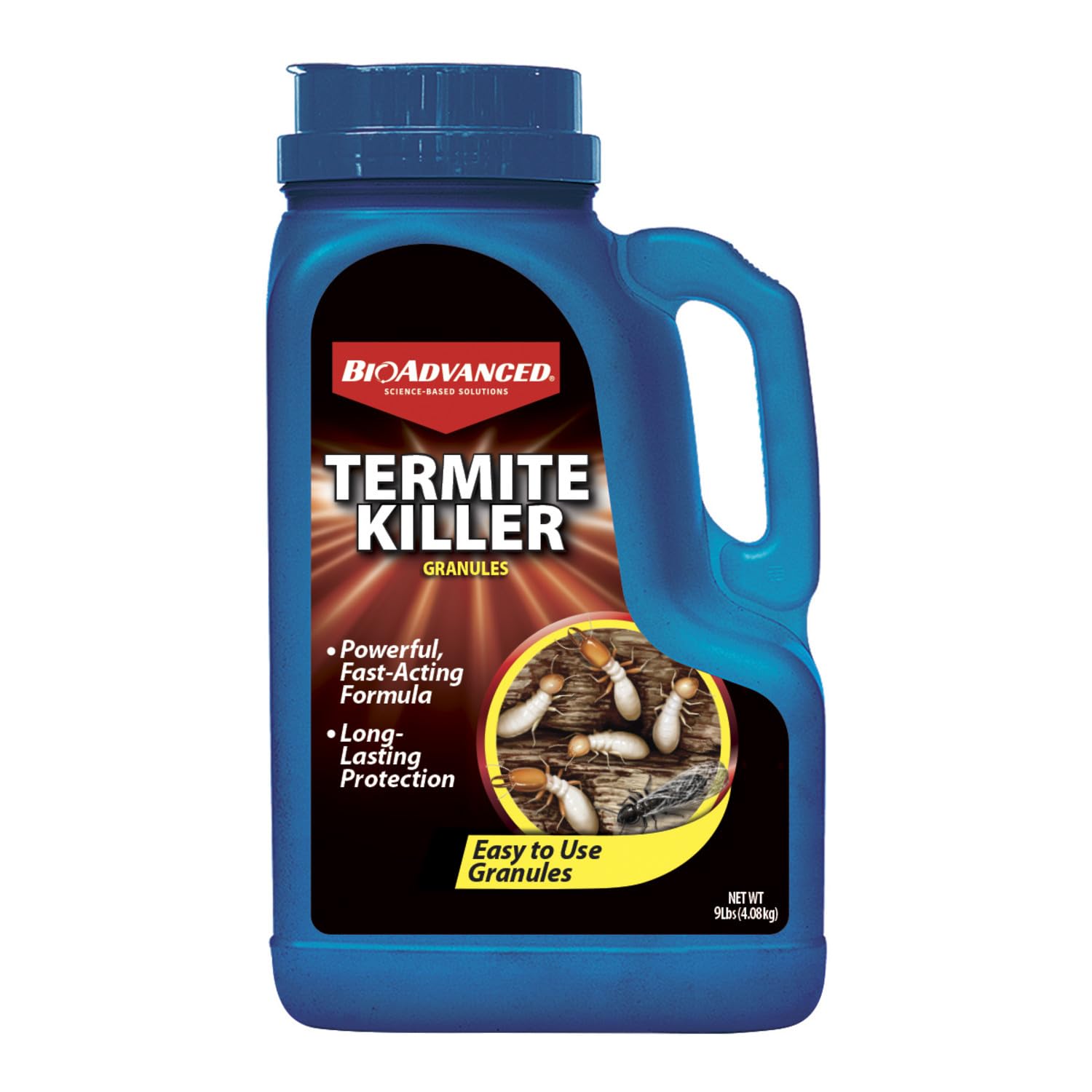
The BioAdvanced granules work as a contact-kill perimeter barrier rather than a true bait station—you sprinkle the BB-sized particles around the foundation, water them in, and the active ingredient forms a chemical zone that kills termites and other soil-dwelling insects on contact. The 9-pound bottle covers up to 4,500 square feet, making it ideal for large lots where installing dozens of individual stakes would be impractical.
This granular approach provides only 30 days of residual protection per application, so you need to reapply monthly during peak termite season. The fast-acting formula eliminates foraging workers within hours of contact, but because it doesn’t rely on social transfer, it won’t eliminate a distant colony the way a true bait station can. It works best as a short-term suppression tool or as a complement to in-ground bait stations.
The easy sprinkle-and-water application makes it accessible for homeowners who don’t want to dig holes or use an auger. Reviewers over age 70 specifically note that the lightweight granules are manageable without heavy lifting, and many use it annually as a preventive perimeter spray around foundations and crawl-space vents.
Why it’s great
- No drilling or station assembly required; simply broadcast and water
- Large coverage area—4,500 square feet per bottle
- Also kills ants, crickets, and centipedes on contact
Good to know
- Only 30 days of residual activity; requires monthly reapplication
- Does not address the colony at the source
4. Bonide Termite & Carpenter Ant Killer

Bonide’s concentrate targets subterranean termites through soil trenching—you dig a shallow trench around the foundation, mix the concentrate with water, and apply it to create a chemical barrier that remains active for up to five years per treatment. The bifenthrin-based formula provides both contact kill (when sprayed directly on insects) and residual activity that kills termites as they cross the treated zone. Users at remote wooded cabins report 15-year effectiveness with annual spring applications.
The 32-ounce bottle makes several gallons of finished spray, which is enough to treat a modest home perimeter in one session. This is not a bait station—it does not leverage colony social feeding—but it does create an extremely long-lasting chemical barrier that stops termites from reaching the structure. For homeowners who want a single-application solution without monitoring stations, this is the most durable option available.
Application requires a pump sprayer or sprinkling can, and the label specifies that the emulsion must be thoroughly mixed with water before use. The product also controls carpenter ants, carpenter bees, and wood-infesting beetles, making it a broad-spectrum wood-protection tool. Just be aware that the five-year residual assumes the soil is not disturbed by digging or heavy rain runoff.
Why it’s great
- Five-year residual barrier from a single trenching treatment
- Concentrate yields several gallons of finished spray
- Also kills carpenter ants and wood-infesting beetles
Good to know
- Requires digging a trench around the foundation for best results
- Does not eliminate the colony; works as a repellent barrier
5. Bifenthrin-Plus-C Insecticide
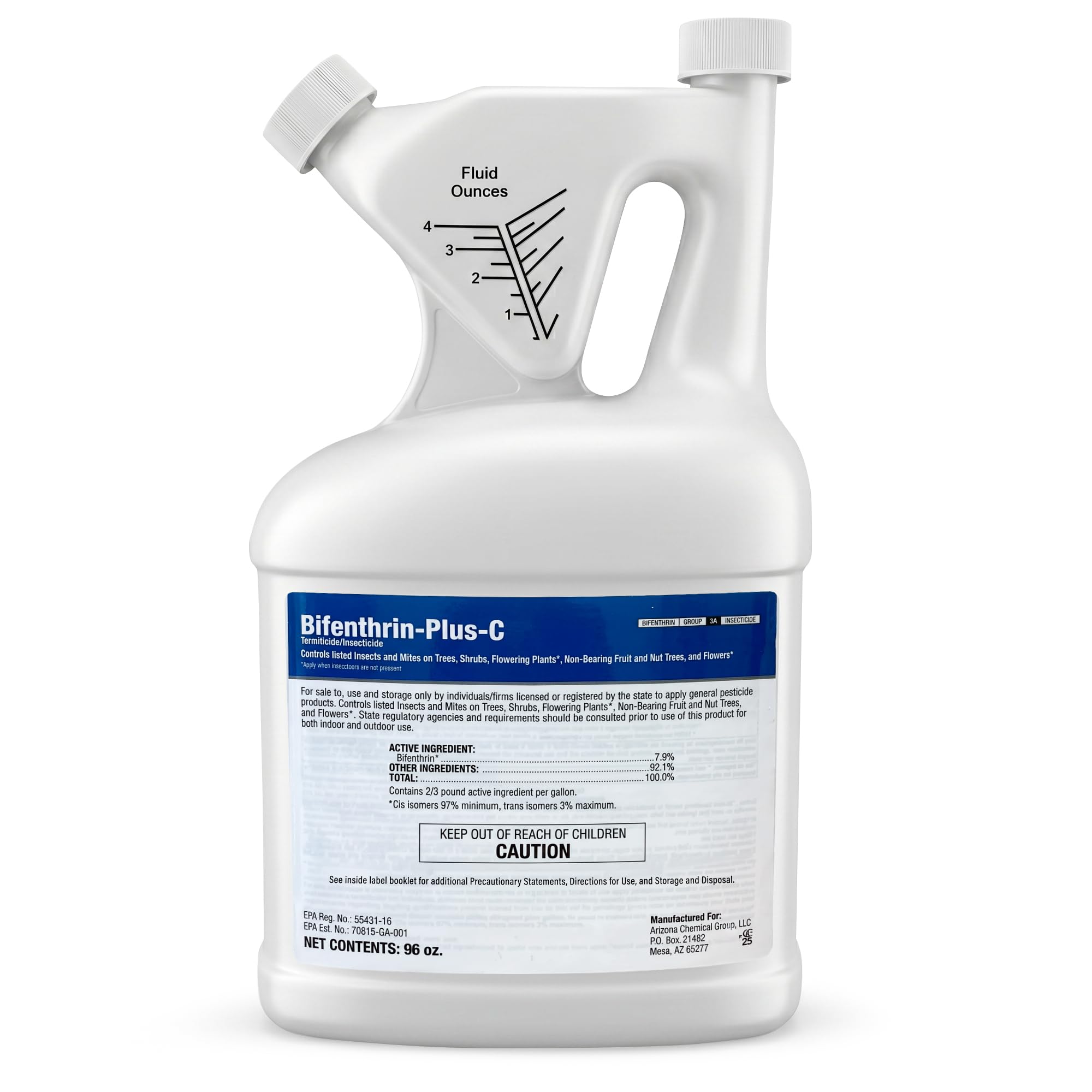
The Bifenthrin-Plus-C liquid concentrate functions as a broad-spectrum barrier spray that kills termites, roaches, ants, wasps, and spiders on contact, with residual activity lasting several weeks on surfaces. At 96 ounces, this is the largest concentrate volume in the guide, and it mixes at a low rate per gallon—one bottle can cover an entire house interior and perimeter in a single application. Users in high-pest regions like South Carolina report seeing no insects after a single treatment when reapplied every two months.
Because bifenthrin is a pyrethroid that works through contact and ingestion, it kills termites that walk through the treated zone but does not rely on social transfer to eliminate the colony. This makes it better suited as a knockdown tool for active infestations or as a maintenance perimeter spray rather than a colony-elimination bait system. The low-odor formulation allows indoor use in baseboards, corners, and crawl spaces without lingering chemical smell.
The biggest strength here is versatility—it handles termites, roaches, wasps, and spiders in one bottle, which eliminates the need to buy separate products for each pest. However, if your goal is specifically subterranean termite colony elimination using trophallaxis, a dedicated bait station system will deliver better long-term results.
Why it’s great
- One concentrate treats multiple pest types across indoor and outdoor spaces
- Low odor suitable for interior baseboard and crack applications
- High volume yields many gallons of finished spray
Good to know
- Not a bait system; kills on contact rather than through colony transfer
- Requires mixing and a sprayer for application
6. Advance Termite Bait Monitoring Stations

The Advance TBS system is a pure detection tool—the kit contains ten in-ground stations, ten untreated wood monitoring blocks, and ten inspection cartridges with no termiticide. You install the stations around your property, check the wood blocks every two to three months, and only introduce poison (usually Trelona cartridges sold separately) once you see termite activity. This two-phase approach gives you complete control over when and where you apply bait, and it avoids dumping chemicals into soil that has no termite pressure.
The station bodies are made from durable ABS plastic that holds up well in freeze-thaw cycles; reviewers report the same stations lasting five years with only the wood block needing replacement once due to rot in wet soil. Installation requires a 2.75-inch auger bit to dig nine-inch holes, and the kit does not include the spider tool needed to open the station lids—you will need to source that separately. The ten-station case covers a typical home perimeter when spaced eight to ten feet apart.
Given that the stations themselves are reusable and the monitoring blocks are replaceable, the long-term cost per year is very low once the initial investment is made. The primary trade-off is the initial labor of digging ten holes and the ongoing inspection schedule—if you prefer a set-and-forget approach, pre-loaded stakes are simpler.
Why it’s great
- Reusable station bodies reduce long-term cost
- Chemical-free monitoring avoids unnecessary pesticide use
- Same system used by professional pest control companies
Good to know
- Does not include poison; bait cartridges must be purchased separately
- No spider opening tool included; requires separate purchase or a flathead screwdriver
7. Protecta EVO Ambush Bait Stations

The Protecta EVO stations are locking plastic enclosures designed primarily for rodent bait but fully compatible with termite bait blocks that you insert manually. Each station has two entry holes, interior vertical rods for securing bait blocks, and a key-locked lid that prevents pets, children, and non-target wildlife from accessing the poison. The six-station case comes with one universal key (per order, not per station), and the bodies are rated for industrial use—reviewers report the same units still functional after four years of outdoor exposure.
Because these stations are empty, you supply your own bait blocks—either termite-specific cellulose baits or rodenticide blocks. This flexibility is useful if you want to switch between pest types throughout the year without buying new station bodies. The 10.3-inch length and 4.15-inch height offer enough internal volume for large bait blocks that termites can access easily via the ground-level entry holes.
The main limitation for termite-specific use is that the stations sit above ground rather than flush with the soil surface, which may make them more visible in a manicured lawn. They also lack the flush-cap design of dedicated in-ground termite stations, so they are better suited for perimeter placement along fence lines, garden edges, or near wood piles rather than right next to the foundation.
Why it’s great
- Lockable keyed lid provides excellent child and pet safety
- Durable ABS construction lasts years in outdoor conditions
- Interior vertical rods accommodate multiple bait formats
Good to know
- Above-ground design may be visually obtrusive near the foundation
- Only one key included per order; bait blocks sold separately
FAQ
How long does it take for termite bait stations to eliminate a colony?
Can I use rodent bait stations for termite bait instead?
Do I need to remove the wood block from detection stations every month?
Will termite bait stations work if I have an active infestation inside my walls?
How deep should I bury in-ground termite bait stations?
Final Thoughts: The Verdict
For most users, the best diy termite bait stations winner is the BASF Trelona Compressed Termite Bait because its novaluron IGR chemistry matches professional-grade colony elimination at a fraction of the service cost. If you want a complete kit that detects and kills in one step, grab the Spectracide Terminate Detection & Killing Stakes. And for a reusable monitoring system that lets you decide when to introduce poison, nothing beats the Advance Termite Bait Monitoring Stations.

Mo Maruf
I created WellFizz to bridge the gap between vague wellness advice and actionable solutions. My mission is simple: to decode the research and give you practical tools you can actually use.
Beyond the data, I am a passionate traveler. I believe that stepping away from the screen to explore new environments is essential for mental clarity and physical vitality.