Our readers keep the lights on and my smoothie glass nicely filled. As an Amazon Associate, I earn from qualifying purchases.
Diesel gel ups the ante every winter, turning a reliable engine into a non-starter. The real fix isn’t a prayer to the weather gods; it’s a tested additive that lowers the pour point, boosts cetane, and strips water from the tank before it can ice up your fuel lines.
I’m Mohammad Maruf — the founder and writer behind WellFizz. For this guide, I combed through hundreds of real user reports and lab-verified specs to separate the additives that actually lower gel points and protect high-pressure fuel pumps from the ones that just smell like diesel.
Because the wrong choice risks a tow bill and a fuel system flush, this review of the top shelf options here delivers the honest data you need to pick the right diesel antifreeze for your rig and your climate.
How To Choose The Best Diesel Antifreeze
Cold-weather diesel operation demands more than just a prayer to the block heater. The right additive lowers the fuel’s cold filter plugging point (CFPP), disperses water that can freeze, and provides the cetane bump needed for reliable ignition when the block is cold. Skip the cheap stuff that just smells like kerosene — it can actually lower lubricity and damage your injection pump.
Cetane Rating and Cold Starts
Cetane is the diesel equivalent of octane — it measures how quickly the fuel ignites under compression. A higher cetane number (typically 45–55 for treated fuel) means faster, more complete combustion, which directly translates to easier cold starts and reduced white smoke on warm-up. Many premium additives boost cetane by 5–7 points.
Anti-Gel vs. Anti-Wax
Diesel waxes at low temperatures — the paraffin crystals drop out of solution and clog fuel filters. True anti-gel additives slow this crystallization process, allowing the fuel to remain fluid several degrees below the normal cloud point. A good additive lowers the gel point by 10–15°F. Some products also include a de-icer that melts existing ice in fuel lines.
Lubricity and Pump Protection
Modern ultra-low sulfur diesel (ULSD) has less natural lubricity than older fuel. The high-pressure fuel pumps (HPFP) in common-rail engines rely on the fuel for lubrication. An additive that restores lubricity can prevent costly pump failure — a repair that often exceeds the value of the vehicle. Look for additives that meet or exceed ASTM D975 lubricity requirements.
Water Management
Water in diesel is the enemy. It causes injector corrosion, promotes microbial growth (diesel bug), and can freeze in fuel lines. Many premium formulations use demulsifiers to separate water from fuel so it can be drained at the water separator, while others use emulsifiers to disperse small amounts of water harmlessly through combustion. For most cold-weather users, a demulsifying formula is safer.
Quick Comparison
On smaller screens, swipe sideways to see the full table.
| Model | Category | Best For | Key Spec | Amazon |
|---|---|---|---|---|
| Hot Shot’s Secret EDT 32 oz | Mid-Range | All-around everyday performance | Treats 800 gallons | Amazon |
| Stanadyne Performance Formula 8 oz | Premium | OEM-level injector protection | Exhaust aftertreatment safe | Amazon |
| FPPF Killem Biocide 16 oz | Premium | Microbial control in stored fuel | Treats 1280 gallons | Amazon |
| Ford PM-23-A 20 oz | Mid-Range | OEM cold start for Ford trucks | ULSD compliant anti-gel | Amazon |
| Red Line 85-Plus 12 oz | Budget | Entry-level cetane boost | 12 oz concentrate | Amazon |
In‑Depth Reviews
1. Hot Shot’s Secret Everyday Diesel Treatment EDT 32 oz

The Hot Shot’s Secret EDT is a comprehensive six-in-one formula that handles everything from anti-gel protection to injector cleaning and cetane boosting. At a 1 oz treatment per 25 gallons, the 32 oz bottle covers 800 gallons — making it one of the most cost-effective options for regular use. Users consistently report 2–3 MPG gains after three consecutive fill-ups, which translates to around 6–7% fuel savings per tank.
The biggest advantage here is the cetane boost — up to 7 points — which delivers noticeably smoother idle and quicker cold starts in common-rail engines. The formula also doubles as a lubricity enhancer, protecting high-pressure fuel pumps from the low-sulfur wear that plagues modern injection systems. Many Duramax and Powerstroke owners note a reduction in DPF regen frequency, especially during stop-and-go city driving.
One minor drawback is that the larger bottle’s cap is prone to leaking if not stored upright. Several users recommend transferring to a smaller bottle after opening. The treatment is also slightly more expensive per ounce than budget additives, but the performance gains justify the extra cost for those who want a proven, all-in-one solution.
Why it’s great
- Proven 2–3 MPG fuel economy improvement
- Treats 800 gallons — exceptional value per treatment
- Boosts cetane by 7 points for easier cold starts
Good to know
- 32 oz bottle cap may leak if stored on its side
- Higher upfront cost per bottle vs. basic additives
2. Stanadyne Performance Formula 8 oz

Stanadyne is a name that carries weight in diesel circles — this is the same company that manufactures fuel injection systems for many OEMs. Their Performance Formula is designed to meet the stringent requirements of modern common-rail engines, and it is exhaust aftertreatment safe, meaning it won’t harm DPF or SCR systems. The 8 oz bottle treats up to 80 gallons of diesel, making it a mid-range option for those who want OEM-level protection.
The formula combines anti-gel protection for cold weather with lubricity enhancement and injector cleaning. Users running ULSD and B20 blends report that it restores the fuel’s natural lubricity, reducing wear on the injection pump. Many note improved throttle response and slightly better highway MPG after regular use. The additive also contains a corrosion inhibitor that protects metal components from moisture damage in the fuel system.
While the price per ounce is higher than some competitors, the peace of mind from using an OEM-approved fuel system protector is significant — especially for high-mileage trucks and heavy equipment. The only notable downside is the small bottle size; heavy users may find themselves reordering frequently, though a 4-bottle pack is available for convenience.
Why it’s great
- OEM-approved for modern common-rail injection systems
- Exhaust aftertreatment safe — no DPF damage risk
- Restores lubricity for ULSD and B20 blends
Good to know
- 8 oz bottle treats only 80 gallons — frequent reordering
- Higher cost per ounce than bulk options
3. FPPF Killem Biocide 16 oz

This is not an anti-gel additive in the traditional sense — it is a biocide designed to kill bacterial and fungal growth in diesel fuel tanks that can cause clogged filters, injector deposits, and corrosion. A single 16 oz bottle treats up to 1280 gallons (at 5 oz per 200 gallons), making it an incredibly concentrated solution for stored diesel. It is EPA registered, so it meets regulatory standards for fuel treatment safety.
Users with long-term fuel storage, such as RV owners and farmers, report that it clears black filter debris within minutes of first treatment. The formula targets both aerobic and anaerobic bacteria, eliminating the slime and sludge that forms at the diesel-water interface.
One thing to note: this is a maintenance product, not a performance additive. It does not boost cetane, improve lubricity, or provide anti-gel protection on its own. It should be used in combination with a quality fuel stabilizer and anti-gel additive, not as a replacement. The lack of manufacturer warranty is also worth considering for commercial operators.
Why it’s great
- Treats up to 1280 gallons — extremely cost-effective
- EPA registered for regulatory compliance
- Clears bacterial and fungal contamination quickly
Good to know
- No anti-gel or cetane boost properties
- No manufacturer warranty on the product
4. Ford PM-23-A ULSD Compliant Anti-Gel 20 oz

If you drive a Ford diesel (particularly a 6.7 Powerstroke or 6.0 Powerstroke), this Motorcraft PM-23-A is the only additive Ford officially approves for maintaining your factory warranty. The 20 oz bottle treats at a rate of 4 oz per tank of diesel, offering anti-gel protection, improved cold starting, and smoother idle. Users on 2016 and newer Ford trucks report fewer DPF regen cycles in city driving, which suggests it helps the fuel burn cleaner.
The formula is ULSD compliant and specifically designed to combat the effects of poor-quality diesel. It prevents wax buildup in fuel lines and filters, and many long-time users note that it improves fuel economy by 2–4 MPG after several fill-ups. The anti-gel properties are strong enough to handle overnight lows well below 0°F, making it a reliable choice for northern winters and mountain driving.
It is pricier per ounce than some generics, but the warranty protection factor alone makes it worth the premium for Ford owners. Users should note that it is best rotated with the summer formula (PM-22A) for year-round protection. A minor inconvenience is that the bottle lacks a measuring cap, so you will need a separate measuring device for accuracy.
Why it’s great
- Ford-approved — maintains factory warranty coverage
- Reduces DPF regen frequency in city driving
- Proven 2–4 MPG fuel economy improvement
Good to know
- No measuring cap included — separate tool needed
- Best used in combination with PM-22A for seasonal rotation
5. Red Line 85-Plus 12 oz
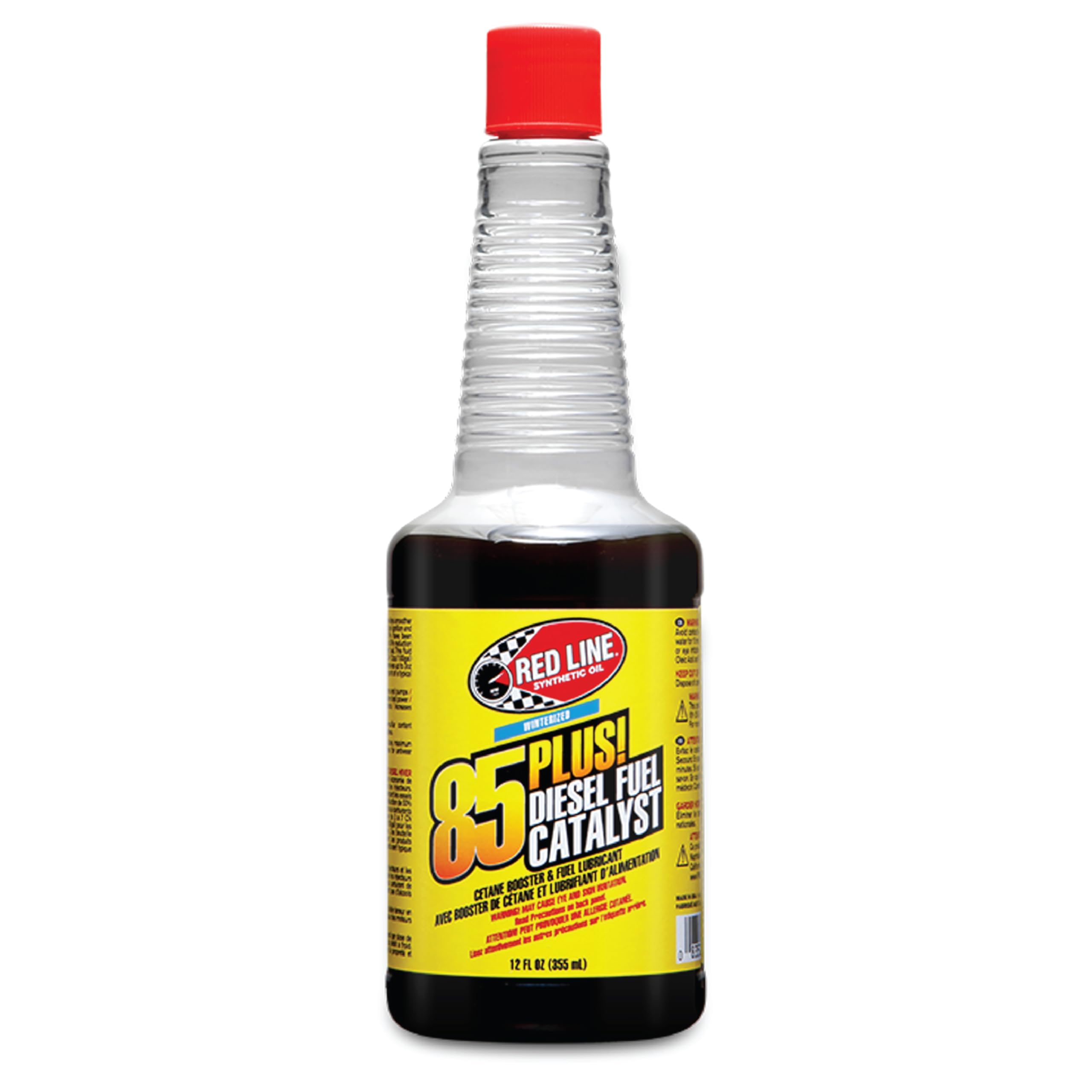
The Red Line 85-Plus is a straightforward cetane booster and lubricity additive that has been on the market for decades. It is particularly popular among owners of older diesel engines — such as the Mercedes 300D and early VW TDI — because it compensates for the missing additives in modern ULSD. Users report a smoother idle and noticeable power improvement off the line, especially in stop-and-go driving.
At 12 ounces, it is one of the smaller bottles in this lineup, and the treatment ratio is approximately 1 oz per 10 gallons, so a single bottle covers about 120 gallons. The formula is metal-safe and designed to mix with all diesel fuel types. It adds color to the fuel (red) which can help with identifying treated vs. untreated fuel in multiple-vehicle operations.
However, some users report mixed results with cold-weather performance. On modern 1.9 ALH VW TDI engines, several owners noted no improvement in diesel “nailing” (the characteristic clatter of diesel combustion) and some felt it may have increased noise slightly. It is best used as a summer or transitional additive rather than a primary winter anti-gel solution. For older engines, it is a solid entry-level choice, but for modern common-rail engines, the more advanced formulations above offer greater cold-weather assurance.
Why it’s great
- Great for restoring additive balance in older diesel engines
- Reduces idle clatter and improves throttle response
- Simple, no-fuss formula — no measuring hassle
Good to know
- Limited anti-gel performance in extreme cold
- Mixed results on modern common-rail engines
FAQ
Do I need a different additive for winter vs. summer driving?
Can too much diesel additive damage my engine?
Will an additive fix gelled fuel that’s already in my filter?
How often should I use a biocide in stored diesel fuel?
Final Thoughts: The Verdict
For most users, the diesel antifreeze winner is the Hot Shot’s Secret EDT 32 oz because it delivers proven fuel economy gains, a 7-point cetane boost, and all-in-one protection at a cost that makes regular use affordable. If you want OEM-specific warranty protection for your Ford truck, grab the Ford PM-23-A. And for long-term fuel storage where microbial contamination is a risk, nothing beats the FPPF Killem Biocide.

Mo Maruf
I created WellFizz to bridge the gap between vague wellness advice and actionable solutions. My mission is simple: to decode the research and give you practical tools you can actually use.
Beyond the data, I am a passionate traveler. I believe that stepping away from the screen to explore new environments is essential for mental clarity and physical vitality.