Our readers keep the lights on and my smoothie glass nicely filled. As an Amazon Associate, I earn from qualifying purchases.
That draft creeping under the baseboard or the attic ceiling sweating in July isn’t just uncomfortable — it’s your HVAC bill walking out the door. DIY foam insulation has changed how homeowners tackle energy loss, offering a way to seal gaps, stop air leaks, and add real thermal resistance without hiring a crew. But the difference between a project that pays for itself and one that turns into a sticky mess often comes down to the formulation, the delivery system, and the R-value per inch you actually get.
I’m Mohammad Maruf — the founder and writer behind WellFizz. I’ve spent hundreds of hours analyzing the chemical makeup, coverage specs, and real-world failure points of spray foam kits so you don’t have to gamble on a can that doesn’t deliver.
After cross-referencing fire ratings, board-foot yields, and customer accounts of adhesion and cure quality, this guide identifies the best diy foam insulation options for sealing, soundproofing, and insulating your home on your own terms.
How To Choose The Best DIY Foam Insulation
Whether you are sealing a rim joist or insulating an entire shed, picking the wrong spray foam kit wastes money and creates a cleanup nightmare. The three factors that separate a successful project from a regret are the foam cell structure, the application method, and the fire safety rating.
Closed Cell vs. Open Cell Density
The cell structure determines how the foam behaves once it cures. Closed-cell foam has a higher density (roughly 2.0 lb per cubic foot) and offers a higher R-value per inch — typically R-6 to R-7 per inch. It also acts as a vapor barrier, making it ideal for exterior walls, basements, and crawl spaces where moisture intrusion is a threat. Open-cell foam is lighter (0.5 lb per cubic foot), expands more aggressively to fill irregular cavities, and provides sound dampening, but it does not block moisture. Choose closed cell for maximum thermal resistance and moisture sealing; choose open cell for soundproofing and filling large, enclosed voids on a budget.
Board-Foot Coverage and Can Yield
Manufacturers list coverage in board feet — one board foot equals one square foot at one inch of thickness. A 12-can kit claiming 240 board feet should theoretically cover 240 square feet at one inch deep. In practice, overspray, uneven application, and tip sputtering can reduce real-world yield by 10–20 percent. Always buy one extra kit if you are insulating a critical envelope area; running out mid-wall means a cold seam and a compromised air seal.
Fire Rating and Safety Compliance
Building codes in most regions require insulation in exposed areas to meet ASTM E84 standards, which measure flame spread and smoke development. Class A (or Class I) is the highest rating, meaning the foam resists ignition and limits smoke output. If your foam will be left exposed in a garage, attic, or basement, a Class A fire-rated product is non-negotiable. Kits that lack this certification are best limited to concealed cavity fills where drywall or another thermal barrier will cover them.
Quick Comparison
On smaller screens, swipe sideways to see the full table.
| Model | Category | Best For | Key Spec | Amazon |
|---|---|---|---|---|
| Froth Pak 630 | Pro-Grade | Large projects, full-wall cavity fills | 630 board ft, 2-part system, 15 ft hose | Amazon |
| BEEST FullStop 480 Kit | Premium | Whole-home air sealing, large attics | 480 board ft, Class A fire rated, R-8.24 | Amazon |
| BEEST FullStop 240 Kit | Premium | Medium rooms, basements, sheds | 240 board ft, hybrid closed/open cell | Amazon |
| Y’allCanDIY 18 Pack | Mid-Range | Large DIY projects, multiple rooms | 360 board ft, R-8 at 2 inch | Amazon |
| QuickCoat Adhesive Guru | Mid-Range | Sheds, workshops, medium cavities | 240 board ft, R-5.66 per inch | Amazon |
| STANLEY F 990P Supercoat | Mid-Range | Automotive insulation, tight spaces | 11.32 R-value at 2 inch, Class A fire | Amazon |
| HADOR Reflective Foam | Budget | Window draft blocking, RV windows | 40 sq ft, 3 mm foam core, reflective foil | Amazon |
In‑Depth Reviews
1. Froth Pak 630 Spray Foam Insulation Kit

The Froth Pak 630 is a two-component closed-cell system designed for serious square footage. It yields up to 630 board feet and delivers an R-value of 6.2 at one inch or R-12.2 at two inches. The 15-foot hose and Insta-Flo gun give you real range of motion without dragging heavy tanks around a ladder.
This kit cures in 30 seconds, allowing re-entry in about one hour with proper ventilation. The foam bonds aggressively to wood, drywall, and masonry, which makes it excellent for rim joists, attic penetrations, and crawl spaces. The 12 cone and 4 fan nozzles included let you adjust the spray pattern between filling deep cavities and coating flat surfaces.
Green Circle Certified and LEED V4 compliant, it meets ICC listing requirements across all 48 contiguous states. Note that PPE is not included despite the professional price — you will need a Tyvek suit, respirator, and floor tarps. Customers consistently report a steep but manageable learning curve and massive heating bill reductions after application.
Why it’s great
- High 630 board-ft yield for large projects
- Fast 30-second cure with R-6.2 per inch
- Class A fire rated up to 2 inches
Good to know
- PPE not included despite premium price
- Requires signature upon delivery
- Sticky, messy cleanup if nozzles clog
2. BEEST FullStop Spray Foam Insulation Kit (480 Board Ft)
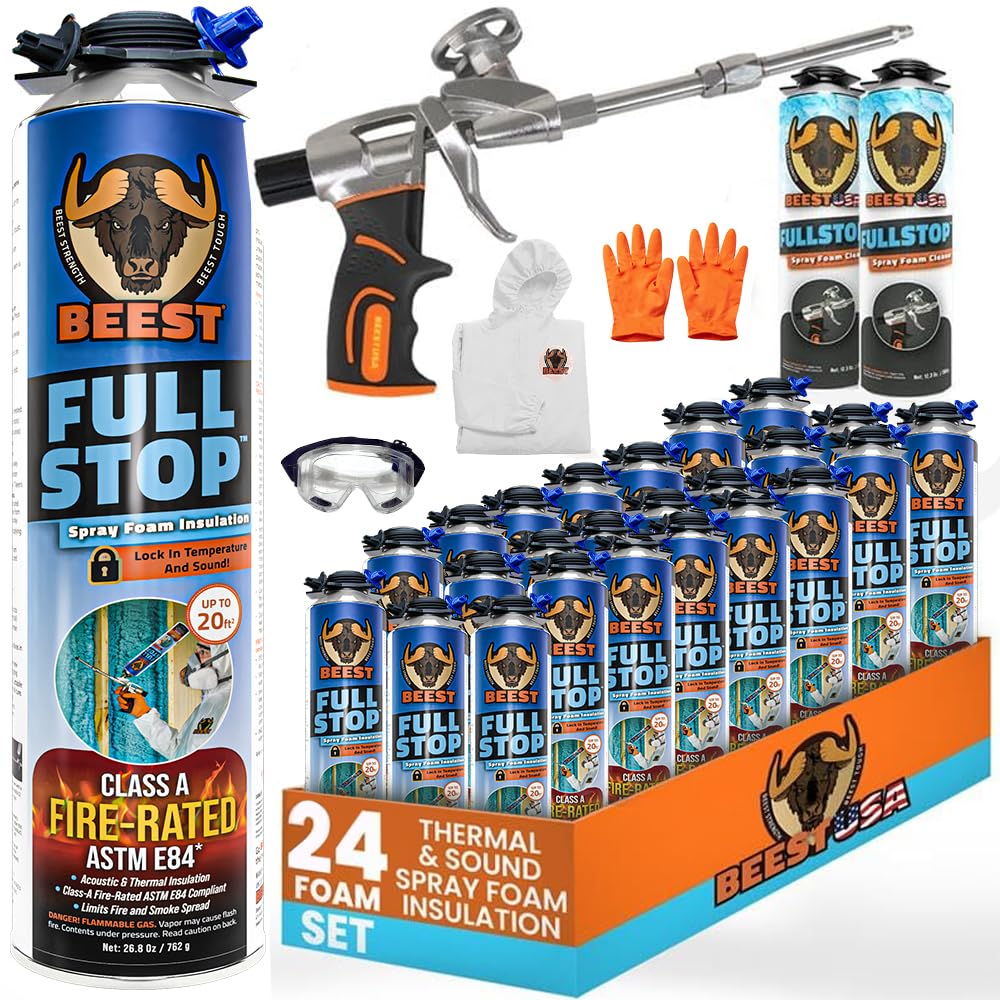
The BEEST FullStop 480 kit is the biggest consumer-grade box on the market. It packs 24 foam cans, two cans of solvent cleaner, one Pro X gun, and full PPE — Tyvek suit, booties, goggles, and gloves. The hybrid formulation combines a closed-cell outer skin that locks moisture out with an open-cell core that expands into irregular gaps without tearing.
At a 2-inch thickness, BEEST delivers an R-value of 8.24 and meets ASTM E84 Class A fire standards. The foam adheres strongly to wood, concrete, brick, and metal, making it reliable for sill plates, rim joists, and basement perimeters. The gun features half-trigger and full-trigger modes so you can switch between precise crack filling and wide fan coverage without changing tips.
Customers report consistent expansion with low fumes and no shrinkage after curing. The biggest real-world edge is the customer service — multiple verified reviews note that when guns leaked or glasses arrived cracked, the seller shipped replacements immediately. If you are insulating a full attic or a large garage, this kit eliminates the need for a second order mid-project.
Why it’s great
- Class A fire rated with R-8.24 at 2 inches
- Full PPE and two cleaner cans included
- Hybrid closed/open cell for moisture seal + expansion
Good to know
- Heavy box at 53 pounds
- Gun must be tilted horizontal in crawl spaces to avoid leaks
3. BEEST FullStop Spray Foam Insulation Kit (240 Board Ft)
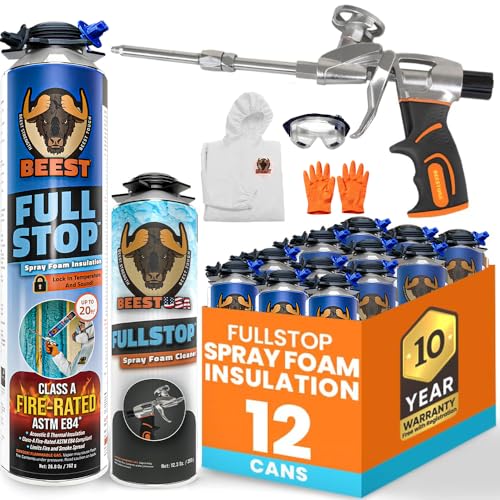
The BEEST FullStop 240 is the sweet spot for medium-scale DIY jobs. It covers 240 board feet — enough for a 10×10 room at 2 inches of depth — and includes 12 foam cans, a Pro X gun, solvent cleaner, goggles, gloves, and a Tyvek suit. The hybrid formulation gives you the moisture resistance of closed cell with the gap-filling flexibility of open cell, so it adapts to uneven wall cavities without pulling away from framing.
Rated R-8.24 at 2 inches, the foam is Class A fire rated and complies with ASTM E84 standards. The gun nozzle design allows on-the-fly adjustment from a thin bead for cracks to a wide fan for open bays. Most users report excellent adhesion to wood, drywall, and concrete with minimal overspray drift.
Customer feedback highlights the low fume level during application and the fact that the foam does not shrink after curing. The few reported issues — a leaking gun joint, a cracked safety glasses frame — were resolved by the seller with immediate replacements. For a single-garage wall, a basement rim joist ring, or a shed insulation project, this kit balances coverage and cost better than anything else in its tier.
Why it’s great
- R-8.24 at 2 inches with Class A fire rating
- All-in-one kit with reusable Pro X gun
- Strong adhesion to wood, concrete, metal
Good to know
- Foam expands quickly — wear gloves immediately
- Not ideal for large attic projects beyond 240 sq ft
4. Y’allCanDIY Spray Foam Insulation Kit (18 Pack)
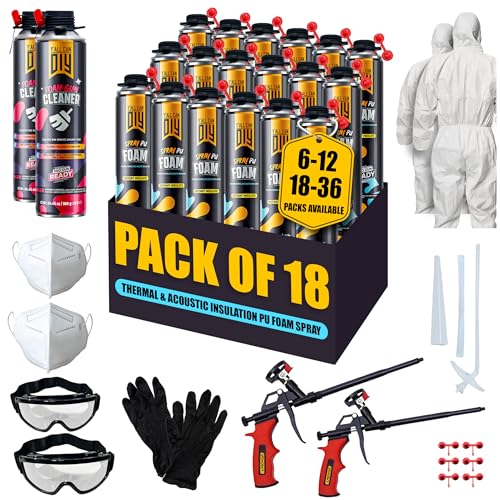
The Y’allCanDIY 18-pack bumps the can count to 18 for 360 board feet of coverage at 1-inch thickness, with an R-value of 8 at 2 inches. The kit includes two Teflon-coated foam guns, two cans of PU cleaner, 12 pairs of nitrile gloves, two safety glasses, two respirator masks, and two full coveralls — enough PPE for two people to work side by side without swapping gear.
The hybrid formula claims to combine closed-cell strength with open-cell expansion, similar to the BEEST approach but at a slightly lower R-value per inch. Each can comes with its own gun straw and a red spreader, and the package includes 4 long straws and 4 nozzles for reaching deep into band joists or floor cavities. Adhesion to wood, concrete, metal, and drywall is reliable when applied within the recommended 60–90°F range.
Customer reviews are mixed on nozzle consistency — some users report that each tip sprays differently, requiring frequent switching. A notable 6 out of 18 cans in one verified review arrived without pressure, and the product support link was broken at the time. If you buy this kit, open and test each can immediately upon arrival to avoid discovering defects mid-project.
Why it’s great
- Two guns and full PPE for dual-worker projects
- R-8 at 2 inches with good coverage per can
- Long straws reach deep into rim joists
Good to know
- Nozzle spray pattern varies can to can
- Some defective cans reported — test immediately
- Coverage may fall short on complex cavity shapes
5. QuickCoat Closed Cell Spray Foam Insulation Kit (Adhesive Guru)

The Adhesive Guru QuickCoat kit delivers 240 board feet with a closed-cell formulation that rates R-5.66 per inch. The box includes 12 foam cans, one aluminum foam gun with a PTFE non-stick coating, one can of cleaner, safety glasses, gloves, a coverall, 2 face masks, and 24 nozzles (12 blue, 12 black). The gun is built from anti-corrosion aluminum and is designed to resist wear over multiple uses.
The foam cures quickly — bonding in minutes and reaching full cure within 24 hours. Adhesion is strong on concrete, wood, metal, drywall, and even glass. The instruction recommends spraying 12–18 inches from vertical surfaces and 6–8 inches from ceilings for optimal expansion without sagging. Each can at 1-inch thickness covers roughly 20 square feet.
User reports are largely positive for medium DIY jobs like sheds and workshop walls, but some customers experienced adhesion failure when spraying overhead — foam fell to the ground before curing. The manufacturer resolved one verified defective kit by sending a full replacement after the return window closed. If you are insulating a ceiling or an overhead cavity, this formula may require very thin passes and extra patience.
Why it’s great
- PTFE-coated gun resists foam buildup
- 24 nozzles included for varied spray patterns
- Excellent customer service for replacements
Good to know
- Overhead adhesion can fail — avoid thick passes
- Gun tip must be cleaned after every can
- R-5.66 is lower than premium hybrid kits
6. STANLEY F 990P Supercoat Spray Foam Insulation Kit
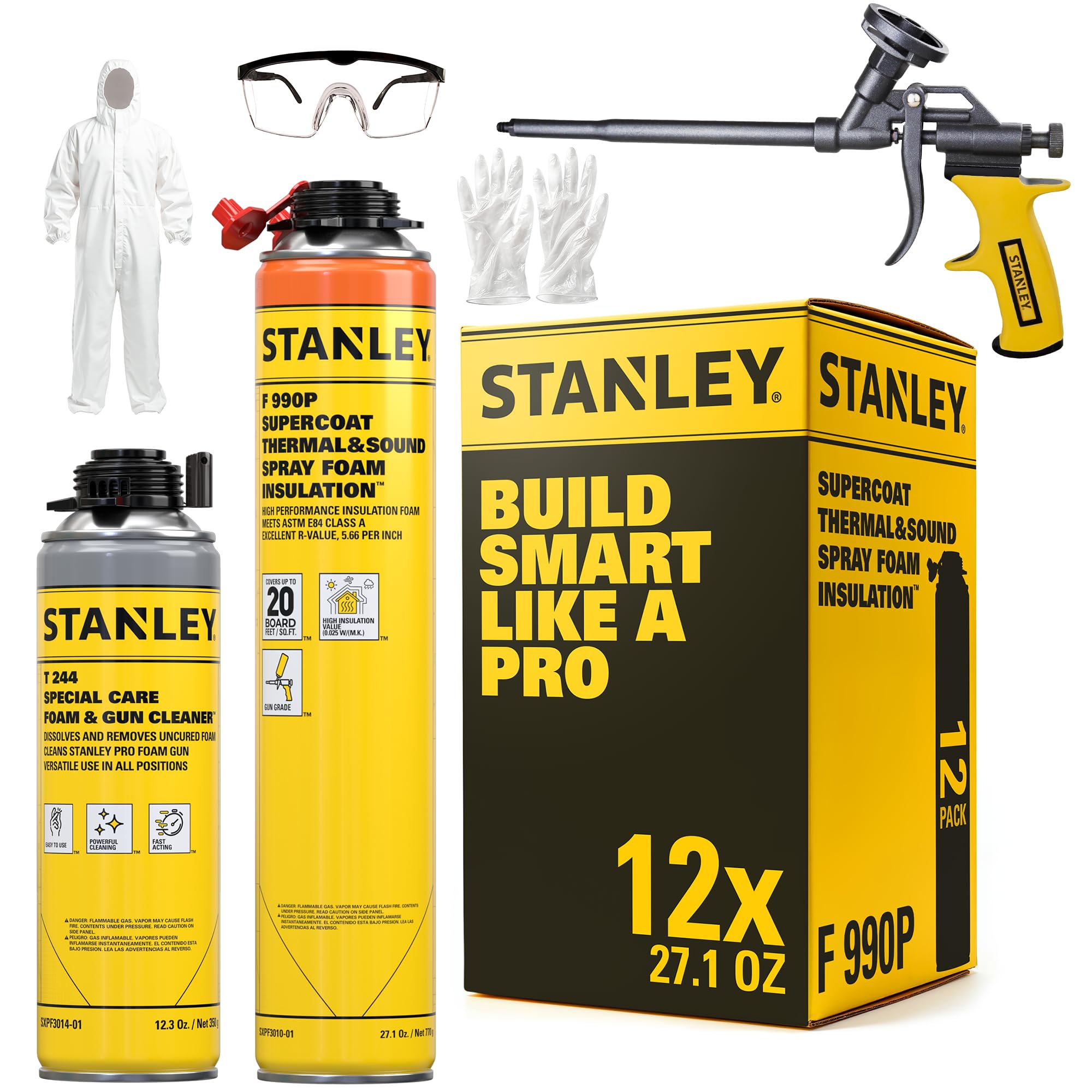
The STANLEY Supercoat kit is a 12-can system that targets automotive and tight-space insulation but works equally well for small home gaps. Its closed-cell polyurethane formulation delivers an R-11.32 at 2 inches and a low thermal conductivity of 0.025 W/(m·K), which means it punches above its can size in thermal resistance. The kit includes the foam gun, cleaner, gloves, glasses, and a protective suit.
What sets this kit apart is its seamless monolithic application — the foam creates a continuous barrier without the junctures and seams typical of EPS boards or fiberglass batts. It is Class A fire rated to ASTM E84, making it safe for visible application in garages and tool sheds. The dense structure acts as a barrier to water, air, and pests once cured.
DIY users report that the spray quality degrades noticeably in the second half of each can, and the gun cleaner loses pressure with about a quarter of the solvent left. One user documented a disastrous basement sill plate application where the foam did not cure properly, creating a difficult cleanup. For small projects like van insulation, duct sealing, or workshop cracks, this kit works well — but it is less forgiving than larger kits for broad wall coverage.
Why it’s great
- High R-11.32 at 2 inches in a small form
- Class A fire rated with monolithic seal
- Compact enough for automotive and RV use
Good to know
- Spray quality drops in second half of each can
- Gun cleaner loses pressure early
- Not reliable for large basement wall insulation
7. HADOR Reflective Window Film Insulation Roll

The HADOR Reflective roll is not spray foam — it is a 3 mm thick polyethylene foam core sandwiched between double-sided aluminum foil, covering 40 square feet per roll. This is your low-cost solution for window draft blocking, RV skylight insulation, and garage door heat reflection. The kit includes 65 hook-and-loop adhesive pads and a roll of heavy-duty aluminum foil tape for mounting without permanent damage.
The reflective foil surface blocks up to 99 percent of light and reduces heat transfer in both directions — keeping interiors cooler in summer and warmer in winter. Unlike spray foam, this product can be cut with scissors or a utility knife and repositioned if you make a mistake. It is also waterproof and suitable for outdoor applications like greenhouses and sheds.
Several customers note that the roll arrives folded with deep creases due to shipping constraints. While the creases do not affect thermal performance, they make the material harder to lay flat on large window panes. The adhesive pads hold well on smooth surfaces but may struggle with textured walls. This is a pure value pick for renters or anyone who needs a fast, removable insulation layer without committing to spray equipment.
Why it’s great
- No spray equipment needed — cut and stick
- Blocks 99% of light with dual reflective surfaces
- Removable with hook-and-loop pads
Good to know
- Arrives folded with creases that resist flattening
- 3 mm foam offers minimal R-value vs spray foam
- Not suitable for wall cavity insulation
FAQ
Can I use one spray foam kit for both walls and windows?
How long does spray foam take to cure before I can install drywall?
What temperature range is required for spray foam application?
Why does my spray foam smell like chemicals after it dries?
Can I paint over spray foam insulation?
Final Thoughts: The Verdict
For most users, the best diy foam insulation winner is the BEEST FullStop 240 Kit because it blends a Class A fire rating, R-8.24 performance at 2 inches, and an all-inclusive kit with a reusable gun at a realistic price for medium-sized projects. If you want maximum coverage for a full attic or large basement, grab the BEEST FullStop 480 Kit for double the board footage. And for pro-scale jobs like an entire house envelope, nothing beats the yield and cure speed of the Froth Pak 630 despite the higher investment in protective gear.

Mo Maruf
I created WellFizz to bridge the gap between vague wellness advice and actionable solutions. My mission is simple: to decode the research and give you practical tools you can actually use.
Beyond the data, I am a passionate traveler. I believe that stepping away from the screen to explore new environments is essential for mental clarity and physical vitality.