Our readers keep the lights on and my smoothie glass nicely filled. As an Amazon Associate, I earn from qualifying purchases.
The difference between a paint job that looks professional and one that screams “weekend warrior” often comes down to the tool in your hand. Rollers leave stipple, brushes leave streaks, and cheap sprayers leave a spitting, uneven mess that takes longer to fix than it would have to just brush it in the first place. The right DIY paint sprayer changes that calculus entirely — turning a weekend of tedium into an afternoon of smooth, factory-grade finishes on trim, cabinets, furniture, and even whole rooms.
I’m Mohammad Maruf — the founder and writer behind WellFizz. I’ve spent hundreds of hours combing through technical specs, comparing motor wattage against nozzle options and real-world cleanup difficulty, to separate the sprayers that actually deliver on their promises from the ones that just look good on a shelf.
Whether you’re refinishing a dresser or tackling the exterior of a shed, this guide breaks down the seven best models on the market to help you find the right diy paint sprayer for your next project and skill level.
How To Choose The Best DIY Paint Sprayer
Selecting the right sprayer is less about finding the most expensive box and more about matching the machine’s core technology to the jobs you actually have planned. Buying an airless unit with 3000 PSI for a single bookshelf project is overkill that complicates cleanup and wastes paint. Picking a tiny HVLP handheld for a whole-house repaint will frustrate you with constant refills and painfully slow coverage. The three factors below will guide your decision better than any brand name.
HVLP vs Airless: Which Technology Fits Your Work
High-Volume Low-Pressure (HVLP) sprayers use a turbine to push a large volume of air at low pressure, which atomizes paint into a soft, controlled mist. This makes HVLP the ideal choice for furniture, cabinets, trim work, and any job where precision and minimal overspray matter more than speed. They waste less paint and produce a finer finish, but they typically require thinning thicker paints like latex. Airless sprayers, by contrast, use a high-pressure piston pump to push paint directly through a small tip. They can spray unthinned latex straight from the can, cover massive square footage rapidly, and power through rough exterior surfaces. The trade-off is more overspray, heavier equipment, and a longer cleanup process. For most DIYers with a mix of small and medium projects, a versatile mid-range HVLP is the smarter starting point.
Nozzle Selection and Spray Pattern Versatility
Nozzle size is the single most overlooked spec by first-time buyers. A nozzle diameter of 1.0mm to 1.5mm is designed for thin materials like stains, sealers, and lacquers. A 1.8mm to 2.0mm nozzle handles most water-based latex paints and primers. A 2.5mm to 3.0mm nozzle is for heavy-bodied exterior paints and textured coatings. Buying a sprayer with at least three interchangeable brass or copper nozzles — ideally from 1.0mm up through 2.5mm or 3.0mm — gives you the flexibility to switch between a delicate furniture finish and a heavy fence coat without buying a second machine. Adjustable spray patterns (horizontal fan, vertical fan, round) add further control for edges, corners, and wide passes.
Cleanup Difficulty: The Real Hidden Spec
Every sprayer must be cleaned immediately after use, but the time and complexity of that process differs enormously. Models with fewer disassembly steps, disposable paint bag liners, or quick-flush adapters dramatically reduce the friction of cleanup. A machine that takes 30 frustrating minutes to disassemble and scrub will get left dirty — and a sprayer with dried paint in its fluid path is a paperweight. Look for models that explicitly advertise tool-free disassembly, reversible clog-clearing tips, or liner systems. If you are spraying multiple colors in one session, disposable liners become a near-necessity to avoid cross-contamination. The best sprayer for a Sunday painter is the one that stays easy to maintain between projects.
Quick Comparison
On smaller screens, swipe sideways to see the full table.
| Model | Category | Best For | Key Spec | Amazon |
|---|---|---|---|---|
| InoKraft HVLP Paint Sprayer | HVLP Handheld | Furniture & Cabinets | 1200ml cup, 3 brass nozzles (1.0-2.6mm) | Amazon |
| LESONJOY 1000W HVLP | HVLP Handheld | Large Furniture & Fences | 1000W motor, 4 copper nozzles (0.8-2.5mm) | Amazon |
| Wagner Control Spray 250 | HVLP Handheld | Stains, Varnishes & Trim | 800ml cup, 3 spray patterns | Amazon |
| Tilswall Shark 800 | HVLP Separated | Extended Reach Projects | 800W motor, 98in hose, 4 brass nozzles (1-3mm) | Amazon |
| Wagner Control Painter 520008 | HVLP Handheld | Decks, Sheds & Walls | 1.5qt hopper, adjustable flow & width | Amazon |
| VEVOR 750W Stand Airless | Airless Stand | House Exteriors & Large Fences | 3000 PSI, 1.2 LPM flow rate, 19.6 lbs | Amazon |
| PHALANX 780W Airless | Airless Handheld | Whole-House & Heavy-Duty | 3000 PSI, 25ft hose, reversible tip | Amazon |
In‑Depth Reviews
1. InoKraft Paint Sprayer
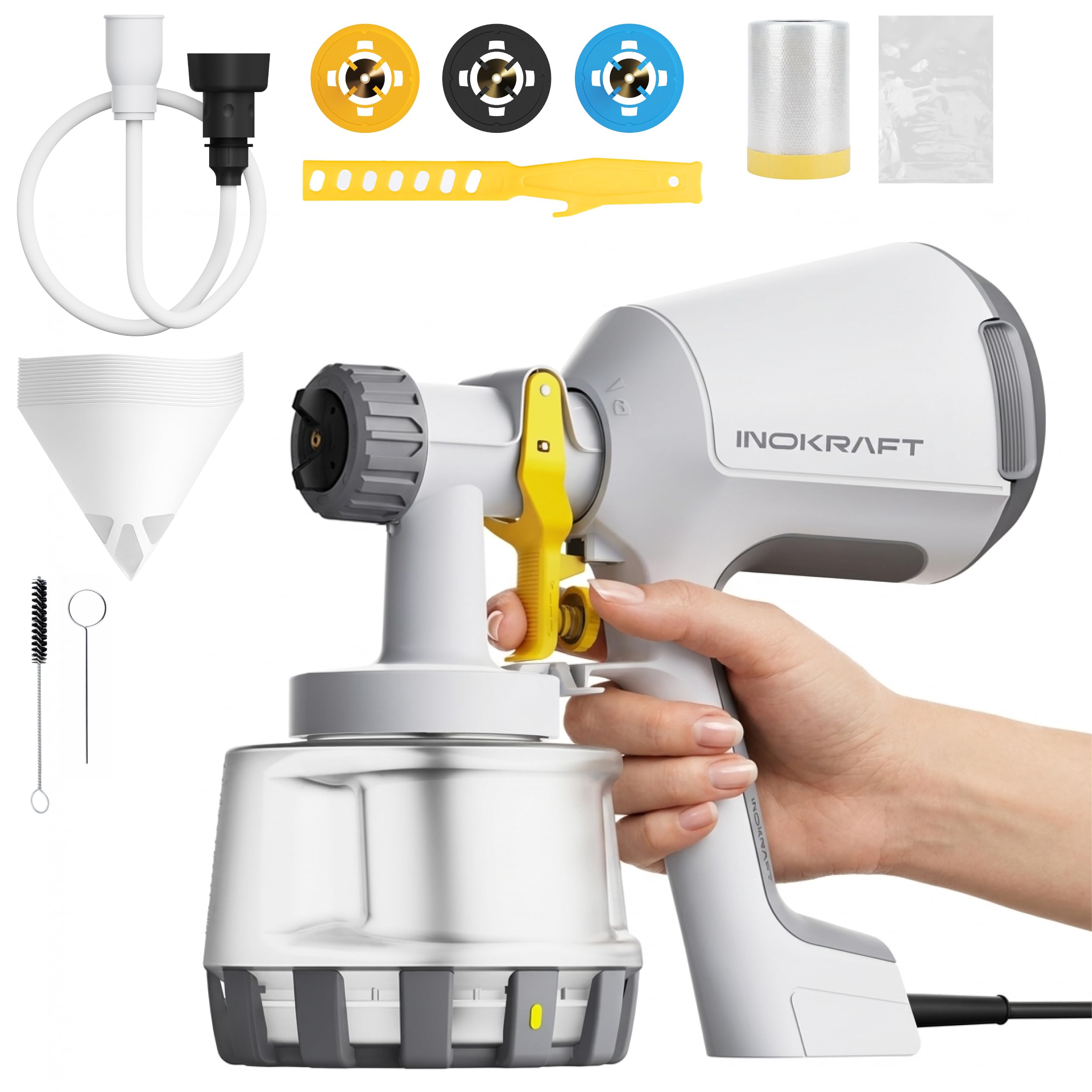
The InoKraft strikes a near-perfect balance for the DIYer who wants professional results without a professional budget. Its 15.8 GPH max flow rate and magnetic base that rotates the suction hose 360° mean you can spray continuously without stopping to reposition, which eliminates the drip-and-stop rhythm that plagues cheaper units. The clear 1200ml container has a mixing scale built in, so you don’t need a separate viscosity cup to get the right paint consistency before you start.
This HVLP sprayer comes with three brass nozzles covering 1.0mm, 1.8mm, and 2.6mm — a range that handles everything from thin stains on a rocking chair to thicker latex on kitchen cabinets. The included QuickFlush adapter and disposable bag liners transform cleanup from a dreaded chore into a five-minute process. Users report that the paper strainers in the kit are low quality, but the bag-only method works well enough that you can skip them entirely.
The real differentiator here is that InoKraft claims you can spray 90% of paints without thinning, which independent users confirm with Glidden satin paints through the 1.8mm nozzle. For -range performance that rivals Wagner units at double the price, this is the safest recommendation for a first-time sprayer buyer.
Why it’s great
- QuickFlush adapter and disposable bag liners make cleanup fast
- Magnetic rotating base prevents paint flow interruptions
- Three brass nozzles cover thin stains to thick latex without upgrade
Good to know
- Paper strainers included are flimsy and may need replacement
- Occasional reports of feed system issues when using the liners
2. LESONJOY 1000W HVLP Sprayer
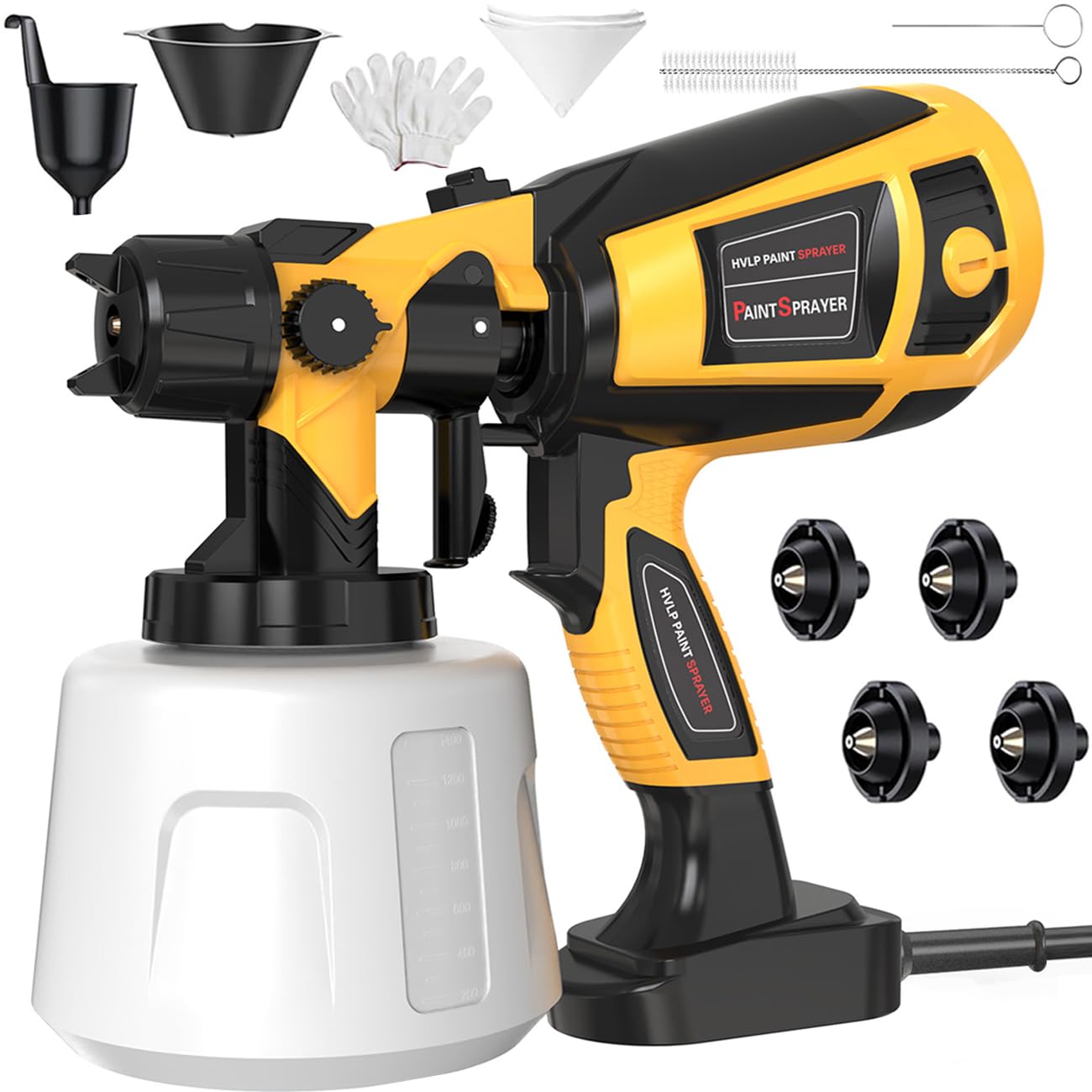
The 1000W motor inside this LESONJOY unit pushes more air volume than typical mid-range HVLP sprayers, which translates to faster coverage on larger items like fence panels and shed walls without sacrificing the fine atomization required for furniture. Four copper nozzles ranging from 0.8mm up to 2.5mm give you precision control for thin stains at the low end and heavy-bodied latex at the high end. The copper construction adds durability compared to the plastic nozzle tips found on entry-level models.
Three adjustable spray patterns — vertical, horizontal, and circular — combined with independent flow and width knobs let you dial in the exact fan shape and paint volume for each surface. The tool-free disassembly design is a welcome feature for cleanup, and the included cleaning brush and clogging needle keep the fluid path clear between uses. Users do note that the build feels lightweight and somewhat disposable, but for small to medium home projects it performs reliably.
The comprehensive kit includes a viscosity cup and filter funnels, which eliminates guesswork for first-timers who are unsure about paint thinning. If your priority is raw power per dollar for projects that mix fine detail with broad coverage, this 1000W model earns its place in the consideration set.
Why it’s great
- 1000W motor provides faster coverage than typical HVLP models
- Four copper nozzles offer wider material compatibility
- Tool-free disassembly and included cleaning kit simplify maintenance
Good to know
- Lightweight plastic construction feels less durable than metal alternatives
- Some users report it is best suited for small, occasional projects
3. Wagner Control Spray 250

Wagner has been the household name in DIY spraying for decades, and the Control Spray 250 justifies that reputation with a lightweight, intuitive design that behaves more like an aerosol can than a piece of heavy machinery. At just 3 pounds with an 800ml cup, this HVLP unit is ideal for staining fences, sealing decks, and spraying trim without arm fatigue. The stain adjustment dial is a standout feature — it lets you fine-tune the flow rate on the fly to minimize overspray and runs, which is exactly the kind of control beginners need.
Three spray patterns (horizontal fan, vertical fan, narrow round) cover the standard range of applications, and the manufacturer claims you can cover an 8×10-foot area in under two minutes. Real-world users confirm this speed on fence staining, with multiple reviewers covering 2000 square feet of fence or a 600-square-foot deck in a single session. The sprayer handles thinned paints, stains, and lacquers well, though thicker latex typically requires thinning to avoid tip clogs.
Cleanup takes the advertised eight minutes or less because the removable parts rinse clean without needing specialized tools. The main limitation is the small 800ml cup — you will refill frequently on larger jobs — but the trade-off in reduced weight and improved maneuverability is worth it for furniture and precision work.
Why it’s great
- Extremely lightweight at 3 pounds for fatigue-free use
- Stain adjustment dial reduces overspray and runs for beginners
- Fast cleanup in eight minutes with basic rinsing
Good to know
- 800ml cup requires frequent refills on large projects
- Thicker paints usually need thinning before spraying
4. Tilswall Shark 800

The Tilswall Shark 800 solves a problem most handheld sprayers ignore: arm weight during long sessions. By separating the 800W motor body from the spray head with a 98-inch air hose and including a shoulder strap, this HVLP system lets you keep the heavy component on the ground or slung over your shoulder while your hand holds only the lightweight gun. That makes a meaningful difference when you are spraying ceilings, tall cabinets, or the entire exterior of a garden shed.
Four brass nozzles from 1mm to 3mm provide the widest nozzle range in this price tier, and the side-feed design lets you refill paint without flipping the gun upside down or interrupting your spraying angle. The 118-inch power cord combined with the hose gives you roughly 16 feet of total operating radius before you need to move the base unit. Users report that spray coverage is smooth and glass-like when the paint is properly thinned and the smallest nozzle is selected at low flow.
While the unit supports high-viscosity paints up to 120 DIN-s, first-time users should still use the included viscosity cup to check consistency. Some users found the assembly slightly clunky initially, but once set up, the Shark 800 delivers professional-grade results on furniture, cabinets, fences, and walls with noticeably less arm strain than any all-in-one handheld.
Why it’s great
- Separated hose-and-body design with shoulder strap reduces hand fatigue
- Four brass nozzles from 1mm to 3mm handle any material thickness
- Side-feed refill keeps the gun stable and pointing at the work
Good to know
- Initial assembly feels clunky before you get used to the setup
- Paint must be thinned to proper viscosity for best results
5. Wagner Control Painter 520008

Stepping up from the Control Spray 250, the Wagner Control Painter 520008 brings a larger 1.5-quart hopper and a more robust motor that spreads coatings five times faster than a brush. This is the sweet spot for medium-to-large DIY projects like painting a basement, finishing a deck, or spraying an entire shed. The hopper is noticeably heavier when full than the Control Spray’s cup, but the extra capacity means you spend less time refilling and more time spraying.
Three adjustable controls — material flow, spray width, and pattern direction (horizontal or vertical) — give you the same beginner-friendly tuning found on the smaller Wagner models. Users consistently report flawless performance with oil-based stains like Ready Seal, and many note that the sprayer paid for itself in a single fence project by eliminating the need to rent professional equipment. Cleaning is straightforward with a four-part disassembly that rinses clean in about 20 minutes.
The main compromises are the need to thin latex paints (typically at a 2:1 paint-to-water ratio) and the hopper weight when completely full, which can strain the wrist over extended use. However, for the price, this Wagner delivers the fastest coverage per minute of any handheld HVLP in this guide, making it the prime choice for large-area DIY work.
Why it’s great
- 1.5-quart hopper reduces refill frequency on large projects
- Three adjustable controls match material and surface conditions
- Users report flawless performance with oil-based stains
Good to know
- Heavier to hold when hopper is full — strap may be needed
- Latex paints typically require thinning to 2:1 ratio
6. VEVOR 750W Stand Airless Sprayer

The VEVOR 750W Stand Airless marks the transition from handheld HVLP to serious airless power, delivering up to 3000 PSI through a stand-mounted unit that can draw paint directly from a 5-gallon bucket. This machine is built for the DIYer who has graduated from furniture projects to whole-house exteriors, long fence lines, and garage doors. The 750W motor pushes paint at 1.2 liters per minute, which users confirm is fast enough to paint hundreds of feet of fence in under two hours or coat an entire two-story house over a weekend.
Fan-shaped atomization technology ensures even coverage across wide passes, and the infinite speed control knob lets you switch between high-output for large walls and lower output for trim to reduce paint consumption. The detachable pump body and included cleaning brush make deep cleaning accessible, though users note that cleanup is messier than with HVLP systems. The 19.6-pound weight and full-metal frame add stability during operation but require storage space in a garage or workshop.
For users tackling medium-to-large painting tasks, this VEVOR unit has repeatedly been described as a machine that “pays for itself after one use” compared to renting professional equipment. The extended hose and detachable design allow you to use an extension pole for high ceilings and ground-level work without bending, making it a practical investment.
Why it’s great
- 3000 PSI and 1.2 LPM flow rate handle large exteriors rapidly
- Infinite speed control reduces paint waste on smaller areas
- Detachable pump body and cleaning brush simplify maintenance
Good to know
- Heavier than handheld units at 19.6 lbs — not for quick touch-ups
- Cleanup is messier and takes longer compared to HVLP systems
7. PHALANX 780W Airless Sprayer

The PHALANX 780W Airless Sprayer takes the airless category a step further with a 25-foot high-pressure hose that lets you leave the heavy pump unit in one spot while you move freely around a room or along a fence line. The 780W motor pushes 3000 PSI of pressure through an upgraded anti-drip metal gun, and the reversible spray tip is a clever time-saver — a 180-degree rotation clears debris clogs in seconds without disassembling anything.
The standout feature here is the quick-rinse system that flushes paint from the fluid path in under 10 minutes, addressing the biggest complaint airless users have about cleanup. The unit draws directly from 1 to 5-gallon buckets, so you never stop to refill a hopper — you just move the hose. Users report painting two 20-foot shipping containers in 10 minutes each and coating entire house interiors in marathon sessions without issues. The ETL certification provides safety assurance that not all imported airless units carry.
Some users experienced a pressure control knob that popped off during use, though PHALANX replaced the units under warranty. Setup and cleanup both take patience on the first use — the instructions are dense — but once mastered, this sprayer delivers the fastest, most consistent coverage of any unit in this guide for whole-house projects. If your agenda includes interior walls, exterior siding, decks, and cabinet refinishing all in one season, this is the tool.
Why it’s great
- 25ft hose allows uninterrupted movement without moving the pump
- Reversible spray tip clears clogs in seconds without disassembly
- Quick-rinse system flushes paint in under 10 minutes
Good to know
- Instructions are dense and first-time setup requires patience
- Occasional quality-control issues with control knob reported
FAQ
Do I need to thin latex paint before using an HVLP sprayer?
Can I use an airless sprayer for small furniture projects?
How long does it take to clean a DIY paint sprayer after use?
What is the difference between brass and copper nozzles?
Is a stand-mounted airless sprayer worth it for occasional use?
Final Thoughts: The Verdict
For most users, the diy paint sprayer winner is the InoKraft Paint Sprayer because it combines a generous 1200ml cup, three brass nozzles, and a QuickFlush cleaning system at a price that makes professional-grade results accessible to anyone. If you want the extended reach and reduced arm fatigue of a separated sprayer system, grab the Tilswall Shark 800. And for whole-house exteriors or massive fence jobs where speed is the priority, nothing beats the PHALANX 780W Airless Sprayer with its 25-foot hose and rapid-clean system.

Mo Maruf
I created WellFizz to bridge the gap between vague wellness advice and actionable solutions. My mission is simple: to decode the research and give you practical tools you can actually use.
Beyond the data, I am a passionate traveler. I believe that stepping away from the screen to explore new environments is essential for mental clarity and physical vitality.