Our readers keep the lights on and my smoothie glass nicely filled. As an Amazon Associate, I earn from qualifying purchases.
Whether you’re safeguarding a curious toddler, tracking foot traffic at a small business, or just want to know when the back door swings open, a reliable alert system turns an unknown event into an immediate, actionable notification. The market is split between simple magnetic contact sensors and more flexible motion-activated chimes — and choosing the wrong type can mean false alarms or missed entries.
I’m Mohammad Maruf — the founder and writer behind WellFizz. My research process involves cross-referencing hundreds of verified customer experiences against manufacturer specs and real-world use cases to isolate what actually works versus what only looks good on the box.
This focused guide cuts through the noise to deliver the best options available, helping you match the right technology to your specific need. Choosing the right door alarm depends on whether you need instant contact alerts or broad motion detection for a busy entryway.
How To Choose The Best Door Alarm
Selecting the right entry alert comes down to three core decisions: sensor type, installation constraints, and how you want to be notified. The wrong choice here can lead to either a system that never triggers or one that triggers constantly for no reason.
Contact Sensor vs. Motion Detector
Magnetic contact sensors are the gold standard for doors and windows that open and close. They trigger instantly when the magnetic gap breaks, providing a precise alert for a specific opening event. Motion detectors, by contrast, cover a broader area and trigger when movement is detected within their field. A contact sensor is ideal for a single door you want to monitor; a motion detector is better for an entire room or a hallway entry where the door itself is often left open.
Volume, Range, and Power Matter
A door alarm that can’t be heard from the basement is useless. Pay attention to the decibel rating: anything above 100 dB can be heard across a typical home, but adjustable volume is a must so you can dial it down for quiet environments. Wireless range determines whether the sensor can reliably communicate with a receiver placed far away — look for at least 300 feet of open-air range for larger homes or commercial spaces. Battery life varies wildly, with contact sensors often lasting years on a coin cell, while motion detectors may need AAA replacements every 12 to 18 months.
Quick Comparison
On smaller screens, swipe sideways to see the full table.
| Model | Category | Best For | Key Spec | Amazon |
|---|---|---|---|---|
| Ring Alarm Contact Sensor 2nd Gen | Smart Contact Sensor | Whole-home smart security | ~3-year battery life | Amazon |
| METAK Door Chime (2 Transmitters) | Wireless Contact Chime | High-volume business or home | 120 dB max volume | Amazon |
| SECRUI Motion Sensor Doorbell | Motion Detector | Open areas & pet monitoring | 500 ft wireless range | Amazon |
| TECKNET 3-Pack (B0BY8D81NB) | Contact Sensor | Multi-door family safety | 0.78-inch trigger gap | Amazon |
| TECKNET 3-Pack (B0FF4TPFZ4) | Contact Sensor | Budget-friendly multi-room | 3-level adjustable volume | Amazon |
In‑Depth Reviews
1. Ring Alarm Contact Sensor – 2nd Gen

Ring’s second-generation contact sensor refines an already solid formula, shrinking the footprint while extending the battery life to a market-leading three years on two CR2032 cells. The tamper-resistant battery cover addresses a common complaint from the first generation, where the coin cells could shift and lose contact. Integration with the Ring ecosystem remains the primary draw, pushing instant mobile alerts through the Ring app whenever a door or window opens.
Installation is genuinely tool-free: the included adhesive backing sticks firmly to most clean surfaces, and the slim profile fits even narrow door frames without protruding. The sensor tolerates up to a 1-inch gap between the magnet and the sensor body, giving some leeway for less-than-perfect alignment. This tolerance is wider than many competing contact sensors, reducing the chance of false triggers from door warping or settling.
Real-world reliability is excellent once mounted on a flat, non-metal surface. Users report that curved or metal door frames can trigger the built-in tamper switch, but a simple wood spacer resolves the issue. The real catch is the requirement for the Ring Alarm Base Station — this is not a standalone alarm. You are buying into the Ring ecosystem, which adds cost but unlocks a full smart-home security platform.
Why it’s great
- Best-in-class 3-year battery life
- Up to 1-inch gap tolerance for easy alignment
- Slim design fits narrow frames
Good to know
- Requires Ring Alarm Base Station to function
- May need wood spacers on metal doors
- Subscription needed for recording features
2. METAK Wireless Door Chime (2 Transmitters)
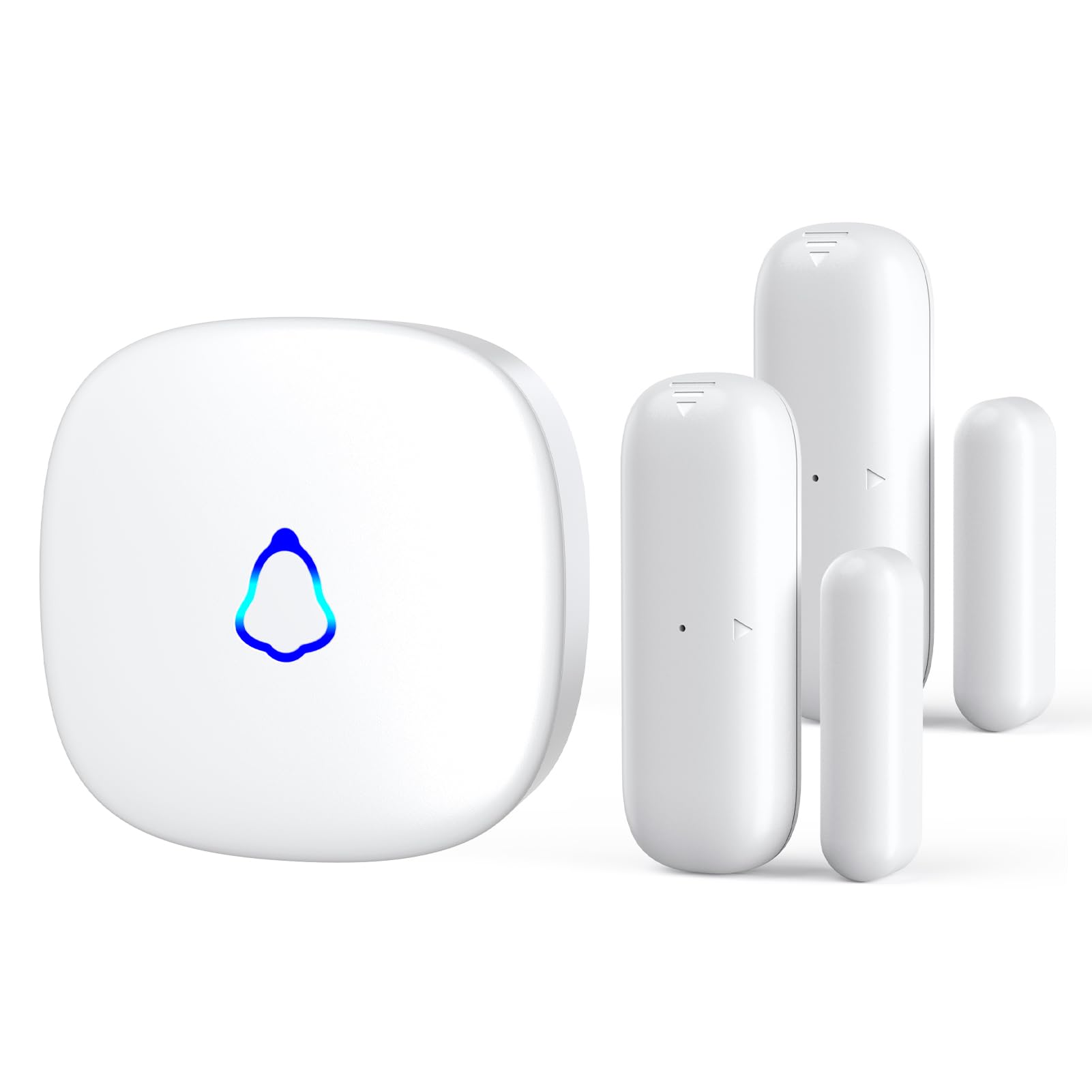
If raw volume and flexibility are your priority, the METAK system stands apart with a blistering 120 dB maximum output — loud enough to cut through a busy workshop or reach the far end of a warehouse. The package includes two slim transmitters and one plug-in receiver, giving you dual-door coverage right out of the box. The 500-foot wireless range in open air means the receiver can sit in a back office while the sensors watch the front and back doors.
The receiver offers 58 unique chime tones, from traditional doorbell sounds to attention-grabbing alarm sequences, all adjustable across five volume levels including a full mute. This granular control lets you match the alert to the environment: a gentle chirp for a home office during the day, or a full blast for a retail store after hours. The transmitters run on a single AAA battery each, and the ultra-low-power design stretches that charge to one or two years depending on usage.
One practical limitation to note is the lack of a low-battery indicator on the transmitter, which some long-term users discovered the hard way when a door silently stopped reporting. The system also chimes once on door open and resets when the door closes, which is reliable but lacks the “tamper alert” found on more sophisticated contact sensors. For pure entry alert duty across two doors with massive volume headroom, this is a compelling turnkey solution.
Why it’s great
- Industry-leading 120 dB max volume
- 58 chime options with 5 volume levels
- 500 ft range covers large properties
Good to know
- No low-battery indicator on transmitters
- Single chime per open event; no tamper detection
- Receiver must be plugged into an outlet
3. SECRUI Wireless Motion Sensor Doorbell

When a standard contact sensor won’t cut it — because the door is frequently open, or you need to cover a hallway entrance — the SECRUI motion detector steps in with a 26-foot detection range and a 360-degree rotatable sensor head. This design allows you to aim the detection zone precisely, avoiding false triggers from pets or passing cars outside a window. The plug-in receiver supports up to 20 sensors or receivers in a single system, making it expandable for retail stores or multi-room facilities.
The receiver offers 32 ringtones and five volume levels, hitting up to 110 dB at maximum. The mute mode works sequentially from the highest volume setting, which is slightly less intuitive than a dedicated mute button but functional once you learn the cycle. The motion sensor itself runs on two included AAA batteries, while the receiver can be powered via USB (5V) if you prefer not to occupy an outlet.
Real-world feedback highlights creative applications beyond simple door monitoring: parents use it to track when children with autism leave their rooms, and pet owners rely on it to catch cats on kitchen counters. The sensitivity is adjustable through positioning, and the sensor has proven reliable over months of continuous use. The main caveat is that motion detectors inherently cannot distinguish between a person and a large pet, so placement and angle are critical for reducing nuisance alerts.
Why it’s great
- 360-degree rotatable sensor for precise aiming
- Expandable up to 20 devices
- Works standalone without a hub or subscription
Good to know
- Motion detectors can trigger on large pets
- Mute mode entry is not immediately obvious
- Sensor batteries not included in all packages
4. TECKNET Door Alarms (B0BY8D81NB) – 3 Pack

The TECKNET three-pack brings straightforward, battery-powered contact sensing to multiple doors without the complexity of a hub or app. Each unit is compact and adhesive-mounted, pairing a small sensor piece with a slightly larger alarm body. The trigger gap is tight at 0.78 inches, so careful alignment during installation is necessary — the two components must sit within this short distance to reliably detect door separation.
Volume is adjustable across three levels, topping out at 65 dB according to the listed spec, though user reports suggest the actual output is more piercing than the number implies. The unit offers two alarm modes: a single doorbell chime for routine entry awareness, and a continuous high-pitched alarm for security situations. The three-level volume control means you can set a gentle chime for a child’s door during nap time and a full blast for an exterior door at night.
The adhesive is strong on clean, flat surfaces, but grooved door molding or textured frames may require repositioning or a small mounting block. Some users successfully installed the alarm upside down — sensor on the door edge, alarm body at an angle on the frame — to accommodate tight clearances. The 65 dB rating is moderate compared to the 120 dB monsters in this guide, making this kit better suited for home use where you need an audible alert without deafening the household.
Why it’s great
- Compact, no-hub design for quick multi-door coverage
- Two alarm modes: doorbell chime or continuous alarm
- Three volume levels for environment-specific use
Good to know
- Tight 0.78-inch trigger gap demands precise alignment
- 65 dB is moderate; not for noisy environments
- Struggles on grooved or textured molding
5. TECKNET Window & Door Alarm (B0FF4TPFZ4) – 3 Pack
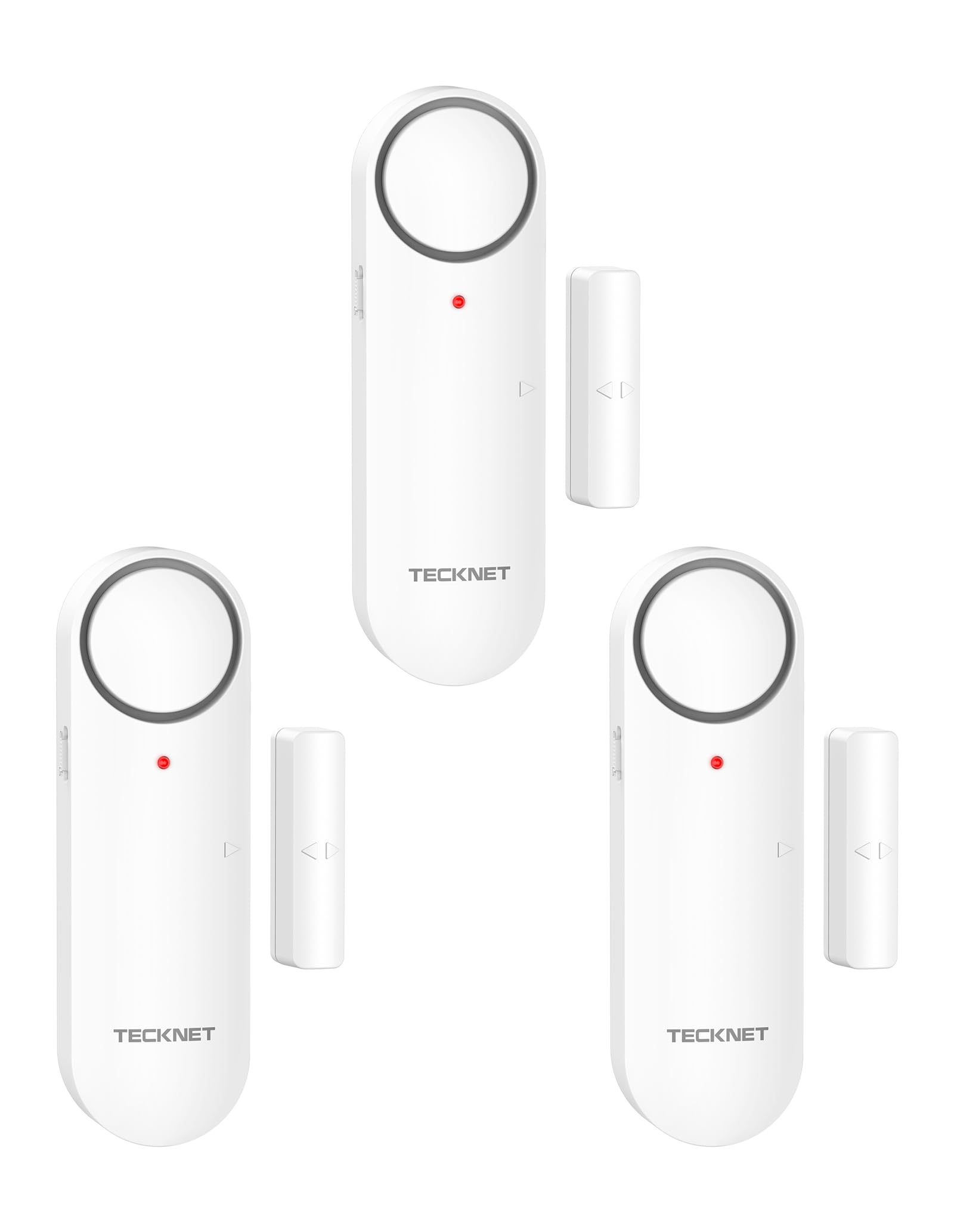
This second TECKNET three-pack is nearly identical in form and function to its sibling, with a few spec differences that shift its best-use scenario. The trigger gap on this model is specified at 2 cm (~0.79 inches), fundamentally the same tight tolerance that requires careful placement. The primary distinction is the power source: this model also uses 2 AAA batteries instead of the smaller cells found in some competing units, offering more total energy capacity and a slightly heavier feel at 141 grams per unit.
The 2-in-1 alarm and chime modes mirror the other TECKNET set, with a long press on the volume button toggling between alarm and doorbell sounds. The three volume levels provide the same flexibility, and the 36-month warranty with registration offers a safety net for the budget-conscious buyer. The white finish is unobtrusive against most door frames and window casings.
Parent reviews dominate the feedback, with multiple households using these to monitor doors opened by toddlers or children with autism. The adhesive holds well on clean surfaces, and the compact size makes these easy to pack for travel — several users noted taking them to hotel rooms for peace of mind. The lack of any smart-home integration is the trade-off for the low entry point, but for a simple, reliable chime or alarm that works independently of WiFi and apps, this pack delivers consistent performance at a very accessible price point.
Why it’s great
- Very accessible price for a three-pack
- AAA batteries offer long replacement cycles
- Works with no WiFi, app, or subscription
Good to know
- Tight 2 cm gap tolerance for reliable triggering
- No smart features or remote alerts
- Adhesive may fail on textured surfaces over time
FAQ
Can a door alarm work on a sliding glass door?
Will a motion detector door alarm trigger on my cat or dog?
How long do door alarm batteries typically last?
Final Thoughts: The Verdict
For most users, the door alarm winner is the Ring Alarm Contact Sensor 2nd Gen because it combines a three-year battery life, slim design, and deep smart-home integration into a single reliable package. If you want deafening volume and dual-door coverage without a hub, grab the METAK Wireless Door Chime. And for a flexible motion-detection system that covers open hallways and entries without any subscription, nothing beats the SECRUI Motion Sensor Doorbell.

Mo Maruf
I created WellFizz to bridge the gap between vague wellness advice and actionable solutions. My mission is simple: to decode the research and give you practical tools you can actually use.
Beyond the data, I am a passionate traveler. I believe that stepping away from the screen to explore new environments is essential for mental clarity and physical vitality.