Our readers keep the lights on and my smoothie glass nicely filled. As an Amazon Associate, I earn from qualifying purchases.
A clogged diesel particulate filter (DPF) triggers a cascade of expensive problems: reduced engine power, frequent regeneration cycles that waste fuel, and eventually a -plus replacement bill if left untreated. The right cleaner dissolves accumulated soot and ash, restores normal regeneration intervals, and protects your CP4 pump and turbo from deposit buildup — all from a single pour into your fuel tank.
I’m Mohammad Maruf — the founder and writer behind WellFizz. I’ve spent hundreds of hours analyzing laboratory data, customer test results, and technical specification sheets on DPF cleaning chemistry to separate maintenance formulas from emergency clog-busters.
This guide breaks down the seven most effective products for restoring your DPF, covering everything from chemical biocide treatments for algae-laden tanks to high-concentration detergents that clear active fault codes. You’ll find the best dpf cleaner for your specific diesel engine — whether you drive a daily commuter, a heavy-duty work truck, or a long-haul RV.
How To Choose The Best DPF Cleaner
Diesel particulate filter cleaners fall into two distinct action categories: fuel-tank additives that chemically reduce soot ignition temperature, and spray-on foam or aerosol solutions applied directly to a removed filter. The most practical choice for the vast majority of modern diesel owners is a fuel-tank additive — it requires zero disassembly, treats the fuel system simultaneously, and costs significantly less than a shop visit. Before buying, match the cleaner to your vehicle’s specific regeneration frequency, fuel system architecture, and driving cycle.
Chemical Composition: Detergent vs. Catalytic Soot Reducer
Some DPF cleaners rely on powerful detergents (amines, polyether amines) that strip carbon deposits from injectors and combustion chambers, reducing the amount of raw soot sent to the filter. Others use proprietary catalysts that lower the temperature at which soot ignites inside the DPF, allowing passive regeneration during normal highway driving. The most effective formulations combine both strategies. If you encounter frequent regeneration requests (every 150 miles or less), prioritize a catalytic reducer that enables passive soot burn-off. If you already see the check engine light, a detergent-heavy formula that descales injectors will likely clear the code faster.
Cetane Boost and Lubricity Protection
Low-sulfur diesel fuel lacks the natural lubricity that older injection pumps require. A DPF cleaner that also boosts cetane by 6 to 8 points and improves lubricity by 30 percent or more (ASTM D6079 test) protects the high-pressure CP4 injection pump — a known failure point on many Duramax and Power Stroke engines. Products that include these secondary benefits deliver twin-layer protection: they clean the DPF while simultaneously preventing the very metal-on-metal wear that sends metal shavings through the fuel system and clogs the filter with debris.
Treatment Volume and Application Frequency
Concentrated formulas treat between 200 and 300 gallons per ounce, while full-bottle one-shot cleaners treat a single tank. Consider your driving habits: someone who tows 1,000 miles per week needs a concentrated maintenance additive that can be used every 3 to 4 fill-ups without breaking the budget. An RV owner who drives 5,000 miles annually is better served by a larger bottle that gets used once or twice per year. Verify the ratio of ounces to gallons treated — a product that requires 16 ounces per 30 gallons will cost more per mile than one that treats 275 gallons from a single 41-ounce container.
Quick Comparison
On smaller screens, swipe sideways to see the full table.
| Model | Category | Best For | Key Spec | Amazon |
|---|---|---|---|---|
| Liqui Moly Pro-Line DPF Cleaner | Direct Spray | DIY DPF removal & soaking | 1 liter / 33.8 fl oz | Amazon |
| Rislone DPF Clean 4-Pack | Fuel Additive | Preventive maintenance | 4 x 16.9 oz bottles | Amazon |
| Lucas Deep Clean | Fuel Additive | Emergency soot overload | 64 oz / treats 30 gal | Amazon |
| Archoil AR6300 | Fuel Additive | Winter anti-gel + DPF | 41 oz / treats 275 gal | Amazon |
| Wynns DPF Cleaner | Fuel Additive | Forced regen assist | 11 oz / single tank | Amazon |
| Hot Shot’s Secret Fuel Duo | Kit | Cetane + lubricity combo | 2 x 16 oz / 60 gal | Amazon |
| FPPF Killem Biocide | Biocide | Algae & bacteria growth | 16 oz / treats 1280 gal | Amazon |
In‑Depth Reviews
1. Liqui Moly Pro-Line Diesel Particulate Filter Cleaner

Liqui Moly’s Pro-Line DPF Cleaner is the only spray-on, soak-off formula in this lineup, designed specifically for removed filters rather than fuel-tank dosing. The chemistry uses a high-concentration solution that dissolves baked-on soot and ash layers that fuel additives cannot reach. Users on Mercedes Sprinter vans and Duramax heavy-duty trucks report dropping soot and ash levels to near zero after soaking the filter with a garden sprayer fitted with a copper tube, then rinsing with water. The one-liter bottle provides enough liquid for a single DPF cleaning session on most passenger and light-commercial vehicles.
Real-world feedback from Sprinter owners with 160,000 miles shows that a single cleaning restored 21 MPG average fuel economy and eliminated P242F error codes. The process requires physically removing the DPF, inserting the spray nozzle into the filter core, and letting the solution dwell for an hour before flushing. For anyone who can unbolt their DPF, this method produces a deeper clean than any fuel additive can deliver, because the detergent directly contacts the filter substrate at full concentration rather than diluted across 30 gallons of diesel.
The trade-off is labor: you need a jack, socket set, and about two hours on a Saturday. The DIY cost runs well under the mark versus dealer prices that often exceed for a forced regeneration or for a new DPF. This product belongs in the garage of any diesel owner who does their own maintenance and wants the deepest possible filter restoration without replacing the hardware.
Why it’s great
- Deep chemical cleaning of the filter substrate itself
- Proven results clearing P242F codes after a single soak
- Complete DIY kit costs under including tools
Good to know
- Requires DPF removal — not a pour-and-go additive
- Effectiveness varies if soot is only surface-level
- Some users need a second cleaning after 10,000 miles
2. Rislone 4744-4PK DPF Clean 4-Pack

Rislone’s DPF Clean formula lowers the ignition temperature inside the diesel particulate filter so that soot burns off during normal highway driving rather than accumulating until a forced regeneration is triggered. The 4-pack configuration provides enough volume for a full year of preventive treatment when applied every 5,000 miles — a schedule that aligns neatly with standard oil change intervals. The chemistry is specifically designed to work with ULSD, biodiesel blends up to B20, and all modern emissions systems including DOC, SCR, and DEF.
Multiple owners of 6.7-liter Cummins engines report that regular use cuts regeneration time in half and reduces the frequency of regeneration events, while the DPF accumulation gauge moves noticeably slower between treatments. For VW Passat TDI and Silverado Duramax owners who were quoted for DPF replacement, a two-bottle application cleared P2002 codes and restored full engine power within 200 miles. The product also handles the secondary task of cleaning injector tips, which helps reduce the raw soot load entering the DPF in the first place.
The 4-pack format means you can keep a spare bottle in your glove box or tool box for roadside emergency use if the check engine light illuminates on a trip. This is the optimal choice for owners who want a set-it-and-forget-it maintenance routine that prevents regenerations from becoming a chronic problem. No DPF removal is required — just pour one bottle into the fuel tank and drive normally.
Why it’s great
- Lowers soot combustion temperature for passive regen
- Four-bottle supply covers a full year of maintenance
- Cleared P2002 and active limp mode codes for many users
Good to know
- Emergency clearing may require two consecutive bottles
- Results vary by driving cycle — highway trips work best
- Not a substitute for a removed DPF physical cleaning
3. Lucas Oil 10873 Diesel Deep Clean

Lucas Oil’s Diesel Deep Clean is the go-to formula when the DPF gauge is pegged at full and the truck has already entered limp mode. The 64-ounce bottle is designed to be poured into a single tank (treating approximately 30 gallons) at full concentration, delivering an aggressive dose of detergents and deposit dissolvers. Laboratory data from Lucas indicates that this treatment reduces particulate matter emissions by up to 32 percent, which translates into faster ash burn-off and restored regeneration efficiency. The formula also cleans fuel injectors simultaneously, addressing two sources of excessive soot generation.
Real-world case studies from owners of 2023 Ram 2500 6.7-liter Cummins trucks show that a full bottle cleared a DPF-full condition that had triggered reduced power mode. After pouring the entire 64 ounces into a 30-gallon tank, performing a stationary regen for one hour, and driving 30 more miles, the DPF gauge dropped from full to zero percent — a repair that would have cost over at a dealership. A 2016 Nissan XD 5.0-liter owner saw MPG improve from 17.8 to 20.2 after a single treatment, with limp mode clearing in just 10 minutes.
For maximum effectiveness, drive at highway speeds above 2,000 RPM for at least 30 minutes after adding the product. The thick, concentrated formula is safe for universal fit on any car or truck with a DPF, including modern common-rail and high-pressure injection systems. Keep a bottle under the back seat if you tow heavy loads through mountainous terrain where regens are frequently interrupted.
Why it’s great
- Single-bottle rescue for full DPF and limp mode
- MPG improvements of 2 to 3 miles per gallon reported
- Covers injector cleaning along with DPF restoration
Good to know
- Large 64 oz bottle is single-use at full tank
- May require stationary regen for best results
- Not designed as a continuous maintenance additive
4. Archoil AR6300 Winter Diesel Treatment
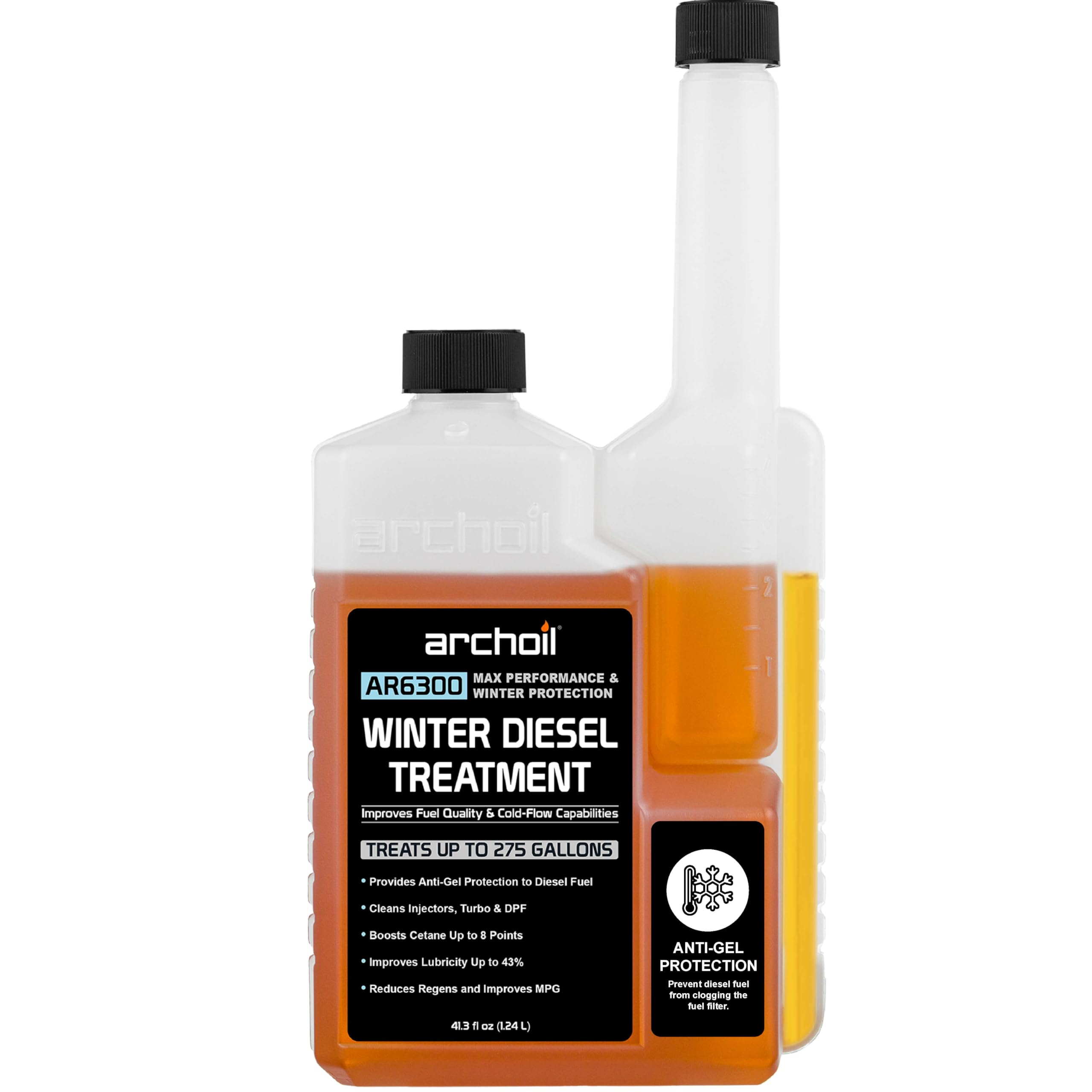
Archoil AR6300 solves two problems with one formula: it prevents diesel fuel gelling in subzero temperatures while simultaneously cleaning the DPF and reducing regeneration frequency. The measuring chamber built into the bottle neck makes dosing straightforward — 41 ounces treats up to 275 gallons of diesel, which works out to roughly five to seven fill-ups for a 30-gallon tank. Third-party ASTM D6079 testing shows a 43 percent lubricity improvement, which is critical for protecting wear-sensitive CP4 injection pumps during cold starts when fuel is at its thickest.
Cetane boost of up to 8 points pushes pump diesel from the typical 40 to 45 range up to a clean-burning 48 to 50, which measurably reduces the amount of unburned soot that reaches the DPF. Owners of 24-valve Power Stroke trucks report the ability to start at negative 10 degrees Fahrenheit without plugging in, with no performance issues and winter MPG staying close to summer highway numbers. The detergent package also targets turbo deposit formation, which helps restore boost response and smooth acceleration during cold-weather towing.
This product earns strong marks for dual-season versatility: switch to Archoil AR6500 during warmer months for maximum year-round performance, or continue using AR6300 straight through summer if winter temperatures in your region stay below 40 degrees. The anti-gel protection is robust enough for the coldest recorded winter in recent years, and the DPF cleaning chemistry is identical to the brand’s year-round formulation. For northern-climate diesel owners who face gelling and regen issues simultaneously, this is the single most efficient product on the list.
Why it’s great
- Anti-gel protection plus DPF cleaning in one additive
- Proven 43 percent lubricity improvement for CP4 pumps
- High value — treats 275 gallons per bottle
Good to know
- May not fully clear an already-clogged DPF
- Primarily designed for cold-weather maintenance
- Best results when used continuously each fill-up
5. Wynns WY28272 Diesel Particulate Filter Cleaner

Wynns DPF Cleaner is a compact 11-ounce formula intended for a single fuel tank treatment that prompts a forced regeneration event. Its primary mechanism is lowering the combustion temperature of accumulated soot inside the DPF, making it easier for the engine control unit to complete a regeneration cycle even if the exhaust temperature is lower than normal. The bottle size is small enough to store in a door pocket or center console for use when the diesel particulate filter warning light first appears on the dashboard.
Users with 2-year-old Nissan Note 1.5-liter diesels that had been through three failed dealer regenerations reported that adding a full bottle to a half tank of fuel, topping off with premium diesel, and driving 80 miles at sustained RPM above 3,000 in third and fourth gears cleared the start-stop system warning and restored full engine power. The engine management light turned off after an additional 70 miles of highway driving. Toyota Yaris D4D owners saw the DPF witness light extinguish after 90 kilometers of sustained high-RPM driving on the highway.
This product works best when combined with deliberate high-RPM driving — it is not a pour-and-forget cleaner. If your commute is exclusively city stop-and-go traffic, you may need to schedule a highway trip after treatment to give the regeneration event a chance to complete. The small bottle size means you will pay a premium per ounce compared to larger concentrates, but for emergency dashboard-light situations, the convenience and reliability justify the cost.
Why it’s great
- Compact emergency bottle stores easily in the vehicle
- Clears DPF warning lights after sustained highway driving
- Proven on smaller diesel passenger cars and vans
Good to know
- Requires active high-RPM driving to trigger regeneration
- Small bottle offers poor per-ounce value
- Not suitable for preventive maintenance dosing
6. Hot Shot’s Secret Fuel Duo — Diesel Extreme & EDT

Hot Shot’s Secret Fuel Duo kit pairs the Diesel Extreme fuel system cleaner with the EDT (Everyday Treatment) conditioner, giving you one intensive cleaning dose and one continuous lubricity/cetane booster for ongoing maintenance. The Diesel Extreme formula uses a high-concentration detergent that strips injector deposits that create poor spray patterns and excess soot generation. The EDT component delivers a steady 4-to-6-point cetane boost and improves fuel lubricity to protect injection pumps on Ecodiesel and other common-rail engines that are prone to CP4 pump failure.
Owners of GMC 2500HD Duramax 6.6-liter trucks report that using the Extreme cleaner fixed a noticeable ticking sound in the engine after four weeks of regular use. The Duo pack format is particularly smart for owners who want to perform a one-time deep clean with the Extreme bottle, then switch to EDT for every fill-up afterward. The combination also helps prevent winter fuel gelling, making it a viable year-round solution for mixed climates. The 2.18-pound total weight and compact bottles make this kit simple to store in a garage cabinet or truck toolbox.
The main limitation is that neither bottle is formulated specifically for DPF cleaning — they target injectors and fuel system chemistry, which indirectly reduces soot entering the DPF. If your DPF is already clogged and throwing fault codes, a dedicated DPF cleaner with catalytic soot reducers will resolve the issue faster. However, for ongoing maintenance that prevents DPF issues from developing in the first place, this duo offers better value than any single bottle at its price tier.
Why it’s great
- Two-bottle kit covers deep clean and maintenance
- Reduces engine noise and improves turbo response
- Cetane boost and lubricity protect CP4 pumps
Good to know
- Not a direct DPF cleaner — works via fuel system
- Already-clogged DPF may require dedicated product
- Some users prefer single-brand continuity
7. FPPF Killem Biocide 16 oz

FPPF Killem Biocide takes a completely different approach to DPF health by targeting the root cause of many filter blockages: microbial growth in the fuel tank. Bacteria, fungi, and algae colonies feed on diesel fuel, producing a slimy biofilm that travels through the fuel system, clogs the fuel filter, and eventually coats the DPF with organic residue that cannot be burned off through normal regeneration. A single 16-ounce bottle treats up to 1,280 gallons of diesel — enough for most heavy-duty trucks for a full year or more. The EPA-registered formula kills existing colonies and prevents regrowth.
Diesel RV owners are the primary audience for this product. Long periods of storage allow moisture to accumulate in the tank, creating the warm, damp environment that microbes need to flourish. Users report that Killem cleared black fuel filter clogs within 5 to 10 minutes of treatment after the vehicle drove 600 miles with a blocked filter. For those who store their vehicles seasonally or travel infrequently, adding Killem before storage or at the start of each season prevents the slime accumulation that eventually leads to DPF plugging and expensive filter swaps.
Killem is not a standalone DPF cleaner — it cannot remove existing soot or ash from a loaded filter. Its role is preventive: stop the biological contamination that accelerates filter clogging and creates sticky deposits that normal heat regeneration cannot address. Combine Killem with a detergent-based fuel additive for complete protection. Biodiesel blends (B5, B20) are especially prone to microbial growth, so owners running alternative fuels should consider Killem as a non-negotiable part of their fuel treatment routine.
Why it’s great
- Ultra-concentrated — treats 1,280 gallons per bottle
- Prevents algae and bacteria that clog fuel filters and DPFs
- EPA-registered formula for reliable microbial kill
Good to know
- Does not clean existing soot or ash from DPF
- Only needed if microbial growth is present
- Requires companion detergent additive for full DPF care
FAQ
Can a fuel additive DPF cleaner clear a check engine light?
How often should I treat my diesel with a DPF cleaner?
Will a DPF cleaner fix a clogged DPF without removing it?
Are DPF cleaners safe for high-pressure common-rail engines?
Final Thoughts: The Verdict
For most diesel owners who want the deepest possible filter restoration and are comfortable with basic mechanical work, the best dpf cleaner is the Liqui Moly Pro-Line because it directly dissolves deposits on the filter substrate rather than relying on fuel-diluted chemistry passing through the combustion chamber. If you prefer a pour-and-forget maintenance additive that clears fault codes and cuts regeneration time in half, grab the Rislone DPF Clean 4-Pack. And for emergency rescue when the DPF gauge is pinned and limp mode has already set in, nothing beats the Lucas Diesel Deep Clean for rapid soot burn-off and restored power.

Mo Maruf
I created WellFizz to bridge the gap between vague wellness advice and actionable solutions. My mission is simple: to decode the research and give you practical tools you can actually use.
Beyond the data, I am a passionate traveler. I believe that stepping away from the screen to explore new environments is essential for mental clarity and physical vitality.