Our readers keep the lights on and my smoothie glass nicely filled. As an Amazon Associate, I earn from qualifying purchases.
A Labrador Retriever pulling at the end of a leash isn’t just a training problem—it’s a physics problem. A 70-pound bundle of enthusiasm hits the end of a standard nylon strap with enough force to yank your shoulder and turn a relaxing walk into an endurance sport. The right leash for this breed needs to absorb that energy, give you quick control, and survive years of wet grass, muddy paws, and the occasional chewing session.
I’m Mohammad Maruf — the founder and writer behind WellFizz. This guide is the result of hours of cross-referencing customer feedback, material science, and real-world wear patterns on leashes strong enough for a Labrador’s drive without sacrificing your comfort.
Whether you’re training a gangly adolescent or walking a steady senior, finding the right gear matters. That’s why we built this guide to the best dog leash for labrador owners who demand durability and daily comfort.
How To Choose The Best Dog Leash For Labrador
A Labrador’s strength, enthusiasm, and thick neck make them one of the most demanding breeds on leash hardware. You need a leash that balances control with comfort. Here are the key factors to prioritize.
Width and Material Density
A one-inch wide strap is the baseline for a Labrador. Thinner webbing digs into your hand and degrades faster under tension. Nylon is the most common choice—light, quick-drying, and strong when stitched properly. Leather offers a natural grip that softens over time and is nearly chew-proof. Braided rope leashes distribute pressure evenly across your palm.
Handle Design and Traffic Control
A padded handle prevents rope burn during sudden pulls. A second handle, positioned 12 to 18 inches from the clip, is essential for training, crossing streets, or passing other dogs. This “traffic loop” lets you shorten your hold instantly without fumbling.
Hardware That Won’t Fail
Labradors can snap weak plastic clips. Look for solid brass or rustproof aluminum alloy snaps. A swivel mechanism prevents the leash from twisting as your dog circles. Auto-lock or screw-lock carabiners add an extra layer of security for strong pullers.
Quick Comparison
On smaller screens, swipe sideways to see the full table.
| Model | Category | Best For | Key Spec | Amazon |
|---|---|---|---|---|
| Roam Gear 6 Foot Dog Leash | Premium | Strong pullers & night walks | 0.5-inch thick rope with locking carabiner | Amazon |
| Soft Touch Collars Braided Leather Leash | Premium | Training durability & classic style | 3/4-inch wide vegetable-tanned leather | Amazon |
| Heydoggy Heavy Duty Nylon Leash | Mid-Range | All-purpose control with reflective visibility | 2.8mm thickness with auto-lock frog clip | Amazon |
| Lupine Dog Leash with Padded Handle | Mid-Range | Lightweight daily walks & chew guarantee | 1-inch wide nylon with lifetime replacement | Amazon |
| Wellbro Real Leather Slip Lead | Budget | Quick on/off training & shedding control | 0.7-inch wide flat leather with adjustable loop | Amazon |
In‑Depth Reviews
1. Roam Gear 6 Foot Dog Leash
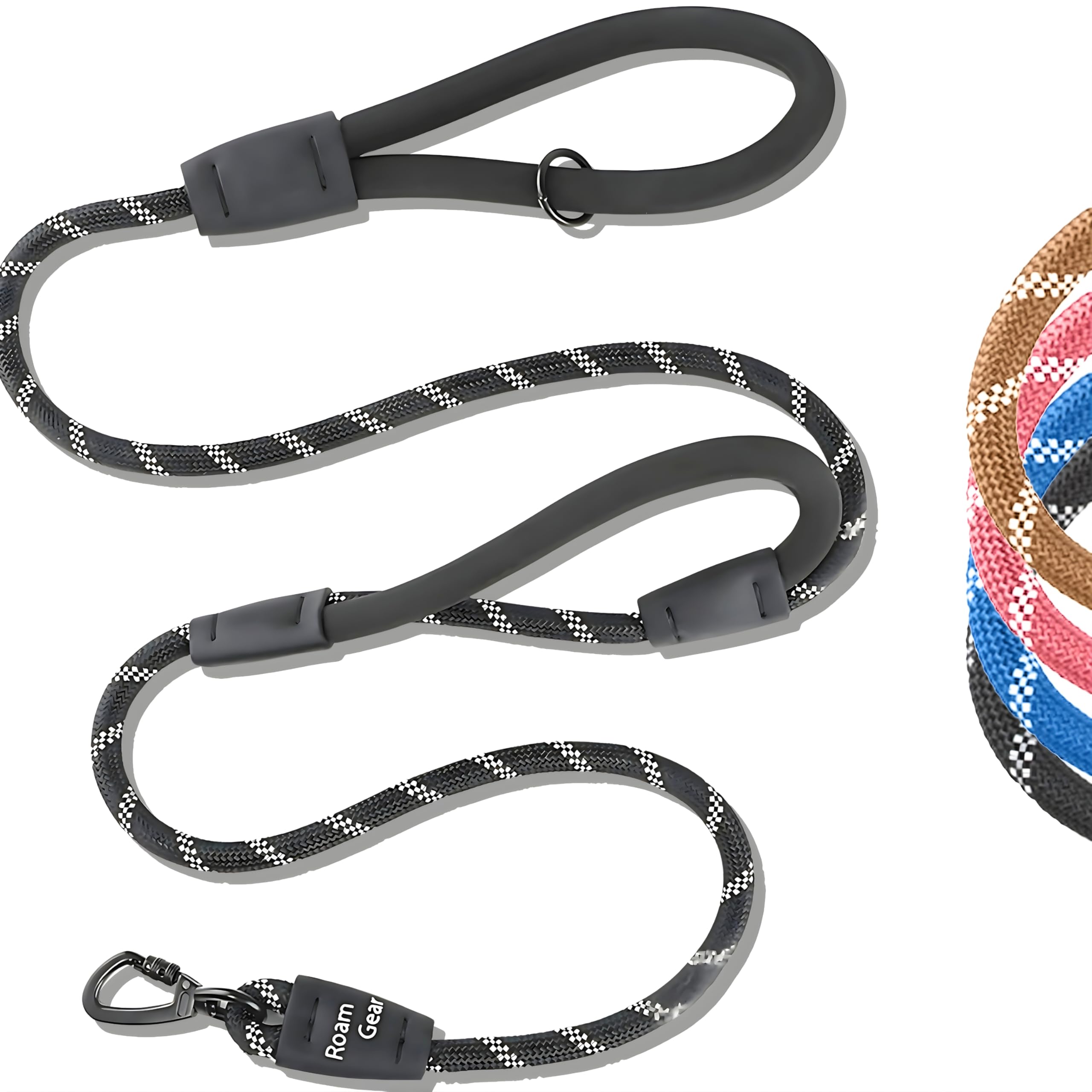
This leash solves the Labrador pull problem with a half-inch thick braided rope that feels substantial in your hand without being rigid. The 360-degree swivel clasp prevents tangling when your dog circles during sniff breaks. Both handles are padded with shock-absorbing foam, which makes a real difference when a 70-pound Lab bolts after a squirrel.
The reflective nylon threads woven through the entire length give you visibility at night without needing an accessory light. The locking carabiner clip adds a level of security that standard snap hooks can’t match—especially useful for Labs who pull sideways against gates or posts during hands-free moments.
At 8.8 ounces, it’s heavier than a flat nylon strap, but the weight is justified by the durability. The silicone clamps at stress points reinforce the O-ring connection, addressing the most common failure point on rope leashes.
Why it’s great
- Locking carabiner prevents accidental unclipping
- Dual foam-padded handles reduce hand fatigue
- Reflective stitching for low-light safety
Good to know
- The second handle can feel bulky when the dog is at full extension
- Carabiner sliding lock may loosen over extended use
2. Soft Touch Collars Braided Leather Leash

Leather is the overlooked material for Labrador leashes, and this braided option changes the calculus. The vegetable-tanning process takes up to 40 days, resulting in a strap that starts firm but molds to your hand over the first few walks. At 3/4-inch wide, it’s narrower than the nylon competition, but the braided construction gives it superior grip and prevents it from slipping through wet hands.
The traffic handle is stitched directly into the main body at a natural reach distance. It’s not padded, but the leather itself softens enough to avoid abrasion. The solid brass hardware with lacquered finish resists rust even after exposure to rain and morning dew—a common weak point on cheaper leather leashes.
Owners of Labs over 80 pounds report this leash holding up for years without fraying or cracking. The braided leather design also discourages chewing better than nylon webbing, which is a relevant factor for adolescent Labs who mouth their gear.
Why it’s great
- Braided leather grips naturally without padding
- Rustproof brass hardware lasts in all weather
- Traffic handle aids heel training and control
Good to know
- Narrower width may feel thin for some hands
- Leather can rip if dog chews the same spot repeatedly
3. Heydoggy Heavy Duty Nylon Leash

The 2.8mm thickness on this nylon leash puts it in a different class from flimsy standard straps. It’s nearly double the thickness of typical leashes, and the triple stitching at every stress point means it won’t separate at the seams when your Lab lunges. The 1-inch width is the sweet spot for this breed—wide enough to distribute pressure without feeling like a tow strap.
The auto-lock frog clip is the standout feature here. It snaps closed automatically when pressed against a D-ring, and releases only when you squeeze both side buttons. This eliminates the risk of accidental unclipping that standard snap hooks occasionally suffer from during excited movements. The 360-degree swivel prevents the leash from twisting into a knot.
Reflective threads run the full length on both sides, making this one of the most visible leashes in low-light conditions. The traffic handle is placed one foot from the clip, giving you close-quarters control for busy sidewalks or training sessions.
Why it’s great
- Auto-lock clip stays secure during active pulls
- Double-sided reflective stitching for night safety
- Padded handles prevent rope burn
Good to know
- The “no pull” claim is misleading—works best with a training collar
- The clip is larger than standard, may not fit all collar rings
4. Lupine Dog Leash with Padded Handle

Lupine’s leash is deceptively simple—a one-inch wide nylon strap with a padded handle and a swivel snap—but the real value is in the guarantee. If your Labrador chews through this leash, Lupine replaces it for free. That’s a meaningful promise for owners of heavy chewers. The material is lightweight at just 0.29 pounds, making it a good choice for daily walks where you don’t want added bulk.
The reverse-gate snap is a thoughtful detail. It attaches quickly to collar D-rings without pinching your fingers and creates a more secure connection than open-gate clips. The padded handle runs the full grip length, which helps during walks when your Lab decides to stop and sniff unexpectedly.
At 73 inches end-to-end, it’s slightly longer than the standard 6-foot measurement. This gives you a bit more slack on hiking trails while still being manageable for neighborhood walks. The material is easy to clean with a hose, which matters for Labs who love mud puddles.
Why it’s great
- Lifetime guarantee covers even chewing damage
- Lightweight design won’t weigh down your hand
- Quick-attach reverse-gate snap is easy to use
Good to know
- Plastic hardware may feel less premium than metal
- Some owners wish the hooks were slightly larger
5. Wellbro Real Leather Slip Lead

A slip lead combines collar and leash into one piece, which is useful for Labs who slip out of standard collars. The Wellbro version uses a single piece of flat leather with reinforced stitching. At 0.7 inches wide, it’s narrower than the nylon options, but leather’s natural stiffness provides enough feedback for training corrections. The metal O-ring and two movable sliders let you adjust the collar loop for Labs with neck girth between 40 and 60 centimeters.
This design works especially well for Labrador owners who do frequent on-off walking—the slip loop slides over the head and tightens only when the dog pulls. It doesn’t collect fur the way nylon tends to, which is a practical bonus during shedding season. The leather surface wipes clean easily.
Customer feedback from owners of 80-pound Labs confirms the strength holds up over time, though the narrow width means the leash can feel less substantial in hand compared to wider options. It’s best suited for trained dogs who don’t need constant correction, rather than puppies still learning loose-leash walking.
Why it’s great
- Slip design prevents escape-artist dogs from backing out
- Leather surface doesn’t collect dog hair
- Adjustable loop fits various neck sizes
Good to know
- Narrow width may not suit owners with large hands
- Not ideal for dogs who still pull heavily during training
FAQ
Should I get a 4-foot or 6-foot leash for my Labrador?
Is a leather or nylon leash better for a Labrador?
Final Thoughts: The Verdict
For most users, the dog leash for labrador winner is the Roam Gear 6 Foot Dog Leash because its locking carabiner, dual padded handles, and reflective rope construction address the three biggest Lab leash problems: security, control, and low-light visibility. If you want the tactile feel and long-term durability of leather, grab the Soft Touch Collars Braided Leather Leash. And for a budget-friendly option that doesn’t sacrifice strength, the Wellbro Real Leather Slip Lead offers a clean, hair-repelling design ideal for escape artists.

Mo Maruf
I created WellFizz to bridge the gap between vague wellness advice and actionable solutions. My mission is simple: to decode the research and give you practical tools you can actually use.
Beyond the data, I am a passionate traveler. I believe that stepping away from the screen to explore new environments is essential for mental clarity and physical vitality.