Our readers keep the lights on and my smoothie glass nicely filled. As an Amazon Associate, I earn from qualifying purchases.
Choosing a new AV receiver is the single most important decision you will make for your home theater. The heart of your system must decode object-based audio, switch multiple high-bandwidth video sources, and drive your speakers with clean power — all without introducing noise or latency. A model that fumbles any of these tasks will leave you with a flat, uninvolving soundstage regardless of the quality of your speakers.
I’m Mohammad Maruf — the founder and writer behind WellFizz. I have spent hundreds of hours cross-referencing technical specifications, analyzing user feedback on HDMI 2.1 compatibility, and comparing room correction algorithms to build this definitive guide.
This deep-dive evaluation covers channel configurations, power output, HDMI 2.1 features, and room calibration systems so you can confidently choose the best dolby atmos receiver for your home theater and budget.
How To Choose The Best Dolby Atmos Receiver
Selecting the right receiver involves balancing power, channel count, room calibration, and future-proofing features. Many buyers over-emphasize raw wattage while ignoring the real-world impact of a poor room correction system. The goal is to match the receiver’s capabilities to your specific speaker configuration, room size, and listening habits.
Channel Configuration and Speaker Layout
A 7.2-channel receiver supports a 5.1.2 setup — five ear-level speakers, one subwoofer, and two overhead or up-firing Atmos channels. A 9.2-channel unit allows a 5.1.4 or 7.1.2 layout, adding two more height channels for a more immersive bubble of sound. The Marantz Cinema 50 offers 9.4 channels, making it ideal for larger rooms where four subwoofers can smooth out bass response.
HDMI 2.1 and Gaming Features
HDMI 2.1 with 40 Gbps or 48 Gbps bandwidth ensures full 4K/120Hz and 8K/60Hz passthrough. Features like Variable Refresh Rate (VRR) and Auto Low Latency Mode (ALLM) eliminate screen tearing and reduce input lag for gamers using PS5 or Xbox Series X. Many early receivers shipped with a flawed Panasonic chipset that limited 4K/120 bandwidth — newer models like the Onkyo TX-RZ50 and Denon AVR-S970H have corrected this.
Room Correction and Calibration
Room correction software analyzes speaker placement and adjusts frequency response to compensate for room acoustics. Dirac Live, found on the Onkyo TX-RZ50, is widely considered the most transparent system, offering precise time-domain and frequency-domain correction. Audyssey MultEQ XT32 (Marantz Cinema 50) and YPAO R.S.C. (Yamaha RX-A4A) are also excellent, but each has a distinct tonal signature. A receiver with poor room correction will sound harsh or boomy regardless of speaker quality.
Power Output and Impedance Handling
Look for power ratings measured with two channels driven into 8 ohms, 20 Hz–20 kHz, at less than 0.08% THD — this standard reveals real-world headroom. Many receivers list wattage at 1 kHz into 6 ohms, which inflates numbers. The Sony STR-AN1000 and STR-AZ1000ES deliver robust current delivery, while the Yamaha RX-A2A and Denon AVR-S770H offer sufficient power for medium-sized rooms with efficient speakers.
Quick Comparison
On smaller screens, swipe sideways to see the full table.
| Model | Category | Best For | Key Spec | Amazon |
|---|---|---|---|---|
| Onkyo TX-RZ50 | Premium | Reference-grade calibration | Dirac Live, 9.2 ch, THX | Amazon |
| Marantz Cinema 50 | High-End | 9.4 ch with 4 subs | 9.4 ch, 110W, HDAM | Amazon |
| Yamaha RX-A4A | Premium | Surround:AI processing | Surround:AI, 7.2, YPAO | Amazon |
| Sony STR-AZ1000ES | High-End | 360 Spatial Sound Mapping | ES Build, 7.2, 8K | Amazon |
| Sony STR-AN1000 | Mid-Range | DCAC IX calibration | 7.2, 165W, 360SSM | Amazon |
| Denon AVR-S970H | Mid-Range | Phono input and 8K | 7.2 ch, 90W, HEOS | Amazon |
| Denon AVR-S770H | Mid-Range | Entry-level 8K value | 7.2 ch, 75W, HEOS | Amazon |
| Yamaha RX-A2A | Mid-Range | AVENTAGE build quality | 7.2, YPAO R.S.C. | Amazon |
| Yamaha RX-V6A | Value | MusicCast multi-room | 7.2, 200W, WiFi | Amazon |
| Onkyo TX-NR6100 | Value | THX and 8K gaming | 7.2, THX, 210W | Amazon |
| Pioneer VSX-935 | Entry-Level | 8K with budget price | 7.2, 8 HDMI, ARC | Amazon |
In‑Depth Reviews
1. Onkyo TX-RZ50

The Onkyo TX-RZ50 is a 9.2-channel powerhouse that ships with Dirac Live out of the box — a room correction system that transforms uneven room acoustics into a neutral, reference-grade soundstage. With 120 watts per channel into 8 ohms (two channels driven, 20 Hz–20 kHz, 0.08% THD), it has ample headroom to drive demanding speakers in a 5.1.4 or 7.1.2 layout. THX Certification ensures transparent playback at reference levels across all channels.
HDMI 2.1 support includes full 40 Gbps bandwidth for 4K/120Hz passthrough, VRR, and ALLM, making it a stellar match for Xbox Series X and PS5. The unit also carries Klipsch Optimize Mode, which automatically applies precise crossover values for Klipsch Reference and Reference Premiere speakers. Built-in streaming covers Spotify, TIDAL, Deezer, and Pandora, plus dual-zone HDMI switching for independent content in two rooms.
HDMI switching takes roughly 12–15 seconds, and the dual subwoofer outputs are not independently configurable. The onboard Wi-Fi card has shown reliability concerns in some units, though warranty coverage has been responsive. For enthusiasts who value calibration transparency and THX-grade performance, the TX-RZ50 delivers a level of accuracy that few receivers in its tier can match.
Why it’s great
- Dirac Live calibration massively improves clarity and bass integration
- THX Certified for consistent reference-level playback
- Full HDMI 2.1 bandwidth for next-gen gaming
Good to know
- HDMI switching has a noticeable delay
- Dual sub outs lack independent calibration
- Some units report Wi-Fi connectivity issues
2. Marantz Cinema 50

The Marantz Cinema 50 is a 9.4-channel receiver built around the brand’s legendary HDAM (Hyper Dynamic Amplifier Module) discrete circuitry and current feedback amplification. It delivers 110 watts per channel (two channels driven, 8 ohms, 20 Hz–20 kHz, 0.05% THD) with a warm, detailed tonal signature that music lovers particularly appreciate. The four independent subwoofer outputs allow for exceptionally smooth bass response across large rooms.
Audyssey MultEQ XT32 room correction provides detailed equalization for up to eight measurement positions, resulting in a balanced and immersive sound field. The receiver supports Dolby Atmos, DTS:X Pro, IMAX Enhanced, and Auro-3D, making it one of the most format-complete units available. Nine HDMI inputs (6 in/3 out) with 8K/60Hz and 4K/120Hz passthrough, plus eARC, cover every modern source.
Setup relies heavily on the HEOS app, which some users find less intuitive than a traditional on-screen menu. The unit runs warm during extended use, so adequate ventilation is essential. For those building a multi-subwoofer home theater who prize musicality and build quality, the Cinema 50 justifies its price with outstanding channel separation and dynamics.
Why it’s great
- Four independent subwoofer outputs for smooth low end
- HDAM circuitry delivers warm, detailed musicality
- Extensive format support including Auro-3D
Good to know
- HEOS app-centric setup can be cumbersome
- Runs hot during extended listening sessions
- Premium price point requires serious investment
3. Yamaha RX-A4A

The Yamaha RX-A4A belongs to the Aventage line, which features premium build quality including an anti-resonance fifth foot and a three-year warranty. It is a 7.2-channel receiver with Surround:AI, a real-time DSP that analyzes audio scenes and automatically optimizes surround effects. YPAO R.S.C. with 3D, multipoint measurement, and precision EQ provides advanced room correction with a focus on maintaining tonal neutrality.
All seven HDMI inputs support 8K60 and 4K120 at 40 Gbps, with eARC, VRR, and ALLM for seamless gaming. MusicCast multi-room streaming works with Spotify, TIDAL, Amazon Music HD, and Qobuz, plus AirPlay 2 and Bluetooth. A phono input is included for turntable users. The unit also supports Works with Sonos via a Sonos Port, adding flexibility for mixed-brand setups.
Firmware updates require a USB flash drive — a process some users describe as tedious. The setup menu is dense, and the manual is necessary to unlock full potential. When properly configured, the RX-A4A delivers spacious soundstages with excellent imaging, making it a strong choice for film enthusiasts who want automated AI-enhanced surround processing.
Why it’s great
- Surround:AI dynamically enhances spatial effects in real time
- Aventage build includes anti-resonance foot and longer warranty
- Full 40 Gbps HDMI 2.1 support on all inputs
Good to know
- Firmware updates require a USB drive
- Setup is complex and demands careful reading
- MusicCast app can feel less polished than HEOS
4. Sony STR-AZ1000ES

The Sony STR-AZ1000ES is a 7.2-channel receiver from Sony’s Elite series, designed for custom integrators and serious home theater builders. It uses Digital Cinema Auto Calibration IX (DCAC IX) and 360 Spatial Sound Mapping, which creates phantom height and surround speakers from fewer physical channels. In a 5.1.2 setup, the spatial mapping can convincingly simulate a 7.1.4 arrangement, dramatically widening the sweet spot.
Power output is rated at 100 watts per channel (8 ohms, 1 kHz, 2ch driven, 0.9% THD), providing solid current for most speakers. HDMI 2.1 with 6 inputs and 2 outputs supports 8K/60Hz and 4K/120Hz, Dolby Vision, HDR10, HLG, and IMAX Enhanced. The receiver runs notably hot and benefits from supplementary cooling like the AC Infinity Aircom T10. Works with Sonos certification and Chromecast built-in expand streaming options.
Auto-calibration can fail if height channels are plugged into the wrong ports, and the receiver lacks HDR10+ and QMS support. Sound quality is exceptional for music and films, with Neural:X upmixing adding depth to stereo content. For those who want a premium Sony ecosystem with advanced spatial processing, the STR-AZ1000ES delivers a unique and convincing sound field.
Why it’s great
- 360 Spatial Sound Mapping creates a convincing 7.1.4 effect from 5.1.2
- DCAC IX calibration is precise when set up correctly
- Elite build quality with IP control for custom integration
Good to know
- Runs very hot — external cooling recommended
- No HDR10+ or QMS support
- Auto-calibration is finicky with channel assignments
5. Sony STR-AN1000

The Sony STR-AN1000 brings much of the same spatial processing found in the ES line to a more accessible price tier. It also uses DCAC IX and 360 Spatial Sound Mapping, allowing a 5.1.2 layout to produce a wide, three-dimensional sound field without actual overhead speakers. Power is rated at 165W (6 ohms, 1 kHz, 1ch driven, 0.9% THD), which offers sufficient headroom for moderately efficient speakers in medium-sized rooms.
Six HDMI inputs (two support 8K/60Hz and 4K/120Hz) cover most sources, and the receiver supports Dolby Atmos, DTS:X, Dolby Vision, and IMAX Enhanced. The on-screen graphical setup assistant walks through each step, making it one of the more user-friendly receivers in its class. Built-in Chromecast, Spotify Connect, AirPlay 2, and Bluetooth provide flexible streaming options.
A known issue exists with Apple TV 4K Dolby Vision passthrough — users must connect the Apple TV directly to the TV. The front display is small and difficult to read from a distance, and there is no phono input for turntables. For buyers who prioritize spatial processing and simple setup over a high channel count, the STR-AN1000 punches well above its price point.
Why it’s great
- 360 Spatial Sound Mapping expands soundstage without height speakers
- User-friendly graphical setup assistant
- Excellent value for Sony’s calibration and spatial processing
Good to know
- Apple TV 4K Dolby Vision passthrough issue exists
- No phono input for vinyl users
- Front display is very small and hard to read
6. Denon AVR-S970H

The Denon AVR-S970H is a 7.2-channel receiver delivering 90 watts per channel (two channels driven, 8 ohms, 20 Hz–20 kHz, 0.08% THD) with HEOS multi-room streaming, Wi-Fi, and Bluetooth. It features three 8K HDMI inputs and two independent HDMI outputs, plus a phono input for turntables — a rarity in this segment. The receiver supports Dolby Atmos, DTS:X, Dolby Vision, HDR10+, and HLG.
Variable Refresh Rate (VRR), Quick Frame Transport (QFT), and Auto Low Latency Mode (ALLM) are all supported, making it a solid gaming companion. Powered Zone 2 uses the rear surround channels, limiting the main room to 5.1, but the trade-off allows whole-home audio. The Audyssey MultEQ room correction is effective for smoothing frequency response, though not as advanced as XT32 found in higher-tier models.
Some users note that HEOS source audio cannot be routed to Bluetooth headphones — a design limitation. The remote lacks a programmable TV power button. For the price, the S970H offers an unusually comprehensive feature list including phono input, dual HDMI outputs, and 8K support, making it a versatile hub for mixed-use entertainment spaces.
Why it’s great
- Includes phono input for turntables
- Dual HDMI outputs for TV and projector setups
- Full HDMI 2.1 gaming features (VRR, ALLM, QFT)
Good to know
- Powered Zone 2 reduces main room to 5.1
- No Bluetooth passthrough for HEOS sources
- Remote lacks programmable power button
7. Denon AVR-S770H

The Denon AVR-S770H is a 7.2-channel entry-level receiver rated at 75 watts per channel (two channels driven, 8 ohms, 20 Hz–20 kHz, 0.08% THD). It supports Dolby Height Virtualization and DTS Virtual:X, which simulate overhead effects from a traditional 5.1 or 7.1 layout without physical height speakers. HDMI 2.1 includes 4K/120Hz passthrough, VRR, ALLM, and QFT for gaming.
HEOS built-in enables multi-room audio with compatible speakers, and the setup process is straightforward thanks to the on-screen assistant. Audyssey MultEQ provides basic room calibration that cleans up the most obvious frequency issues. The 6 HDMI inputs (1 front) cover essential sources, and eARC simplifies audio return from the TV.
Some units have experienced firmware-related issues such as random volume drops or no-picture events that require a power cycle. The remote has a learning curve, and the menu system, while functional, is not as polished as higher-tier Denon models. For a budget-conscious buyer seeking 8K-ready performance and HEOS streaming, the S770H represents a reliable entry point.
Why it’s great
- Dolby Height Virtualization provides convincing effects without height speakers
- 8K/60Hz and 4K/120Hz HDMI 2.1 with gaming features
- HEOS multi-room streaming at an attractive price
Good to know
- Reports of firmware issues causing volume drops
- Audyssey MultEQ is basic, not XT32
- 75W/ch may feel limited with low-sensitivity speakers
8. Yamaha RX-A2A

The Yamaha RX-A2A is a 7.2-channel Aventage receiver with YPAO R.S.C. and multipoint measurement. It features three 8K60B/4K120AB HDMI inputs with ALLM and VRR, plus phono input and eARC. The Aventage line’s build includes an extra foot for stability and a three-year warranty, setting it apart from the standard RX-V series in terms of construction quality.
Surround:AI is not included in this model — that feature is reserved for the RX-A4A and above. However, YPAO R.S.C. with multipoint calibration does an excellent job of balancing sound across a listening area. MusicCast delivers reliable multi-room streaming with Spotify, TIDAL, and Amazon Music HD support.
Some users have reported intermittent no-signal issues with Sony TVs, requiring a power cycle. The unit lacks analog video inputs, which may matter for legacy sources. At its discounted price, the RX-A2A offers genuine Aventage build quality and excellent room correction for those with smaller spaces who do not need more than seven channels.
Why it’s great
- True Aventage build with anti-resonance foot and 3-year warranty
- YPAO R.S.C. multipoint calibration
- Phono input and eARC included
Good to know
- No Surround:AI — reserved for higher Aventage models
- Intermittent no-signal issue with some Sony TVs
- No analog video inputs for legacy devices
9. Yamaha RX-V6A

The Yamaha RX-V6A is a 7.2-channel receiver that packs MusicCast multi-room, HDMI 2.1 with three 8K/60Hz inputs, and YPAO room correction into a compact package. With 200W total power (claimed), it drives most bookshelf and floorstanding speakers to healthy volumes. Bluetooth, Wi-Fi, AirPlay 2, and Spotify Connect provide comprehensive streaming options.
Dolby Atmos Height Virtualization creates overhead effects without height speakers, making this a good entry point for Atmos on a budget. The unit supports Dolby Vision, HDR10+, HLG, and BT.2020 passthrough. Setup is straightforward, and clean dialogue paired with dynamic action scenes makes this a capable performer for movies and gaming.
Some criticism centers on the dated menu design and the lack of a dedicated Bluetooth button — accessing two-way Bluetooth requires navigating multiple menus. Early production units had HDMI 2.1 bandwidth limitations that were later addressed via firmware. For a budget-conscious buyer who wants MusicCast and 8K support, the RX-V6A remains a compelling, feature-rich choice.
Why it’s great
- MusicCast multi-room with broad streaming service support
- Dolby Atmos Height Virtualization works well for small rooms
- Three 8K HDMI inputs at the value tier
Good to know
- Early HDMI 2.1 bandwidth issues required firmware fix
- Two-way Bluetooth is buried in menus
- Menu interface looks dated
10. Onkyo TX-NR6100
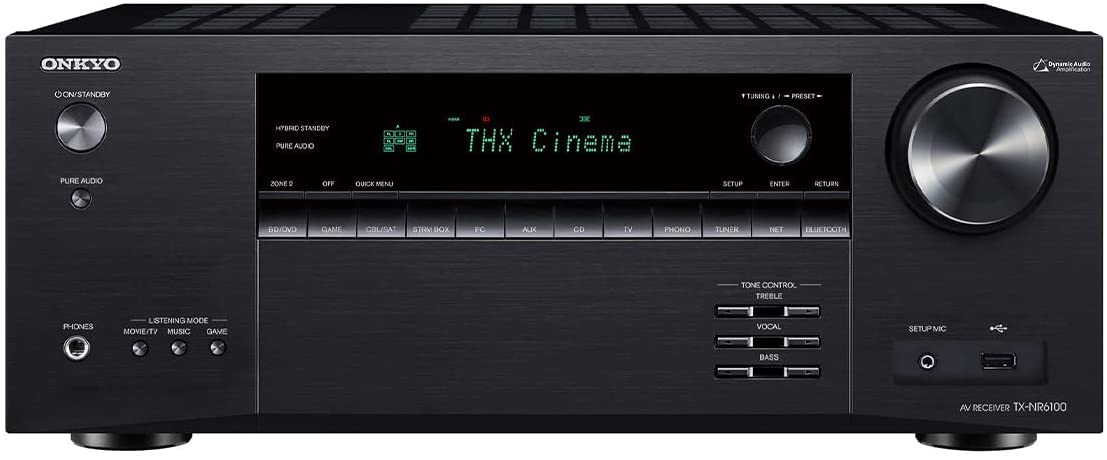
The Onkyo TX-NR6100 is a 7.2-channel receiver with THX Select Certification, ensuring reference-level playback in medium-sized rooms. It delivers 210W per channel (6 ohms, 1 kHz, 1ch driven) and supports 5.2.2-channel Dolby Atmos and DTS:X. Three HDMI 2.1 inputs at 40 Gbps provide full 4K/120Hz support for next-gen gaming, VRR, ALLM, and QFT are also included.
Eight HDMI inputs (3 are 8K-capable) and discrete Zone 2 audio/video output offer flexibility for multi-room setups. The unit has a solid power supply and runs cooler than previous Onkyo generations according to some users. Bi-amping the front speakers uses the surround channels, reducing the system to 5.1 — a trade-off to consider.
Long-term reliability has been inconsistent, with reports of loud fan noise and HDMI 2.1 failures after extended use. The remote lacks a backlight, and inputs 4–6 are limited to 4K only. For buyers who want THX Certification and 8K gaming support without overspending, the TX-NR6100 offers excellent initial performance, provided you budget for potential future issues.
Why it’s great
- THX Select Certification for guaranteed reference quality
- Full 40 Gbps HDMI 2.1 with VRR and ALLM
- Discrete Zone 2 HDMI for independent multi-room viewing
Good to know
- Long-term reliability concerns with fan and HDMI
- Bi-amping reduces system to 5.1
- Inputs 4–6 are 4K, not 8K
11. Pioneer VSX-935
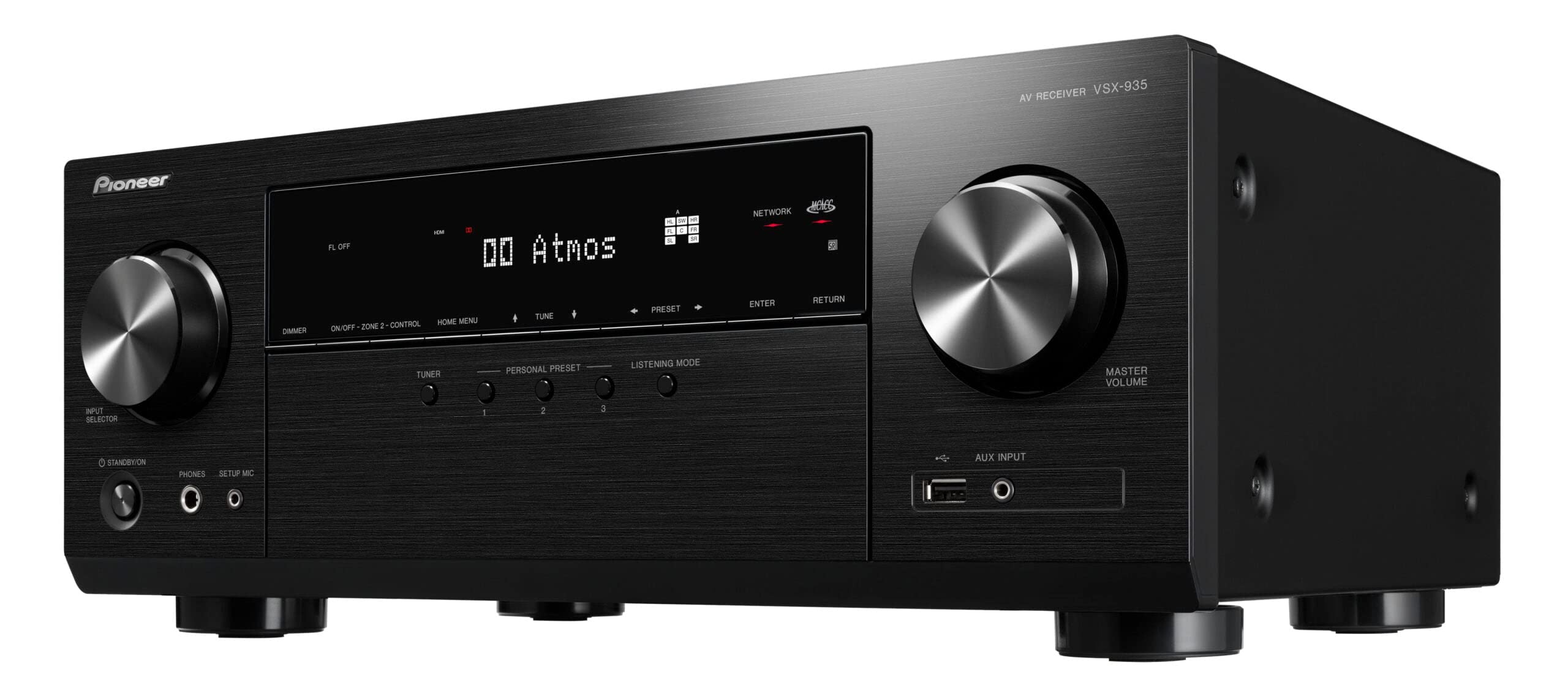
The Pioneer VSX-935 is a 7.2-channel receiver that brings 8K HDMI 2.1 support to the entry-level segment. It features eight HDMI inputs (one on the front), Dolby Atmos and DTS:X decoding, and Dolby Atmos Height Virtualization for systems without physical height speakers. Bluetooth with two-way streaming and dual-zone output add flexibility for whole-home audio.
The RF remote is responsive, and the front display offers dimmer controls for dark rooms. Pioneer’s room correction is basic but effective for cleaning up the most audible room modes. Audio quality is crisp and clear, with a volume curve that ramps gradually up to 50 then accelerates — users should calibrate carefully to avoid sudden jumps.
Two-way Bluetooth functionality is unreliable for some users and remains buried deep in the menu system. The on-screen interface looks dated, and a few units have arrived DOA or with dead displays. At its price, the VSX-935 provides a genuine path to 8K and Atmos without the high entry fee of mid-range competitors.
Why it’s great
- 8K HDMI 2.1 at the most accessible price
- Eight HDMI inputs provide abundant connectivity
- RF remote with good range and dimmable display
Good to know
- Two-way Bluetooth is unreliable and hard to access
- Some units arrive DOA or with dead displays
- Basic room correction and dated interface
FAQ
Do I need height speakers for Dolby Atmos?
Does a 7.2 receiver support 5.1.4 Atmos?
What is HDMI eARC and do I need it?
Why does room correction matter for Atmos?
Final Thoughts: The Verdict
For most users, the best dolby atmos receiver winner is the Onkyo TX-RZ50 because Dirac Live calibration offers unmatched room correction accuracy, and the 9.2-channel layout with THX Certification provides a reference-grade foundation for any home theater. If you want an expanded multi-subwoofer setup and prefer a warmer musical tonality, grab the Marantz Cinema 50. And for a budget-friendly entry point that still delivers HDMI 2.1 and Dolby Atmos Height Virtualization, nothing beats the Pioneer VSX-935.

Mo Maruf
I created WellFizz to bridge the gap between vague wellness advice and actionable solutions. My mission is simple: to decode the research and give you practical tools you can actually use.
Beyond the data, I am a passionate traveler. I believe that stepping away from the screen to explore new environments is essential for mental clarity and physical vitality.