Our readers keep the lights on and my smoothie glass nicely filled. As an Amazon Associate, I earn from qualifying purchases.
A cold night in the backcountry separates a down sleeping bag from a heavy, bulky synthetic. The difference isn’t just warmth — it’s whether your pack leaves room for food, water, and a camp stove. A quality down sleeping bag delivers high loft with minimal weight, compressing into a load that frees up space for everything else on the trail.
I’m Mohammad Maruf — the founder and writer behind WellFizz. This guide is the result of dozens of hours comparing fill powers, shell fabrics, temperature ratings, and real-world user experiences across nine distinct down sleeping bags to identify which models earn their spot in your gear closet.
The right insulation, shell durability, and weight-to-warmth ratio define the best down sleeping bag for any trip, and this breakdown helps you match the bag to the conditions.
How To Choose The Best Down Sleeping Bag
Choosing a down sleeping bag means balancing three variables: warmth, weight, and durability. A bag with high fill power packs smaller and weighs less per ounce of insulation, but requires a robust shell to protect the down from moisture and abrasion. Temperature ratings, baffle design, and shell fabric make the difference between a good night’s sleep and a shivering dawn.
Fill Power: The Insulation Metric
Fill power measures how many cubic inches one ounce of down occupies. A 650-fill bag offers solid loft for three-season use, while 800-fill or higher packs dramatically smaller for ultralight pursuits. Budget-friendly bags often use 550-600 fill, which still outperforms synthetic at the same weight but requires more down to reach the same warmth — increasing packed size.
Shell Fabric and DWR
Down loses its insulating properties when wet, so a durable, water-repellent shell is critical. Look for 20D to 30D nylon ripstop with a DWR finish. Higher denier fabrics resist tears and ground abrasion better, but add weight. Bags with hydrophobic down treatments add an extra layer of moisture protection for damp conditions.
Baffle Design and Temperature Ratings
Baffles — the chambers that hold the down — prevent migration and cold spots. Box baffles allow full loft, while sewn-through baffles save weight but create thin zones. ISO-rated bags test temperature ratings in a standardized chamber, giving you a reliable comparison. Comfort rating is the temperature at which a cold sleeper rests comfortably; limit rating assumes a curled position and lighter clothing.
Quick Comparison
On smaller screens, swipe sideways to see the full table.
| Model | Category | Best For | Key Spec | Amazon |
|---|---|---|---|---|
| Kelty Cosmic 20 | Premium | Reliable three-season backpacking | 550 FP, ISO limit 21°F | Amazon |
| Rab Men’s Ascent | Premium | Cold-weather mountaineering | 650 FP, comfort 5°F | Amazon |
| Kelty Supernova | Premium | Roomy fit for stomach sleepers | 550 FP, 20°F rating | Amazon |
| TETON Sports ALTOS | Mid-Range | Value-oriented three-season use | Down fill, 2.5 lb weight | Amazon |
| QEZER 600 FP Mummy | Mid-Range | Budget cold-weather protection | 600 FP, limit 28°F | Amazon |
| QEZER 600 FP Semi-Rectangular | Mid-Range | Extra room for side sleepers | 600 FP, 86.6″ length | Amazon |
| Naturehike CW295 | Mid-Range | Ultralight warm-weather hikes | 650 FP, 1.3 lb weight | Amazon |
| ZOOOBELIVES Alplive T400 | Budget | Couples or summer car camping | 650 FP, 1.7 lb weight | Amazon |
| QEZER 600 FP Ultralight (500g) | Budget | Entry-level three-season trips | 600 FP, 1.9 lb weight | Amazon |
In‑Depth Reviews
1. Kelty Cosmic 20 Down Mummy Sleeping Bag

The Kelty Cosmic 20 remains a reference point in the down sleeping bag category because it balances reliable warmth, sustainable materials, and a price that undercuts most premium competitors. The 550-fill RDS-certified down provides enough loft for three-season use, and the ISO limit rating of 21°F gives a realistic baseline — users consistently report comfort into the high 20s with a base layer. The recycled nylon shell with PFAS-free DWR keeps moisture at bay without the environmental trade-off.
At roughly 2 lb 6 oz for the regular size, it’s not ultralight, but the 13 x 7-inch stuffed size packs easily into a 50-liter pack. The dual-direction zipper and draft collar seal in warmth effectively, and the hood cinches down to eliminate drafts. The mummy cut is snug through the shoulders — broad-shouldered users may find the regular size restrictive and should consider sizing up.
The Cosmic 20 doesn’t chase the highest fill power numbers. Instead, it delivers proven performance with ethical sourcing and recycled fabrics, making it the most complete package for a backpacker who wants a single bag for spring through fall.
Why it’s great
- ISO-rated 21°F limit matches real-world use
- RDS-certified down with traceable batch sourcing
- Recycled shell and liner with PFAS-free DWR
- Packs small enough for motorcycle saddlebags
Good to know
- Snug cut in shoulders may not fit broad users
- Not ultralight at over 2.5 lb
2. Rab Men’s Ascent Down Sleeping Bag
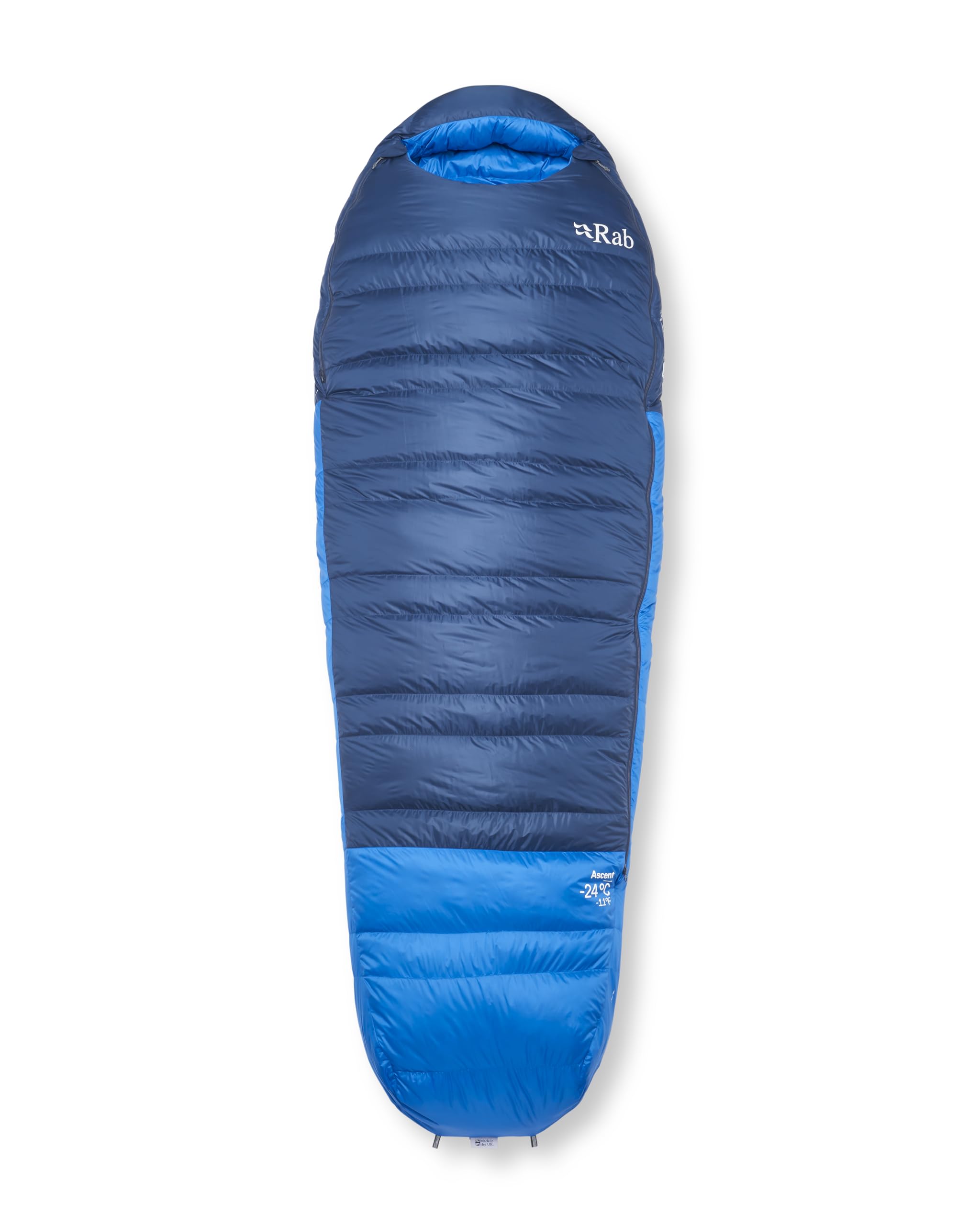
Rab’s Ascent is a serious cold-weather tool. With a comfort rating of 5°F and a limit of -11°F, this bag uses 650FP European duck down treated with Grangers hydrophobic finish, combined with a 20D Pertex Quantum shell that blocks wind while remaining breathable. The L.O.F.T baffling prevents down from shifting, and the anatomic hood with drawcord adjustment seals heat in without restricting vision. At 66.7 oz for the regular size, it’s not the lightest option for its warmth, but the packed size of 10.2 x 17.7 inches is reasonable for a bag this capable in sub-zero conditions.
The ¾-length zipper reduces weight and bulk at the footbox, and the down-filled baffle along the zipper path eliminates cold spots. A 3D collar adds another layer of insulation around the neck. Some users report the temperature rating feels optimistic — one reviewer noted cold at 20°F with a wool base layer — suggesting that cold sleepers should treat the comfort rating as a limit rather than a guaranteed warm line.
For winter backpacking or high-altitude camps where single-digit nights are expected, the Ascent delivers serious warmth in a package that still fits inside a standard pack. It’s an investment, but the build quality and materials justify the premium tier.
Why it’s great
- Comfort-rated to 5°F with robust down fill
- Pertex Quantum shell resists wind and moisture
- Hydrophobic down treatment for damp conditions
- Anatomic hood with effective drawcord seal
Good to know
- Some users find temperature rating over-optimistic
- Heavier than comparable 20°F bags
3. Kelty Supernova Down Sleeping Bag

The Kelty Supernova solves a persistent complaint about mummy bags: restrictive fit. The semi-rectangular cut measures 33 inches wide in the regular size, providing enough room for side sleepers and stomach sleepers to shift positions naturally. Despite the extra space, the 550-fill down with 24 oz of fill weight delivers warmth comparable to the Cosmic 20, and the 20°F rating keeps campers comfortable well below freezing. The recycled shell and liner fabrics maintain Kelty’s sustainability commitment.
At 3 lb packed weight, the Supernova is heavier than a true backpacking bag. The trade-off is interior volume — the bag zips together with a second Supernova to create a two-person down haven, and the footbox leaves room for two pillows. The 14 x 8-inch packed size fits in a larger pack or strapped to the outside. The zipper baffle occasionally catches fabric, a minor annoyance in an otherwise well-executed design.
This bag suits campers who prioritize freedom of movement over ultralight weight. It’s also a strong choice for couples who want a roomy double bag without moving to a bulky synthetic model.
Why it’s great
- Semi-rectangular cut fits all sleep positions
- Roomy 33-inch width in regular size
- Zips together with a second bag for couples
- Recycled materials with durable construction
Good to know
- Heavier at 3 lb than dedicated backpacking bags
- Zipper baffle can catch occasionally
4. TETON Sports ALTOS Down Sleeping Bag
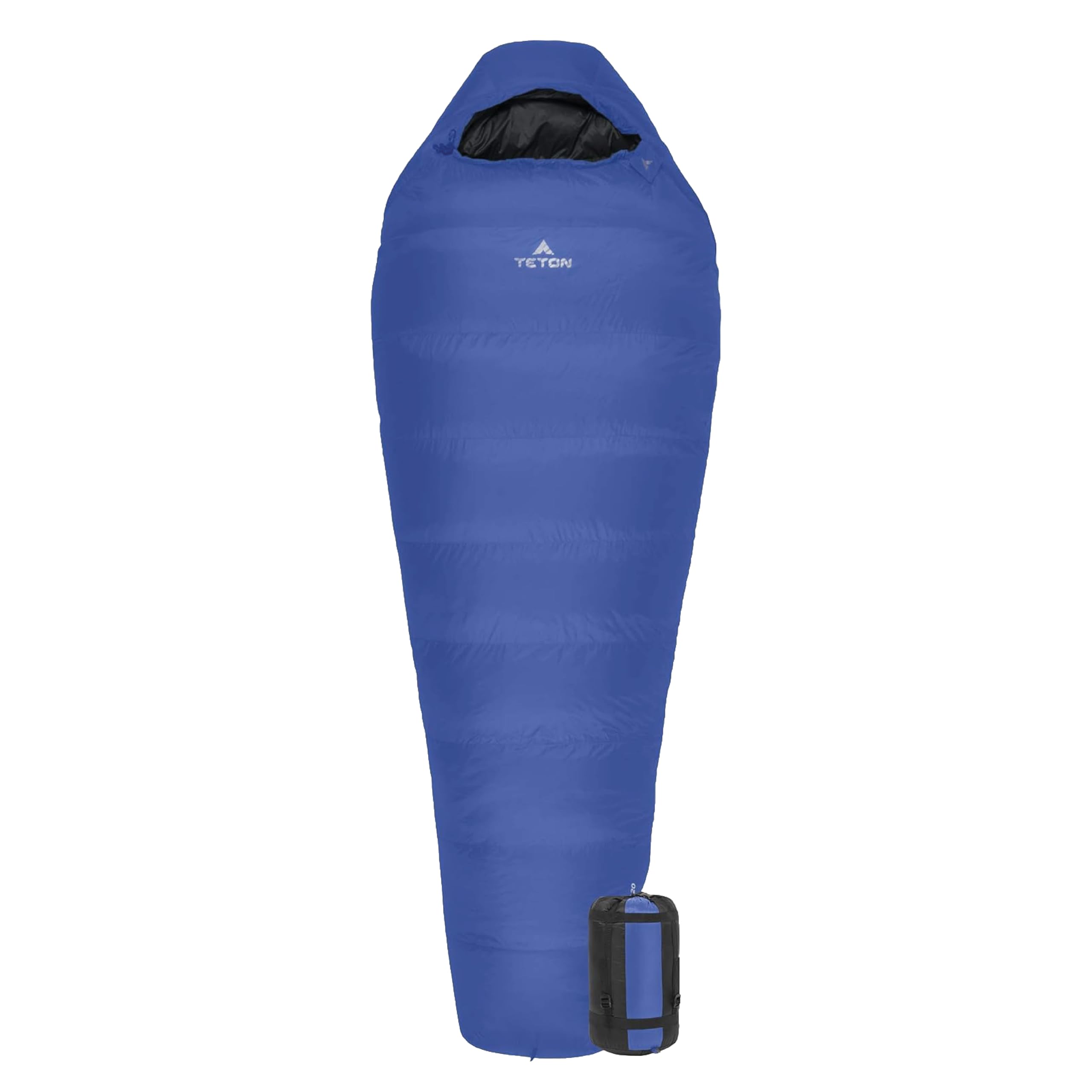
TETON Sports built the ALTOS to bridge the gap between budget synthetic bags and premium down models. The water-resistant down fill maintains loft in humid conditions, and the mummy shape includes extra shoulder and leg room relative to traditional narrow cuts. The built-out footbox provides space for natural foot movement, and the 84-inch length accommodates sleepers up to 7 feet. Packs down to roughly 11 x 8.5 x 8.5 inches using the included compression sack.
Real-world testing shows the 20°F rating is optimistic — users report comfort down to about 28°F with a 4.4 R-value pad and base layers. Below that, cold spots at pressure points become noticeable. The shell fabric is thin but compressible, and the draft flap along the zipper helps retain heat. At 2.5 lb, it’s competitive with bags at nearly double the price.
For a first down sleeping bag purchase or a backup for car camping, the ALTOS delivers surprising warmth-to-weight for its price tier. It’s not built for extreme cold, but it handles three-season conditions with confidence.
Why it’s great
- Excellent warmth-to-weight for the price
- Roomy footbox and shoulder area
- Compression sack included with heavy-duty straps
- Fits tall sleepers up to 7 feet
Good to know
- 20°F rating feels closer to 28°F limit
- Thin shell requires careful groundsheet use
5. QEZER 600 Fill Power Mummy Sleeping Bag
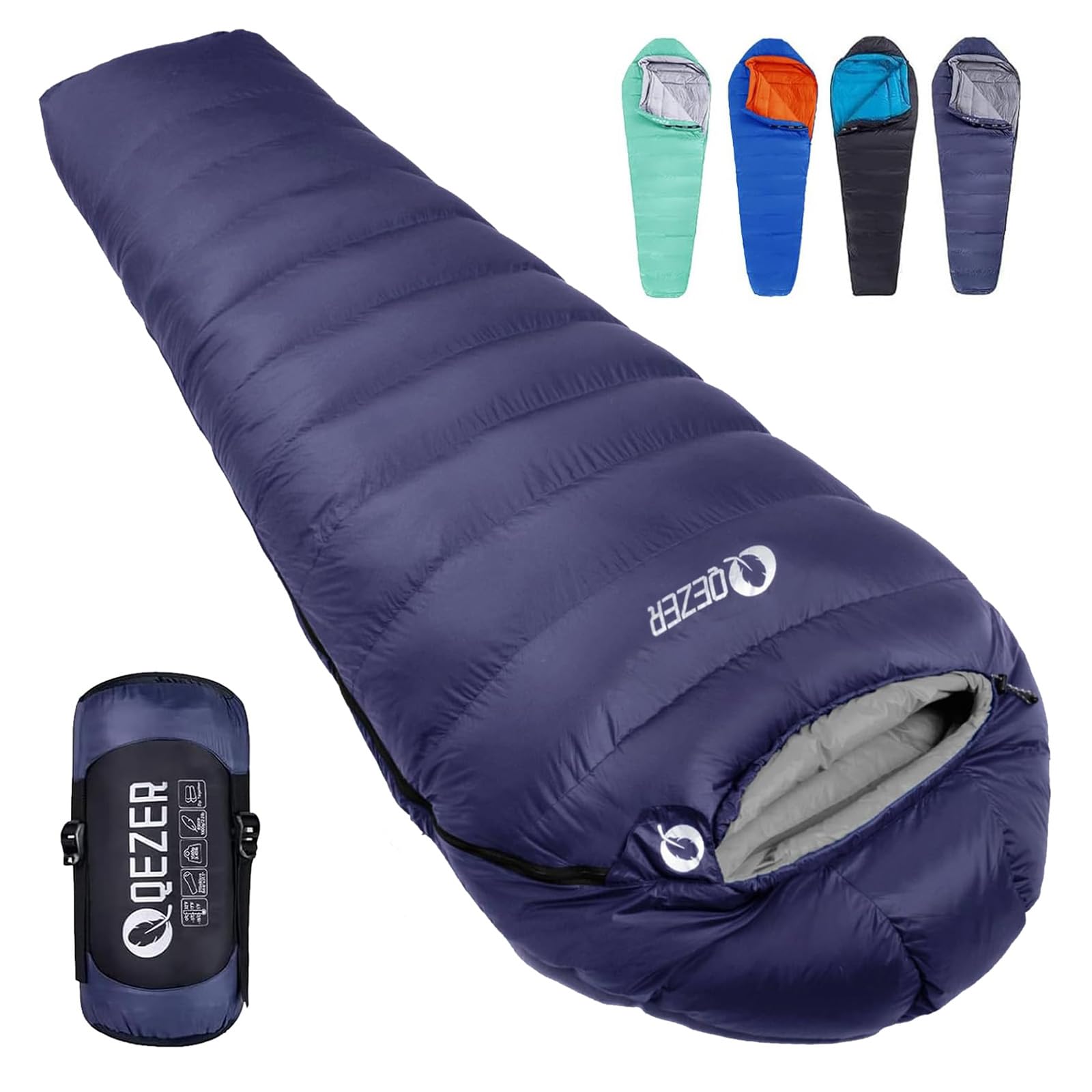
The QEZER mummy bag proves that 600-fill down doesn’t need a high price tag. Filled with 1.1 lb of duck down, this bag hits a comfort range of 41°F to 54°F with a limit of 28°F. The 400T ripstop nylon shell prevents down leakage and resists tears, while the trapezoidal footbox offers more toe room than a standard mummy. It zips left and right, allowing two bags to combine into a double — a rare feature at this price point.
Users report staying warm in single-digit conditions by layering, though the bag’s thickness at the bottom is lighter than the top — a common cost-saving measure. The compression sack works well, reducing the 84.65-inch length to a manageable 13.78 x 6.3-inch package. Some reviewers noted an inner mesh bag that ripped on first use, but the outer compression sack held up fine.
This bag makes sense for a camper who needs a reliable 20°F down bag without spending beyond three figures. The semi-rectangular cut inside the mummy silhouette adds welcome space without sacrificing thermal efficiency.
Why it’s great
- 600-fill down at a competitive price
- 400T ripstop nylon prevents down leakage
- Pairs with another bag for double use
- Compresses smaller than equivalent synthetic bags
Good to know
- Bottom has less fill than top section
- Inner storage bag may tear easily
6. QEZER 600 Fill Power Semi-Rectangular Sleeping Bag
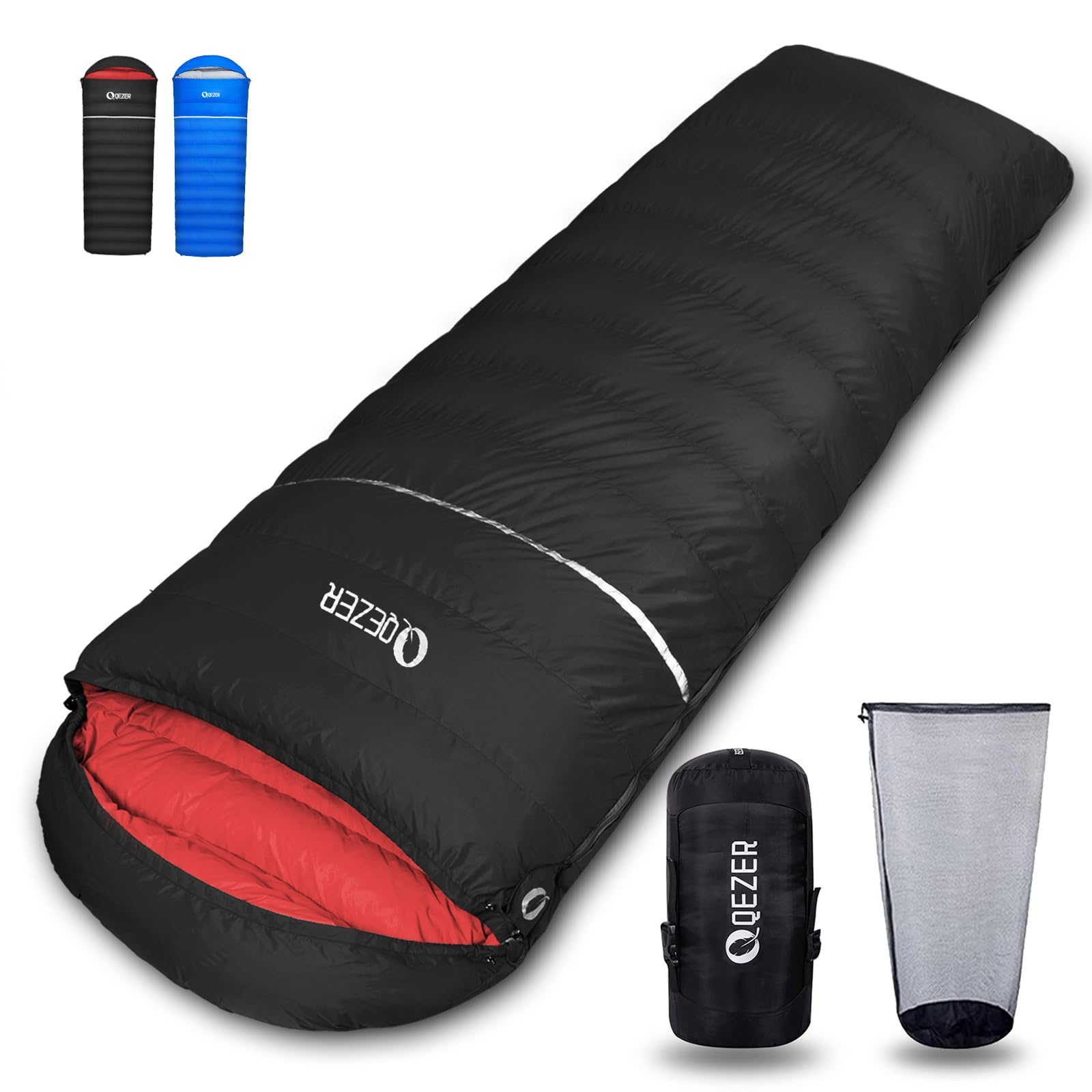
This QEZER variant trades the mummy taper for a semi-rectangular shape that gives the shoulders and feet more breathing room. The 30.71 x 86.61-inch dimensions suit taller campers and those who feel claustrophobic in a standard mummy. The 600-fill duck down provides the same warmth range — comfort 41°F to 54°F, limit 28°F — as the brand’s mummy bag, but the extra interior volume means the bag requires slightly more down displacement to achieve the same loft. A foot zipper allows ventilation on warmer nights.
The 400T nylon fabric feels soft against the skin, and the double zipper design includes an anti-snag feature. Reviewers praised the bag’s ability to stay warm below 30°F with proper layering, though some noted the outer fabric is thin — a 1-inch hole appeared from a splinter on one trip, requiring a nylon patch. The bag packs to 13.78 x 6.3 inches, comparable to the mummy version despite the larger cut.
This is a strong option for backpackers who prioritize comfort over pure weight savings. The semi-rectangular shape also makes it easier to combine with a second bag for couples without the restriction of a tight mummy fit.
Why it’s great
- Semi-rectangular shape eliminates confined feel
- 86.6-inch length fits tall users
- Foot zipper provides venting in warmer weather
- Smooth double zipper with anti-snag design
Good to know
- Thin outer fabric is prone to punctures
- Stuff sack is smaller than ideal for packed size
7. Naturehike Ultralight RDS Down Sleeping Bag

The Naturehike CW295 redefines what a sub-1.5 lb down sleeping bag can do. At just 1.3 lb — roughly the weight of a water bottle — this bag uses 295g of 650-fill RDS-certified duck down to achieve a comfort range of 42.8°F to 51.8°F. The 20D 400T nylon shell is soft, wear-resistant, and treated with a water-repellent finish. The YKK two-way zipper operates smoothly and allows two bags to zip together. The packed size of 4.7 x 10.2 inches is small enough to fit in a daypack.
This bag lives in the warm-weather niche. Users report comfort down to the mid-40s, but temperatures below 32°F require a liner and insulated pad even for warm sleepers. The individual down channel design keeps insulation evenly distributed, and the highly elasticized hood opening seals heat around the neck. Some reviewers flagged a drawstring design flaw — single threads anchor the cord mechanism, and overtightening can cause premature failure.
For summer backpacking, thru-hikes in mild climates, or a camp quilt that unzips flat, the Naturehike CW295 offers category-leading lightness and a tiny pack profile. The RDS certification adds ethical peace of mind at this entry-level price.
Why it’s great
- Incredibly light at 1.3 lb
- Packs to the size of a water bottle
- RDS-certified down with ethical sourcing
- Unzips to function as a quilt
Good to know
- Warm-weather only — comfort limit around 42°F
- Drawstring mechanism may fail under heavy use
8. ZOOOBELIVES Alplive T400 Down Sleeping Bag

The ZOOOBELIVES Alplive T400 sits at the intersection of value and versatility. The 650-fill hydrophobic down delivers a warmth range of 32°F to 50°F, and the rectangular shape offers the most interior space in this lineup — users can shift positions freely, and two bags zip together to form a double. The 20D nylon shell carries a DWR finish, and the dual YKK zippers include anti-snag sliders. At 1.7 lb with an 11 x 6.7-inch packed size, it’s competitive with bags costing significantly more.
The bag’s rectangular design means it will never be as thermally efficient as a mummy — the extra volume allows more air circulation, requiring a higher fill weight to reach the same warmth. User reports place the comfortable limit around 40°F, with the bag handling 50°F reliably. The fabric feels plasticky and rustles during movement, a common complaint among longer-term users, though the shell holds up well to repeated compression cycles.
For couples who want a single down bag for car camping or mild backpacking trips, the Alplive T400 is a smart buy. The ability to unzip completely into a flat comforter extends its utility beyond sleeping.
Why it’s great
- Spacious rectangular cut for freedom of movement
- Zips together with another bag for double use
- Hydrophobic down treatment resists moisture
- Unzips completely into a flat comforter
Good to know
- Rectangular shape is less thermally efficient
- Fabric feels plasticky and rustles
9. QEZER 600 FP Ultralight Down Sleeping Bag (500g)
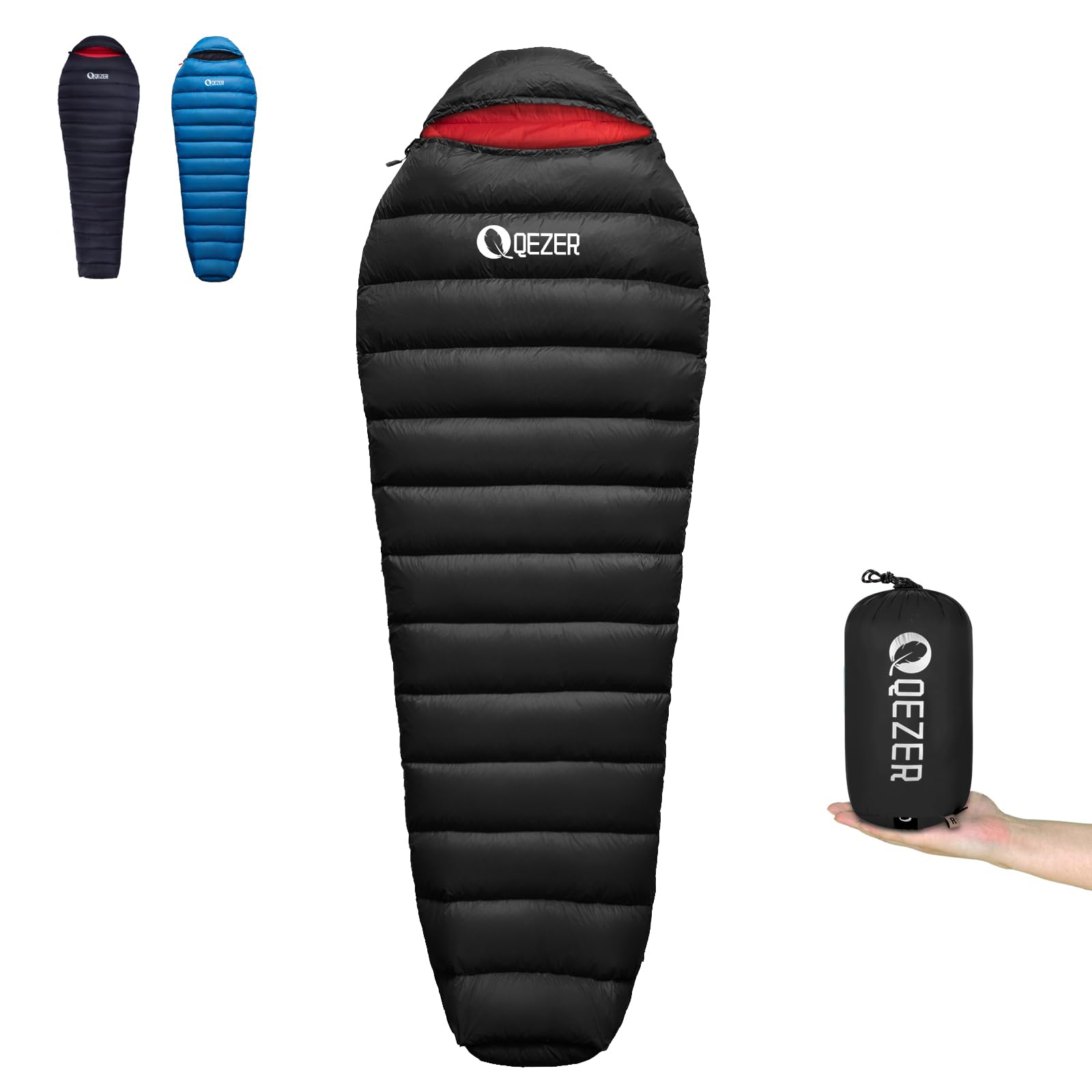
The QEZER 500g down bag enters the budget tier with a 600-fill power duck down fill rated for 3-season use, with a comfort range of 46°F to 63°F and a limit of 36°F. The mummy shape uses a trapezoidal footbox for natural foot splay, and the 400T ripstop nylon shell resists tears while preventing down leakage. At 1.9 lb with a packed size of 10.63 x 6.69 inches, it matches the weight and volume of bags at higher price points.
User feedback highlights the bag’s impressive warmth-to-weight ratio — reviewers stayed comfortable into the low teens by layering, and some used it in RTT setups without a heater. However, several reports mention feather leakage after several months of use, and one unit arrived with a small hole (replaced under warranty). The fabric crinkles during movement, a texture difference from softer-shelled bags. The interior pocket keeps a phone or headlamp accessible through the night.
For a backpacker on a strict budget who needs a compact down bag for spring through fall, this QEZER model delivers genuine down performance at a fraction of the cost of premium brands. The leakage issue is inconsistent but worth noting for long-term reliability.
Why it’s great
- Lightweight 1.9 lb build for the price
- Trapezoidal footbox for natural foot position
- Interior pocket for essential items
- Compresses smaller than comparable budget bags
Good to know
- Some units show feather leakage over time
- Crinkly fabric is audible during movement
FAQ
How does down fill power affect the overall pack size of the sleeping bag?
Can I use a down sleeping bag in humid climates without ruining the insulation?
How do I properly store a down sleeping bag when not in use?
What’s the difference between a mummy cut and a rectangular cut for cold-weather camping?
Final Thoughts: The Verdict
For most users, the best down sleeping bag winner is the Kelty Cosmic 20 because it combines reliable ISO-rated warmth, sustainable materials, and a reasonable pack size at a price that respects your budget. If you need uncompromising cold-weather performance, grab the Rab Men’s Ascent. And for a roomy down bag that accommodates stomach sleepers and couples without sacrificing warmth, nothing beats the Kelty Supernova.

Mo Maruf
I created WellFizz to bridge the gap between vague wellness advice and actionable solutions. My mission is simple: to decode the research and give you practical tools you can actually use.
Beyond the data, I am a passionate traveler. I believe that stepping away from the screen to explore new environments is essential for mental clarity and physical vitality.