Our readers keep the lights on and my smoothie glass nicely filled. As an Amazon Associate, I earn from qualifying purchases.
That specific spot in the yard where your dog repeatedly digs, marks, or eliminates isn’t just a behavioral problem — it’s a chemical conversation happening between pheromones left in the soil and your dog’s nose. Standard deterrents fail because they mask the scent temporarily, leaving the underlying chemical signal intact for the next visit. The most effective strategy targets the odor at a molecular level, breaking down the ammonia-based compounds and eliminating the scent trail that tells your dog “this spot is yours.”
I’m Mohammad Maruf — the founder and writer behind WellFizz. My research into outdoor repellents focuses on the specific enzyme pathways and odor-neutralizing chemistry that determine whether a product actually stops re-marking behavior or just smells like lemon for an afternoon.
The right outdoor deterrence hinges on whether the formula breaks down uric acid and pheromone residues rather than simply covering them with fragrance. This guide evaluates five formulations across granular, spray, and concentrated liquid categories to help you find the most effective dog repellent for yard that matches your specific lawn surface and pet habits.
How To Choose The Best Dog Repellent For Yard
Dog repellents for yards aren’t one-size-fits-all. The formula that works on natural grass may not penetrate synthetic turf fibers, and a spray that deters one dog may be ignored by another if the underlying pheromone signal remains intact. Focus on three key differentiators: the active mechanism, the surface compatibility, and the weather durability.
Active Mechanism: Enzyme vs. Scent Masking
The most effective yard repellents use biological enzyme complexes that break down uric acid crystals and pheromone residues into harmless carbon dioxide and water. Scent-masking products simply layer a stronger fragrance over the existing odor, which degrades within hours and leaves the original chemical signal exposed once the fragrance fades. Look for “enzyme-based” or “bio-enzymatic” on the label if your goal is long-term behavioral change rather than temporary cover-up.
Surface Compatibility: Turf, Grass, Gravel, Concrete
Artificial turf requires a different approach than natural grass because urine soaks through the synthetic blades into the infill layer below, where it can’t be rinsed away by rain. Granular infill products designed specifically for synthetic grass absorb moisture directly at the base and release neutralizing compounds over weeks. For natural grass and concrete patios, liquid sprays with hose attachments offer faster, broader coverage but may wash away after heavy rain.
Weather Resistance and Reapplication Frequency
Outdoor products face sun, heat, rain, and freezing temperatures. Granular formulas with sticking agents or rain-resistant barriers can last 7 to 30 days depending on traffic and moisture levels. Liquid sprays typically need reapplication every 3 to 7 days, especially after rainfall. Match the reapplication schedule to your local climate and how many times your dog visits the treated area per day.
Quick Comparison
On smaller screens, swipe sideways to see the full table.
| Model | Category | Best For | Key Spec | Amazon |
|---|---|---|---|---|
| MICROBE-LIFT Outdoor Pet Odor Eliminator | Liquid Spray | Natural grass & patios | 32 oz — covers 6,000 sq ft | Amazon |
| Nature’s MACE Rabbit MACE Granules | Granular Repellent | Garden & flowerbed perimeters | 3 lbs — treats 1,350 sq ft | Amazon |
| Cedarcide YardSafe | Hose-End Spray | Insect & pest deterrence + dogs | 32 oz — covers 5,000 sq ft | Amazon |
| Mighty Mint Peppermint Oil Spray | Natural Oil Spray | Entry points & perimeter barriers | 128 oz — gallon concentrate | Amazon |
| BioTurf Granular Turf Infill | Granular Infill | Artificial turf & dog runs | 1 gallon pail — 7.52 lbs | Amazon |
In‑Depth Reviews
1. MICROBE-LIFT Outdoor Pet Odor Eliminator

The MICROBE-LIFT uses live enzyme cultures that digest uric acid and ammonia crystals on contact, converting them into carbon dioxide and water instead of just masking the smell. With a 32-ounce bottle covering 6,000 square feet, this is one of the most economical options for homeowners managing a medium-to-large natural grass yard or concrete patio where dogs repeatedly mark.
The formula works without requiring additional water — just spray directly on the affected area, let it sit for five minutes, and rinse. Users consistently report that the odor stays gone for days rather than hours, and multiple verified reviews confirm that the olfactory bait that draws dogs back to the same spot is effectively eliminated after the first application.
One reviewer noted that it eliminated stray cat spray odor without damaging plants, which highlights the formula’s broad-spectrum effectiveness. The clear liquid leaves no visible residue on turf or concrete, making it practical for visible front-yard areas where staining would be a concern.
Why it’s great
- Breaks down odor molecules biologically rather than masking them
- Large 6,000 sq ft coverage per bottle reduces long-term cost
- Safe on natural grass, concrete, artificial turf, and patios
Good to know
- Requires rinsing after five minutes for best results
- Some users report inconsistent results on heavily saturated artificial turf
2. BioTurf Granular Turf Infill
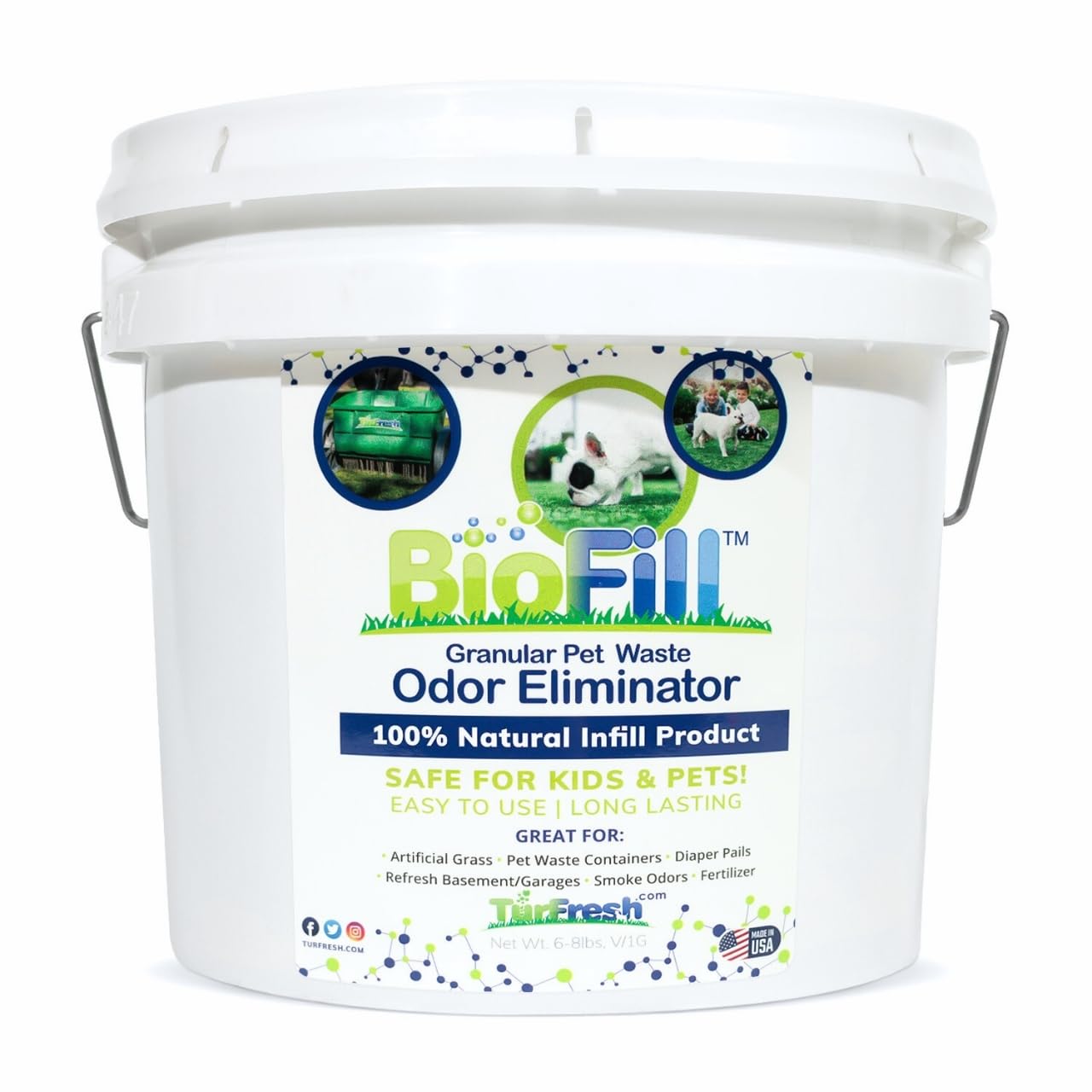
The BioTurf Granular Turf Infill targets the specific problem of pet odor trapped deep within synthetic grass fibers. Unlike liquid sprays that sit on the surface and evaporate, these granules work as a physical sponge — drawing moisture and ammonia compounds from the base layer of artificial turf and breaking them down into neutral salts and water vapor.
The 1-gallon pail is designed for small to medium artificial grass installations, dog runs, and potty patches. Application is simple: spread evenly by hand or with a cup, then brush into the turf fibers with a stiff broom. One pail lasts roughly two to three months on a standard backyard turf install, depending on how many dogs use the area daily.
Users report that the ammonia smell typically disappears within hours of application, and the granules remain active through moderate rain and heat. For heavy-use areas, monthly reapplication keeps odors under control without the need for deep rinsing or enzymatic sprays. The non-toxic formula is safe for pets and children to walk on immediately after brushing.
Why it’s great
- Absorbs and neutralizes odor at the turf base rather than top layer
- Weather-resistant with minimal reapplication needed
- Safe for immediate contact after application
Good to know
- Only practical for artificial grass, not natural lawns
- Heavy rain may require touch-ups sooner than standard schedule
3. Cedarcide YardSafe
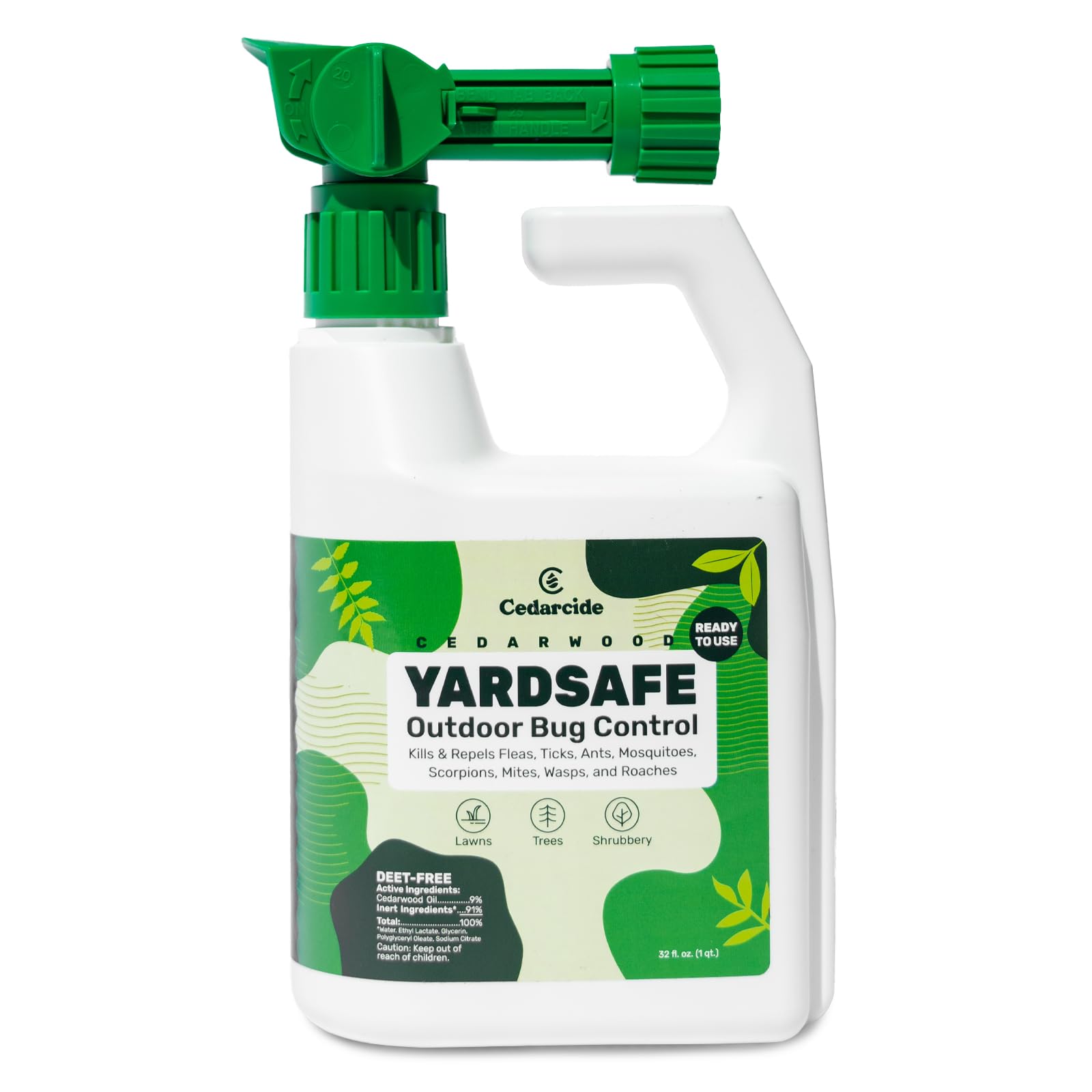
Cedarcide YardSafe is primarily marketed as an insect repellent for mosquitoes, ticks, and fleas, but its strong cedar and lemongrass essential oil profile also functions as a deterrent for dogs by creating an unfamiliar scent environment in the yard. The 32-ounce bottle connects directly to a garden hose and covers up to 5,000 square feet in one pass.
The natural oil formula is safe for pets and children, with no downtime needed after application — the yard is immediately usable. The cedar oil creates a sensory boundary that many dogs find aversive, which can discourage them from entering treated areas, especially around perimeter zones and garden beds.
Users note that the scent dissipates within a few hours, but the repellent effect lasts 7 to 10 days under normal conditions. This makes Cedarcide a good option for homeowners who want dual-purpose pest and dog deterrence without switching between multiple products. However, it’s less effective as a stand-alone solution for dogs that are highly motivated by established marking spots.
Why it’s great
- Repels insects and dogs simultaneously with one application
- Hose-end sprayer makes large-yard coverage fast
- No waiting time after spraying; safe for immediate use
Good to know
- Does not break down existing urine odor — only masks it temporarily
- Some reports of inconsistent results depending on local pest pressure
4. Mighty Mint Peppermint Oil Spray

Mighty Mint relies on highly concentrated peppermint essential oil to create a scent barrier that many dogs find overwhelming and aversive. The 128-ounce gallon size provides extensive coverage for indoor and outdoor perimeter areas, though its effectiveness as a yard-wide dog deterrent is limited compared to enzyme-based formulas.
The peppermint oil disrupts the olfactory cues that dogs use to navigate and mark territory. When applied around entry points, baseboards, patios, and garden borders, it creates a strong sensory wall that can discourage dogs from crossing into treated zones. Users report that the smell is pleasant to humans but potent enough to deter spiders, ants, and mice as a secondary benefit.
Where this product falls short is in treating existing urine-soaked turf or concrete. Peppermint oil does not break down uric acid crystals or ammonia compounds, so dogs already attracted to a specific spot may push through the scent to reach the underlying pheromone signal. It works best as a preventive perimeter barrier rather than a remedial treatment for established marking areas.
Why it’s great
- Strong peppermint scent that dogs find naturally aversive
- Gallon size reduces per-application cost for large perimeter treatments
- Effective deterrent for multiple pest types beyond dogs
Good to know
- Does not eliminate existing urine odor, only masks it
- Frequent reapplication needed after rain or heavy dew
5. Nature’s MACE Rabbit MACE Granules

Nature’s MACE Rabbit MACE Granules are engineered specifically for garden perimeters and flowerbed borders rather than open lawn coverage. The granular formula uses scent and taste aversion technology that creates a barrier 18 to 30 inches wide around plantings, discouraging rabbits from browsing. While designed for rabbits, the strong botanical deterrent can also reduce dog entry in the same treated zones.
The 3-pound bag treats 1,350 square feet with a rain-resistant barrier that holds up through moderate weather. The sticking agent technology helps the granules remain in place when sprinkled around the base of plants, along fence lines, and near garden entrances. Reapplication every 7 to 10 days is recommended for consistent results, with a wider 30-inch barrier needed in high-traffic areas.
User experiences are split: some report complete deterrence with no rabbit or dog damage after the first application, while others note that determined animals will cross the barrier if the reward (food or established marking spot) is strong enough. This product works best as a proactive perimeter defense in gardens, not as a stand-alone solution for a dog that already marks an entire lawn.
Why it’s great
- Rain-resistant formula with long-lasting sticking agents
- Effective for targeted perimeter protection around plants
- Safe for pets, children, and nearby plants when used as directed
Good to know
- Not designed for open lawn or large turf areas
- Some users report minimal effect on highly motivated animals
FAQ
Will enzyme-based repellents harm my natural grass?
How often should I reapply granular repellent on artificial turf?
Can I use a rabbit repellent to stop dogs from digging in my garden?
Final Thoughts: The Verdict
For most users, the dog repellent for yard winner is the MICROBE-LIFT Outdoor Pet Odor Eliminator because its enzyme-based chemistry eliminates the underlying odor signal rather than just covering it, and its 6,000 sq ft coverage makes it practical for standard suburban lawns. If you maintain artificial grass and need odor absorption deep in the turf fibers, grab the BioTurf Granular Turf Infill. And for dual-purpose pest and dog deterrence around garden perimeters, nothing beats the Cedarcide YardSafe for fast, hose-end coverage across large areas.

Mo Maruf
I created WellFizz to bridge the gap between vague wellness advice and actionable solutions. My mission is simple: to decode the research and give you practical tools you can actually use.
Beyond the data, I am a passionate traveler. I believe that stepping away from the screen to explore new environments is essential for mental clarity and physical vitality.